Skip to content
X-Dreamers

World · One place across the ages

Ancient Jerusalem in 3D

One hill, three thousand years

What did Jerusalem look like in Jesus' time, and a thousand years before? Stand on the Mount of Olives in immersive 3D and drag the years from David's town to Herod's city and today, with the evidence for every wall.

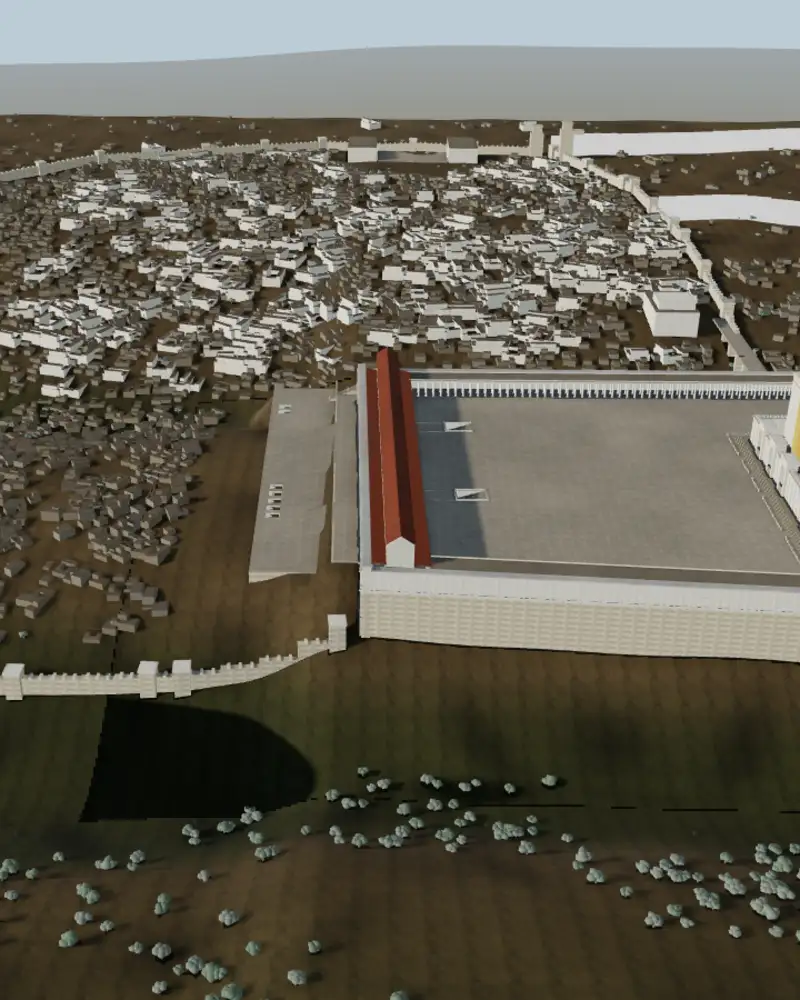
Jerusalem in Herod's day seen from the Mount of Olives, with the Temple on its great platform

Jerusalem Through the Ages

Drag three thousand years over Jerusalem, from David's town to today.

Explore in 3D · drag to turn, pinch to zoom

3D · about 2.6 MB

Loading Jerusalem Through the Ages…

Hezekiah's Jerusalem, about 700 BC. A model of what the evidence suggests, not a photograph; its stone and bare rock show the material, not the actual masonry, and each era's light and colour are an artistic cue, not the weather of the day

Reconstruction · Era 3 of 7

Hezekiah's Jerusalem

about 700 BC

Look for

Take the guided tour through 7 eras of Jerusalem.

Drag through the ages

Drag through the ages

Era 3 of 7 · about 700 BC

Hezekiah's Jerusalem

By Hezekiah's day the city had spread across the Western Hill, perhaps swelled by refugees from the north after Samaria fell. Facing the Assyrian king Sennacherib, Hezekiah built a great wall round the new quarter, tearing down houses to make it broad, and cut a tunnel through the rock to bring the Gihon's water inside the walls to the Pool of Siloam.

Go deeper

Scripture

20And the rest of the acts of Hezekiah, and all his might, and how he made a pool, and a conduit, and brought water into the city, are they not written in the book of the chronicles of the kings of Judah?

2 Kings 20:20

2And when Hezekiah saw that Sennacherib was come, and that he was purposed to fight against Jerusalem, 3He took counsel with his princes and his mighty men to stop the waters of the fountains which were without the city: and they did help him. 4So there was gathered much people together, who stopped all the fountains, and the brook that ran through the midst of the land, saying, Why should the kings of Assyria come, and find much water? 5Also he strengthened himself, and built up all the wall that was broken, and raised it up to the towers, and another wall without, and repaired Millo in the city of David, and made darts and shields in abundance.

2 Chronicles 32:2–5

9Ye have seen also the breaches of the city of David, that they are many: and ye gathered together the waters of the lower pool. 10And ye have numbered the houses of Jerusalem, and the houses have ye broken down to fortify the wall. 11Ye made also a ditch between the two walls for the water of the old pool: but ye have not looked unto the maker thereof, neither had respect unto him that fashioned it long ago.

Isaiah 22:9–11

In this era

Tap a wall or building in the scene, or choose it here.

The eras

How sure is each structure?

  • Textually stated

    Textually stated: Said directly in the biblical text.

  • Strongly supported

    Strongly supported: A close inference from the text or firm evidence.

  • Plausible

    Plausible: A reasonable reconstruction among live options.

  • Speculative

    Speculative: An informed guess; the text is silent.

  • Artistic

    Artistic: A stylistic choice made for the reconstruction.

On the stage's title card: the dot is how sure each feature is; the book means the text speaks of it, the pick that it was found in the ground. Every shape is a reconstruction.

In the textFound in the groundTextually statedStrongly supportedPlausibleSpeculative

Sources

  1. R. A. S. Macalister and J. G. Duncan, Excavations on the Hill of Ophel, Jerusalem, 1923–1925 (1926)
  2. Y. Shiloh, Excavations at the City of David I, 1978–1982 (Qedem 19, 1984)
  3. J. M. Cahill, “Jerusalem at the Time of the United Monarchy: The Archaeological Evidence”, in Jerusalem in Bible and Archaeology (2003)
  4. E. Mazar, “Did I Find King David's Palace?”, Biblical Archaeology Review 32:1 (2006)
  5. A. Mazar, “Archaeology and the Biblical Narrative: The Case of the United Monarchy”, in One God – One Cult – One Nation (2010)
  6. I. Finkelstein, Z. Herzog, L. Singer-Avitz and D. Ussishkin, “Has King David's Palace in Jerusalem Been Found?”, Tel Aviv 34 (2007)
  7. R. Reich and E. Shukron, “Light at the End of the Tunnel”, Biblical Archaeology Review 25:1 (1999)
  8. R. Reich and E. Shukron, “The Date of the Siloam Tunnel Reconsidered”, Tel Aviv 38 (2011)
  9. E. Mazar, Discovering the Solomonic Wall in Jerusalem (2011)
  10. E. Mazar, “The Wall That Nehemiah Built”, Biblical Archaeology Review 35:2 (2009)
  11. J. Monson, “The New ‘Ain Dara Temple: Closest Solomonic Parallel”, Biblical Archaeology Review 26:3 (2000)
  12. N. Avigad, Discovering Jerusalem (1983)
  13. H. Geva, “Western Jerusalem at the End of the First Temple Period in Light of the Excavations in the Jewish Quarter”, in Jerusalem in Bible and Archaeology (2003)
  14. A. Frumkin, A. Shimron and J. Rosenbaum, “Radiometric Dating of the Siloam Tunnel, Jerusalem”, Nature 425 (2003)
  15. I. Finkelstein, “Jerusalem in the Persian (and Early Hellenistic) Period and the Wall of Nehemiah”, JSOT 32 (2008)
  16. Josephus, The Jewish War (about AD 75), books 5–6
  17. Josephus, Jewish Antiquities (about AD 94), book 15
  18. Mishnah, tractate Middot (about AD 200)
  19. C. Warren and C. R. Conder, The Survey of Western Palestine: Jerusalem (1884)
  20. B. Mazar, The Mountain of the Lord (1975)
  21. L. Ritmeyer, The Quest: Revealing the Temple Mount in Jerusalem (2006)
  22. A. S. Kaufman, “Where the Ancient Temple of Jerusalem Stood”, Biblical Archaeology Review 9:2 (1983)
  23. C. Clermont-Ganneau, “Une stèle du Temple de Jérusalem”, Revue archéologique 23 (1872)
  24. L.-H. Vincent, “L'Antonia et le Prétoire”, Revue biblique 42 (1933)
  25. P. Benoit, “L'Antonia d'Hérode le Grand et le forum oriental d'Aelia Capitolina”, Harvard Theological Review 64 (1971)
  26. C. N. Johns, “The Citadel, Jerusalem: A Summary of Work since 1934”, QDAP 14 (1950)
  27. M. Broshi and S. Gibson, “Excavations along the Western and Southern Walls of the Old City of Jerusalem”, in Ancient Jerusalem Revealed (1994)
  28. F. J. Bliss and A. C. Dickie, Excavations at Jerusalem 1894–1897 (1898)
  29. K. M. Kenyon, Digging Up Jerusalem (1974)
  30. U. Lux, “Vorläufiger Bericht über die Ausgrabung unter der Erlöserkirche im Muristan”, ZDPV 88 (1972)
  31. E. L. Sukenik and L. A. Mayer, The Third Wall of Jerusalem (1930)
  32. S. Ben-Arieh and E. Netzer, “Excavations along the ‘Third Wall’ of Jerusalem, 1972–1974”, Israel Exploration Journal 24 (1974)
  33. E. W. Hamrick, “The Third Wall of Agrippa I”, Biblical Archaeologist 40 (1977)
  34. H. Shanks, “The Siloam Pool: Where Jesus Cured the Blind Man”, Biblical Archaeology Review 31:5 (2005)
  35. S. Auld and R. Hillenbrand (eds.), Ottoman Jerusalem: The Living City 1517–1917 (2000)
  36. O. Grabar, The Dome of the Rock (2006)
  37. K. A. C. Creswell, Early Muslim Architecture, vol. 1 (1932)
  38. M. Benvenisti, Jerusalem: The Torn City (1976)
  39. R. Greenberg, “Extreme Exposure: Archaeology in Jerusalem 1967–2007”, Conservation and Management of Archaeological Sites 11 (2009)

Photograph credits

Use this in class

7 stops · about 25 minutes

Teach mode puts large captions on the projector, follows a presentation clicker and keeps presenter notes on your own screen.

How to teach with the labs →

Watch a 40-second tour

A silent clip of the guided tour with its captions, made from this lab. Play it before class, or download it to show without a connection.

How sure is this? Every ancient era is a reconstruction: legible blocks for walls, platforms and gates, not a picture of what stood there. Each structure says how sure we can be of it, which excavations it rests on, and where scholars still disagree. The “today” layer is simplified present-day massing beside real photographs.

Scripture quotations are from the King James Version (1769). Present-day photographs are from Wikimedia Commons under open licences; each is credited where it is shown and in the sources.

What did Jerusalem look like from David to Jesus, and what is there now?

Jerusalem began as a small walled town on a narrow ridge above the Gihon spring, the stronghold David took from the Jebusites about 1000 BC. Solomon built the Temple on the hilltop to the north, on the threshing floor his father had bought, and his palace below it. By Hezekiah's day, about 700 BC, the city had spread over the Western Hill behind a new wall, and a tunnel brought the spring's water inside. Babylon burned it all in 586 BC; those who returned built a modest Second Temple and Nehemiah rebuilt the walls of a much smaller city.

Herod the Great rebuilt the Temple from about 20 BC on a vast platform that still stands: its walls are the Western Wall and the southern wall with its steps. This is the city of Jesus' last week, which Rome destroyed in AD 70. Today the Dome of the Rock and al-Aqsa stand on Herod's platform, inside the Ottoman walls of 1537–1541. This lab keeps one view from the Mount of Olives and lets you slide through seven eras, marking every ancient one as a reconstruction, giving each wall and building its evidence and its debates, and setting today's city beside real photographs.

Five sanctuaries at one scaleSee it beside the other Temples →The Temple of each era at one scale: Solomon's, the modest Second Temple of the return and Herod's, beside the Tabernacle.

Jerusalem through the ages at a glance

Jerusalem through the ages at a glance
City of DavidAbout 1000 BC: a walled town of some 4–5 hectares above the Gihon spring (2 Samuel 5)
Solomon's TempleOn Mount Moriah, the threshing floor of Araunah (2 Chronicles 3:1); burned 586 BC
HezekiahAbout 700 BC: the Western Hill walled in, the Broad Wall, a 533 m tunnel to Siloam
The returnSecond Temple finished 515 BC; Nehemiah's wall rebuilt in 52 days, 445 BC
Herod's TempleRebuilt from about 20 BC; “46 years” in building (John 2:20); burned AD 70
Walls in Jesus' dayThe First and Second Walls; the Third Wall began about AD 41–44
GolgothaOutside the city wall (John 19:20; Hebrews 13:12)
TodayOttoman walls of 1537–1541; the Dome of the Rock (691/692) on Herod's platform

Key verses 6

6And the king and his men went to Jerusalem unto the Jebusites, the inhabitants of the land: which spake unto David, saying, Except thou take away the blind and the lame, thou shalt not come in hither: thinking, David cannot come in hither. 7Nevertheless David took the strong hold of Zion: the same is the city of David. 8And David said on that day, Whosoever getteth up to the gutter, and smiteth the Jebusites, and the lame and the blind, that are hated of David’s soul, he shall be chief and captain. Wherefore they said, The blind and the lame shall not come into the house. 9So David dwelt in the fort, and called it the city of David. And David built round about from Millo and inward.

2 Samuel 5:6–9

1Then Solomon began to build the house of the LORD at Jerusalem in mount Moriah, where the Lord appeared unto David his father, in the place that David had prepared in the threshingfloor of Ornan the Jebusite.

2 Chronicles 3:1

20And the rest of the acts of Hezekiah, and all his might, and how he made a pool, and a conduit, and brought water into the city, are they not written in the book of the chronicles of the kings of Judah?

2 Kings 20:20

15So the wall was finished in the twenty and fifth day of the month Elul, in fifty and two days.

Nehemiah 6:15

20Then said the Jews, Forty and six years was this temple in building, and wilt thou rear it up in three days?

John 2:20

12Wherefore Jesus also, that he might sanctify the people with his own blood, suffered without the gate.

Hebrews 13:12

Scripture quotations: King James Version (1769) (KJV).

What the Bible says, what our model adds to it, where good readers disagree, and where the old copies and the translations differ. We set the views side by side and do not pick a winner.

  • Textually stated9
  • Strongly supported3
  • Plausible5
  • Speculative2

A few of the model's choices

  • Plausible

    The City of David's wall: its eastern line is found in places; the rest of the circuit is reconstructed.

  • Plausible

    Solomon's Temple: its size comes from the text; its look is a reconstruction, and its spot on the hill is debated.

  • Speculative

    Solomon's palace: the text gives sizes; the place and layout are an informed guess.

Show all 27
What the text says9

Stated in Scripture. Quoted from the King James Version (KJV) and the 1919 Chinese Union Version (和合本).

  • David took the stronghold of Zion and called it the City of David.

    Textually stated

    7Nevertheless David took the strong hold of Zion: the same is the city of David.

    2 Samuel 5:7 · KJV
  • Solomon built the LORD's house, his own house, the Millo and the wall of Jerusalem.

    Textually stated

    15And this is the reason of the levy which king Solomon raised; for to build the house of the LORD, and his own house, and Millo, and the wall of Jerusalem, and Hazor, and Megiddo, and Gezer.

    1 Kings 9:15 · KJV
  • Hezekiah stopped the upper outlet of the Gihon and brought the water down to the west side of the City of David.

    Textually stated

    30This same Hezekiah also stopped the upper watercourse of Gihon, and brought it straight down to the west side of the city of David. And Hezekiah prospered in all his works.

    2 Chronicles 32:30 · KJV
  • Hezekiah rebuilt the broken wall and built another wall outside it.

    Textually stated

    5Also he strengthened himself, and built up all the wall that was broken, and raised it up to the towers, and another wall without, and repaired Millo in the city of David, and made darts and shields in abundance.

    2 Chronicles 32:5 · KJV
  • The Babylonians burned the Temple, the palace and every great house, and broke down the walls.

    Textually stated

    9And he burnt the house of the LORD, and the king’s house, and all the houses of Jerusalem, and every great man’s house burnt he with fire. 10And all the army of the Chaldees, that were with the captain of the guard, brake down the walls of Jerusalem round about.

    2 Kings 25:9–10 · KJV
  • Nehemiah's wall was finished in fifty-two days.

    Textually stated

    15So the wall was finished in the twenty and fifth day of the month Elul, in fifty and two days.

    Nehemiah 6:15 · KJV
  • Herod's Temple had been building for forty-six years.

    Textually stated

    20Then said the Jews, Forty and six years was this temple in building, and wilt thou rear it up in three days?

    John 2:20 · KJV
  • Jesus foretold that not one stone of the Temple's buildings would be left on another.

    Textually stated

    1And as he went out of the temple, one of his disciples saith unto him, Master, see what manner of stones and what buildings are here! 2And Jesus answering said unto him, Seest thou these great buildings? there shall not be left one stone upon another, that shall not be thrown down.

    Mark 13:1–2 · KJV
  • The place where Jesus was crucified was near the city.

    Textually stated

    20This title then read many of the Jews: for the place where Jesus was crucified was nigh to the city: and it was written in Hebrew, and Greek, and Latin.

    John 19:20 · KJV
What the model adds10

Choices the reconstruction has to make where the text is silent, each with its evidence level and the reason for it.

Strongly supported3
  • The Temple Mount platform: its outline is standing masonry; the courts and porticoes follow Josephus and the Mishnah.

    Why: Warren (1867–1870) traced the walls' foundations to bedrock; Benjamin Mazar (1968–1978) exposed the Herodian courses and the street below.

  • Herod's palace: the place and the tower base are known; the palace buildings are a reconstruction.

    Why: The base of one tower survives in the Citadel (Johns, 1934–1940); the podium's retaining walls were found in the Armenian Garden (Broshi, 1970–1971).

  • The burning of 586 BC: the burnt layer is found across the city; the scene shows only where.

    Why: Shiloh (1978–1985) excavated the Burnt Room, the House of Ahiel and the House of the Bullae, with 51 seal impressions.

Plausible5
  • The City of David's wall: its eastern line is found in places; the rest of the circuit is reconstructed.

    Why: Kenyon (1961–1967) and Shiloh (1978–1985) uncovered stretches of the eastern wall halfway down the slope.

  • Solomon's Temple: its size comes from the text; its look is a reconstruction, and its spot on the hill is debated.

    Why: Nothing of it has been excavated; the closest known parallel is the temple at Ain Dara in Syria.

  • The wall of the Western Hill: its northern line is found; its southern course is less certain.

    Why: Avigad (1969–1982) found Iron Age walls and a tower in the Jewish Quarter, with arrowheads from the siege of 586 BC.

  • Herod's Temple: its plan and size follow Josephus and the Mishnah; its exact place on the platform is not known.

    Why: No excavation has ever been made on the platform itself.

  • The Third Wall: a wall of the right age is in the ground; whether it is Agrippa's wall is debated.

    Why: Sukenik and Mayer (1925–1927) and Ben-Arieh and Netzer (1972–1974) traced a heavy wall about 400 m north of the Old City.

Speculative2
  • Solomon's palace: the text gives sizes; the place and layout are an informed guess.

    Why: No building has been securely identified as Solomon's palace.

  • The Second Temple: that it stood here is textual; its form is an informed guess.

    Why: Nothing of it is known in the ground: Herod's Temple replaced it on the same hill.

Competing views6

Where careful readers disagree. Each view with who holds it and the evidence for and against it. No verdict.

Where did the Second Wall run?

John 19:20; Hebrews 13:12

A short line east of the Holy Sepulchre site, leaving the quarry and the tombs outside the city

Held by Most archaeologists, from the quarry under the Muristan and the Redeemer church

For

  • Kenyon found a deep quarry in the Muristan, filled in only in the 1st century AD: open ground outside the city in Jesus' day.
  • Under the Lutheran Church of the Redeemer, Ute Lux found the same quarry and no city wall.

Against

  • No stretch of the wall itself has been surely identified; Josephus gives only its two ends.

Sources: K. M. Kenyon, Digging Up Jerusalem (1974); U. Lux, “Vorläufiger Bericht über die Ausgrabung unter der Erlöserkirche im Muristan”, ZDPV 88 (1972); Josephus, The Jewish War (about AD 75), books 5–6

A wider line further west and north, which would put the Holy Sepulchre site inside the city

Held by Some 19th- and 20th-century writers, often arguing for another site of Golgotha (such as the Garden Tomb)

For

  • Josephus gives only the wall's two ends, so its course between them is open to more than one reading.

Against

  • The quarry under the Muristan and the Redeemer church was open ground outside the city in Jesus' day, with no wall across it.

Sources: Josephus, The Jewish War (about AD 75), books 5–6

What the lab shows (a drawing choice, not a ruling): The model draws the short eastern line, marked Speculative.

When was the Stepped Stone Structure built?

2 Samuel 5:9; 1 Kings 9:15

In the 12th–11th century BC: the Jebusite fortress David captured

Held by Jane Cahill and others

For

  • The pottery in its fills dates to the 12th–11th century BC.

Against

  • Others read the structure as one with the building above it, or as later work in several phases.

Sources: J. M. Cahill, “Jerusalem at the Time of the United Monarchy: The Archaeological Evidence”, in Jerusalem in Bible and Archaeology (2003)

In the 10th century BC, one structure with the Large Stone Structure above it

Held by Amihai Mazar and Eilat Mazar

For

  • The stepped mantle and the massive walls on the summit fit together as the support and the building of one great structure.

Against

  • Finkelstein and colleagues see walls of several periods rather than one building.

Sources: A. Mazar, “Archaeology and the Biblical Narrative: The Case of the United Monarchy”, in One God – One Cult – One Nation (2010); E. Mazar, “Did I Find King David's Palace?”, Biblical Archaeology Review 32:1 (2006)

Later, in the 9th century BC or in several phases, not in David's time

Held by Israel Finkelstein and colleagues

For

  • They read the remains as built in phases, mostly after David.

Against

  • Cahill's pottery from the fills points to an earlier date.

Sources: I. Finkelstein, Z. Herzog, L. Singer-Avitz and D. Ussishkin, “Has King David's Palace in Jerusalem Been Found?”, Tel Aviv 34 (2007)

Is the Large Stone Structure David's palace?

2 Samuel 5:11

Yes: a royal building of the 10th century BC, the house Hiram's builders made for David

Held by Eilat Mazar, its excavator (2006, 2009)

For

  • Walls up to several metres thick stand on the summit, just where 2 Samuel 5:11 would put a king's house.

Against

  • No inscription names the building, and its date is disputed.

Sources: E. Mazar, “Did I Find King David's Palace?”, Biblical Archaeology Review 32:1 (2006)

A large building of the 10th–9th century BC, perhaps the fortress; its identity is open

Held by Amihai Mazar (2010)

For

  • It accepts an early, large building without claiming more than the finds show.

Against

  • Finkelstein and colleagues still dispute the early date.

Sources: A. Mazar, “Archaeology and the Biblical Narrative: The Case of the United Monarchy”, in One God – One Cult – One Nation (2010)

Not one building: walls of several periods, mostly later than David

Held by Israel Finkelstein, Ze'ev Herzog, Lily Singer-Avitz and David Ussishkin (2007)

For

  • They read the walls as belonging to different periods, mostly later than David.

Against

  • The excavator reads the same walls as one building of the 10th century BC.

Sources: I. Finkelstein, Z. Herzog, L. Singer-Avitz and D. Ussishkin, “Has King David's Palace in Jerusalem Been Found?”, Tel Aviv 34 (2007)

What the lab shows (a drawing choice, not a ruling): The model shows the walls as found and marks what they belonged to as Speculative.

Was it Hezekiah's tunnel?

2 Kings 20:20; 2 Chronicles 32:30

Yes: cut about 700 BC

Held by Amos Frumkin and colleagues (2003), and most scholars

For

  • Radiocarbon and uranium–thorium dating of the plaster and stalactites placed the tunnel about 700 BC.
  • The script of the Siloam inscription fits that time, and Kings and Chronicles credit Hezekiah with bringing the water in.

Against

  • Reich and Shukron date the pottery found at its ends about a century earlier.

Sources: A. Frumkin, A. Shimron and J. Rosenbaum, “Radiometric Dating of the Siloam Tunnel, Jerusalem”, Nature 425 (2003)

Earlier, about 800 BC

Held by Ronny Reich and Eli Shukron (2011)

For

  • The pottery found at the tunnel's ends dates to about 800 BC.

Against

  • The radiometric dates of the plaster and the inscription's script point to about 700 BC.

Sources: R. Reich and E. Shukron, “The Date of the Siloam Tunnel Reconsidered”, Tel Aviv 38 (2011)

What did Nehemiah's wall enclose?

Nehemiah 2:13–15; Nehemiah 3:1–3

Only the City of David ridge and the Temple hill: a small city

Held by Kathleen Kenyon, Yigal Shiloh and most archaeologists

For

  • Kenyon dated a wall on the crest of the eastern slope, above the older one, to Nehemiah's time.
  • A circuit this short fits a rebuilding finished in fifty-two days (Nehemiah 6:15).

Against

  • Nehemiah 3 names more gates and towers than a small ridge seems to need.

Sources: K. M. Kenyon, Digging Up Jerusalem (1974); Y. Shiloh, Excavations at the City of David I, 1978–1982 (Qedem 19, 1984)

The ridge and part of the Western Hill too

Held by Some earlier scholars, reading Nehemiah 3 against the later city

For

  • It fits more of the gates and towers of Nehemiah 3.

Against

  • It reads the list against the larger city of later times, not the Persian-period remains.
Nehemiah 3 describes a later, Hasmonean wall; the Persian-period city was smaller still

Held by Israel Finkelstein (2008)

For

  • He finds the Persian-period city too small for the wall Nehemiah 3 describes.

Against

  • The text ties the list to Nehemiah's rebuilding, and Eilat Mazar proposed a tower above the Stepped Stone Structure as part of his wall.

Sources: I. Finkelstein, “Jerusalem in the Persian (and Early Hellenistic) Period and the Wall of Nehemiah”, JSOT 32 (2008); E. Mazar, “The Wall That Nehemiah Built”, Biblical Archaeology Review 35:2 (2009)

What the lab shows (a drawing choice, not a ruling): The model draws the small line round the ridge and the Temple hill, marked Speculative.

How big was the Antonia?

Acts 21:31–40

A great four-towered fortress covering the whole rock north of the platform, about 150 × 90 m

Held by Louis-Hugues Vincent (1930s), from Josephus's description; many older models

For

  • Josephus describes a fortress with four corner towers.

Against

  • The large paving under the Ecce Homo convent, read as its courtyard, belongs to Hadrian's city of the 2nd century AD.

Sources: L.-H. Vincent, “L'Antonia et le Prétoire”, Revue biblique 42 (1933); Josephus, The Jewish War (about AD 75), books 5–6

A smaller fortress on the rock scarp at the platform's north-west corner

Held by Pierre Benoit (1971) and most archaeologists since

For

  • Benoit showed that the paving further north is later, so the fortress need not cover it.

Against

  • Josephus's description suggests a large building, and its plan is not known from excavation.

Sources: P. Benoit, “L'Antonia d'Hérode le Grand et le forum oriental d'Aelia Capitolina”, Harvard Theological Review 64 (1971)

What the lab shows (a drawing choice, not a ruling): The model shows a fortress of the smaller kind (Plausible).

Textual notes2

Places where manuscripts, ancient versions or translations differ in numbers or wording. KJV and 和合本 are quoted as they stand.

Shelah, "the pool of Siloah" or 「西羅亞池」?

Translations

15But the gate of the fountain repaired Shallun the son of Col-hozeh, the ruler of part of Mizpah; he built it, and covered it, and set up the doors thereof, the locks thereof, and the bars thereof, and the wall of the pool of Siloah by the king’s garden, and unto the stairs that go down from the city of David.

Nehemiah 3:15 · KJV

15管理米斯巴、各荷西的兒子沙崙、修造泉門.立門、蓋門頂、安門扇、和閂鎖、又修造靠近王園西羅亞池的牆垣、直到那從大衞城下來的臺階。

尼希米記 3:15 · 和合本 (CUV 1919)

7And said unto him, Go, wash in the pool of Siloam, (which is by interpretation, Sent.) He went his way therefore, and washed, and came seeing.

John 9:7 · KJV

7對他說、你往西羅亞池子裏去洗、(西羅亞繙出來、就是奉差遣)他去一洗、回頭就看見了。

約翰福音 9:7 · 和合本 (CUV 1919)

The Hebrew name here is Shelah (Shelach). KJV writes "the pool of Siloah" and the 和合本 「西羅亞池」, the pool of Siloam of John 9:7. The Cambridge Bible and Keil and Delitzsch explain that Shelach recalls the Shiloah of Isaiah 8:6, "sent" water: the pool fed by the channel from the spring. John gives the same meaning: Siloam, "which is by interpretation, Sent".

Sources: Commentaries on Nehemiah 3:15 (Cambridge Bible, Keil and Delitzsch, Barnes)

David's "gutter" (2 Samuel 5:8)

Translations

8And David said on that day, Whosoever getteth up to the gutter, and smiteth the Jebusites, and the lame and the blind, that are hated of David’s soul, he shall be chief and captain. Wherefore they said, The blind and the lame shall not come into the house.

2 Samuel 5:8 · KJV

8當日、大衞說、誰攻打耶布斯人、當上水溝攻打我心裏所恨惡的瘸子、瞎子.從此有俗語說、在那裏有瞎子、瘸子、他不能進屋去。

撒母耳記下 5:8 · 和合本 (CUV 1919)

KJV reads "gutter" and the 和合本 「水溝」 for the rare Hebrew tsinnor. Its meaning is uncertain: older commentators proposed a water channel, an underground passage (Kennicott, after Josephus) or a waterfall (Keil and Delitzsch), and the Pulpit Commentary links it with the shaft Charles Warren found leading down to the spring.

Sources: Commentaries on 2 Samuel 5:8 (Ellicott, Benson, Keil and Delitzsch, Pulpit Commentary)

Frequently asked questions

What did Jerusalem look like in Jesus' time?

It was Herod's city. The Temple stood on a walled platform of about 14 hectares, among the largest temple precincts of the Roman world, with the Antonia fortress at its north-west corner. Herod's palace stood on the Western Hill, and the city filled both hills inside the First and Second Walls, reaching down to the Pool of Siloam. The Third Wall came about ten years later. The platform's walls survive; the rest is a reconstruction from excavations and Josephus.

Where was the City of David?

On the narrow ridge running south from today's Temple Mount, between the Kidron and the Tyropoeon valleys, above the Gihon spring. It lies outside today's Old City walls, in the neighbourhood of Silwan, where its excavations can be visited.

Where exactly did the Temple stand?

On the hilltop that Herod later enclosed in his platform, but the exact spot is debated. Most scholars place it on the site of the Dome of the Rock, with the bedrock outcrop under the most holy place or the altar; others have proposed a site to the north or to the south. No excavation has ever been made on the platform.

Is the Western Wall part of the Temple?

It is part of the retaining wall Herod built round the Temple platform, not a wall of the Temple building itself. Its lower courses are Herodian stones; the plaza in front of it was opened in 1967.

Was Hezekiah's tunnel really Hezekiah's?

The Bible says Hezekiah brought the Gihon's water into the city, and dating of the tunnel's plaster and stalactites fits about 700 BC, so most scholars say yes. Some excavators have argued from pottery that it was cut about a century earlier.

Were the walls of the Old City there in Jesus' day?

No. The walls round the Old City today were built by the Ottoman sultan Suleiman in 1537–1541, about 1,500 years later, partly on older lines. In Jesus' day the city had the First and Second Walls, and its southern part reached down to the Pool of Siloam.

Was Golgotha inside or outside the city?

The Gospel of John and Hebrews say Jesus died outside the city. Excavations found a quarry under and near the Church of the Holy Sepulchre that lay outside the city in the 1st century, which fits the most common line of the Second Wall; the wall's course is still debated.

What are the main periods in the history of ancient Jerusalem?

The lab shows seven: David's town about 1000 BC (2 Samuel 5); Solomon's Jerusalem with the first Temple about 950 BC; Hezekiah's walled city about 700 BC; the destruction of 586 BC and the return from 538 BC, with Nehemiah's wall in 445 BC; Herod's Jerusalem from about 20 BC to AD 70; the city at Passover in AD 30 or 33; and the Old City today. Every era before today is a reconstruction.

Sources & limits

Limits of this lab 4

  • One viewpoint shows seven eras; every structure is placed by its excavated remains where they exist and reconstructed elsewhere, each with its level.
  • The Temple Mount platform has never been excavated, so the Temples' exact places on it are not known.
  • The dates of several key remains (the Stepped Stone Structure, the Large Stone Structure, the Ophel wall) are disputed among archaeologists; the lab shows the positions side by side.
  • Buildings are simplified massing, not detailed architecture; the "today" layer uses photographs of the real sites, and reconstructions are always labelled.

Sources 52

  1. King James Version (KJV) (Public domain outside the United Kingdom)
  2. 官話和合譯本 (Chinese Union Version, 1919), zh.wikisource (Public domain)
  3. R. A. S. Macalister and J. G. Duncan, Excavations on the Hill of Ophel, Jerusalem, 1923–1925 (1926)
  4. Y. Shiloh, Excavations at the City of David I, 1978–1982 (Qedem 19, 1984)
  5. J. M. Cahill, “Jerusalem at the Time of the United Monarchy: The Archaeological Evidence”, in Jerusalem in Bible and Archaeology (2003)
  6. E. Mazar, “Did I Find King David's Palace?”, Biblical Archaeology Review 32:1 (2006)
  7. A. Mazar, “Archaeology and the Biblical Narrative: The Case of the United Monarchy”, in One God – One Cult – One Nation (2010)
  8. I. Finkelstein, Z. Herzog, L. Singer-Avitz and D. Ussishkin, “Has King David's Palace in Jerusalem Been Found?”, Tel Aviv 34 (2007)
  9. R. Reich and E. Shukron, “Light at the End of the Tunnel”, Biblical Archaeology Review 25:1 (1999)
  10. R. Reich and E. Shukron, “The Date of the Siloam Tunnel Reconsidered”, Tel Aviv 38 (2011)
  11. E. Mazar, Discovering the Solomonic Wall in Jerusalem (2011)
  12. E. Mazar, “The Wall That Nehemiah Built”, Biblical Archaeology Review 35:2 (2009)
  13. J. Monson, “The New ‘Ain Dara Temple: Closest Solomonic Parallel”, Biblical Archaeology Review 26:3 (2000)
  14. N. Avigad, Discovering Jerusalem (1983)
  15. H. Geva, “Western Jerusalem at the End of the First Temple Period in Light of the Excavations in the Jewish Quarter”, in Jerusalem in Bible and Archaeology (2003)
  16. A. Frumkin, A. Shimron and J. Rosenbaum, “Radiometric Dating of the Siloam Tunnel, Jerusalem”, Nature 425 (2003)
  17. I. Finkelstein, “Jerusalem in the Persian (and Early Hellenistic) Period and the Wall of Nehemiah”, JSOT 32 (2008)
  18. Josephus, The Jewish War (about AD 75), books 5–6
  19. Josephus, Jewish Antiquities (about AD 94), book 15
  20. Mishnah, tractate Middot (about AD 200)
  21. C. Warren and C. R. Conder, The Survey of Western Palestine: Jerusalem (1884)
  22. B. Mazar, The Mountain of the Lord (1975)
  23. L. Ritmeyer, The Quest: Revealing the Temple Mount in Jerusalem (2006)
  24. A. S. Kaufman, “Where the Ancient Temple of Jerusalem Stood”, Biblical Archaeology Review 9:2 (1983)
  25. C. Clermont-Ganneau, “Une stèle du Temple de Jérusalem”, Revue archéologique 23 (1872)
  26. L.-H. Vincent, “L'Antonia et le Prétoire”, Revue biblique 42 (1933)
  27. P. Benoit, “L'Antonia d'Hérode le Grand et le forum oriental d'Aelia Capitolina”, Harvard Theological Review 64 (1971)
  28. C. N. Johns, “The Citadel, Jerusalem: A Summary of Work since 1934”, QDAP 14 (1950)
  29. M. Broshi and S. Gibson, “Excavations along the Western and Southern Walls of the Old City of Jerusalem”, in Ancient Jerusalem Revealed (1994)
  30. F. J. Bliss and A. C. Dickie, Excavations at Jerusalem 1894–1897 (1898)
  31. K. M. Kenyon, Digging Up Jerusalem (1974)
  32. U. Lux, “Vorläufiger Bericht über die Ausgrabung unter der Erlöserkirche im Muristan”, ZDPV 88 (1972)
  33. E. L. Sukenik and L. A. Mayer, The Third Wall of Jerusalem (1930)
  34. S. Ben-Arieh and E. Netzer, “Excavations along the ‘Third Wall’ of Jerusalem, 1972–1974”, Israel Exploration Journal 24 (1974)
  35. E. W. Hamrick, “The Third Wall of Agrippa I”, Biblical Archaeologist 40 (1977)
  36. H. Shanks, “The Siloam Pool: Where Jesus Cured the Blind Man”, Biblical Archaeology Review 31:5 (2005)
  37. S. Auld and R. Hillenbrand (eds.), Ottoman Jerusalem: The Living City 1517–1917 (2000)
  38. O. Grabar, The Dome of the Rock (2006)
  39. K. A. C. Creswell, Early Muslim Architecture, vol. 1 (1932)
  40. M. Benvenisti, Jerusalem: The Torn City (1976)
  41. R. Greenberg, “Extreme Exposure: Archaeology in Jerusalem 1967–2007”, Conservation and Management of Archaeological Sites 11 (2009)
  42. Photograph: The Old City from the Mount of Olives: the Temple Mount with al-Aqsa (left) and the Dome of the Rock. (Askii, CC BY-SA 3.0, Wikimedia Commons) (CC BY-SA 3.0)
  43. Photograph: The Western Wall and its plaza, with the Dome of the Rock behind. (Gary Bembridge, CC BY 2.0, Wikimedia Commons) (CC BY 2.0)
  44. Photograph: The excavated southern steps below the Temple Mount's southern wall and al-Aqsa. (Carole Raddato, CC BY-SA 2.0, Wikimedia Commons) (CC BY-SA 2.0)
  45. Photograph: The Stepped Stone Structure on the City of David ridge, with the Kidron and Silwan beyond. (Ricardo Tulio Gandelman, CC BY 2.0, Wikimedia Commons) (CC BY 2.0)
  46. Photograph: The steps of the Pool of Siloam of Jesus' day, found in 2004. (Ian Scott, CC BY-SA 2.0, Wikimedia Commons) (CC BY-SA 2.0)
  47. Photograph: The Damascus Gate in Suleiman's walls of the 1530s. (Berthold Werner, CC BY-SA 3.0, Wikimedia Commons) (CC BY-SA 3.0)
  48. Photograph: The Kidron Valley below the Mount of Olives, with the monument called Absalom's Pillar. (Davidbena, CC BY-SA 4.0, Wikimedia Commons) (CC BY-SA 4.0)
  49. Photograph: The Broad Wall, Hezekiah's city wall of the 8th century BC, in the Jewish Quarter. (Fallaner, CC BY-SA 4.0, Wikimedia Commons) (CC BY-SA 4.0)
  50. Photograph: Inside Hezekiah's tunnel, with the Gihon's water still flowing. (Davidbena, CC BY-SA 4.0, Wikimedia Commons) (CC BY-SA 4.0)
  51. Commentaries on Nehemiah 3:15 (Cambridge Bible, Keil and Delitzsch, Barnes) (Public domain)
  52. Commentaries on 2 Samuel 5:8 (Ellicott, Benson, Keil and Delitzsch, Pulpit Commentary) (Public domain)

Scripture is quoted only from KJV and the 1919 和合本. Other works are cited for facts and arguments, not quoted at length.

How we build the Labs →Found a mistake? Report it →

What’s new · v1.2.1Version 1.2.1: English Scripture is now quoted from the King James Version (1769).