From the Tabernacle to Herod's Temple, at one scale
How did Solomon's Temple compare with Herod's? The Tabernacle, Solomon's Temple, the Second Temple, Herod's Temple and Ezekiel's vision, drawn at one scale in immersive 3D, each number with its verse and how sure it is.
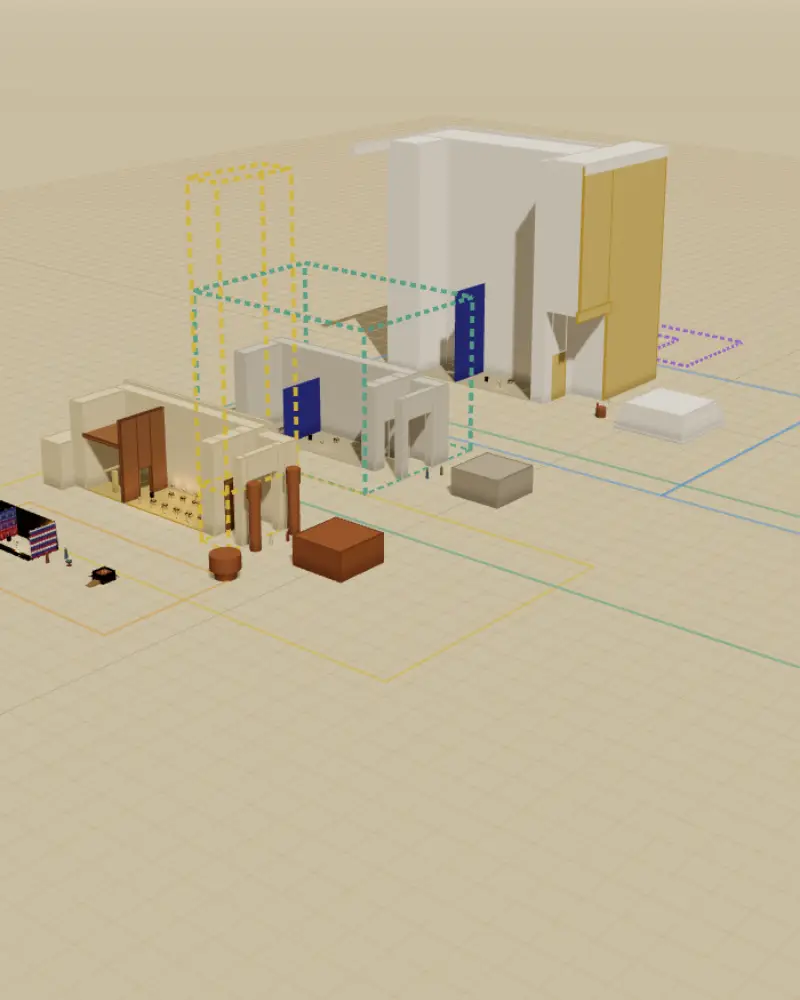
Five sanctuaries at one scale: from the Tabernacle's tent to Herod's 100-cubit front.
Explore in 3D · drag to turn, pinch to zoom
3D · about 400 KB
All five in a row, facing east, at one scale.
Loading the Tabernacle and the Temples…
Cubit
Take the guided tour: 8 stops, from the Tabernacle to Ezekiel's vision.
The five
Tap a building, or choose it here, for its numbers, verses and evidence.
How big, at one scale
The main house of each, in metres with the cubit you choose.
LengthWidthHeight
Tabernacle
Length: 13.5 m
Width: 4.5 m
Height: 4.5 m
Solomon
Length: 27 m
Width: 9 m
Height: 13.5 m
Zerubbabel
Length: 27 m
Width: 9 m
Height: 13.5 m
Herod
Length: 45 m
Width: 45 m
Height: 45 m
Ezekiel (vision)
Length: 45 m
Width: 22.5 m
Height: ?
Cubit
All five in a row, facing east, at one scale.
Side by side: what each one had
Each cell gives its source; a dash means the source is silent. Josephus and the Mishnah are first- and second-century Jewish writings, not Scripture.
Feature
Tabernacle
Solomon
Zerubbabel
Herod
Ezekiel (vision)
When
About 1445 BC or the 13th century BC
Exodus 40:17
17And it came to pass in the first month in the second year, on the first day of the month, that the tabernacle was reared up.
About 966–959 BC (seven years); burned 586 BC
1 Kings 6:1
1And it came to pass in the four hundred and eightieth year after the children of Israel were come out of the land of Egypt, in the fourth year of Solomon’s reign over Israel, in the month Zif, which is the second month, that he began to build the house of the LORD.
1 Kings 6:37–38
37In the fourth year was the foundation of the house of the LORD laid, in the month Zif: 38And in the eleventh year, in the month Bul, which is the eighth month, was the house finished throughout all the parts thereof, and according to all the fashion of it. So was he seven years in building it.
2 Kings 25:8–9
8And in the fifth month, on the seventh day of the month, which is the nineteenth year of king Nebuchadnezzar king of Babylon, came Nebuzar-adan, captain of the guard, a servant of the king of Babylon, unto Jerusalem: 9And he burnt the house of the LORD, and the king’s house, and all the houses of Jerusalem, and every great man’s house burnt he with fire.
Begun about 536 BC, finished 515 BC
Ezra 3:8
8Now in the second year of their coming unto the house of God at Jerusalem, in the second month, began Zerubbabel the son of Shealtiel, and Jeshua the son of Jozadak, and the remnant of their brethren the priests and the Levites, and all they that were come out of the captivity unto Jerusalem; and appointed the Levites, from twenty years old and upward, to set forward the work of the house of the LORD.
Ezra 6:15
15And this house was finished on the third day of the month Adar, which was in the sixth year of the reign of Darius the king.
From about 20 BC; “46 years” in building by Jesus' day; burned AD 70
John 2:20
20Then said the Jews, Forty and six years was this temple in building, and wilt thou rear it up in three days?
Josephus, AntiquitiesJosephus, War
Vision of 573 BC; never built
Ezekiel 40:1
1In the five and twentieth year of our captivity, in the beginning of the year, in the tenth day of the month, in the fourteenth year after that the city was smitten, in the selfsame day the hand of the LORD was upon me, and brought me thither.
Built by
Bezalel and Oholiab, under Moses
Exodus 31:1–6
1And the LORD spake unto Moses, saying, 2See, I have called by name Bezaleel the son of Uri, the son of Hur, of the tribe of Judah: 3And I have filled him with the spirit of God, in wisdom, and in understanding, and in knowledge, and in all manner of workmanship, 4To devise cunning works, to work in gold, and in silver, and in brass, 5And in cutting of stones, to set them, and in carving of timber, to work in all manner of workmanship. 6And I, behold, I have given with him Aholiab, the son of Ahisamach, of the tribe of Dan: and in the hearts of all that are wise hearted I have put wisdom, that they may make all that I have commanded thee;
Solomon, with Hiram of Tyre
1 Kings 5:1–12
1And Hiram king of Tyre sent his servants unto Solomon; for he had heard that they had anointed him king in the room of his father: for Hiram was ever a lover of David. 2And Solomon sent to Hiram, saying, 3Thou knowest how that David my father could not build an house unto the name of the LORD his God for the wars which were about him on every side, until the LORD put them under the soles of his feet. 4But now the LORD my God hath given me rest on every side, so that there is neither adversary nor evil occurrent. 5And, behold, I purpose to build an house unto the name of the LORD my God, as the LORD spake unto David my father, saying, Thy son, whom I will set upon thy throne in thy room, he shall build an house unto my name. 6Now therefore command thou that they hew me cedar trees out of Lebanon; and my servants shall be with thy servants: and unto thee will I give hire for thy servants according to all that thou shalt appoint: for thou knowest that there is not among us any that can skill to hew timber like unto the Sidonians. 7And it came to pass, when Hiram heard the words of Solomon, that he rejoiced greatly, and said, Blessed be the LORD this day, which hath given unto David a wise son over this great people. 8And Hiram sent to Solomon, saying, I have considered the things which thou sentest to me for: and I will do all thy desire concerning timber of cedar, and concerning timber of fir. 9My servants shall bring them down from Lebanon unto the sea: and I will convey them by sea in floats unto the place that thou shalt appoint me, and will cause them to be discharged there, and thou shalt receive them: and thou shalt accomplish my desire, in giving food for my household. 10So Hiram gave Solomon cedar trees and fir trees according to all his desire. 11And Solomon gave Hiram twenty thousand measures of wheat for food to his household, and twenty measures of pure oil: thus gave Solomon to Hiram year by year. 12And the LORD gave Solomon wisdom, as he promised him: and there was peace between Hiram and Solomon; and they two made a league together.
1 Kings 7:13–14
13And king Solomon sent and fetched Hiram out of Tyre. 14He was a widow’s son of the tribe of Naphtali, and his father was a man of Tyre, a worker in brass: and he was filled with wisdom, and understanding, and cunning to work all works in brass. And he came to king Solomon, and wrought all his work.
Zerubbabel and Jeshua, urged by Haggai and Zechariah
Ezra 5:1–2
1Then the prophets, Haggai the prophet, and Zechariah the son of Iddo, prophesied unto the Jews that were in Judah and Jerusalem in the name of the God of Israel, even unto them. 2Then rose up Zerubbabel the son of Shealtiel, and Jeshua the son of Jozadak, and began to build the house of God which is at Jerusalem: and with them were the prophets of God helping them.
Herod the Great
Josephus, Antiquities
Shown to Ezekiel in a vision
Ezekiel 40:2–4
2In the visions of God brought he me into the land of Israel, and set me upon a very high mountain, by which was as the frame of a city on the south. 3And he brought me thither, and, behold, there was a man, whose appearance was like the appearance of brass, with a line of flax in his hand, and a measuring reed; and he stood in the gate. 4And the man said unto me, Son of man, behold with thine eyes, and hear with thine ears, and set thine heart upon all that I shall shew thee; for to the intent that I might shew them unto thee art thou brought hither: declare all that thou seest to the house of Israel.
The house (L × W × H, cubits)
30 × 10 × 10 (the tent)
Strongly supportedExodus 26:15–25
15And thou shalt make boards for the tabernacle of shittim wood standing up. 16Ten cubits shall be the length of a board, and a cubit and a half shall be the breadth of one board. 17Two tenons shall there be in one board, set in order one against another: thus shalt thou make for all the boards of the tabernacle. 18And thou shalt make the boards for the tabernacle, twenty boards on the south side southward. 19And thou shalt make forty sockets of silver under the twenty boards; two sockets under one board for his two tenons, and two sockets under another board for his two tenons. 20And for the second side of the tabernacle on the north side there shall be twenty boards: 21And their forty sockets of silver; two sockets under one board, and two sockets under another board. 22And for the sides of the tabernacle westward thou shalt make six boards. 23And two boards shalt thou make for the corners of the tabernacle in the two sides. 24And they shall be coupled together beneath, and they shall be coupled together above the head of it unto one ring: thus shall it be for them both; they shall be for the two corners. 25And they shall be eight boards, and their sockets of silver, sixteen sockets; two sockets under one board, and two sockets under another board.
60 × 20 × 30 inside
Textually stated1 Kings 6:2
2And the house which king Solomon built for the LORD, the length thereof was threescore cubits, and the breadth thereof twenty cubits, and the height thereof thirty cubits.
3In the first year of Cyrus the king the same Cyrus the king made a decree concerning the house of God at Jerusalem, Let the house be builded, the place where they offered sacrifices, and let the foundations thereof be strongly laid; the height thereof threescore cubits, and the breadth thereof threescore cubits;
100 × 100 × 100
Strongly supportedMishnah MiddotJosephus, War
100 long; heights not given
Textually statedEzekiel 41:13
13So he measured the house, an hundred cubits long; and the separate place, and the building, with the walls thereof, an hundred cubits long;
Ark of the covenant
Yes, with the mercy seat and two cherubim
Textually statedExodus 40:20–21
20And he took and put the testimony into the ark, and set the staves on the ark, and put the mercy seat above upon the ark: 21And he brought the ark into the tabernacle, and set up the vail of the covering, and covered the ark of the testimony; as the LORD commanded Moses.
Yes, brought in under two great cherubim of 10 cubits
Textually stated1 Kings 8:6
6And the priests brought in the ark of the covenant of the LORD unto his place, into the oracle of the house, to the most holy place, even under the wings of the cherubims.
1 Kings 6:23
23And within the oracle he made two cherubims of olive tree, each ten cubits high.
No: the ark was lost; a stone stood in its place
Strongly supportedMishnah YomaHecataeus in Josephus
No: “nothing at all” in the most holy place (Josephus); the foundation stone (Mishnah)
Strongly supportedJosephus, WarMishnah Yoma
Not mentioned
Textually statedEzekiel 41:4
4So he measured the length thereof, twenty cubits; and the breadth, twenty cubits, before the temple: and he said unto me, This is the most holy place.
Lampstands
One, of pure gold, seven lamps
Textually statedExodus 25:31–37
31And thou shalt make a candlestick of pure gold: of beaten work shall the candlestick be made: his shaft, and his branches, his bowls, his knops, and his flowers, shall be of the same. 32And six branches shall come out of the sides of it; three branches of the candlestick out of the one side, and three branches of the candlestick out of the other side: 33Three bowls made like unto almonds, with a knop and a flower in one branch; and three bowls made like almonds in the other branch, with a knop and a flower: so in the six branches that come out of the candlestick. 34And in the candlestick shall be four bowls made like unto almonds, with their knops and their flowers. 35And there shall be a knop under two branches of the same, and a knop under two branches of the same, and a knop under two branches of the same, according to the six branches that proceed out of the candlestick. 36Their knops and their branches shall be of the same: all it shall be one beaten work of pure gold. 37And thou shalt make the seven lamps thereof: and they shall light the lamps thereof, that they may give light over against it.
Ten, five on each side
Textually stated1 Kings 7:49
49And the candlesticks of pure gold, five on the right side, and five on the left, before the oracle, with the flowers, and the lamps, and the tongs of gold,
One (taken by Antiochus IV, remade 164 BC)
Strongly supported1 MaccabeesHecataeus in Josephus
One; carried to Rome and carved on the Arch of Titus
Strongly supportedJosephus, War
Not mentioned
Textually stated
Table of the bread
One
Textually statedExodus 25:23–30
23Thou shalt also make a table of shittim wood: two cubits shall be the length thereof, and a cubit the breadth thereof, and a cubit and a half the height thereof. 24And thou shalt overlay it with pure gold, and make thereto a crown of gold round about. 25And thou shalt make unto it a border of an hand breadth round about, and thou shalt make a golden crown to the border thereof round about. 26And thou shalt make for it four rings of gold, and put the rings in the four corners that are on the four feet thereof. 27Over against the border shall the rings be for places of the staves to bear the table. 28And thou shalt make the staves of shittim wood, and overlay them with gold, that the table may be borne with them. 29And thou shalt make the dishes thereof, and spoons thereof, and covers thereof, and bowls thereof, to cover withal: of pure gold shalt thou make them. 30And thou shalt set upon the table shewbread before me alway.
Ten (Chronicles); “the table” (Kings)
Textually stated2 Chronicles 4:8
8He made also ten tables, and placed them in the temple, five on the right side, and five on the left. And he made an hundred basons of gold.
1 Kings 7:48
48And Solomon made all the vessels that pertained unto the house of the LORD: the altar of gold, and the table of gold, whereupon the shewbread was,
One
Strongly supported1 Maccabees
One; also on the Arch of Titus
Strongly supportedJosephus, War
A wooden altar-table “before the LORD”
Textually statedEzekiel 41:22
22The altar of wood was three cubits high, and the length thereof two cubits; and the corners thereof, and the length thereof, and the walls thereof, were of wood: and he said unto me, This is the table that is before the LORD.
Incense altar
Gold, before the veil
Textually statedExodus 30:1–6
1And thou shalt make an altar to burn incense upon: of shittim wood shalt thou make it. 2A cubit shall be the length thereof, and a cubit the breadth thereof; foursquare shall it be: and two cubits shall be the height thereof: the horns thereof shall be of the same. 3And thou shalt overlay it with pure gold, the top thereof, and the sides thereof round about, and the horns thereof; and thou shalt make unto it a crown of gold round about. 4And two golden rings shalt thou make to it under the crown of it, by the two corners thereof, upon the two sides of it shalt thou make it; and they shall be for places for the staves to bear it withal. 5And thou shalt make the staves of shittim wood, and overlay them with gold. 6And thou shalt put it before the vail that is by the ark of the testimony, before the mercy seat that is over the testimony, where I will meet with thee.
Cedar overlaid with gold
Textually stated1 Kings 6:20–22
20And the oracle in the forepart was twenty cubits in length, and twenty cubits in breadth, and twenty cubits in the height thereof: and he overlaid it with pure gold; and so covered the altar which was of cedar. 21So Solomon overlaid the house within with pure gold: and he made a partition by the chains of gold before the oracle; and he overlaid it with gold. 22And the whole house he overlaid with gold, until he had finished all the house: also the whole altar that was by the oracle he overlaid with gold.
Yes (taken and remade)
Strongly supported1 Maccabees
Yes
Strongly supportedJosephus, War
Perhaps the wooden altar-table
PlausibleEzekiel 41:22
22The altar of wood was three cubits high, and the length thereof two cubits; and the corners thereof, and the length thereof, and the walls thereof, were of wood: and he said unto me, This is the table that is before the LORD.
Altar of burnt offering
5 × 5 × 3, bronze over acacia
Textually statedExodus 27:1
1And thou shalt make an altar of shittim wood, five cubits long, and five cubits broad; the altar shall be foursquare: and the height thereof shall be three cubits.
20 × 20 × 10, bronze
Textually stated2 Chronicles 4:1
1Moreover he made an altar of brass, twenty cubits the length thereof, and twenty cubits the breadth thereof, and ten cubits the height thereof.
Built first, on its old base; 20 × 20 × 10 of unhewn stone (Hecataeus)
SpeculativeEzra 3:2–3
2Then stood up Jeshua the son of Jozadak, and his brethren the priests, and Zerubbabel the son of Shealtiel, and his brethren, and builded the altar of the God of Israel, to offer burnt offerings thereon, as it is written in the law of Moses the man of God. 3And they set the altar upon his bases; for fear was upon them because of the people of those countries: and they offered burnt offerings thereon unto the LORD, even burnt offerings morning and evening.
Hecataeus in Josephus
32 × 32 (Mishnah) or 50 × 50 × 15 (Josephus)
PlausibleMishnah MiddotJosephus, War
A stepped altar, its hearth 12 × 12
Textually statedEzekiel 43:13–17
13And these are the measures of the altar after the cubits: The cubit is a cubit and an hand breadth; even the bottom shall be a cubit, and the breadth a cubit, and the border thereof by the edge thereof round about shall be a span: and this shall be the higher place of the altar. 14And from the bottom upon the ground even to the lower settle shall be two cubits, and the breadth one cubit; and from the lesser settle even to the greater settle shall be four cubits, and the breadth one cubit. 15So the altar shall be four cubits; and from the altar and upward shall be four horns. 16And the altar shall be twelve cubits long, twelve broad, square in the four squares thereof. 17And the settle shall be fourteen cubits long and fourteen broad in the four squares thereof; and the border about it shall be half a cubit; and the bottom thereof shall be a cubit about; and his stairs shall look toward the east.
Water for washing
A bronze basin
Textually statedExodus 30:17–21
17And the LORD spake unto Moses, saying, 18Thou shalt also make a laver of brass, and his foot also of brass, to wash withal: and thou shalt put it between the tabernacle of the congregation and the altar, and thou shalt put water therein. 19For Aaron and his sons shall wash their hands and their feet thereat: 20When they go into the tabernacle of the congregation, they shall wash with water, that they die not; or when they come near to the altar to minister, to burn offering made by fire unto the LORD: 21So they shall wash their hands and their feet, that they die not: and it shall be a statute for ever to them, even to him and to his seed throughout their generations.
The Sea, 10 cubits across, on twelve oxen, and ten stands
Textually stated1 Kings 7:23–25
23And he made a molten sea, ten cubits from the one brim to the other: it was round all about, and his height was five cubits: and a line of thirty cubits did compass it round about. 24And under the brim of it round about there were knops compassing it, ten in a cubit, compassing the sea round about: the knops were cast in two rows, when it was cast. 25It stood upon twelve oxen, three looking toward the north, and three looking toward the west, and three looking toward the south, and three looking toward the east: and the sea was set above upon them, and all their hinder parts were inward.
1 Kings 7:38
38Then made he ten lavers of brass: one laver contained forty baths: and every laver was four cubits: and upon every one of the ten bases one laver.
Not described; a reservoir “like the sea” by about 200 BC
PlausibleSirach 50
A laver between the porch and the altar
PlausibleMishnah Middot
None; a river flows out from under the threshold
Textually statedEzekiel 47:1
1Afterward he brought me again unto the door of the house; and, behold, waters issued out from under the threshold of the house eastward: for the forefront of the house stood toward the east, and the waters came down from under from the right side of the house, at the south side of the altar.
Before the most holy place
A veil of blue, purple and scarlet with cherubim
Textually statedExodus 26:31–33
31And thou shalt make a vail of blue, and purple, and scarlet, and fine twined linen of cunning work: with cherubims shall it be made: 32And thou shalt hang it upon four pillars of shittim wood overlaid with gold: their hooks shall be of gold, upon the four sockets of silver. 33And thou shalt hang up the vail under the taches, that thou mayest bring in thither within the vail the ark of the testimony: and the vail shall divide unto you between the holy place and the most holy.
Olive-wood doors (Kings) and a veil (Chronicles)
Textually stated1 Kings 6:31–32
31And for the entering of the oracle he made doors of olive tree: the lintel and side posts were a fifth part of the wall. 32The two doors also were of olive tree; and he carved upon them carvings of cherubims and palm trees and open flowers, and overlaid them with gold, and spread gold upon the cherubims, and upon the palm trees.
2 Chronicles 3:14
14And he made the vail of blue, and purple, and crimson, and fine linen, and wrought cherubims thereon.
A curtain (taken and remade)
Strongly supported1 Maccabees
One veil (Josephus, the Gospels) or two curtains a cubit apart (Mishnah)
PlausibleMatthew 27:51
51And, behold, the veil of the temple was rent in twain from the top to the bottom; and the earth did quake, and the rocks rent;
Josephus, WarMishnah Yoma
Doors; no veil is mentioned
Textually statedEzekiel 41:23–24
23And the temple and the sanctuary had two doors. 24And the doors had two leaves apiece, two turning leaves; two leaves for the one door, and two leaves for the other door.
Courts
One court, 100 × 50
Textually statedExodus 27:18
18The length of the court shall be an hundred cubits, and the breadth fifty every where, and the height five cubits of fine twined linen, and their sockets of brass.
An inner court and a “great court”, not measured
Textually stated1 Kings 6:36
36And he built the inner court with three rows of hewed stone, and a row of cedar beams.
1 Kings 7:12
12And the great court round about was with three rows of hewed stones, and a row of cedar beams, both for the inner court of the house of the LORD, and for the porch of the house.
Courts with chambers; a walled enclosure about 500 feet by 100 cubits (Hecataeus)
SpeculativeNehemiah 13:7
7And I came to Jerusalem, and understood of the evil that Eliashib did for Tobiah, in preparing him a chamber in the courts of the house of God.
Hecataeus in Josephus
Court of the Gentiles on the platform, a barrier, the Court of the Women, Israel's and the priests' courts
Strongly supportedJosephus, WarMishnah Middot
An outer and an inner court with six gates, inside a square of 500
Textually statedEzekiel 40:47
47So he measured the court, an hundred cubits long, and an hundred cubits broad, foursquare; and the altar that was before the house.
Ezekiel 42:16–20
16He measured the east side with the measuring reed, five hundred reeds, with the measuring reed round about. 17He measured the north side, five hundred reeds, with the measuring reed round about. 18He measured the south side, five hundred reeds, with the measuring reed. 19He turned about to the west side, and measured five hundred reeds with the measuring reed. 20He measured it by the four sides: it had a wall round about, five hundred reeds long, and five hundred broad, to make a separation between the sanctuary and the profane place.
What became of it
Set up at Shiloh, later at Gibeon; brought into Solomon's Temple
Joshua 18:1
1And the whole congregation of the children of Israel assembled together at Shiloh, and set up the tabernacle of the congregation there. And the land was subdued before them.
1 Kings 8:4
4And they brought up the ark of the LORD, and the tabernacle of the congregation, and all the holy vessels that were in the tabernacle, even those did the priests and the Levites bring up.
Burned by Nebuchadnezzar's army in 586 BC
2 Kings 25:8–9
8And in the fifth month, on the seventh day of the month, which is the nineteenth year of king Nebuchadnezzar king of Babylon, came Nebuzar-adan, captain of the guard, a servant of the king of Babylon, unto Jerusalem: 9And he burnt the house of the LORD, and the king’s house, and all the houses of Jerusalem, and every great man’s house burnt he with fire.
Profaned in 167 BC, rededicated in 164 BC (Hanukkah), rebuilt by Herod
John 10:22
22And it was at Jerusalem the feast of the dedication, and it was winter.
1 Maccabees
Burned by Rome in AD 70, as Jesus foretold
Matthew 24:1–2
1And Jesus went out, and departed from the temple: and his disciples came to him for to shew him the buildings of the temple. 2And Jesus said unto them, See ye not all these things? verily I say unto you, There shall not be left here one stone upon another, that shall not be thrown down.
Josephus, War
Never built; read as a future temple or as a picture of God's presence
Ezekiel 43:10–11
10Thou son of man, shew the house to the house of Israel, that they may be ashamed of their iniquities: and let them measure the pattern. 11And if they be ashamed of all that they have done, shew them the form of the house, and the fashion thereof, and the goings out thereof, and the comings in thereof, and all the forms thereof, and all the ordinances thereof, and all the forms thereof, and all the laws thereof: and write it in their sight, that they may keep the whole form thereof, and all the ordinances thereof, and do them.
Debated numbers, side by side
How high was the porch of Solomon's Temple?
1 Kings gives the porch's width and depth but no height. 2 Chronicles 3:4 gives a height that differs between the Hebrew and some ancient translations.
Shown side by side, without a verdict.
120 cubits, as the Hebrew reads: a tower four times the height of the house.
Who holds it: The Hebrew (Masoretic) text, followed by the KJV, ESV and the Chinese Union Version; Josephus also gives the Temple a height of 120 cubits.
2 Chronicles 3:4
4And the porch that was in the front of the house, the length of it was according to the breadth of the house, twenty cubits, and the height was an hundred and twenty: and he overlaid it within with pure gold.
Bible translationsJosephus, Antiquities
20 cubits, as some Greek and Syriac copies read: lower than the house behind it.
Who holds it: Some manuscripts of the Septuagint and the Syriac; the NIV and BSB translate “twenty”.
Bible translationsJaphet 1993
As high as the house, 30 cubits: Kings gives no height and Chronicles' number is a copying slip. The model draws this.
Who holds it: Many commentators; the Solomon's Temple lab draws the porch this way.
Busink
How big was the Second Temple?
Cyrus's decree in Ezra 6:3 says “the height thereof threescore cubits, and the breadth thereof threescore cubits” and gives no length. Yet the old men wept at how small it was, and Haggai calls it “as nothing”.
Shown side by side, without a verdict.
It was built to the decree: 60 high and 60 wide. Herod said it was 60 cubits lower than Solomon's, which Josephus gives as 120.
Who holds it: Josephus, who repeats the decree and Herod's speech.
Ezra 6:3
3In the first year of Cyrus the king the same Cyrus the king made a decree concerning the house of God at Jerusalem, Let the house be builded, the place where they offered sacrifices, and let the foundations thereof be strongly laid; the height thereof threescore cubits, and the breadth thereof threescore cubits;
Josephus, Antiquities
The decree set a limit for the king's money, not a plan: they rebuilt on Solomon's foundations, smaller and plainer. The model draws this.
Who holds it: Many commentators, from Ezra 3:12, Ezra 5:15 (“in his place”) and Haggai 2:3.
Ezra 3:12
12But many of the priests and Levites and chief of the fathers, who were ancient men, that had seen the first house, when the foundation of this house was laid before their eyes, wept with a loud voice; and many shouted aloud for joy:
Haggai 2:3
3Who is left among you that saw this house in her first glory? and how do ye see it now? is it not in your eyes in comparison of it as nothing?
Williamson 1985
The figures have been damaged in copying: a length is missing, and the original may have matched Solomon's 60 long and 20 wide.
Who holds it: Some commentators, who note that the decree's sizes are incomplete.
Williamson 1985
Was there one veil in Herod's Temple, or two curtains?
The Gospels say “the veil of the temple was rent in twain”. The Mishnah describes the high priest walking between two curtains on the Day of Atonement.
Shown side by side, without a verdict.
One veil before the most holy place, like the Tabernacle's.
Who holds it: Josephus, who saw it; the Gospels speak of “the veil”.
Matthew 27:51
51And, behold, the veil of the temple was rent in twain from the top to the bottom; and the earth did quake, and the rocks rent;
Josephus, War
Two curtains a cubit apart, in place of a wall a cubit thick.
Who holds it: The Mishnah (Yoma 5:1; Middot 4:7 gives the cubit between).
Mishnah YomaMishnah Middot
How big was the altar in Herod's Temple?
Two first- and second-century sources give two sizes.
Shown side by side, without a verdict.
32 cubits square at its base, rising in steps to a hearth of 24.
Who holds it: The Mishnah (Middot 3:1). The model draws this.
Mishnah Middot
50 cubits square and 15 high, reached by a ramp.
Who holds it: Josephus (War 5.225).
Josephus, War
Was Ezekiel's outer square 500 cubits or 500 reeds?
A reed is six long cubits, so the two readings differ sixfold: about 260 m or about 1.6 km on each side.
Shown side by side, without a verdict.
500 reeds, as the Hebrew reads: a vast square larger than the city.
Who holds it: The Hebrew text, followed by the KJV.
Ezekiel 42:16
16He measured the east side with the measuring reed, five hundred reeds, with the measuring reed round about.
Bible translations
500 cubits, as the Greek reads and as Ezekiel 45:2 fits. The lab draws this.
Who holds it: The Septuagint; the ESV, the NIV and the Chinese Union Version; most commentators.
Ezekiel 45:2
2Of this there shall be for the sanctuary five hundred in length, with five hundred in breadth, square round about; and fifty cubits round about for the suburbs thereof.
Bible translationsBlock 1998
How long was a cubit?
A cubit is a forearm, but there were two standards. Chronicles says Solomon used cubits “after the first measure”, and Ezekiel's cubit is “a cubit and an hand breadth”. Switch the ruler to see every building grow or shrink.
Shown side by side, without a verdict.
About 45 cm, the common cubit: the Siloam tunnel of “1,200 cubits” measures about 533 m.
Who holds it: Most reconstructions, including this lab's default.
Siloam inscriptionScott 1959
About 52 cm, the long or royal cubit, a handbreadth longer: for Solomon's “first measure” and Ezekiel's cubit.
Who holds it: Scholars who read 2 Chronicles 3:3 and Ezekiel 40:5 this way; Egyptian royal cubit rods measure about 52.4 cm.
2 Chronicles 3:3
3Now these are the things wherein Solomon was instructed for the building of the house of God. The length by cubits after the first measure was threescore cubits, and the breadth twenty cubits.
Ezekiel 40:5
5And behold a wall on the outside of the house round about, and in the man’s hand a measuring reed of six cubits long by the cubit and an hand breadth: so he measured the breadth of the building, one reed; and the height, one reed.
Scott 1959
How sure is each number?
Textually stated
Textually stated: Said directly in the biblical text.
Strongly supported
Strongly supported: A close inference from the text or firm evidence.
Plausible
Plausible: A reasonable reconstruction among live options.
Speculative
Speculative: An informed guess; the text is silent.
Artistic
Artistic: A stylistic choice made for the reconstruction.
1 Maccabees 1:21–23 and 4:47–51 (the lampstand, table, incense altar and curtain taken and remade)
Sirach (Ecclesiasticus) 50:1–3 (Simon the high priest repairs the Temple and its reservoir)
Leen Ritmeyer, The Quest: Revealing the Temple Mount in Jerusalem (Carta, 2006)
Th. A. Busink, Der Tempel von Jerusalem von Salomo bis Herodes, 2 vols (Brill, 1970–1980)
H. G. M. Williamson, Ezra, Nehemiah (Word Biblical Commentary 16, 1985), on Ezra 6:3
Sara Japhet, I & II Chronicles (Old Testament Library, 1993), on 2 Chronicles 3:4
Daniel I. Block, The Book of Ezekiel, Chapters 25–48 (NICOT, 1998)
R. B. Y. Scott, “Weights and Measures of the Bible”, The Biblical Archaeologist 22 (1959)
The Siloam tunnel inscription (about 700 BC): the tunnel is “1,200 cubits”; measured, it is about 533 m
Bible translations compared on 2 Chronicles 3:4 and Ezekiel 42:16: KJV, ESV, NIV, BSB and the 1919 Chinese Union Version
How to read this model. Solid shapes are the lab's reconstruction; dashed lines are a vision or a reading the model does not draw. The Tabernacle is the Tabernacle lab's own model; the other buildings are simple massing from their numbers, not finished architecture. The Second Temple is the least certain: nothing of it has been found. Jachin and Boaz, the Sea's oxen and the cherubim are the Solomon's Temple lab's reconstructions. The stone and sand show the material, not how the walls were coursed, and a soft light falls on the chosen building to show its shape.
Scripture in English from the King James Version (1769); in Chinese from the 1919 Chinese Union Version (public domain).
How big were the Tabernacle and the Temples, compared at one scale?
The Tabernacle's tent was 30 cubits long, 10 wide and 10 high. Solomon's Temple kept its plan and doubled it: a house 60 cubits long and 20 wide, and 30 high, with a most holy place of 20 cubits every way. After the exile the returned Jews rebuilt on the same foundations; Cyrus's decree allows 60 cubits of height and width, but the old men wept at how small it was, and nothing of it has been found. Herod rebuilt it from about 20 BC with a front 100 cubits high and wide, yet inside it kept Solomon's holy place of 40 by 20 cubits.
This lab draws all five at one scale, Ezekiel's visionary temple only as a dashed plan, and lets you set them side by side, stack them on one spot, or walk from one into the next. A cubit ruler switches between the common cubit of about 45 cm and the long cubit of about 52 cm. Every number gives its verse, or Josephus and the Mishnah, with how sure it is; disputed numbers are shown side by side without a verdict.
100 × 100 × 100 cubits (Josephus, Mishnah); “46 years” in building (John 2:20)
Ezekiel's vision
House 100 cubits long; outer square 500 (Ezekiel 41–42); never built
The ark
In the Tabernacle and Solomon's Temple; absent from the Second Temple and Herod's
A cubit
About 45 cm (common) or 52 cm (long, “royal”)
Key verses 6
+
2And the house which king Solomon built for the LORD, the length thereof was threescore cubits, and the breadth thereof twenty cubits, and the height thereof thirty cubits. 3And the porch before the temple of the house, twenty cubits was the length thereof, according to the breadth of the house; and ten cubits was the breadth thereof before the house.
3Now these are the things wherein Solomon was instructed for the building of the house of God. The length by cubits after the first measure was threescore cubits, and the breadth twenty cubits. 4And the porch that was in the front of the house, the length of it was according to the breadth of the house, twenty cubits, and the height was an hundred and twenty: and he overlaid it within with pure gold.
3In the first year of Cyrus the king the same Cyrus the king made a decree concerning the house of God at Jerusalem, Let the house be builded, the place where they offered sacrifices, and let the foundations thereof be strongly laid; the height thereof threescore cubits, and the breadth thereof threescore cubits; 4With three rows of great stones, and a row of new timber: and let the expenses be given out of the king’s house:
3Who is left among you that saw this house in her first glory? and how do ye see it now? is it not in your eyes in comparison of it as nothing?
20Then said the Jews, Forty and six years was this temple in building, and wilt thou rear it up in three days?
16He measured the east side with the measuring reed, five hundred reeds, with the measuring reed round about. 17He measured the north side, five hundred reeds, with the measuring reed round about. 18He measured the south side, five hundred reeds, with the measuring reed. 19He turned about to the west side, and measured five hundred reeds with the measuring reed. 20He measured it by the four sides: it had a wall round about, five hundred reeds long, and five hundred broad, to make a separation between the sanctuary and the profane place.
Scripture quotations: King James Version (1769) (KJV).
What the Bible says, what our model adds to it, where good readers disagree, and where the old copies and the translations differ. We set the views side by side and do not pick a winner.
Textually stated8
Strongly supported3
Plausible5
Speculative4
A few of the model's choices
Strongly supported
The tent: 30 × 10 × 10 cubits. Twenty boards of 1½ cubits make the 30-cubit sides; the boards are 10 cubits high. The width of 10 is worked out from the back wall's boards.
Plausible
Most holy place: 10 × 10 × 10 cubits. Exodus gives no size: a cube of 10 follows from hanging the veil under the clasps.
Plausible
The porch: 10 × 20 cubits. 20 wide and 10 deep. Kings gives no height; Chronicles reads 120 in Hebrew and 20 in some Greek and Syriac copies (see the debate). Drawn at the house's height.
Show all 29Show less+
What the text says8+
Stated in Scripture. Quoted from the King James Version (KJV) and the 1919 Chinese Union Version (和合本).
The court: 100 × 50 × 5 cubits. Linen hangings 100 cubits on the north and south sides, 50 on the west and east, 5 cubits high.
Textually stated
9And thou shalt make the court of the tabernacle: for the south side southward there shall be hangings for the court of fine twined linen of an hundred cubits long for one side: 10And the twenty pillars thereof and their twenty sockets shall be of brass; the hooks of the pillars and their fillets shall be of silver. 11And likewise for the north side in length there shall be hangings of an hundred cubits long, and his twenty pillars and their twenty sockets of brass; the hooks of the pillars and their fillets of silver. …
Altar of burnt offering: 5 × 5 × 3 cubits. Acacia wood overlaid with bronze, five cubits square and three high.
Textually stated
1And thou shalt make an altar of shittim wood, five cubits long, and five cubits broad; the altar shall be foursquare: and the height thereof shall be three cubits.
The house: 60 × 20 × 30 cubits. “The length thereof was threescore cubits, and the breadth thereof twenty cubits, and the height thereof thirty cubits.” Inside measurements.
Textually stated
2And the house which king Solomon built for the LORD, the length thereof was threescore cubits, and the breadth thereof twenty cubits, and the height thereof thirty cubits.
Most holy place: 20 × 20 × 20 cubits. A cube of 20 cubits, overlaid with gold; the holy place before it was 40 long.
Textually stated
16And he built twenty cubits on the sides of the house, both the floor and the walls with boards of cedar: he even built them for it within, even for the oracle, even for the most holy place. 17And the house, that is, the temple before it, was forty cubits long. 18And the cedar of the house within was carved with knops and open flowers: all was cedar; there was no stone seen. …
Bronze altar: 20 × 20 × 10 cubits. Twenty cubits square and ten high: four times the Tabernacle's across.
Textually stated
1Moreover he made an altar of brass, twenty cubits the length thereof, and twenty cubits the breadth thereof, and ten cubits the height thereof.
Cyrus's decree: ? × 60 × 60 cubits. “The height thereof threescore cubits, and the breadth thereof threescore cubits”; no length is given. Whether this is what was built is debated.
Textually stated
3In the first year of Cyrus the king the same Cyrus the king made a decree concerning the house of God at Jerusalem, Let the house be builded, the place where they offered sacrifices, and let the foundations thereof be strongly laid; the height thereof threescore cubits, and the breadth thereof threescore cubits;
Holy place and most holy place: 60 × 20 cubits. The holy place 40 by 20 and the most holy place 20 by 20, as in Solomon's house.
Textually stated
2And the breadth of the door was ten cubits; and the sides of the door were five cubits on the one side, and five cubits on the other side: and he measured the length thereof, forty cubits: and the breadth, twenty cubits. 3Then went he inward, and measured the post of the door, two cubits; and the door, six cubits; and the breadth of the door, seven cubits. 4So he measured the length thereof, twenty cubits; and the breadth, twenty cubits, before the temple: and he said unto me, This is the most holy place.
Inner court: 100 × 100 cubits. A square of 100 cubits before the house, with the altar in it.
Textually stated
47So he measured the court, an hundred cubits long, and an hundred cubits broad, foursquare; and the altar that was before the house.
What the model adds12+
Choices the reconstruction has to make where the text is silent, each with its evidence level and the reason for it.
Strongly supported3+
The tent: 30 × 10 × 10 cubits. Twenty boards of 1½ cubits make the 30-cubit sides; the boards are 10 cubits high. The width of 10 is worked out from the back wall's boards.
Why: Exodus 26 gives the boards, not the room: 20 boards of 1½ cubits make the 30-cubit sides.
The sanctuary: 100 × 100 × 100 cubits. 100 by 100 by 100 cubits, the porch's front the full width and the building behind it 70 wide (the Mishnah) or 60 (Josephus).
Why: Josephus (War 5) and the Mishnah (Middot 4) agree on 100 cubits, and differ on the width behind the porch.
The platform: 470 × 290 m. Its walls still stand: about 488 m on the west, 470 on the east, 280 on the south and 315 on the north. The Mishnah gives 500 by 500 cubits.
Why: The retaining walls stand today and are measured in metres.
Plausible5+
Most holy place: 10 × 10 × 10 cubits. Exodus gives no size: a cube of 10 follows from hanging the veil under the clasps.
Why: Exodus gives no size; the cube follows from hanging the veil under the clasps.
The porch: 10 × 20 cubits. 20 wide and 10 deep. Kings gives no height; Chronicles reads 120 in Hebrew and 20 in some Greek and Syriac copies (see the debate). Drawn at the house's height.
Why: Kings gives width and depth only; the height differs between the Hebrew and some Greek copies of Chronicles.
Inner courts: 322 × 135 cubits. The priests' and Israel's court, 187 by 135 cubits, and the Court of the Women, 135 square.
Why: Mishnah Middot 2 and 5 give the courts; Josephus' figures differ in places.
The outer wall: 500 × 500 cubits. 500 on each side: “reeds” in the Hebrew (about 1.6 km), cubits in the Greek and most modern versions.
Why: The Hebrew of 42:16–19 reads reeds, the Greek and 42:20 and 45:2 cubits.
Josephus saw it and the Mishnah measures it; they agree on the main sizes and differ on others. The platform is archaeology.
Why: Josephus (War 5, Antiquities 15) and Mishnah Middot describe it; the platform's walls stand.
Speculative4+
The inner court: 200 × 100 cubits. Named but not measured in Kings; drawn as the Solomon's Temple lab draws it.
Why: Kings names the inner court but gives no size; drawn as the Solomon's Temple lab draws it.
The house as drawn: 60 × 20 × 30 cubits. Drawn on Solomon's plan, “in his place” on the old foundations; one reading among several.
Why: Ezra 5:15 says "in his place"; the decree's 60 × 60 is debated (see Competing views).
The enclosure: 340 × 100 cubits. Hecataeus, quoted by Josephus, describes a wall about 500 feet long and 100 cubits wide round an altar; his account is late and its authenticity is debated.
Why: From Hecataeus as quoted by Josephus (Against Apion 1.197–199), a late account whose authenticity is debated.
That it stood here is textual; its size and form are a guess. Nothing of it has been excavated.
Why: Ezra and Haggai say it was built; Herod's Temple later replaced it on the same hill.
Competing views6+
Where careful readers disagree. Each view with who holds it and the evidence for and against it. No verdict.
How high was the porch of Solomon's Temple?
2 Chronicles 3:4
120 cubits, as the Hebrew reads: a tower four times the height of the house.
Held by The Hebrew (Masoretic) text, followed by the KJV, ESV and the Chinese Union Version; Josephus also gives the Temple a height of 120 cubits.
For
The Hebrew text reads 120, and KJV and the 和合本 both follow it.
Against
It would make the porch four times the height of the house; the Alexandrinus copy of the Greek and the Arabic version read 20 (Ellicott, Barnes).
What the lab shows(a drawing choice, not a ruling): The lab draws the porch 30 cubits high and lets you switch to 120 and 20.
How big was the Second Temple?
Ezra 6:3; Ezra 3:12; Haggai 2:3
It was built to the decree: 60 high and 60 wide. Herod said it was 60 cubits lower than Solomon's, which Josephus gives as 120.
Held by Josephus, who repeats the decree and Herod's speech.
For
Both translations read the decree as it stands, 60 cubits high and 60 wide, and Josephus repeats it.
Against
The old men wept at the new house (Ezra 3:12) and Haggai calls it "as nothing" (2:3); the Cambridge Bible notes that a house larger than Solomon's would hardly draw that criticism.
What the lab shows(a drawing choice, not a ruling): The lab draws Ezekiel's outer square at 500 cubits, as a dashed plan only: it was a vision, never built.
How long was a cubit?
2 Chronicles 3:3; Ezekiel 40:5
About 45 cm, the common cubit: the Siloam tunnel of “1,200 cubits” measures about 533 m.
Held by Most reconstructions, including this lab's default.
For
The Siloam tunnel, "1,200 cubits" in its inscription, measures about 533 m: about 44–45 cm to the cubit in Judah.
Against
Chronicles says Solomon's cubits were "after the first measure" (2 Chronicles 3:3), which may mean an older, longer cubit.
Sources: The Siloam tunnel inscription (about 700 BC): the tunnel is “1,200 cubits”; measured, it is about 533 m; R. B. Y. Scott, “Weights and Measures of the Bible”, The Biblical Archaeologist 22 (1959)
About 52 cm, the long or royal cubit, a handbreadth longer: for Solomon's “first measure” and Ezekiel's cubit.
Held by Scholars who read 2 Chronicles 3:3 and Ezekiel 40:5 this way; Egyptian royal cubit rods measure about 52.4 cm.
For
Ezekiel's cubit is "a cubit and an hand breadth" (43:13; compare 40:5), and Egyptian royal cubit rods measure about 52.4 cm.
Against
The one measured Judean figure, the Siloam tunnel, points to the shorter cubit.
Sources: R. B. Y. Scott, “Weights and Measures of the Bible”, The Biblical Archaeologist 22 (1959)
What the lab shows(a drawing choice, not a ruling): The lab uses the common cubit of 0.45 m by default and lets you switch every building to the royal cubit.
Textual notes3+
Places where manuscripts, ancient versions or translations differ in numbers or wording. KJV and 和合本 are quoted as they stand.
Ezra 6:3: 60 cubits high and 60 wide, and no length
Parallel accounts
3In the first year of Cyrus the king the same Cyrus the king made a decree concerning the house of God at Jerusalem, Let the house be builded, the place where they offered sacrifices, and let the foundations thereof be strongly laid; the height thereof threescore cubits, and the breadth thereof threescore cubits;
2And the house which king Solomon built for the LORD, the length thereof was threescore cubits, and the breadth thereof twenty cubits, and the height thereof thirty cubits.
2所羅門王爲耶和華所建的殿、長六十肘、寬二十肘、高三十肘。
KJV and the 和合本 both read "the height thereof threescore cubits, and the breadth thereof threescore cubits" / 「殿高六十肘、寬六十肘」, with no length. Solomon's house was 60 long, 20 wide and 30 high (1 Kings 6:2). Barnes and the Cambridge Bible note the missing length, the Cambridge Bible doubting whether the text is sound; Matthew Poole reads the figures as a limit Cyrus set; Gill compares the height with the porch's 120.
16He measured the east side with the measuring reed, five hundred reeds, with the measuring reed round about.
16他用量度的竿量四圍、量東面五百肘。
20He measured it by the four sides: it had a wall round about, five hundred reeds long, and five hundred broad, to make a separation between the sanctuary and the profane place.
20他量四面四圍有牆、長五百肘、寬五百肘、爲要分別聖地與俗地。
Other witnesses
Hebrew (Masoretic) text, verses 16–19
500 reeds
Greek Septuagint
500 cubits
KJV follows the Hebrew: "five hundred reeds". The 和合本 follows the Greek: 「五百肘」. In verse 20 the KJV still reads reeds and the 和合本 cubits. Keil and Delitzsch keep the reeds; the Cambridge Bible and the Pulpit Commentary note that reeds would give 3,000 cubits a side.
4And the porch that was in the front of the house, the length of it was according to the breadth of the house, twenty cubits, and the height was an hundred and twenty: and he overlaid it within with pure gold.
4殿前的廊子長二十肘、與殿的寬窄一樣、高一百二十肘.裏面貼上精金。
Other witnesses
Hebrew (Masoretic) text
120 cubits
Greek Septuagint, Codex Alexandrinus; the Arabic version
20 cubits
KJV and the 和合本 both read 120. Ellicott and Barnes report 20 in the Alexandrinus copy and the Arabic; Keil and Delitzsch judge the number corrupt. The lab draws 30 and offers the other two.
What is the difference between Solomon's Temple and Herod's Temple?
+
Solomon's Temple was the first, built about 960 BC and burned by Babylon in 586 BC. Herod's Temple was the Second Temple of the return, rebuilt on a far grander scale from about 20 BC and destroyed by Rome in AD 70; it is the one Jesus knew. Herod kept the holy place at Solomon's 40 by 20 cubits but raised the front to about 100 cubits and set the courts on a vast platform. Solomon's held the ark; Herod's most holy place was empty. The sizes come from 1 Kings 6, Josephus and the Mishnah.
How big was Solomon's Temple compared with the Tabernacle?
+
Twice as long and twice as wide, and three times as high: the house was 60 by 20 by 30 cubits, the Tabernacle's tent 30 by 10 by 10. With a cubit of 45 cm Solomon's house was about 27 m long, 9 m wide and 13.5 m high inside.
Was the Second Temple smaller than Solomon's?
+
Probably plainer, and perhaps smaller. Cyrus's decree in Ezra 6:3 allows 60 cubits of height and width but gives no length; the old men who had seen the first house wept, and Haggai calls it “as nothing”. Nothing of the building has been found, so its size is the least certain of the five.
Was the ark of the covenant in the Second Temple?
+
No. The ark is last seen in Solomon's Temple. Josephus says the most holy place of Herod's Temple had “nothing at all” in it, and the Mishnah says a stone, the foundation stone, stood where the ark had been.
How tall was Herod's Temple?
+
About 100 cubits, some 45 m, according to both Josephus and the Mishnah, with a front 100 cubits wide, narrower behind. Its courts stood on a platform about 470 by 290 m whose retaining walls, such as the Western Wall, still stand.
Was Ezekiel's temple ever built?
+
No. Ezekiel 40–48 is a vision measured by a man with a measuring reed. Its holy rooms match Solomon's, but it gives few heights, and readers take it as a future temple or as a picture of God's presence among his people. This lab draws it only as a dashed plan.
How long was a biblical cubit?
+
The common cubit was about 45 cm: the Siloam tunnel, “1,200 cubits” in its inscription, measures about 533 m. A long or “royal” cubit was a handbreadth longer, about 52 cm; Chronicles says Solomon built by “the first measure”, and Ezekiel's cubit is “a cubit and an hand breadth”.
How many temples were there in Jerusalem?
+
Two. The First Temple was Solomon's (1 Kings 6). The Second Temple was built by the returned exiles and finished in 515 BC (Ezra 6:15); Herod's great rebuilding is still counted as the Second Temple, since worship never stopped. Before them the Tabernacle was a tent, and Ezekiel's temple (Ezekiel 40–48) is a vision that was never built. This lab draws all five so they can be compared.
Sources & limits
Limits of this lab 4
+
Only Herod's platform survives to be measured; every building on it, and every earlier building, is drawn from texts.
Nothing of Zerubbabel's Temple is known in the ground, so its size and form are a guess.
Ezekiel's temple is a vision; the lab shows it only as a dashed plan and never as a building.
All sizes depend on the cubit; the lab uses 0.45 m and offers the royal cubit of about 0.52 m.
 X-Dreamers