 X-Dreamers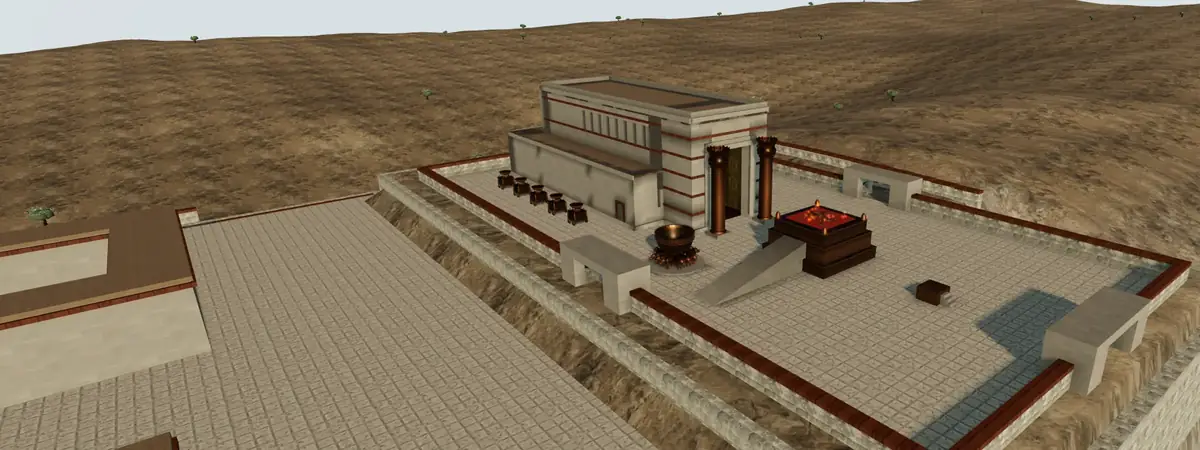
How we build the Labs
How we decide what to draw, how sure we say we are, where our sources come from, how we show disagreement, and how to tell us when we are wrong.
Five evidence levels
Every claim in every lab carries one of these five levels. The level is about the evidence, not about how much we like an idea.
- Textually stated
- The Bible says it in so many words. We quote the verse.
- Strongly supported
- Follows closely from the text, or rests on firm evidence such as an excavated site or an inscription.
- Plausible
- A reasonable reconstruction among several that would work. We say what the others are.
- Speculative
- An informed guess. The text does not say, and the evidence is thin or indirect.
- Artistic
- A choice of style made so the scene can be drawn at all: faces, colours, light, crowds.
How we reconstruct
We start from the text. Measurements, materials, numbers and places the Bible gives are drawn as given, in cubits, and the scale is always stated.
Where the text is silent we look for the closest evidence: excavated buildings and objects of the same time and region first, then later writers such as Josephus or the Mishnah, marked as later. Where there is nothing, we choose the simplest form that fits and mark it Speculative or Artistic.
- God is never depicted. The cloud, the fire and the glory are shown with restraint, as light.
- Models and pictures are built by hand or in code. We use no AI-generated images.
- When the text allows more than one form, the lab says which one it draws and why, and where it can, lets you switch.
"Today" and "reconstruction" are always labelled
A photograph of a site as it is now is marked Today. A drawing of how it may have looked is marked as a reconstruction, with its era. The two are never mixed in one picture without a label, so you can always tell what was seen from what was imagined.
How we choose sources
Scripture is quoted only from two translations: in English the King James Version (1769) and in Chinese the 1919 Chinese Union Version (和合本), public domain. Verse text comes from our own text pipeline, never retyped by hand.
For facts beyond the text we prefer, in this order: excavation reports and the archaeologists who dug the site (Kenyon, Mazar, Reich and Shukron and others, named in each lab); established reference works and open data such as Pleiades and OpenBible; older public-domain encyclopedias and commentaries, marked with their date; and general reference articles as a starting point, cited when we use them. Ancient writers outside the Bible, such as Josephus, are cited for what they say and marked as later than the text.
Every lab ends with a Sources & limits section that lists its sources and says plainly what the lab cannot show.
How we show disagreement
Where careful readers disagree (where Sinai was, which way Israel crossed the sea, where the Temple stood on its hill, where Jesus was tried), we set the views side by side. Each view says who holds it and gives the evidence for it and against it. We do not pick a winner.
A 3D scene still has to draw something. When it does, the panel says what the model shows and marks it as a drawing choice, not a ruling. We include views that serious scholars defend in print; we leave out ideas no one defends.
Textual notes
Old manuscripts and translations sometimes differ, often in numbers: the porch of Solomon's Temple is 120 cubits high in the Hebrew of 2 Chronicles 3:4 and 20 in one great Greek manuscript; Kings and Chronicles give the Bronze Sea 2,000 and 3,000 baths. We show what KJV and the 和合本 actually read, side by side, and list other witnesses only when we can cite where the reading is recorded. If we cannot verify a variant from a source we can cite, we leave it out.
How each lab is checked
Before a lab or a change is released:
- Automatic checks run on every release: every verse reference must exist in the Bible text we quote from, every claim must carry a level, every competing view must have evidence on both sides, and every source must render.
- The team reads the lab through in English and in Chinese, against the sources it cites.
- We check it on a desktop and on a phone, in English and Chinese.
Our use of AI tools
We are honest about this. AI tools help us write code and draft text. They do not decide what is true: every claim is checked against the sources cited on the page, and Scripture is quoted only from KJV and the 1919 和合本 through our own pipeline, never generated. The Labs contain no AI-generated images, and no feature sends your questions or data to an AI service.
Labs are built by a small team at X-Dreamers, and the Labs are not yet reviewed by outside scholars. That is why the next section is empty for now.
Reviewed by
No outside reviewer is named yet. When a scholar reviews a lab and agrees to be named, their name, what they reviewed and when will appear here and on the lab.
Corrections
If you find a mistake in a verse, a place, a measurement, a translation or anything else, please tell us. We correct it as soon as we can, and the lab's "What's new" line says what changed.
Report a mistake →Labs with a full evidence panel
Each has "How sure are we?" and "Sources & limits" below its 3D view or map. More are added lab by lab.
- Solomon's Temple
- The Tabernacle
- Holy Week in Jerusalem
- The Exodus: through the Sea to Sinai
- Jerusalem Through the Ages
- Hezekiah's Tunnel
- Noah's Ark
- places-of-jesus/temple-mount
- places-of-jesus/bethlehem
- The Feast of Tabernacles
- Paul's Roads
- The Seven Churches
- Places of Jesus
- places-of-jesus/capernaum
- places-of-jesus/nazareth
- The Priests' Garments
- places-of-jesus/sea-of-galilee
- Joseph's Robe
- Paul's Second Journey
- The Biblical Family Tree
- The Bible Time Map
- Temples Side by Side
- Hebrew Word Explorer
- Bible Word Usage
- The Bible Story Map
- Life Phases of Old Testament Heroes
- Children’s Bible Stories
- Knowledge Graph Explorer