 X-Dreamers
What Did the High Priest Wear? The Eight Garments of Exodus 28, Layer by Layer
The high priest’s eight garments in Exodus 28: the blue robe and its bells, the ephod, the breastpiece of twelve stones, the Urim and Thummim, the gold plate.
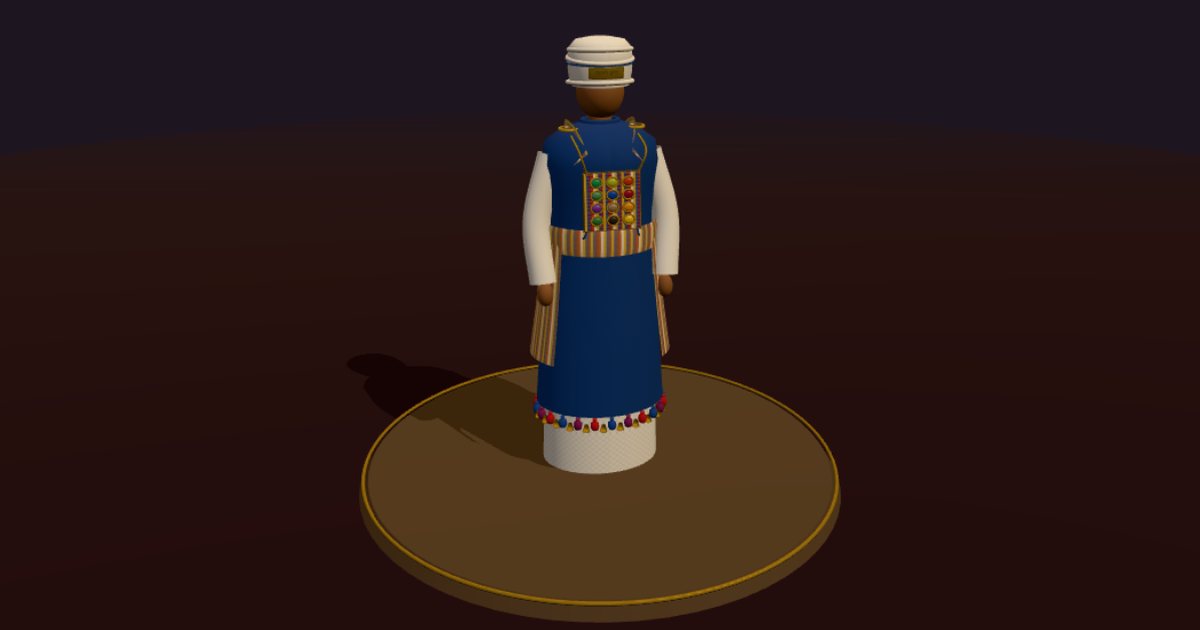
The high priest of Israel wore eight garments, made “for glory and for beauty” (Exodus 28:2). Next to the skin went four of linen that every priest wore: undergarments, a long tunic, a sash and, for him, a turban. Over them went four that only he wore: a robe all of blue with golden bells and pomegranates on its hem, the ephod woven with gold, the breastpiece set with twelve stones and holding the Urim and Thummim, and a plate of pure gold on his forehead engraved “HOLY TO THE LORD”. Exodus 28 and 39 and Leviticus 8 give the materials, colours and order of dressing; they do not give the cut of most garments, the minerals of most stones or the form of the Urim and Thummim, so the lab marks how sure each part is.
Dress the high priest in 3D, layer by layer →
The high priest’s garments at a glance
| Garment | Hebrew | Who wore it | Model in the lab |
|---|---|---|---|
| Linen undergarments | mikhnese bad | Every priest | Strongly supported |
| Tunic | ketonet | Every priest | Plausible |
| Sash | avnet | Every priest | Plausible |
| Turban (headband for priests) | mitsnefet | High priest | Plausible |
| Robe of the ephod, all blue | me’il | High priest | Plausible |
| Ephod | ephod | High priest | Speculative |
| Breastpiece, a span square | ḥoshen | High priest | Plausible |
| Urim and Thummim | urim, tummim | High priest | Speculative |
| Gold plate, “the holy crown” | tsits | High priest | Plausible |
Ordinary priests wore a linen headband (migba’ot) instead of the turban. The last column rates the model, not the garment.
Dressed in the order of Leviticus 8
Leviticus 8 shows Moses dressing Aaron, and the lab follows its order. After washing came the linen undergarments, “from the waist even to the thighs” (Exodus 28:42). Then:
He put the tunic on him, tied the sash on him, clothed him with the robe, put the ephod on him, and he tied the skillfully woven band of the ephod on him and fastened it to him with it. (Leviticus 8:7)
The breastpiece followed, with the Urim and Thummim placed in it, then the turban, then the gold plate on its front. Stop after the ephod, or take the whole set apart.
The robe and its bells
The robe was woven in one colour, tekhelet, with a bound opening for the head so that it would not tear. Round the hem hung pomegranates of blue, purple and scarlet yarn, with gold bells between them. The reason is given: “its sound shall be heard when he goes in to the holy place before the LORD, and when he comes out, that he not die” (Exodus 28:35).
How many bells? The text does not say; the model draws 24 (Artistic), and the Talmud counts 72, or 36.
The ephod and the names on his shoulders
The ephod was the richest weave: blue, purple, scarlet and twined linen, with gold beaten thin and cut into threads (Exodus 39:3). Two shoulder straps carried two onyx stones in gold settings, each engraved with six names of the sons of Israel “in the order of their birth” (Exodus 28:10), so that “Aaron shall bear their names before the LORD on his two shoulders for a memorial” (Exodus 28:12).
Its shape is not given. Rashi saw a wrap-around apron with the straps rising behind; Josephus describes something short, like a tunic; and the same word is used for the plain linen ephod the boy Samuel wore (1 Samuel 2:18). The lab shows the apron and lets you switch to the vest.
The breastpiece and its twelve stones
The breastpiece (the WEBU says “breastplate”) was a square of the same weave, folded double, a span (about 22 cm) each way, tied on with gold chains and a blue cord. It carried twelve stones in four rows, each engraved with the name of a tribe:
Aaron shall bear the names of the children of Israel in the breastplate of judgment on his heart, when he goes in to the holy place, for a memorial before the LORD continually. (Exodus 28:29)
Which stones were they? Most of the Hebrew names occur only in lists of gems, and translations disagree widely. The first, odem, comes from the word for “red”: the WEBU says ruby, but ruby was hardly engraved in the region then, and carnelian, common in seals, is proposed instead. The sixth, yahalom, is “emerald” in the WEBU, jasper in the Greek and diamond in the 1919 Chinese Bible, a stone that could not yet be cut. Sappir gave us the word sapphire, but it was probably lapis lazuli. Only shevo, agate, is a stone most translations agree on.
The lab sets three approaches side by side: follow the Septuagint’s Greek names; start from the stones actually engraved in Egypt and the Levant at the time (Harrell, Hoffmeier and Williams, 2017); or accept that most identifications are guesses. Which name went on which stone is not stated either: the model uses birth order, others the camp order of Numbers 2.
The Urim and the Thummim
Moses put them “in the breastplate of judgment” (Exodus 28:30), and through them the priest inquired of the LORD for Israel’s leader (Numbers 27:21). After the exile no priest had them, and a question about the priesthood had to wait “until a priest stood up to serve with Urim and with Thummim” (Ezra 2:63).
What were they? The lab draws no object, only a dashed outline, and lists three views: two lots giving yes or no, as most modern scholars read the longer Greek text of 1 Samuel 14:41; the breastpiece stones shining with the answer, as Josephus and the Talmud say; or a question best left open.
The gold plate on his forehead
The plate was pure gold, tied with a blue cord to the front of the turban and engraved “like the engravings of a signet, ‘HOLY TO THE LORD.’” (Exodus 28:36) Leviticus 8:9 calls it “the holy crown”. Through it Aaron bore the guilt attached to Israel’s holy gifts, “that they may be accepted before the LORD” (Exodus 28:38). The model uses the square script of printed Bibles; Aaron’s plate would have had the older letters.
Blue, purple and scarlet
The scarlet came from the kermes insect and the purple from murex sea snails (Strongly supported). Tekhelet, the blue, was probably a murex dye too, but was it sky blue, as the dye turns in sunlight, or blue-violet, like the Greek hyakinthos? The lab keeps both: see the robe in blue-violet.
The priests, and the Day of Atonement
Aaron’s sons served daily in four linen garments: undergarments, tunic, sash and headband. Whether their sashes were embroidered is debated in the Talmud itself.
Once a year the high priest laid the gold and colours aside. To go behind the veil on the Day of Atonement he bathed and put on plain linen: “They are the holy garments.” (Leviticus 16:4) Afterwards he took them off and left them in the Tent of Meeting.
What we know and what is reconstructed
| Detail | Evidence level |
|---|---|
| The eight garments, their materials and colours, the order of dressing, the inscription | Textually stated |
| Murex purple and kermes scarlet; linen undergarments to the thigh | Strongly supported |
| The cut of the tunic, robe, sash and turban; tekhelet as a murex dye | Plausible |
| The ephod’s shape; the priests’ headband; the form of the Urim and Thummim; most stone identifications | Speculative |
| 24 bells; the stones’ colours in the model; the faceless figure | Artistic |
Frequently asked questions
Did ordinary priests wear the ephod? Not the gold one. A plain linen ephod was worn more widely, by Samuel and by David (2 Samuel 6:14).
Is the tunic the same word as Joseph’s coat? Yes, ketonet. See Joseph’s robe and our article on it.
Can I use it in a class? Print the one-page sheet of facts, verses and questions.
Dress the high priest from the linen up →, then walk into the Tabernacle as a priest.
Related
- The chapter guides to Exodus 28, Leviticus 16, 1 Samuel 14 and Hebrews 9, and the verse journey “that I may dwell among them”.
- Ḥoshen in the Hebrew Word Explorer and the Urim and Thummim in the Knowledge Graph.
- Inside the Tabernacle, the Feast of Tabernacles and Jacob’s twelve sons.
- Solomon’s Temple compared to Herod’s, in the Temples Side by Side lab.
Found this helpful? Pass it on.