 X-Dreamers
What Did Joseph’s “Coat of Many Colours” Really Look Like?
Genesis never describes Joseph’s robe. What the Hebrew ketonet passim means, how the oldest translations read it, and what Bronze Age cloth shows.
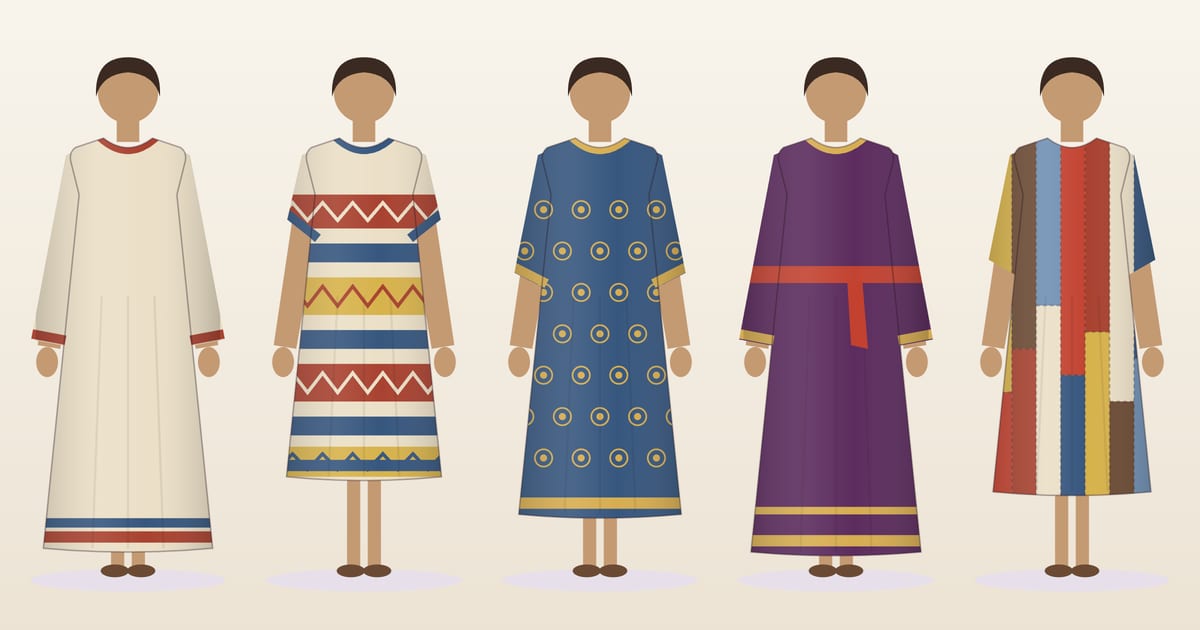
Nobody knows exactly, because Genesis never describes it. The Hebrew calls it a ketonet passim: ketonet is a tunic, and passim is a word so rare that its meaning has been argued over for more than two thousand years. The oldest Greek translation read it as “varied” or many-coloured, and that is where the familiar “coat of many colours” comes from. Other ancient translators read it as a tunic reaching the wrists and ankles, and some modern scholars think it was decorated. One thing is clear from both places the phrase is used: it was a garment of rank, the kind of robe a king’s daughter wore, not the work clothes of a shepherd.
Weigh the evidence for Joseph’s robe →
What Genesis actually says
The robe appears in one verse of introduction and three more of trouble:
Now Israel loved Joseph more than all his children, because he was the son of his old age, and he made him a tunic of many colors. (Genesis 37:3)
That is the whole description: who made it, for whom, and why. The next verse gives the result: “they hated him, and couldn’t speak peaceably to him” (Genesis 37:4). When Joseph comes out to Dothan, his brothers “stripped Joseph of his tunic, the tunic of many colors that was on him” (Genesis 37:23). They kill a goat, dip the robe in its blood and bring it home, and Jacob says, “It is my son’s tunic. An evil animal has devoured him.” (Genesis 37:33)
Not one of these mentions names a colour, a length or a pattern. “Many colors” in the WEBU and other English Bibles comes from the translators, not from a Hebrew colour word.
Two words, one puzzle
The Joseph’s Robe lab opens with the phrase itself, read right to left: כְּתֹנֶת פַּסִּים, kĕtōnet passîm, “a tunic of passim”.
Ketonet is not the problem. It is the ordinary word for the shirt-like garment worn next to the body, by men and women alike. God clothes Adam and Eve in ketonot of skin (Genesis 3:21), and the priests wear a linen ketonet.
Passim is the puzzle. It is the plural of a noun pas, and in biblical Hebrew it occurs nowhere except in this phrase. Three main suggestions have been made:
- Palms and soles. In the Aramaic of Daniel, pas yeda is the part of the hand that wrote on Belshazzar’s wall: “The king saw the part of the hand that wrote.” (Daniel 5:5) A tunic of passim would then reach to the palms and the soles.
- Strips. In later Hebrew, centuries after the Bible, pas means a strip or stripe.
- Ornaments. An Akkadian word, pišannu, names ornaments sewn onto fine robes.
| The phrase ketonet passim | Where it appears |
|---|---|
| Jacob makes the robe | Genesis 37:3 |
| The brothers strip it off | Genesis 37:23 |
| It is brought, bloodied, to Jacob | Genesis 37:32 |
| Tamar wears one, as the king’s daughters did | 2 Samuel 13:18 |
| Tamar tears it in grief | 2 Samuel 13:19 |
Those five verses are the whole of the evidence inside the Hebrew Bible.
How the oldest translators read it
The lab sets out seventeen translations in a table, from the Septuagint to the NET Bible, with a column for what each one reads passim as: colour, length, decoration or status.
| Translation | Genesis 37:3 | 2 Samuel 13:18 |
|---|---|---|
| Septuagint (Greek, 3rd–2nd c. BC) | chitōn poikilos, a varied or many-coloured tunic | chitōn karpōtos, a tunic reaching the wrists |
| Aquila (Greek, c. AD 130) | a tunic to the ankles | |
| Symmachus (Greek, late 2nd c. AD) | a tunic with sleeves | |
| Targum Onkelos (Aramaic) | leaves pas untranslated | |
| Vulgate (Latin, c. AD 405) | tunica polymita, woven of many threads | tunica talaris, ankle-length |
| King James Version (1611) | “a coat of many colours” | “a garment of divers colours” |
The most revealing detail is in the first row. The same Greek translators rendered the identical Hebrew phrase two different ways in two books: “many-coloured” for Joseph, “reaching the wrists” for Tamar. Jerome did the same in Latin. The King James translators followed the Greek and Latin in Genesis, and the English-speaking world has pictured a rainbow coat ever since. Modern versions are still divided between “long robe with sleeves”, “ornate robe” and “many colors”.
Tamar: the only other robe with this name
The best clue in Scripture is not in Genesis at all. When Amnon has violated his half-sister Tamar and thrown her out, the narrator stops to explain what she is wearing:
She had a garment of various colors on her, for the king’s daughters who were virgins dressed in such robes. (2 Samuel 13:18)
Then she “tore her garment of various colors that was on her” (2 Samuel 13:19). Whatever a ketonet passim looked like, it was the dress of royal daughters, and it could be worn by a woman as well as a man. So Jacob dressed his seventeen-year-old shepherd son in something like princely clothes.
What people in Joseph’s world wore
No ancient picture of Joseph exists, but the lab’s Parallels section shows what Semitic people of roughly that era could look like. In a tomb at Beni Hasan in Egypt, painted around 1890 BC, thirty-seven Semitic travellers, the Aamu, led by a chief named Abishai, arrive in garments of red, blue and white wool, in zigzags, bands and fringes, standing out against the Egyptians’ plain white linen. It is not Joseph, but it shows that bright, patterned clothing was not out of place.
The dyes existed too: madder red, kermes scarlet, woad blue, plant yellows and costly sea-snail purple. Dyed wool was expensive, so a coloured robe would have said something about the family.
What we know and what is guessed
The lab lays out five readings, each with its evidence for and against, and a Compare button that sets two or three side by side. The reconstruction slider then draws one figure five ways, changing only the length, sleeves, colours and pattern. Every drawing is labelled artistic: no ancient source shows Joseph’s robe.
| Claim | Evidence level |
|---|---|
| Jacob made it for Joseph out of favouritism; the brothers stripped it off and used it to deceive him | Stated in the text |
| Genesis never gives its colour, length or decoration | Stated in the text |
| It was a garment of rank (the one conclusion that does not depend on the meaning of passim) | Strongly supported |
| Long, with sleeves reaching the wrists and ankles | Plausible |
| Many-coloured | Plausible |
| Decorated or embroidered | Plausible |
| Made of strips or pieces | Speculative |
| It looked like the Beni Hasan garments | Speculative |
The readings can overlap: a long robe with sleeves could also be coloured, and any of them could mark rank.
Why the robe matters to the story
Clothes mark every turn in Joseph’s life. His brothers strip off the robe. In Potiphar’s house he leaves his garment in the hand of his master’s wife and runs. And at the end Pharaoh “arrayed him in robes of fine linen, and put a gold chain about his neck” (Genesis 41:42). The robe his father gave him was taken away, and the clothes of a ruler came thirteen years later. If you want to follow those years, from seventeen to thirty, Seasons of Waiting looks at them alongside Abraham, Moses and David.
Frequently asked questions
Was Joseph’s coat really multicoloured? Possibly, but the Hebrew does not say so. The idea comes from the Septuagint’s poikilos and the Latin Vulgate. The same translators read the phrase as “reaching the wrists” in 2 Samuel.
Why did Jacob give Joseph the coat? Because “Israel loved Joseph more than all his children, because he was the son of his old age” (Genesis 37:3). Some commentators think it also marked him as heir, but the text only says it showed love.
Who else wore a ketonet passim? Only Tamar, King David’s daughter, in 2 Samuel 13.
Look for yourself
The lab has the Hebrew phrase, all five verses, the translation table, the five readings and the reconstructions, each tagged with how certain it is.
Related labs
- The phrase in the Hebrew Word Explorer: passim in Genesis 37:3, word by word.
- Joseph’s robe on the Bible Story Map: the robe, the dreams and what followed.
- Life Phases: Joseph’s thirteen years from the pit to Pharaoh, on one age axis.
Found this helpful? Pass it on.