 X-Dreamers
Reading A
A copy of the heavenly sanctuary
Strongly supportedInterpretation
Hebrews reads the Tabernacle as a copy and shadow of the heavenly things, quoting God's word to Moses about the pattern.
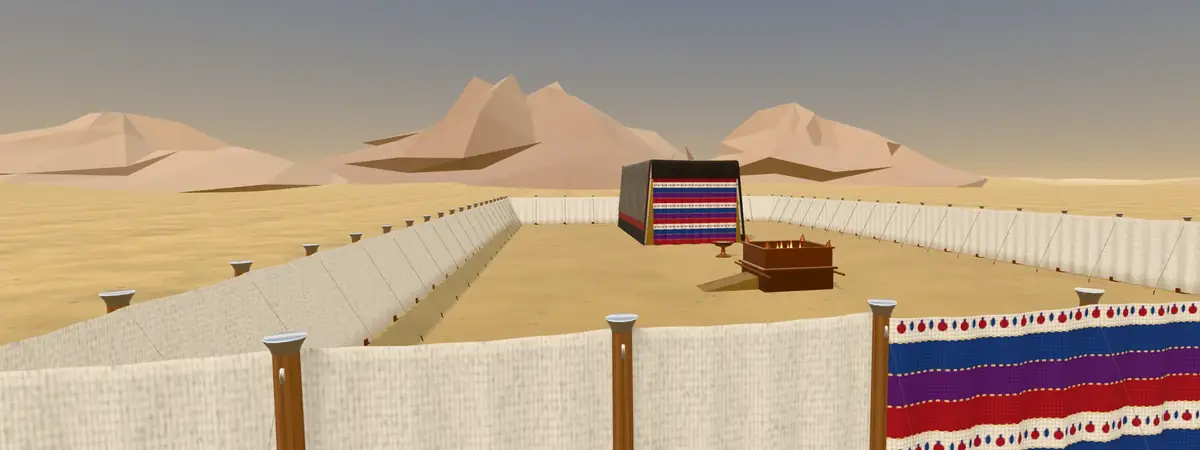
Enter from a verse
Let them make me a sanctuary, that I may dwell among them
8And let them make me a sanctuary; that I may dwell among them.
Scripture: King James Version (1769).
At Sinai God asks for a tent so that he can live in the middle of his people's camp. Four doors open the mountain, the camp, the sanctuary and the readings of its pattern.
Israel has heard the Ten Commandments and made the covenant. Moses goes up into the cloud for forty days, and the first thing God speaks of is an offering to make a sanctuary, built according to the pattern he will show.
8And let them make me a sanctuary; that I may dwell among them. 9According to all that I shew thee, after the pattern of the tabernacle, and the pattern of all the instruments thereof, even so shall ye make it.
The tabernacle was built according to a pattern shown to Moses on the mountain.
Stated directly in the text.
The tent stood in the centre of the camp, with three tribes encamped on each side under their standards and the cloud resting over it. Wherever Israel moved, God's dwelling moved with them.
Three tribes camped on each side under a standard, with the Tent of Meeting in the middle.
Stated directly in the text.
The camp is drawn compressed, with the lead tribe of each side in the middle of its three.
Numbers gives sides and order but not distances or shapes; the text says only that they camped 'at a distance' around the tent. One tent stands for about 400 men, drawn as a low tent of dark goats' hair like those desert herders still pitch, doors turned toward the Tabernacle; the hills around are generic bare granite ranges, not a claim about where Sinai was.
A courtyard of a hundred by fifty cubits surrounded the tent. Inside were two rooms: the holy place with the lampstand, the table and the altar of incense, and behind the veil the most holy place with the ark of the covenant.
33And thou shalt hang up the vail under the taches, that thou mayest bring in thither within the vail the ark of the testimony: and the vail shall divide unto you between the holy place and the most holy.
The ark was 2.5 × 1.5 × 1.5 cubits, of acacia overlaid with pure gold.
Stated directly in the text.
One cubit is about 0.45 m (roughly 18 inches).
Consistent with ancient Near Eastern common cubits and with the Siloam tunnel inscription; the text itself does not give a conversion.
Exodus says only that Moses was shown a pattern. Later Scripture reads the Tabernacle in more than one light. Two readings are set out below, each a reading of other passages rather than a fact of Exodus.
5Who serve unto the example and shadow of heavenly things, as Moses was admonished of God when he was about to make the tabernacle: for, See, saith he, that thou make all things according to the pattern shewed to thee in the mount.
14And the Word was made flesh, and dwelt among us, (and we beheld his glory, the glory as of the only begotten of the Father,) full of grace and truth.
Reading A
Hebrews reads the Tabernacle as a copy and shadow of the heavenly things, quoting God's word to Moses about the pattern.
Reading B
John says the Word became flesh and 'tabernacled' among us: the presence promised in Exodus 25:8 seen in Jesus.
Doors into the verse
8And let them make me a sanctuary; that I may dwell among them.
See this verse's connections in the Knowledge Graph
Every door is drawn from the Bible Labs knowledge graph: each claim keeps its evidence level, and readings that link one passage to another are marked as interpretation. King James Version (1769).