Skip to content
X-Dreamers

Bible Timeline and Map

A Bible timeline from the patriarchs to the early church, tied to a map. Move through time and see the kings of Israel and Judah, the prophets beside them, the empires around them and where each book belongs.

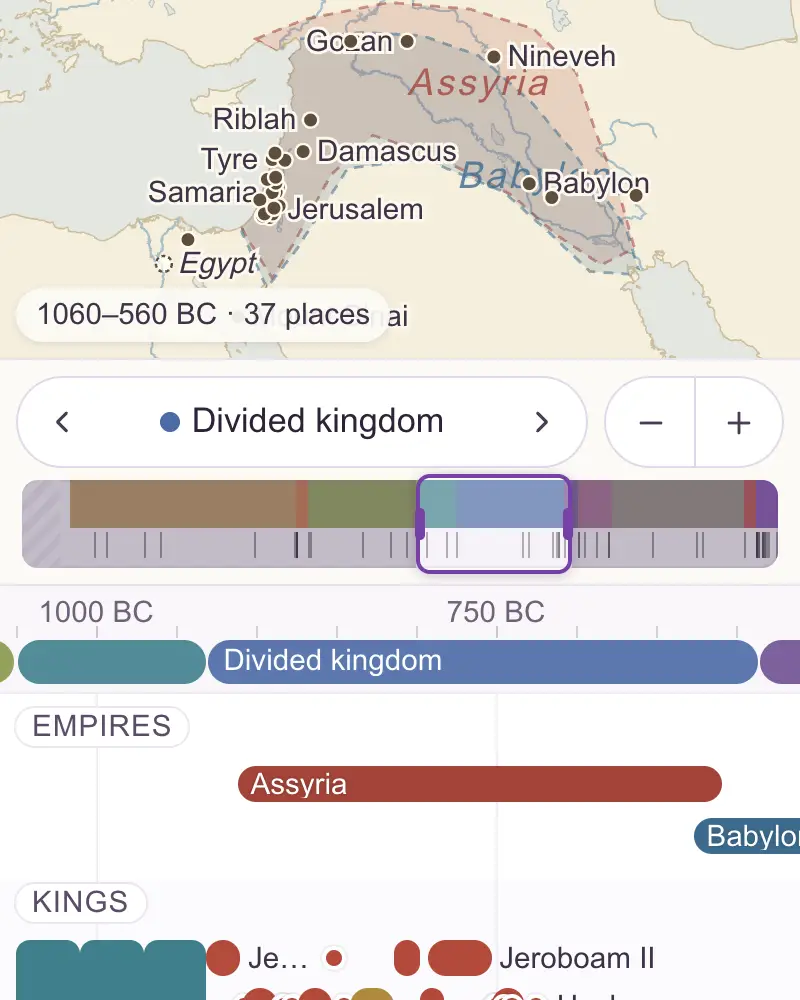
The Bible Time Map on a phone: a map of the Near East over a timeline of kings, prophets and events

The Bible Time Map

Kings, prophets, empires and books on one timeline, tied to a map.

Swipe through time · pinch to zoom · tap anything

On the map: the beginnings (undated) and 2200 BC – AD 10078 places

Exodus date

Moves every date before the judges.

Whole story

Swipe the timeline or the overview · Pinch or use + and − to zoom · ‹ › step through the eras · Tap anythingDrag the timeline or the overview to move through time · Ctrl + scroll or pinch to zoom · ← → step through the eras · Click anything

  • Kings, as judged in Kings:
  • Did right
  • Did evil
  • Mixed
  • Bars across both rows: the united kingdom
  • Faint bar: date very uncertain

How to read the map

Drag the timeline, or the window in the overview strip above it, to move through time; the ‹ › buttons step from era to era. Whatever part you can see decides what the map shows: the places of every item in view, and the empires of that time shaded behind them. Kings are drawn as bars for their reigns, with Israel above Judah; overlapping bars are co-regencies. Books sit where their story happens, or, for the prophets and letters, when they were written.

Dates before the kings are debated. From Solomon on, Assyrian and Babylonian records tie the biblical kings to fixed years. Before that, dates are counted back from the text and depend above all on when the Exodus happened: about 1446 BC if 1 Kings 6:1 is read as 480 calendar years, or about 1260 BC if it counts generations. The switch moves every earlier date together, and each item shows how sure we can be of it.

Evidence levels

  • Textually statedSaid directly in the biblical text.
  • Strongly supportedA close inference from the text or firm evidence.
  • PlausibleA reasonable reconstruction among live options.
  • SpeculativeAn informed guess; the text is silent.
  • ArtisticA stylistic choice made for the reconstruction.

Data and licences

  • People and verse counts: Theographic Bible Metadata by Robert Rouse (CC BY-SA 4.0).
  • Place locations and confidence: OpenBible.info Bible Geocoding Data (CC BY 4.0).
  • Coastlines, lakes and rivers: Natural Earth (public domain).
  • Empire outlines, dates and descriptions are drawn up for this lab from standard reference works; the outlines are rough sketches.
  • Scripture quotations are from the King James Version (1769).

A Bible timeline tied to a map

The Bible Time Map lays the whole biblical story on one zoomable timeline, from the undated beginnings of Genesis 1–11 and the patriarchs to the early church, and ties it to a map. It holds 207 items in rows: 7 empires around Israel, 42 kings of the united kingdom, Israel and Judah, 20 prophets, people and events, and all 66 books of the Bible. Whatever part of the timeline you can see decides what the map shows, across 78 places.

Every date carries its evidence. From the divided kingdom on, reigns follow Edwin Thiele's chronology, anchored by Assyrian records; the fall of Samaria (722 BC) and of Jerusalem (586 BC) are fixed by Assyrian and Babylonian chronicles. Earlier dates are counted back from 1 Kings 6:1 and depend on when the Exodus happened, so a switch compares the early date (c. 1446 BC) with the late date (c. 1260 BC).

One place across the agesSee Jerusalem through the ages →One place across the periods: Jerusalem from David's small town to Solomon, Hezekiah, the return, Herod and today, in 3D.

The eras of the Bible timeline

The eras of the Bible timeline
BeginningsUndated (Genesis 1–11)
Patriarchsc. 2166–1446 BC (late Exodus: c. 1980–1260 BC)
Exodus & wildernessc. 1446–1406 BC (late Exodus: c. 1260–1220 BC)
Conquest & judgesc. 1406–1050 BC (late Exodus: c. 1220–1050 BC)
United kingdomc. 1050–931 BC
Divided kingdomc. 931–586 BC
Exilec. 586–538 BC
Returnc. 538–430 BC
Between the Testamentsc. 430–6 BC
Life of Jesusc. 6 BC – AD 30
Early churchc. AD 30–100

Key verses 5

1Now the LORD had said unto Abram, Get thee out of thy country, and from thy kindred, and from thy father’s house, unto a land that I will shew thee: 2And I will make of thee a great nation, and I will bless thee, and make thy name great; and thou shalt be a blessing: 3And I will bless them that bless thee, and curse him that curseth thee: and in thee shall all families of the earth be blessed.

Genesis 12:1–3

40Now the sojourning of the children of Israel, who dwelt in Egypt, was four hundred and thirty years. 41And it came to pass at the end of the four hundred and thirty years, even the selfsame day it came to pass, that all the hosts of the LORD went out from the land of Egypt.

Exodus 12:40–41

1And it came to pass in the four hundred and eightieth year after the children of Israel were come out of the land of Egypt, in the fourth year of Solomon’s reign over Israel, in the month Zif, which is the second month, that he began to build the house of the LORD.

1 Kings 6:1

1Now in the first year of Cyrus king of Persia, that the word of the LORD by the mouth of Jeremiah might be fulfilled, the LORD stirred up the spirit of Cyrus king of Persia, that he made a proclamation throughout all his kingdom, and put it also in writing, saying, 2Thus saith Cyrus king of Persia, The LORD God of heaven hath given me all the kingdoms of the earth; and he hath charged me to build him an house at Jerusalem, which is in Judah. 3Who is there among you of all his people? his God be with him, and let him go up to Jerusalem, which is in Judah, and build the house of the LORD God of Israel, (he is the God,) which is in Jerusalem.

Ezra 1:1–3

1Now in the fifteenth year of the reign of Tiberius Cæsar, Pontius Pilate being governor of Judæa, and Herod being tetrarch of Galilee, and his brother Philip tetrarch of Ituraea and of the region of Trachonitis, and Lysanias the tetrarch of Abilene, 2Annas and Caiaphas being the high priests, the word of God came unto John the son of Zacharias in the wilderness. 3And he came into all the country about Jordan, preaching the baptism of repentance for the remission of sins;

Luke 3:1–3

Scripture quotations: King James Version (1769) (KJV).

What the Bible says, what our model adds to it, where good readers disagree, and where the old copies and the translations differ. We set the views side by side and do not pick a winner.

  • Textually stated5
  • Strongly supported4
  • Plausible6
  • Speculative2

A few of the model's choices

  • Speculative

    Creation: undated on the Time Map.

  • Speculative

    The binding of Isaac: c. 2050–2040 BC on the Time Map.

  • Plausible

    Slavery in Egypt: c. 1580–1446 BC on the Time Map.

Show all 21
What the text says5

Stated in Scripture. Quoted from the King James Version (KJV) and the 1919 Chinese Union Version (和合本).

  • Solomon began the temple in the 480th year after Israel came out of Egypt, in the fourth year of his reign.

    Textually stated

    1And it came to pass in the four hundred and eightieth year after the children of Israel were come out of the land of Egypt, in the fourth year of Solomon’s reign over Israel, in the month Zif, which is the second month, that he began to build the house of the LORD.

    1 Kings 6:1 · KJV
  • Israel lived in Egypt 430 years.

    Textually stated

    40Now the sojourning of the children of Israel, who dwelt in Egypt, was four hundred and thirty years.

    Exodus 12:40 · KJV
  • Shishak king of Egypt came up against Jerusalem in Rehoboam's fifth year.

    Textually stated

    25And it came to pass in the fifth year of king Rehoboam, that Shishak king of Egypt came up against Jerusalem:

    1 Kings 14:25 · KJV
  • Luke dates the word of God coming to John to the fifteenth year of Tiberius.

    Textually stated

    1Now in the fifteenth year of the reign of Tiberius Cæsar, Pontius Pilate being governor of Judæa, and Herod being tetrarch of Galilee, and his brother Philip tetrarch of Ituraea and of the region of Trachonitis, and Lysanias the tetrarch of Abilene, 2Annas and Caiaphas being the high priests, the word of God came unto John the son of Zacharias in the wilderness.

    Luke 3:1–2 · KJV
  • Paul was brought before Gallio, proconsul of Achaia.

    Textually stated

    12And when Gallio was the deputy of Achaia, the Jews made insurrection with one accord against Paul, and brought him to the judgment seat,

    Acts 18:12 · KJV
What the model adds12

Choices the reconstruction has to make where the text is silent, each with its evidence level and the reason for it.

Strongly supported4
  • Asa: c. 911–870 BC on the Time Map.

    Why: Kings gives the length of each reign and ties it to the other kingdom. The years follow Edwin Thiele's widely used chronology, anchored by Assyrian records (the battle of Qarqar in 853 BC, Jehu's tribute in 841 BC). Other reconstructions differ by a few years, and some reigns overlap as co-regencies.

  • First exiles to Babylon: c. 605–597 BC on the Time Map.

    Why: Fixed by Assyrian and Babylonian chronicles; the Babylonian Chronicle, for example, dates Jerusalem's surrender to March 597 BC. Some years are debated by one (586 or 587 BC).

  • The second temple finished: 520–516 BC on the Time Map.

    Why: Ezra, Nehemiah, Haggai and Zechariah date events by the years of Persian kings, whose reigns are well fixed by Babylonian and Greek sources.

  • Persia: c. 550–330 BC on the Time Map.

    Why: The years of each empire come from its own records and are well established. The map outline is a rough sketch of the empire near its height, not a border.

Plausible6
  • Slavery in Egypt: c. 1580–1446 BC on the Time Map.

    Why: 1 Kings 6:1 puts the Exodus 480 years before Solomon began the temple (c. 966 BC), about 1446 BC. Many scholars read the 480 years as twelve generations and link the store city Rameses (Exodus 1:11) with Rameses II, about 1260 BC. Use the Exodus switch to compare.

  • Samson: c. 1090–1070 BC on the Time Map.

    Why: The judges fill the time between the conquest and Saul. Its length depends on the Exodus date and on how many judges ruled at the same time in different regions.

  • Nathan: c. 1000–965 BC on the Time Map.

    Why: Saul, David and Solomon are dated by counting back from the division of the kingdom. Their reigns are given in round numbers (about 40 years each), so the years are approximate.

  • Isaiah: c. 740–681 BC on the Time Map.

    Why: Dated by the kings named in the book's first verse, or by the events it describes. The exact span of each ministry is an estimate.

  • Jesus: c. 5 BC – AD 30 on the Time Map.

    Why: Jesus was born before Herod died (4 BC), so about 6–4 BC. Luke 3:1 dates John's preaching to Tiberius' fifteenth year (AD 28/29). The crucifixion is usually placed in AD 30 or AD 33.

  • Paul's first journey: c. AD 46–48 on the Time Map.

    Why: Acts gives few years. An inscription at Delphi puts Gallio in Corinth in AD 51–52 (Acts 18:12); most other dates in Paul's life are counted from it.

Speculative2
  • Creation: undated on the Time Map.

    Why: Genesis 1–11 gives genealogies but no calendar, and readers differ on whether its numbers can be added up into dates. These events are shown before the dated timeline, without years.

  • The binding of Isaac: c. 2050–2040 BC on the Time Map.

    Why: Counted back from the Exodus with the ages in Genesis and Exodus 12:40, so these dates move with the Exodus date you choose. No outside record names the patriarchs.

Competing views2

Where careful readers disagree. Each view with who holds it and the evidence for and against it. No verdict.

When was the Exodus?

1 Kings 6:1; Exodus 1:11; Judges 11:26

Early: about 1446 BC

Held by Readers who take the 480 years of 1 Kings 6:1 as a count of years

For

  • 1 Kings 6:1 counts 480 years back from Solomon's fourth year (about 966 BC).
  • Jephthah's "300 years" in the land (Judges 11:26) fits a long period of judges.

Against

  • 480 may be twelve generations of forty years, a round figure; the Greek text even reads 440.

Sources: Commentaries on 1 Kings 6:1 (Ellicott, Barnes, Cambridge Bible, Keil and Delitzsch)

Late: about 1270–1250 BC, under Ramesses II

Held by Many archaeologists, for example Kenneth Kitchen and James Hoffmeier

For

  • Israel built the store city Rameses (Exodus 1:11), and Pi-Ramesse was built in the 13th century BC.

Against

  • It must read the 480 years as symbolic, and the name Rameses could be a later name for an older place (compare Genesis 47:11).

Sources: Kenneth A. Kitchen, On the Reliability of the Old Testament (Eerdmans, 2003); James K. Hoffmeier, Israel in Egypt: The Evidence for the Authenticity of the Exodus Tradition (Oxford University Press, 1997)

What the lab shows (a drawing choice, not a ruling): The map uses the early date and has an Exodus switch to show the late one; the patriarchs' dates move with it.

How should the reigns of the kings be dated?

1 Kings 15:9–10; 1 Kings 16:23

Edwin Thiele's chronology, with co-regencies and two ways of counting a king's first year

Held by Edwin Thiele (The Mysterious Numbers of the Hebrew Kings), the most widely followed system

For

  • It reconciles most of the cross-dated reigns of Kings and is anchored by Assyrian records (Qarqar, 853 BC; Jehu's tribute, 841 BC).

Against

  • Critics find its many co-regencies and calendar rules too elaborate.

Sources: Wikipedia, "Chronology of the Bible" (the kings of Israel and Judah)

Other reconstructions, differing by a few years

Held by Scholars who reject some of Thiele's co-regencies; there is little consensus among them

For

  • The raw totals do not agree (95 years in Judah against 98 in Israel for the same span), so any system must make choices.

Against

  • No single alternative has wide agreement.

Sources: Wikipedia, "Chronology of the Bible" (the kings of Israel and Judah)

What the lab shows (a drawing choice, not a ruling): The map follows Thiele and marks the kings Strongly supported; it notes that other systems differ by a few years.

Textual notes2

Places where manuscripts, ancient versions or translations differ in numbers or wording. KJV and 和合本 are quoted as they stand.

430 years in Egypt, or in Canaan and Egypt? (Exodus 12:40)

Manuscripts

40Now the sojourning of the children of Israel, who dwelt in Egypt, was four hundred and thirty years.

Exodus 12:40 · KJV

40以色列人住在埃及共有四百三十年。

出埃及記 12:40 · 和合本 (CUV 1919)
Other witnesses
Hebrew (Masoretic) textin Egypt, 430 years
Greek Septuagint; Samaritan Pentateuchin the land of Canaan and in Egypt, 430 years

KJV and the 和合本 both follow the Hebrew. The longer reading counts from the patriarchs' time in Canaan; Benson links it with Paul's 430 years from the promise to the law (Galatians 3:17). The map counts the patriarchs back from the Exodus with the Hebrew figure.

Sources: Commentaries on Exodus 12:40 (Benson, Jamieson–Fausset–Brown, Gill)

480 years, or 440? (1 Kings 6:1)

Manuscripts

1And it came to pass in the four hundred and eightieth year after the children of Israel were come out of the land of Egypt, in the fourth year of Solomon’s reign over Israel, in the month Zif, which is the second month, that he began to build the house of the LORD.

1 Kings 6:1 · KJV

1以色列人出埃及地後四百八十年、所羅門作以色列王、第四年西弗月、就是二月、開工建造耶和華的殿。

列王紀上 6:1 · 和合本 (CUV 1919)
Other witnesses
Hebrew (Masoretic) text480th year
Greek Septuagint440th year

Both translations read 480, and the map's early Exodus date is counted from it.

Sources: Commentaries on 1 Kings 6:1 (Ellicott, Barnes, Cambridge Bible, Keil and Delitzsch)

Frequently asked questions

What are the main periods of the Bible timeline?

This timeline uses 11 eras: Beginnings, Patriarchs, Exodus & wilderness, Conquest & judges, United kingdom, Divided kingdom, Exile, Return, Between the Testaments, Life of Jesus, Early church. From the divided kingdom (about 931 BC) on, the dates follow Thiele's chronology of the kings, anchored by Assyrian and Babylonian records (Ahab at the battle of Qarqar in 853 BC, Jehu's tribute in 841 BC); other reconstructions differ by a few years. Earlier dates depend on when the Exodus happened, and Genesis 1–11 is left undated.

When was the Exodus?

1 Kings 6:1 puts the Exodus 480 years before Solomon began the temple (c. 966 BC), which gives about 1446 BC. Many scholars read the 480 years as twelve generations and link the store city Rameses with Rameses II, about 1260 BC. Both dates are plausible; the lab's Exodus switch moves every earlier date with it.

When did Abraham live?

Counting back from the Exodus with the ages in Genesis and Exodus 12:40 gives about 2166–1991 BC with the early Exodus date, or about 1980–1805 BC with the late one. No record outside the Bible names the patriarchs, so these dates are speculative.

When did the kingdom of Israel divide?

About 931 BC, when ten tribes rejected Rehoboam and followed Jeroboam (1 Kings 12). The year follows Edwin Thiele's chronology, anchored by Assyrian records such as the battle of Qarqar in 853 BC; other reconstructions differ by a few years.

When was Jerusalem destroyed by Babylon?

In 586 BC, though some date it to 587 BC. The Babylonian Chronicle dates Jerusalem's first surrender to March 597 BC, when Jehoiachin and many others were taken to Babylon. These years are firmly fixed by outside records.

When was Jesus born and when did he die?

Jesus was born before Herod died in 4 BC, so about 6–4 BC. Luke 3:1 dates John the Baptist's preaching to the fifteenth year of Tiberius (AD 28/29). The crucifixion is usually placed in AD 30 or AD 33.

How many years passed from Abraham to Jesus?

About two thousand. Abraham's birth works out to about 2166 BC with the early Exodus date, or about 1980 BC with the late one, and Jesus was born about 6–4 BC. The patriarchs' dates are counted back through the ages in Genesis and have no outside record, so the span is approximate.

Sources & limits

Limits of this lab 4

  • Dates before the kings are approximate and depend on the Exodus date you choose; Genesis 1–11 is left undated.
  • Reigns follow one chronology (Thiele); others differ by a few years.
  • Place points come from OpenBible.info with its confidence scores; empire outlines are rough sketches near their height, not borders.
  • The span of a prophet's ministry is an estimate from the kings his book names.

Sources 8

  1. King James Version (KJV) (Public domain outside the United Kingdom)
  2. 官話和合譯本 (Chinese Union Version, 1919), zh.wikisource (Public domain)
  3. OpenBible.info Bible Geocoding Data (CC BY 4.0)
  4. Commentaries on 1 Kings 6:1 (Ellicott, Barnes, Cambridge Bible, Keil and Delitzsch) (Public domain)
  5. Commentaries on Exodus 12:40 (Benson, Jamieson–Fausset–Brown, Gill) (Public domain)
  6. Wikipedia, "Chronology of the Bible" (the kings of Israel and Judah)
  7. Kenneth A. Kitchen, On the Reliability of the Old Testament (Eerdmans, 2003)
  8. James K. Hoffmeier, Israel in Egypt: The Evidence for the Authenticity of the Exodus Tradition (Oxford University Press, 1997)

Scripture is quoted only from KJV and the 1919 和合本. Other works are cited for facts and arguments, not quoted at length.

How we build the Labs →Found a mistake? Report it →

What’s new · v1.0.1Version 1.0.1: English Scripture is now quoted from the King James Version (1769).