Skip to content
X-Dreamers
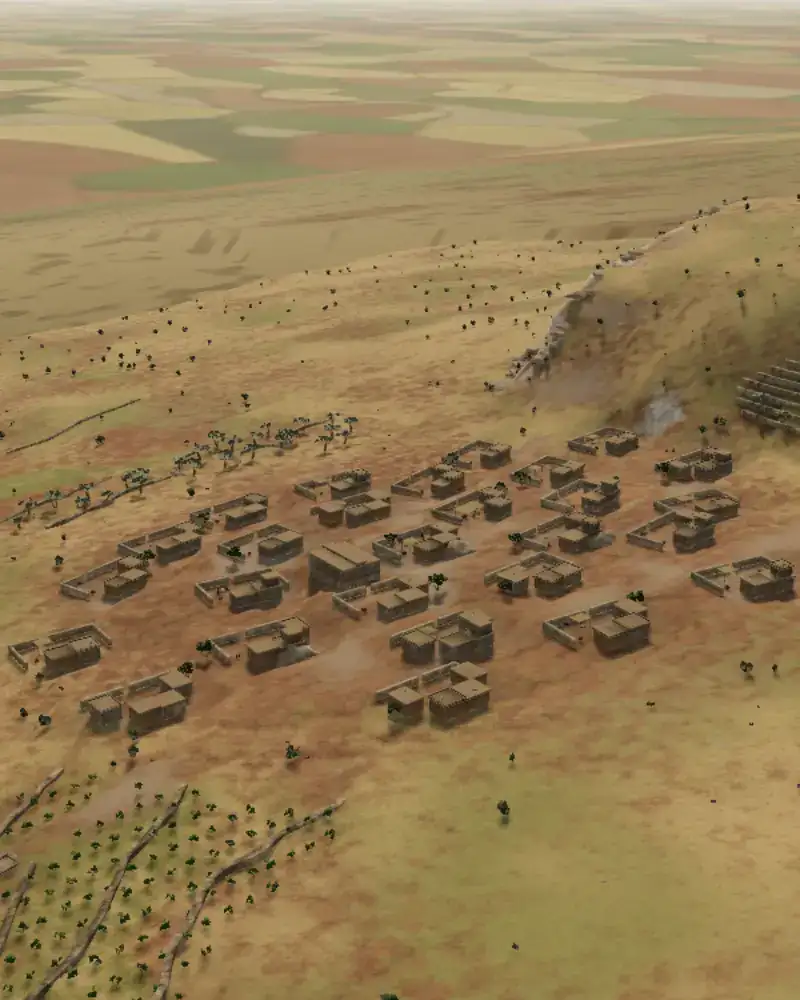
A real-time render of the reconstructed village at sunset: vine terraces in the foreground, stone courtyard houses below a limestone hill, and the plain in haze.

Places of Jesus · First century

Nazareth in Jesus' Time

What was Nazareth like in Jesus' time? A hill village of a few hundred people in Lower Galilee, where he grew up and worked as a builder, rebuilt in immersive 3D from the Gospels and the excavations.

  • about 200–400 people
  • about 350 m above sea level
  • 6 km from Sepphoris

Frame from the real-time 3D scene below, at sunset. A reconstruction, not a photograph or a painting of the ancient village.

The reconstructed village of Nazareth: stone courtyard houses on a limestone hill above terraces

Nazareth

Look over the hill village where Jesus grew up, or walk its lanes to the spring and the synagogue.

Walk in 3D · move with the on-screen stick

3D · about 2.6 MB

Loading Nazareth…

Stop 1 of 11 · Above the village · Overview

From the ridge you see all of Nazareth: a small village of stone houses above the plain. Tap Next to walk into its lanes.

This is a reconstruction. No first-century house in Nazareth survives standing, no first-century synagogue has been found there, and the Gospels do not say which house or which cliff. The layout, the number of houses and many details are informed guesses from excavations at Nazareth and at other Galilean villages. Each place and story shows its claims with an evidence level.

The landscape is compressed: in reality the village lay in a hollow and the view south over the Jezreel Valley to Mount Tabor opens from the ridge above it, about 2 km away. Distances to Tabor and the valley are close to real; the brow of the hill is placed next to the village for the story.

Modelled procedurally in Blender (reproducible scripts), lit with baked ambient occlusion and real-time sun, and rendered in your browser with three.js. Ground, stone, plaster, wood and earth textures are CC0 from Poly Haven; foliage and the valley fields are drawn procedurally. No AI-generated imagery is used.

Scripture quotations: King James Version (1769); the 1919 Chinese Union Version (官話和合譯本), public domain.

Sources

  • Yardenna Alexandre, “Nazareth,” Hadashot Arkheologiyot 124 (2012): report on the 2009 excavation near the Basilica of the Annunciation.
  • Bellarmino Bagatti, Excavations in Nazareth, vol. 1 (Jerusalem: Franciscan Printing Press, 1969).
  • Ken Dark, Roman-Period and Byzantine Nazareth and Its Hinterland (Routledge, 2020).
  • Jonathan L. Reed, Archaeology and the Galilean Jesus (Trinity Press International, 2000).
  • S. Pfann, R. Voss and Y. Rapuano, “Surveys and Excavations at the Nazareth Village Farm (1997–2002): Final Report,” BAIAS 25 (2007).
  • M. Avi-Yonah, “A List of Priestly Courses from Caesarea,” Israel Exploration Journal 12 (1962).
  • Excavated first-century synagogues at Gamla and Magdala (benches along the walls, central floor, columns).
  • Justin Martyr, Dialogue with Trypho 88 (2nd century).
  • Protevangelium of James 11 (2nd century).

What was Nazareth like in Jesus' time?

Nazareth was a small farming village in the hills of Lower Galilee, about 350 m above sea level, in a hollow above the Jezreel Valley. Perhaps 200 to 400 people lived there. The Old Testament never mentions it, and neither does Josephus. Families lived in one-storey rooms of fieldstone set around courtyards, and used the caves, cisterns and storage pits cut into the soft limestone. Around the village were terraces, vineyards, winepresses and a spring. Sepphoris, the regional capital that Herod Antipas was rebuilding while Jesus was young, was about an hour's walk away.

This scene rebuilds the village and walks it through the Gospel stories: the annunciation, the family's return from Egypt, the builder's yard, the synagogue on the Sabbath and the crowd at the brow of the hill. No first-century house in Nazareth can be tied to Jesus' family, and no synagogue of the period has been found, so the scene shows typical forms and says so at every stop.

Nazareth at a glance

Nazareth at a glance
WhereLower Galilee, in a hollow in the hills above the Jezreel Valley; about 350 m above sea level
PeopleAbout 200–400 (an estimate)
NeighboursSepphoris about 6 km north; the Sea of Galilee about 25 km east; Jerusalem about 105 km south in a straight line
HousesOne-storey fieldstone rooms around courtyards, with caves, cisterns and silos cut into the limestone
Jesus' tradeTekton (Mark 6:3): a builder or craftsman, mostly in wood but also in stone
What is unknownWhich house was the family's, where the synagogue stood, and which cliff Luke means

Key verses 6

26And in the sixth month the angel Gabriel was sent from God unto a city of Galilee, named Nazareth, 27To a virgin espoused to a man whose name was Joseph, of the house of David; and the virgin’s name was Mary.

Luke 1:26–27

39And when they had performed all things according to the law of the Lord, they returned into Galilee, to their own city Nazareth. 40And the child grew, and waxed strong in spirit, filled with wisdom: and the grace of God was upon him.

Luke 2:39–40

3Is not this the carpenter, the son of Mary, the brother of James, and Joses, and of Juda, and Simon? and are not his sisters here with us? And they were offended at him.

Mark 6:3

16And he came to Nazareth, where he had been brought up: and, as his custom was, he went into the synagogue on the sabbath day, and stood up for to read.

Luke 4:16

29And rose up, and thrust him out of the city, and led him unto the brow of the hill whereon their city was built, that they might cast him down headlong. 30But he passing through the midst of them went his way,

Luke 4:29–30

45Philip findeth Nathanael, and saith unto him, We have found him, of whom Moses in the law, and the prophets, did write, Jesus of Nazareth, the son of Joseph. 46And Nathanael said unto him, Can there any good thing come out of Nazareth? Philip saith unto him, Come and see.

John 1:45–46

Scripture quotations: King James Version (KJV).

What the Bible says, what our model adds to it, where good readers disagree, and where the old copies and the translations differ. We set the views side by side and do not pick a winner.

  • Textually stated5
  • Strongly supported3
  • Plausible1
  • Speculative6
  • Artistic2

A few of the model's choices

  • Strongly supported

    Early Roman houses in Galilean villages were one-storey rooms of local fieldstone, often plastered with mud, grouped around courtyards.

  • Strongly supported

    Nazareth's soft limestone was full of caves, silos, cisterns and pits used by households; many were found under the Church of the Annunciation.

  • Speculative

    Which house was Mary and Joseph's is unknown. This courtyard is a typical house, not a claim about a specific site.

Show all 18
What the text says5

Stated in Scripture. Quoted from the King James Version (KJV) and the 1919 Chinese Union Version (和合本).

  • The annunciation took place in Nazareth, to Mary, who was engaged to Joseph of the house of David.

    Textually stated

    26And in the sixth month the angel Gabriel was sent from God unto a city of Galilee, named Nazareth, 27To a virgin espoused to a man whose name was Joseph, of the house of David; and the virgin’s name was Mary.

    Luke 1:26–27 · KJV
  • Jesus grew up in Nazareth after the family returned from Egypt.

    Textually stated

    23And he came and dwelt in a city called Nazareth: that it might be fulfilled which was spoken by the prophets, He shall be called a Nazarene.

    Matthew 2:23 · KJV
  • Jesus is called “the carpenter” (Mark 6:3) and “the carpenter's son” (Matthew 13:55).

    Textually stated

    3Is not this the carpenter, the son of Mary, the brother of James, and Joses, and of Juda, and Simon? and are not his sisters here with us? And they were offended at him.

    Mark 6:3 · KJV
  • Nazareth had a synagogue, where Jesus stood up to read on the Sabbath “as his custom was.”

    Textually stated

    16And he came to Nazareth, where he had been brought up: and, as his custom was, he went into the synagogue on the sabbath day, and stood up for to read.

    Luke 4:16 · KJV
  • The town was built on a hill with a brow steep enough to throw a man down; Jesus passed through the crowd and went away.

    Textually stated

    29And rose up, and thrust him out of the city, and led him unto the brow of the hill whereon their city was built, that they might cast him down headlong. 30But he passing through the midst of them went his way,

    Luke 4:29–30 · KJV
What the model adds12

Choices the reconstruction has to make where the text is silent, each with its evidence level and the reason for it.

Strongly supported3
  • Early Roman houses in Galilean villages were one-storey rooms of local fieldstone, often plastered with mud, grouped around courtyards.

    Why: Excavated houses of the period in Galilean villages, including the house found near the Basilica of the Annunciation in 2009 (Reed; Alexandre).

  • Nazareth's soft limestone was full of caves, silos, cisterns and pits used by households; many were found under the Church of the Annunciation.

    Why: Bagatti's excavations under and around the Church of the Annunciation.

  • No first-century synagogue building has been excavated at Nazareth. In a small village the congregation may have met in a modest hall or even a large house.

    Why: Luke names a synagogue, but none of the 1st century has been found in Nazareth.

Plausible1
  • Ancient terraces, a rock-cut winepress, watchtowers and a quarry were surveyed on the Nazareth Village farm, west of the old town, with Roman-period pottery.

    Why: The Nazareth Village Farm survey (Pfann, Voss and Rapuano, 2007).

Speculative6
  • Which house was Mary and Joseph's is unknown. This courtyard is a typical house, not a claim about a specific site.

    Why: Nothing ties any excavated house to Mary and Joseph; the scene shows a typical one.

  • The form, stepped benches around a central floor with columns, is borrowed from synagogues at Gamla and Magdala.

    Why: Borrowed from the excavated 1st-century synagogues of Gamla and Magdala.

  • The place is unknown. Tradition points to Mount Precipice (Jebel el-Qafze) about 2.5 km south-east, or to cliffs within the town near the Maronite church.

    Why: Luke names no place; two traditions point to different cliffs.

  • Justin Martyr (2nd century) says Jesus made ploughs and yokes. It is an early tradition, not a Gospel statement.

    Why: Justin Martyr's Dialogue with Trypho 88, a 2nd-century tradition, not a Gospel statement.

  • Joseph and Jesus may have found work rebuilding Sepphoris, an hour's walk away; no text says so.

    Why: Sepphoris was being rebuilt by Herod Antipas in Jesus' youth, an hour's walk away; no text links Joseph or Jesus to it.

  • The number and arrangement of houses in the scene is a reconstruction.

    Why: Only parts of the village have been excavated, under the modern city.

Artistic2
  • Putting the scarp beside the houses is a choice made for the story, not a map.

    Why: The cliff is moved beside the houses so the story can be told in one scene.

  • Luke does not give the time of day; sunset is chosen for the scene.

    Why: A choice of light for the scene.

Competing views1

Where careful readers disagree. Each view with who holds it and the evidence for and against it. No verdict.

Where in Nazareth did the angel come to Mary?

Luke 1:26–28

In her home: the grotto under the Basilica of the Annunciation

Held by Catholic tradition, with churches on the site since the Byzantine period

For

  • Luke has the angel "come in" to her, which suggests a house; many Nazareth houses opened into caves like this one.
  • A Byzantine church stood here by about 570, and a Crusader church was built over it after 1102.

Against

  • No find ties the grotto to Mary; the tradition is centuries later than the event.

Sources: Wikipedia, "Basilica of the Annunciation"; Bellarmino Bagatti, Excavations in Nazareth, vol. 1 (Franciscan Printing Press, 1969)

At the spring, while she drew water

Held by Greek Orthodox tradition, at the Church of St Gabriel over the spring, following the Protevangelium of James

For

  • The spring was the village's water source, and the tradition is as old as the 2nd-century Protevangelium.

Against

  • The Protevangelium is not Scripture, and Luke names only the town.

Sources: Wikipedia, "Basilica of the Annunciation"; Protevangelium of James 11 (2nd century)

What the lab shows (a drawing choice, not a ruling): The scene sets the annunciation in a family courtyard by a house-cave, as a typical house, not a claim about the site.

Textual notes

Places where manuscripts, ancient versions or translations differ in numbers or wording. KJV and 和合本 are quoted as they stand.

No textual notes. We know of no difference between manuscripts or translations that changes what this scene draws. (Mark 6:3 calls Jesus "the carpenter", Matthew 13:55 "the carpenter's son": two Gospels, not two readings.)

Frequently asked questions

What was Nazareth like in Jesus' time?

A small farming village of a few hundred people. Houses were simple rooms of local stone around courtyards, many opening onto caves used for storage. People grew grapes, olives and grain on terraces around the village and drew water from one spring. Excavations have found no public buildings, paved streets or inscriptions from the period.

Was Jesus a carpenter?

Mark 6:3 calls him “the carpenter”, Greek tekton, and Matthew 13:55 “the carpenter's son”. A tekton was a builder or craftsman, above all in wood but also in stone. In a village that meant roof beams, doors, tools and furniture. Justin Martyr, in the 2nd century, says Jesus made ploughs and yokes; that is an early tradition, not a Gospel statement.

Why did Nathanael ask, “Can there any good thing come out of Nazareth?”

Because Nazareth was nobody's idea of an important place (John 1:46). It is not named in the Old Testament, Josephus or the Mishnah, and it was a village of a few hundred people a short walk from a bigger town. Nathanael came from Cana, only a few kilometres away (John 21:2), so he knew it well.

Where is the cliff where they tried to throw Jesus down?

Luke says the town was built on a hill and they led him to its brow (4:29), but he names no place. Tradition points to Mount Precipice, about 2.5 km south-east of the old town, or to cliffs within the town near the Maronite church. The scene puts a cliff beside the houses so the story can be told in one view, and marks that choice as artistic.

Where did the angel appear to Mary?

Luke names only the town (1:26). Catholic tradition places it in a cave-room under the Basilica of the Annunciation, where churches have stood since the Byzantine period. Greek Orthodox tradition, following the 2nd-century Protevangelium of James, places it at the spring, now under the Church of St Gabriel. Neither can be proven.

Has the house where Jesus grew up been found?

No house can be tied to his family. Two finds show what such a home was like: in 2009 the Israel Antiquities Authority excavated an Early Roman house next to the Basilica of the Annunciation, with a courtyard, a rock-cut cistern and chalk vessels used by Jewish families; and Ken Dark has studied a courtyard house cut partly into the rock below the Sisters of Nazareth convent, which Byzantine Christians honoured as the house where Jesus was brought up. That identification is a tradition, not proof.

Did Jesus work in Sepphoris?

Perhaps, but no text says so. Sepphoris, the regional capital, lay about 6 km north, an hour's walk, and Herod Antipas rebuilt it during Jesus' youth, so a builder from Nazareth may well have found work there. The Gospels never mention the city, and the finds at Nazareth, plain cooking pots and chalk vessels without the fine imported wares of Sepphoris, show a modest Jewish village. The lab marks the idea as speculative.

Sources & limits

Limits of this lab 4

  • First-century Nazareth lies under the modern city; only small areas have been excavated, mostly around the churches.
  • No house can be tied to Jesus' family, and no 1st-century synagogue has been found; the scene shows typical forms.
  • The brow of the hill is placed beside the houses for the story; its real place is unknown.
  • People, light and the number of houses are artistic.

Sources 19

  1. King James Version (KJV) (Public domain outside the United Kingdom)
  2. 官話和合譯本 (Chinese Union Version, 1919), zh.wikisource (Public domain)
  3. Pleiades: a gazetteer of past places (CC BY 3.0)
  4. Wikipedia, "Cana"
  5. Wikipedia, "Bethsaida"
  6. Wikipedia, "Transfiguration of Jesus"
  7. Commentaries on Luke 24:13 (Meyer, Cambridge Bible, Pulpit Commentary) (Public domain)
  8. Commentaries on John 1:28 (Bengel, Ellicott, Cambridge Bible, Meyer, Barnes) (Public domain)
  9. Wikipedia, "Capernaum" (citing Stanislao Loffreda, Recovering Capharnaum, 1984)
  10. Shelley Wachsmann, The Sea of Galilee Boat (1995)
  11. Mendel Nun, The Sea of Galilee and Its Fishermen in the New Testament (1989)
  12. Bellarmino Bagatti, Excavations in Nazareth, vol. 1 (Franciscan Printing Press, 1969)
  13. Ken Dark, Roman-Period and Byzantine Nazareth and Its Hinterland (Routledge, 2020)
  14. Jonathan L. Reed, Archaeology and the Galilean Jesus (Trinity Press International, 2000)
  15. Yardenna Alexandre, "Nazareth", Hadashot Arkheologiyot 124 (2012)
  16. Protevangelium of James 11 (2nd century)
  17. Wikipedia, "Basilica of the Annunciation"
  18. Commentaries on Mark 5:1 (Ellicott, Cambridge Bible, Pulpit Commentary) (Public domain)
  19. Wikipedia, "Exorcism of the Gerasene demoniac"

Scripture is quoted only from KJV and the 1919 和合本. Other works are cited for facts and arguments, not quoted at length.

How we build the Labs →Found a mistake? Report it →

What’s new · v1.7.1Version 1.7.1: English Scripture is now quoted from the King James Version (1769).