Skip to content
X-Dreamers

The Sea of Galilee in 3D

Where did Jesus walk on water, calm the storm and call his fishermen? An immersive 3D map of the harp-shaped lake 210 m below sea level, with its shore towns and each Gospel event placed on the water.

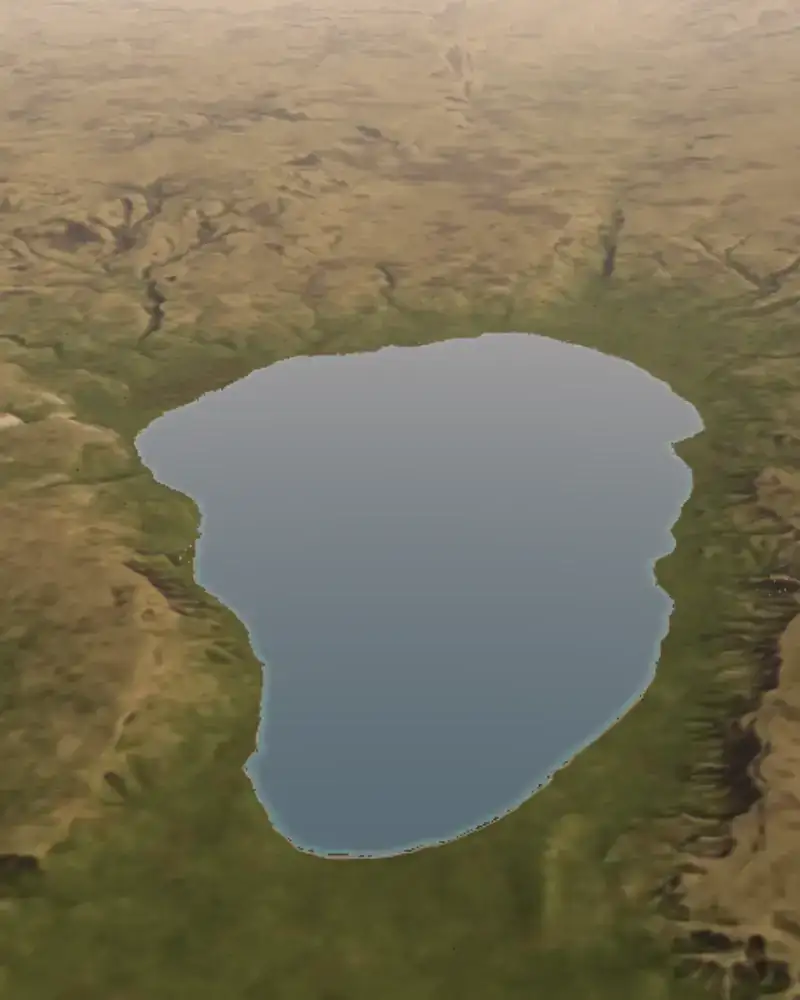
The Sea of Galilee at dawn, seen from high above the hills to the south

The Sea of Galilee

Fly over the lake, sit in a fishing boat, and watch the storm grow still.

Explore in 3D · drag to turn, pinch to zoom

3D · about 1.8 MB

Loading the Sea of Galilee…

Stop 1 of 11 · The lake · Aerial

This is the Sea of Galilee from above, about 21 by 13 kilometres, ringed by hills. Tap Next to go down to the shore where Jesus called the fishermen.

This is a reconstruction. Hills and shoreline come from satellite elevation data; towns, boats, people and weather are drawn from excavations, ancient descriptions and the Gospel texts. Each detail carries an evidence level, from what the text states to what is an artistic choice.

Terrain: Copernicus DEM GLO-30, © DLR e.V. 2010–2014 and © Airbus Defence and Space GmbH 2014–2018, provided under COPERNICUS by the European Union and ESA; all rights reserved. Heights are true scale (no exaggeration); the lake bed is approximated. Skies, water and textures are procedural. Scripture: King James Version (1769); 1919 Chinese Union Version, public domain.

Where did Jesus calm the storm and walk on water?

The Sea of Galilee is a freshwater lake about 21 km long and 13 km wide, lying about 210 m below sea level in the Jordan rift. Most of Jesus' ministry happened on or around it. Capernaum, Bethsaida, Magdala and Chorazin stood near its northern shore, and the Gospels cross it by boat again and again. Matthew, Mark and John call it a sea; Luke, more exactly, calls it the lake of Gennesaret.

This scene builds the lake and its shores from elevation data and walks round it in a guided tour: the calling of the fishermen, the storm stilled, the walking on the water, the feeding of the five thousand, the man among the tombs on the east shore, and the breakfast on the beach. The Gospels rarely name the exact spot, so each event shows what the text says and how sure we can be of the place drawn. The boats follow the Galilee Boat, a fishing boat from the 1st century BC or AD found in the mud of the shore in 1986.

The Sea of Galilee at a glance

The Sea of Galilee at a glance
SizeAbout 21 km north to south and 13 km east to west; about 166 km²
SurfaceAbout 210 m below sea level; it rises and falls a few metres with rain and drought
Deepest pointAbout 43 m
NamesSea of Galilee, lake of Gennesaret (Luke 5:1), Sea of Tiberias (John 6:1; 21:1), Chinnereth (Numbers 34:11)
The Galilee Boat8.27 × 2.30 m, 1.3 m deep as preserved; 1st century BC to 1st century AD

Key verses 5

1After these things Jesus went over the sea of Galilee, which is the sea of Tiberias.

John 6:1

1And it came to pass, that, as the people pressed upon him to hear the word of God, he stood by the lake of Gennesaret,

Luke 5:1

16Now as he walked by the sea of Galilee, he saw Simon and Andrew his brother casting a net into the sea: for they were fishers. 17And Jesus said unto them, Come ye after me, and I will make you to become fishers of men. 18And straightway they forsook their nets, and followed him.

Mark 1:16–18

35And the same day, when the even was come, he saith unto them, Let us pass over unto the other side. 36And when they had sent away the multitude, they took him even as he was in the ship. And there were also with him other little ships. 37And there arose a great storm of wind, and the waves beat into the ship, so that it was now full. 38And he was in the hinder part of the ship, asleep on a pillow: and they awake him, and say unto him, Master, carest thou not that we perish? 39And he arose, and rebuked the wind, and said unto the sea, Peace, be still. And the wind ceased, and there was a great calm. 40And he said unto them, Why are ye so fearful? how is it that ye have no faith? 41And they feared exceedingly, and said one to another, What manner of man is this, that even the wind and the sea obey him?

Mark 4:35–41

24But the ship was now in the midst of the sea, tossed with waves: for the wind was contrary. 25And in the fourth watch of the night Jesus went unto them, walking on the sea. 26And when the disciples saw him walking on the sea, they were troubled, saying, It is a spirit; and they cried out for fear. 27But straightway Jesus spake unto them, saying, Be of good cheer; it is I; be not afraid.

Matthew 14:24–27

Scripture quotations: King James Version (KJV).

What the Bible says, what our model adds to it, where good readers disagree, and where the old copies and the translations differ. We set the views side by side and do not pick a winner.

  • Textually stated6
  • Plausible7
  • Speculative4
  • Artistic3

A few of the model's choices

  • Speculative

    The exact spot was the springs of Tabgha.

  • Plausible

    The crossing drawn here runs from near Capernaum toward Kursi.

  • Artistic

    The storm is shown with dark slate water, whitecaps, rain and a low sky, the horizon kept a little lighter so the boat can be seen.

Show all 23
What the text says6

Stated in Scripture. Quoted from the King James Version (KJV) and the 1919 Chinese Union Version (和合本).

  • Simon and Andrew were casting a net; James and John were mending nets in a boat with hired servants.

    Textually stated

    16Now as he walked by the sea of Galilee, he saw Simon and Andrew his brother casting a net into the sea: for they were fishers. 17And Jesus said unto them, Come ye after me, and I will make you to become fishers of men.

    Mark 1:16–17 · KJV
  • Jesus was in the stern, asleep on the cushion; the waves were breaking into the boat.

    Textually stated

    37And there arose a great storm of wind, and the waves beat into the ship, so that it was now full. 38And he was in the hinder part of the ship, asleep on a pillow: and they awake him, and say unto him, Master, carest thou not that we perish?

    Mark 4:37–38 · KJV
  • It happened in the fourth watch, with the wind against them, far from land.

    Textually stated

    24But the ship was now in the midst of the sea, tossed with waves: for the wind was contrary. 25And in the fourth watch of the night Jesus went unto them, walking on the sea.

    Matthew 14:24–25 · KJV
  • The crowd sat in groups of hundreds and fifties on green grass.

    Textually stated

    39And he commanded them to make all sit down by companies upon the green grass. 40And they sat down in ranks, by hundreds, and by fifties.

    Mark 6:39–40 · KJV
  • It happened on the eastern shore, among tombs, with a steep bank down to the lake.

    Textually stated

    1And they came over unto the other side of the sea, into the country of the Gadarenes. 2And when he was come out of the ship, immediately there met him out of the tombs a man with an unclean spirit,

    Mark 5:1–2 · KJV
  • Seven disciples, a night of fishing, 153 large fish, a charcoal fire with fish and bread, about 200 cubits from shore.

    Textually stated

    9As soon then as they were come to land, they saw a fire of coals there, and fish laid thereon, and bread. 10Jesus saith unto them, Bring of the fish which ye have now caught. 11Simon Peter went up, and drew the net to land full of great fishes, an hundred and fifty and three: and for all there were so many, yet was not the net broken.

    John 21:9–11 · KJV
What the model adds14

Choices the reconstruction has to make where the text is silent, each with its evidence level and the reason for it.

Plausible7
  • The crossing drawn here runs from near Capernaum toward Kursi.

    Why: It fits 'the other side' and the next scene on the eastern shore; the text gives no route.

  • A bright moon lit the lake.

    Why: Passover was near (John 6:4) and Passover falls at full moon, but the text does not describe the light.

  • They were heading for Bethsaida or Capernaum across the northern part of the lake.

    Why: Mark 6:45 says Bethsaida, John 6:17 says Capernaum; both lie on the north shore, and harmonisations differ.

  • The feeding took place on slopes near Bethsaida on the north-east shore.

    Why: Luke 9:10 names Bethsaida; John 6:1 says it was across the lake. Mark 6:45 then sends the disciples 'to Bethsaida', which some read as a short hop along the shore.

  • The place was Kursi (Gergesa).

    Why: It fits the steep slope and the Byzantine memorial, but the Gospels' place names point in different directions.

  • Bethsaida lay just east of the Jordan inflow; the model places it on the mound of et-Tell.

    Why: et-Tell has an Iron Age gate and Roman-period remains, but lies about 2 km from today's shore. el-Araj, right by the old shoreline, has recently produced Roman-period remains and a Byzantine church and is a strong rival.

  • The town is drawn as basalt courtyard houses with a harbour quay.

    Why: Excavated insulae and the harbour installations along the shore; the number and arrangement of houses here is illustrative.

Speculative4
  • The exact spot was the springs of Tabgha.

    Why: A later tradition, made likely by Tabgha's good winter fishing but not stated in the text.

  • The meal took place at Tabgha.

    Why: Pilgrim tradition from the 4th century (Egeria). John says only 'the Sea of Tiberias'.

  • Its Aramaic name, Migdal Nunya, means 'tower of fish'; the tower drawn here is a nod to it.

    Why: The name is attested in rabbinic sources; no tower of this form has been excavated.

  • The sermon was given on a hillside near Capernaum; this particular slope is the traditional spot.

    Why: Matthew says only 'the mountain'. A Byzantine chapel stood lower on this slope; the modern church dates to 1938.

Artistic3
  • The storm is shown with dark slate water, whitecaps, rain and a low sky, the horizon kept a little lighter so the boat can be seen.

    Why: An impression of a sudden gale on the lake; the waves' height follows the 2–3 m recorded, the colours are chosen for the scene.

  • A soft extra light keeps the boat and its crew readable in the storm and on the night lake.

    Why: A teaching aid, not part of the reconstruction.

  • The seated crowd is drawn with a few hundred figures to stand for five thousand men besides women and children.

    Why: A representative crowd keeps the scene light enough to run on phones.

Competing views2

Where careful readers disagree. Each view with who holds it and the evidence for and against it. No verdict.

Where did the herd rush down into the lake?

Mark 5:1; Matthew 8:28; Luke 8:26

What the lab shows (a drawing choice, not a ruling): The scene places it at Kursi (Plausible) and says that the Gospels' place names point in different directions.

Where were the five thousand fed?

Luke 9:10; John 6:1; Mark 6:45

On slopes near Bethsaida, on the north-east shore

Held by Readers who follow Luke 9:10 and John 6:1

For

  • Luke names Bethsaida, and John says it was across the lake.

Against

  • Mark 6:45 sends the disciples "to Bethsaida" afterwards, which reads as if they were not already there.
At Tabgha, on the north-west shore

Held by Byzantine pilgrim tradition, kept at the Church of the Multiplication

For

  • A church has marked the miracle there since the Byzantine period.

Against

  • John says Jesus went "to the other side of the sea" (6:1), while Tabgha lies near Capernaum, his home base.

What the lab shows (a drawing choice, not a ruling): The scene sets the feeding on slopes near Bethsaida (Plausible) and names Tabgha as the other tradition.

Textual notes1

Places where manuscripts, ancient versions or translations differ in numbers or wording. KJV and 和合本 are quoted as they stand.

Gerasenes, Gadarenes or Gergesenes?

Manuscripts

1And they came over unto the other side of the sea, into the country of the Gadarenes.

Mark 5:1 · KJV

1他們來到海那邊、格拉森人的地方。

馬可福音 5:1 · 和合本 (CUV 1919)

28And when he was come to the other side into the country of the Gergesenes, there met him two possessed with devils, coming out of the tombs, exceeding fierce, so that no man might pass by that way.

Matthew 8:28 · KJV

28耶穌旣渡到那邊去、來到加大拉人的地方、就有兩個被鬼附的人、從墳塋裏出來迎着他、極其凶猛、甚至沒有人能從那條路上經過。

馬太福音 8:28 · 和合本 (CUV 1919)

26And they arrived at the country of the Gadarenes, which is over against Galilee.

Luke 8:26 · KJV

26他們到了格拉森人的地方、就是加利利的對面。

路加福音 8:26 · 和合本 (CUV 1919)
Other witnesses
The better manuscripts of Mark (Ellicott)Gerasenes
Other manuscripts of all three Gospels (Cambridge Bible)Gadarenes or Gergesenes

All three Gospels vary in their manuscripts between Gadarenes, Gergesenes and Gerasenes, and the two translations choose differently. KJV reads "Gadarenes" in Mark and Luke and "Gergesenes" in Matthew; the 和合本 reads 格拉森人 (Gerasenes) in Mark and Luke and 加大拉人 (Gadarenes) in Matthew. The names point to three different places: Gadara about 10 km from the lake, Gerasa more than twice as far, and Gergesa, which Origen placed on the shore.

Sources: Commentaries on Mark 5:1 (Ellicott, Cambridge Bible, Pulpit Commentary); Wikipedia, "Exorcism of the Gerasene demoniac"

Frequently asked questions

Where did Jesus calm the storm?

Somewhere out on the lake between Capernaum and the east shore. Mark says they set out in the evening to cross “to the other side” (4:35), and after the storm they landed in the country of the Gerasenes or Gadarenes on the east side (5:1). The scene draws the crossing from near Capernaum towards Kursi, a reasoned route, not a known one.

Why are there sudden storms on the Sea of Galilee?

The lake lies about 210 m below sea level in a basin ringed by hills and cut by steep valleys. Cooler air pours down those valleys onto the warm water, and a wind can rise and whip up waves within minutes. Fishermen on the lake still know these storms well.

Where did Jesus walk on water?

On the northern part of the lake, far from shore. After the feeding of the five thousand the disciples rowed toward Bethsaida (Mark 6:45) or Capernaum (John 6:17) against the wind. Matthew says the boat was “in the midst of the sea” (14:24), and John says they had rowed about 25 or 30 stadia, 5 to 6 km. Jesus came to them in the fourth watch, between about 3 and 6 a.m.

Is the Sea of Galilee a sea or a lake?

A freshwater lake. Matthew, Mark and John use the ordinary Greek word for sea, thalassa, as people around the lake did. Luke, writing for readers who knew the Mediterranean, calls it a lake, limnē. The same water is also called Gennesaret, Tiberias and, in the Old Testament, Chinnereth.

What kind of boat did the disciples use?

Very likely one like the Galilee Boat, found near Ginosar in 1986 when the lake was low. It is 8.27 m long and 2.30 m wide, built of cedar and oak with many repairs, and could carry about 15 people. It had oars and probably a mast with a square sail. Nothing connects this boat to Jesus; it shows the kind of boat the Gospels describe.

What towns were around the Sea of Galilee in Jesus' day?

On the north shore, Capernaum, Bethsaida near the Jordan inflow and Chorazin a little inland; on the west, Magdala, the plain of Gennesaret and Tiberias, which Herod Antipas founded about AD 20 (John 6:23); on the east, the country of the Gerasenes or Gadarenes, where tradition places the swine at Kursi. Josephus gathered 230 boats at Taricheae, usually identified with Magdala (War 2.635), a sign of how busy the lake was.

Where did Jesus feed the five thousand?

In a lonely place by the lake. Luke links it with Bethsaida (Luke 9:10), and John says it was across the sea and up on a hillside (John 6:1–3). Since at least the 4th century it has been remembered at Tabgha on the north-west shore, where the Church of the Multiplication keeps a famous mosaic of loaves and fish. The north-east shore near Bethsaida fits Luke better, so the site is debated.

Sources & limits

Limits of this lab 4

  • The far shores and hills are generated from elevation data and approximate town positions, not a survey; the lake's level and shoreline have changed since the 1st century.
  • Most Gospel scenes on the lake name no exact spot; the places shown for the calling, the feeding and the breakfast are traditions or reasoned guesses, each marked.
  • Boats follow the excavated Galilee Boat; crowds and herds are drawn smaller than the numbers in the text.
  • Weather, light and people are artistic.

Sources 19

  1. King James Version (KJV) (Public domain outside the United Kingdom)
  2. 官話和合譯本 (Chinese Union Version, 1919), zh.wikisource (Public domain)
  3. Pleiades: a gazetteer of past places (CC BY 3.0)
  4. Wikipedia, "Cana"
  5. Wikipedia, "Bethsaida"
  6. Wikipedia, "Transfiguration of Jesus"
  7. Commentaries on Luke 24:13 (Meyer, Cambridge Bible, Pulpit Commentary) (Public domain)
  8. Commentaries on John 1:28 (Bengel, Ellicott, Cambridge Bible, Meyer, Barnes) (Public domain)
  9. Wikipedia, "Capernaum" (citing Stanislao Loffreda, Recovering Capharnaum, 1984)
  10. Shelley Wachsmann, The Sea of Galilee Boat (1995)
  11. Mendel Nun, The Sea of Galilee and Its Fishermen in the New Testament (1989)
  12. Bellarmino Bagatti, Excavations in Nazareth, vol. 1 (Franciscan Printing Press, 1969)
  13. Ken Dark, Roman-Period and Byzantine Nazareth and Its Hinterland (Routledge, 2020)
  14. Jonathan L. Reed, Archaeology and the Galilean Jesus (Trinity Press International, 2000)
  15. Yardenna Alexandre, "Nazareth", Hadashot Arkheologiyot 124 (2012)
  16. Protevangelium of James 11 (2nd century)
  17. Wikipedia, "Basilica of the Annunciation"
  18. Commentaries on Mark 5:1 (Ellicott, Cambridge Bible, Pulpit Commentary) (Public domain)
  19. Wikipedia, "Exorcism of the Gerasene demoniac"

Scripture is quoted only from KJV and the 1919 和合本. Other works are cited for facts and arguments, not quoted at length.

How we build the Labs →Found a mistake? Report it →

What’s new · v1.5.1Version 1.5.1: English Scripture is now quoted from the King James Version (1769).