Skip to content
X-Dreamers

Places of Jesus · Galilee

Capernaum in Jesus' Time

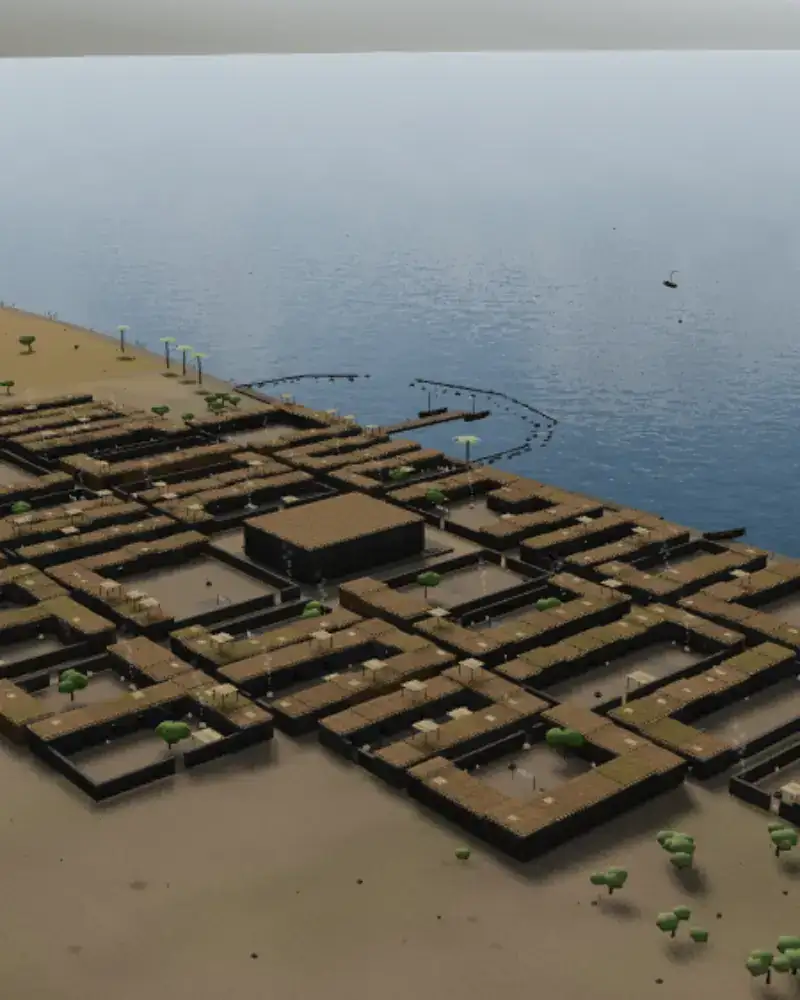
The lakeside town Jesus made his home, rebuilt in immersive 3D as it may have looked around AD 30: basalt houses round courtyards, the synagogue where he taught, the house remembered as Peter's, and boats on the shore.

Capernaum on the shore of the Sea of Galilee, seen from above the lake

Capernaum

Fly over the fishing town by the lake, or walk its streets to Peter's house.

Walk in 3D · move with the on-screen stick

3D · about 2.0 MB

Loading Capernaum…

Take the guided tour: 13 stops, one after another.

This is a reconstruction. Excavations give the plans of houses, the synagogue foundations and the building materials, but not the height of walls, the roofs or the full extent of the village. Every place and event carries an evidence level, from what the Gospels state outright to what is an artistic choice. Terrain and far hills are approximate.

Built with Blender (procedural model, baked ambient occlusion) and three.js. Textures and skies: Poly Haven (CC0). Scripture: King James Version (1769); 1919 Chinese Union Version, public domain.

Where was Capernaum, and what was it like?

Capernaum lay on the north-west shore of the Sea of Galilee, a few kilometres west of where the Jordan flows into the lake. Its ruins are at Tell Hum (Kfar Nahum). Matthew says Jesus left Nazareth and settled here (4:13) and calls it “his own city” (9:1). It was a village, not a city in our sense: perhaps 600 to 1,500 people, living in black basalt houses built around shared courtyards.

This scene rebuilds the town as it may have looked around AD 30 and walks it in 13 stops: the synagogue where Jesus taught, the house where he healed Simon's mother-in-law, the roof the friends broke open, the centurion who paid for the synagogue, and the harbour where Simon, Andrew, James and John worked. The Gospels give the events. The excavations give house plans, the synagogue foundations and the building materials. Wall heights, roofs and the street layout are our estimates, and each one is marked as such.

Capernaum at a glance

Capernaum at a glance
WhereNorth-west shore of the Sea of Galilee, at Tell Hum; about 15 km north of Tiberias and about 210 m below sea level
From NazarethAbout 35 km north-east in a straight line; a long day or two on foot
PeoplePerhaps 600 to 1,500 (an estimate from the excavated area)
HousesUnworked basalt fieldstones without mortar, rooms around courtyards, flat roofs of beams, reeds and packed earth
The white synagogueLate 4th to 5th century; the basalt walls under it may be the synagogue of Jesus' day
Peter's houseA 1st-century house about 30 m from the synagogue, built over by a 5th-century octagonal church

Key verses 5

13And leaving Nazareth, he came and dwelt in Capernaum, which is upon the sea coast, in the borders of Zabulon and Nephthalim: 14That it might be fulfilled which was spoken by Esaias the prophet, saying, 15The land of Zabulon, and the land of Nephthalim, by the way of the sea, beyond Jordan, Galilee of the Gentiles; 16The people which sat in darkness saw great light; and to them which sat in the region and shadow of death light is sprung up.

Matthew 4:13–16

29And forthwith, when they were come out of the synagogue, they entered into the house of Simon and Andrew, with James and John. 30But Simon’s wife’s mother lay sick of a fever, and anon they tell him of her. 31And he came and took her by the hand, and lifted her up; and immediately the fever left her, and she ministered unto them.

Mark 1:29–31

4And when they could not come nigh unto him for the press, they uncovered the roof where he was: and when they had broken it up, they let down the bed wherein the sick of the palsy lay.

Mark 2:4

5For he loveth our nation, and he hath built us a synagogue.

Luke 7:5

59These things said he in the synagogue, as he taught in Capernaum.

John 6:59

Scripture quotations: King James Version (KJV).

What the Bible says, what our model adds to it, where good readers disagree, and where the old copies and the translations differ. We set the views side by side and do not pick a winner.

  • Textually stated7
  • Strongly supported3
  • Plausible10
  • Speculative4
  • Artistic3

A few of the model's choices

  • Speculative

    The village had perhaps 600 to 1,500 people.

  • Plausible

    This was the house of Simon Peter.

  • Strongly supported

    The walls are basalt fieldstones laid in rough courses, with mud and small stones packed into the joints; the floor is basalt cobbles set in beaten earth.

Show all 29
What the text says7

Stated in Scripture. Quoted from the King James Version (KJV) and the 1919 Chinese Union Version (和合本).

  • Jesus left Nazareth and lived in Capernaum, by the sea.

    Textually stated

    13And leaving Nazareth, he came and dwelt in Capernaum, which is upon the sea coast, in the borders of Zabulon and Nephthalim:

    Matthew 4:13 · KJV
  • Jesus taught in the Capernaum synagogue on the Sabbath and drove out an unclean spirit there.

    Textually stated

    21And they went into Capernaum; and straightway on the sabbath day he entered into the synagogue, and taught.

    Mark 1:21 · KJV
  • Jesus healed Simon’s mother-in-law in the house of Simon and Andrew, and healed many at its door that evening.

    Textually stated

    29And forthwith, when they were come out of the synagogue, they entered into the house of Simon and Andrew, with James and John. 30But Simon’s wife’s mother lay sick of a fever, and anon they tell him of her. 31And he came and took her by the hand, and lifted her up; and immediately the fever left her, and she ministered unto them.

    Mark 1:29–31 · KJV
  • The friends removed the roof and broke through it to let the man down.

    Textually stated

    4And when they could not come nigh unto him for the press, they uncovered the roof where he was: and when they had broken it up, they let down the bed wherein the sick of the palsy lay.

    Mark 2:4 · KJV
  • A centurion had built (or paid for) the synagogue.

    Textually stated

    5For he loveth our nation, and he hath built us a synagogue.

    Luke 7:5 · KJV
  • Simon, Andrew, James and John were fishermen working from boats by the lake, and Zebedee employed hired men.

    Textually stated

    16Now as he walked by the sea of Galilee, he saw Simon and Andrew his brother casting a net into the sea: for they were fishers.

    Mark 1:16 · KJV
  • Jesus gave the bread-of-life teaching in the synagogue at Capernaum.

    Textually stated

    59These things said he in the synagogue, as he taught in Capernaum.

    John 6:59 · KJV
What the model adds20

Choices the reconstruction has to make where the text is silent, each with its evidence level and the reason for it.

Strongly supported3
  • The walls are basalt fieldstones laid in rough courses, with mud and small stones packed into the joints; the floor is basalt cobbles set in beaten earth.

    Why: V. Corbo (Cafarnao I, 1975) and S. Loffreda (Recovering Capharnaum, 1993) describe the insula’s walls as unworked or roughly shaped basalt fieldstones set in mud, without lime mortar, and its floors as basalt cobbles and beaten earth. Basalt is the local stone. The size and colour of each stone in the model are illustrative.

  • The standing white limestone synagogue dates to the late 4th–5th century, not to Jesus’ day.

    Why: Thousands of late Roman coins and pottery sealed under its floor (Corbo, Loffreda). Earlier scholars dated it to the 2nd–3rd century on stylistic grounds.

  • Capernaum roofs were beams covered with reeds or branches and packed earth, reached by outside stairs.

    Why: No roof tiles were found in the excavated houses, and their light fieldstone walls could not carry heavy stone roofs. This fits Mark’s description. Luke’s “through the tiling” (5:19) is usually read as Luke describing the scene for readers who knew tiled roofs.

Plausible10
  • This was the house of Simon Peter.

    Why: The tradition is attested by the 4th century and the site was venerated earlier still. Its location fits the Gospels, which put the house next to the synagogue. Nothing on the site names its first-century owner, and readings of the graffiti are disputed.

  • The roof is wooden beams across the room, a layer of branches and reeds, and packed mud on top, reached by an outside stone stair, with a low parapet.

    Why: No roof tiles or stone roof slabs were found, and the light fieldstone walls could not carry a heavy roof. Mark says the friends “uncovered the roof” and “had broken it up” to let the mat down (Mark 2:4), which fits branches and mud. The stair, the parapet (Deuteronomy 22:8) and the stone roller for re-packing the mud follow other Galilean houses and the Law; where they stand here is reconstruction.

  • Inside: oil lamps, storage jars and a cooking pot, a basalt hand mill, sleeping mats, and fishing gear: a net with floats and sinkers, and bronze hooks.

    Why: Wheel-made oil lamps, storage jars, Galilean cooking pots and basalt grinding stones are common finds at Capernaum, and the excavators report fishhooks from the floors of the insula sacra. The Gospels place fishermen in this household (Mark 1:16–20, 29). Which things stood where is reconstruction.

  • With the later layers on, room 1 is shown as it was venerated: plastered walls with a painted dado and scratched graffiti (late 1st–4th century), a plastered floor, and the arch set across the room in the 4th century.

    Why: Corbo found the walls and floor of room 1 plastered several times over, and many graffiti scratched into the plaster, mostly in Greek with some in Syriac and Latin: crosses, a boat and invocations of the Lord Jesus Christ (published by E. Testa, 1972). When the house became a church in the 4th century an arch was built across the room to carry a higher roof. The dating of the earliest plaster is debated; the colours and the individual marks drawn here are illustrative.

  • Basalt walls and a cobbled floor beneath it belong to a first-century synagogue.

    Why: The walls roughly follow the later plan, and first-century pottery was found beneath the floor. Some scholars question whether the walls are a separate earlier building or just the later foundations.

  • The later white synagogue is drawn in translucent dressed limestone: its raised platform, its hall with columns on three sides, and three doors in the south facade, facing Jerusalem.

    Why: After the standing remains excavated by Kohl and Watzinger and by Corbo and Loffreda; its heights and roof are reconstruction.

  • Capernaum had stone harbour works: a quay along the shore, piers and breakwaters.

    Why: Mendel Nun recorded a long promenade and piers along the shore. Their date (Roman to Byzantine) is uncertain, and the first-century harbour may have been smaller. The model’s layout is illustrative.

  • A single mast with a square sail, oars and a steering oar.

    Why: The hull has a mast step. The rig follows the 1st-century Magdala mosaic of a boat and contemporary Mediterranean practice.

  • The hull is drawn plank by plank over oak frames, with small decks at bow and stern, four oars, a steering oar and pitch below the waterline.

    Why: The Galilee boat preserves its cedar planking, oak frames and mast step; the decks, pitch, oars and fittings follow it and Mediterranean boats of the time.

  • He served Herod Antipas rather than a Roman legion.

    Why: No Roman legions were stationed in Galilee in Jesus’ time. Antipas’s troops used Roman ranks, and many were non-Jews. A small Roman or auxiliary post is also possible.

Speculative4
  • The village had perhaps 600 to 1,500 people.

    Why: Estimates from the excavated extent and house density (e.g. J. L. Reed; Crossan and Reed). Earlier figures of 10,000 or more are no longer accepted.

  • A hall with stepped benches on three sides, two rows of columns and a flat earth roof.

    Why: Only the foundations survive. The form is modelled on first-century synagogues at Gamla and Magdala.

  • This happened in Peter’s house.

    Why: Mark says only that Jesus “was in the house” (Mark 2:1). Many readers link this with Simon’s house (Mark 1:29), but the text does not say so. The opened roof is placed in Peter’s insula for illustration.

  • Wall heights, doors and window openings in the model.

    Why: Walls survive only a metre or two high; the rest is estimated from their thickness and from other Galilean villages.

Artistic3
  • The arrangement of rooms, doors and stairs in the model.

    Why: Based loosely on the published plan; the heights, roofs and furnishings are reconstruction.

  • The street grid and the number and placement of houses.

    Why: The model follows the general pattern of the excavated quarters: blocks divided by a north–south street and cross streets. The rest of the village is extrapolated.

  • A soft extra light falls on the place each stop is about, so it reads on a phone or a projector.

    Why: A teaching aid, not part of the reconstruction.

Competing views2

Where careful readers disagree. Each view with who holds it and the evidence for and against it. No verdict.

Was the house under the octagonal church Simon Peter's?

Mark 1:29

Yes: the room venerated from the 1st century was Peter's house

Held by The excavators, Virgilio Corbo and Stanislao Loffreda, and Christian tradition since the 4th century

For

  • One room of a 1st-century house was plastered and set apart for gatherings, then built over by a house-church and an octagonal church.
  • It lies about 30 m from the synagogue, and Mark has Jesus go "immediately" from the synagogue to the house.

Against

  • No inscription names Peter; the graffiti the excavators read as his name others find barely legible.

Sources: Wikipedia, "Capernaum" (citing Stanislao Loffreda, Recovering Capharnaum, 1984)

Unproven: an early Christian meeting place, not shown to be Peter's

Held by Scholars who question the excavators' readings, after James F. Strange and Hershel Shanks ("Has the House Where Jesus Stayed in Capernaum Been Found?", 1982)

For

  • The paved floor, a large space without supports and a cooking place look more like another courtyard than a room.

Against

  • The long continuity of veneration on this one spot still needs an explanation.

Sources: Wikipedia, "Capernaum" (citing Stanislao Loffreda, Recovering Capharnaum, 1984)

What the lab shows (a drawing choice, not a ruling): The scene draws the house as the one venerated as Peter's and marks the identity Plausible; its rooms and stairs are Artistic.

Is there a 1st-century synagogue under the white synagogue?

Mark 1:21; Luke 7:5

What the lab shows (a drawing choice, not a ruling): The scene draws a 1st-century synagogue on the basalt foundations (Plausible), in a form borrowed from Gamla and Magdala (Speculative): stepped benches, columns and a reading table on a low platform. At the synagogue stops its roof is left off so the hall can be seen.

Textual notes

Places where manuscripts, ancient versions or translations differ in numbers or wording. KJV and 和合本 are quoted as they stand.

No textual notes. We know of no difference between manuscripts or translations that changes what this scene draws.

Frequently asked questions

What was Capernaum like in Jesus' time?

A lakeside village of perhaps 600 to 1,500 people (an estimate from the excavated area). Houses were rooms of unworked black basalt, laid without mortar around shared courtyards, under flat roofs of beams, reeds and packed earth. It lived from the lake: fishing crews and boats, and the tolls and trade of a border town on a road, which explains Levi's customs post (Mark 2:14) and a centurion stationed there (Luke 7:2–5).

Where was Capernaum?

On the north-west shore of the Sea of Galilee, at the site now called Tell Hum, about 15 km north of Tiberias. The town was abandoned in the Middle Ages and its ruins were identified in the 19th century. Today the site is split between a Franciscan property, with the synagogue and Peter's house, and a Greek Orthodox one.

Has Peter's house in Capernaum been found?

Possibly. Excavators found a 1st-century basalt house, one room of which was plastered and used for gatherings from the later 1st century. A 4th-century house-church and a 5th-century octagonal church were built over it. It lies about 30 m from the synagogue, which fits Mark 1:29. No inscription names Peter, so the identification is plausible, not proven.

Is the synagogue at Capernaum the one where Jesus taught?

Not the white limestone building you can visit, which dates to the late 4th or 5th century. Beneath it are basalt walls and a cobbled floor with 1st-century pottery, which many archaeologists take to be the earlier synagogue, the one Luke says a centurion built (7:5). Others think the paving may be an open square.

Why did Jesus live in Capernaum?

Matthew gives the reason he cares about: it fulfilled Isaiah's words about light dawning in Galilee of the nations (4:13–16). The Gospels give no other. On the ground, Capernaum was a lakeside town on a road near a border, with fishermen among his first followers and a customs post where Levi worked.

How did the friends open the roof in Mark 2?

Roofs here were wooden beams covered with reeds or branches and a thick layer of packed earth, reached by an outside stair. Mark says the friends “uncovered the roof” and “had broken it up” (2:4): they dug through the earth and pulled the reeds aside. Mark does not say whose house it was. Placing it in Peter's house is a guess.

What happened in Capernaum in the Gospels?

More than in any other town. Jesus taught in its synagogue and freed a man there (Mark 1:21–28), healed Simon's mother-in-law (Mark 1:29–31), forgave and healed the paralysed man let down through a roof (Mark 2:1–12), called Levi from the tax booth (Mark 2:14) and healed the centurion's servant (Luke 7:1–10). John sets the bread of life teaching in its synagogue (John 6:59), and Jesus later warned the town for not repenting (Matthew 11:23).

Sources & limits

Limits of this lab 4

  • Most of Capernaum is unexcavated or lies under church property; the street grid and the number of houses follow the excavated quarters only in general.
  • Walls survive only a metre or two high, so heights, roofs, doors and windows are estimates.
  • Which house was Peter's, and whether a 1st-century synagogue lies under the later one, are debated; the scene marks both.
  • People, colours, boats' rigging and the far shore are artistic.

Sources 19

  1. King James Version (KJV) (Public domain outside the United Kingdom)
  2. 官話和合譯本 (Chinese Union Version, 1919), zh.wikisource (Public domain)
  3. Pleiades: a gazetteer of past places (CC BY 3.0)
  4. Wikipedia, "Cana"
  5. Wikipedia, "Bethsaida"
  6. Wikipedia, "Transfiguration of Jesus"
  7. Commentaries on Luke 24:13 (Meyer, Cambridge Bible, Pulpit Commentary) (Public domain)
  8. Commentaries on John 1:28 (Bengel, Ellicott, Cambridge Bible, Meyer, Barnes) (Public domain)
  9. Wikipedia, "Capernaum" (citing Stanislao Loffreda, Recovering Capharnaum, 1984)
  10. Shelley Wachsmann, The Sea of Galilee Boat (1995)
  11. Mendel Nun, The Sea of Galilee and Its Fishermen in the New Testament (1989)
  12. Bellarmino Bagatti, Excavations in Nazareth, vol. 1 (Franciscan Printing Press, 1969)
  13. Ken Dark, Roman-Period and Byzantine Nazareth and Its Hinterland (Routledge, 2020)
  14. Jonathan L. Reed, Archaeology and the Galilean Jesus (Trinity Press International, 2000)
  15. Yardenna Alexandre, "Nazareth", Hadashot Arkheologiyot 124 (2012)
  16. Protevangelium of James 11 (2nd century)
  17. Wikipedia, "Basilica of the Annunciation"
  18. Commentaries on Mark 5:1 (Ellicott, Cambridge Bible, Pulpit Commentary) (Public domain)
  19. Wikipedia, "Exorcism of the Gerasene demoniac"

Scripture is quoted only from KJV and the 1919 和合本. Other works are cited for facts and arguments, not quoted at length.

How we build the Labs →Found a mistake? Report it →

What’s new · v1.7.1Version 1.7.1: English Scripture is now quoted from the King James Version (1769).