 X-Dreamers
What Did Jerusalem Look Like in Jesus’ Time? One Hill Across Three Thousand Years
Jerusalem in Jesus’ day: Herod’s Temple platform, the Antonia, the palace, the walls and Golgotha outside them, and the city from David’s town to today.
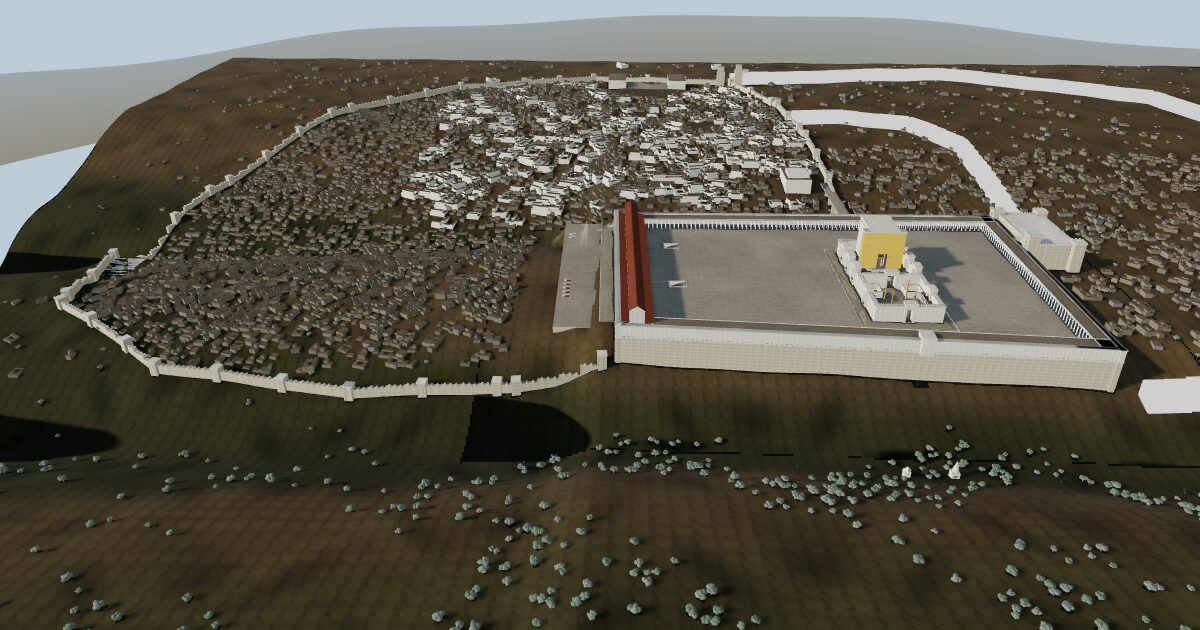
In Jesus’ day Jerusalem was a walled city on two hills, dominated by one building project. Herod the Great had turned the hilltop of the Temple into a walled platform of about 14 hectares, the largest sacred precinct in the Roman world, and on it stood his rebuilt Temple, faced with white stone and gold. At the platform’s north-west corner was the Antonia fortress, where a Roman cohort watched the courts at the feasts. Across the city, on the high Western Hill, stood Herod’s palace with its three towers. Two walls enclosed the city; a third, further north, was begun only about ten years after the crucifixion. Golgotha lay outside the Second Wall, near the city. South of the platform, on the narrow ridge where Jerusalem began a thousand years earlier, steps led down to the Pool of Siloam. Some of this still stands; the rest is reconstruction, and the lab says which is which.
See Jerusalem at Passover, AD 30 or 33 →
Jerusalem in Jesus’ day at a glance
| What the lab shows | How sure | |
|---|---|---|
| Temple platform | About 14 ha, walls of stones up to several hundred tonnes | Strongly supported |
| Herod’s Temple | About 100 cubits high, courts of the women, of Israel and of the priests | Plausible |
| Royal Stoa | A basilica on the south edge, four rows of columns | Plausible |
| Antonia fortress | North-west corner of the platform | Plausible |
| Herod’s palace | Western Hill, towers Hippicus, Phasael and Mariamne | Strongly supported |
| First Wall | Round the Upper City and the City of David | Strongly supported |
| Second Wall | Round the northern quarter; its line is a guess | Speculative |
| Third Wall | Begun AD 41–44, after Jesus’ day | Plausible |
| Pool of Siloam | Found in 2004 | Strongly supported |
The city Jesus walked into
The disciples noticed the stones first. “Teacher, see what kind of stones and what kind of buildings!” (Mark 13:1) They were looking at Herod’s platform, whose retaining walls still stand; the Western Wall is part of them. Herod had begun rebuilding about 20 BC, and the work was still going on: “It took forty-six years to build this temple!” (John 2:20)
The Temple itself follows Josephus and the Mishnah tractate Middot. Nothing of it has been dug, because no excavation has ever been made on the platform. That is why its exact spot is open. The lab sets out three positions side by side: on the site of the Dome of the Rock, which most archaeologists hold and the model follows; about 100 m to the north-west (Asher Kaufman); or to the south, near the al-Kas fountain (Tuvia Sagiv).
Along the south edge ran the Royal Stoa, 162 columns in four rows by Josephus’ count, the busiest part of the outer court and the likeliest place for the money-changers Jesus drove out (see the verse page on Mark 11:15). Pilgrims came up the southern steps to the Huldah gates, with ritual baths at the foot. Benjamin Mazar uncovered them in 1968–1978, and they can be visited today.
The Antonia is where soldiers carried Paul up the stairs “because of the violence of the crowd” (Acts 21:35). Its place is sure; its size is not. Louis-Hugues Vincent drew a great four-towered fortress of about 150 × 90 m, while Pierre Benoit and most archaeologists since see a smaller one on the rock scarp. The large paving under the Ecce Homo convent, long taken for its courtyard (the Lithostrotos), turned out to belong to Hadrian’s city of the 2nd century.
On the far hill stood Herod’s palace, where Roman governors stayed. The base of one of its towers survives in the Citadel by the Jaffa Gate. Most say it is Phasael, some Hippicus.
Golgotha and the walls
John says “the place where Jesus was crucified was near the city” (John 19:20), and Hebrews that he “suffered outside of the gate” (Hebrews 13:12). So the line of the Second Wall matters, and it is the least certain wall in the scene. Josephus gives only its two ends. Kathleen Kenyon found a deep quarry south of the Holy Sepulchre that was filled only in the 1st century AD, and Ute Lux found the same quarry, and no wall, under the Church of the Redeemer. Most archaeologists therefore draw a short line that leaves the Holy Sepulchre site outside. Some 19th- and 20th-century writers drew a wider line that would put it inside, often while arguing for another Golgotha such as the Garden Tomb. The model draws the first.
The Third Wall is why the lab has a separate Holy Week era. Agrippa I began it about AD 41–44, so it appears in Herod’s era and vanishes when you slide to Holy Week. Its own line is debated too: a wall found about 400 m north of the Old City, or the line under today’s Damascus Gate.
In the Holy Week view gold markers follow the last week, from Palm Sunday on the Mount of Olives to Golgotha. Each opens that stop in the Holy Week lab, for example Golgotha.
Before Herod: drag the slider back
The lab is one view from the Mount of Olives with a slider of seven eras.
David, about 1000 BC. “Nevertheless David took the stronghold of Zion. This is David’s city.” (2 Samuel 5:7) It was a walled town of four or five hectares on the ridge above the Gihon spring, with the hilltop above still a threshing floor. The Stepped Stone Structure still stands some 18 m high; whether it is Jebusite, 10th century or later is argued, and the lab gives all three dates with who holds them. The Large Stone Structure above it was proposed by Eilat Mazar as David’s palace, and is marked Speculative.
Solomon, about 950 BC. The Temple from the Solomon’s Temple lab stands on the summit at its real size, small against the hill.
Hezekiah, about 700 BC. The city has spread over the Western Hill. Isaiah’s line, “you broke down the houses to fortify the wall” (Isaiah 22:10), can be seen in the Broad Wall, seven metres thick, built over the stumps of demolished houses. Below runs the tunnel from the Gihon to Siloam (see 2 Kings 20:20 and the Hezekiah’s Tunnel lab).
Destruction and return, 586–445 BC. Babylon burned the city; the burnt rooms are still found. The returned exiles built a modest Second Temple, “as nothing” to those who remembered the first (Haggai 2:3), and Nehemiah’s wall “was finished in the twenty-fifth day of Elul, in fifty-two days” (Nehemiah 6:15). How much it enclosed is debated three ways.
Today. Suleiman’s walls of 1537–1541, the Dome of the Rock on Herod’s platform, and photographs of the real places, such as the steps of the Pool of Siloam.
What we know and what is reconstructed
The lab’s own note is plain: every ancient era is a reconstruction, legible blocks for walls, platforms and gates, not a picture.
| Detail | Evidence level |
|---|---|
| David bought the threshing floor; Nehemiah rebuilt the walls | Textually stated |
| Temple platform, Broad Wall, Hezekiah’s tunnel, Pool of Siloam, palace site, First Wall | Strongly supported |
| Herod’s Temple, the Antonia, the Royal Stoa, the Third Wall | Plausible |
| The Second Wall, Nehemiah’s line, Solomon’s palace, the Large Stone Structure | Speculative |
Where scholars disagree, the panel headed “Still debated” lists each position with who holds it, “shown side by side, without a verdict”.
Frequently asked questions
How big was Jerusalem in Jesus’ day? It filled both hills, from Herod’s palace on the west to the Temple platform on the east and south to Siloam. The platform alone was about 14 hectares; David’s town had been four or five.
Was Golgotha outside the city walls? Yes, the texts say so. Most archaeologists put the Holy Sepulchre site just outside the Second Wall, in an old quarry; the line of that wall is still a reasoned guess.
Can you still see Herod’s Jerusalem? In part: the platform’s walls, the southern steps, the Pool of Siloam and a tower base in the Citadel.
Drag three thousand years over Jerusalem →
Related
- Holy Week in Jerusalem, day by day, and Where Did Jesus Live and Teach?
- What Did Solomon’s Temple Look Like?, and the Temples side by side at one scale
- The Temple Mount in 3D, and John 2:19 on “this temple”
- Chapter guides: 2 Samuel 5, 2 Kings 20, Nehemiah 3, Mark 13, John 19
Found this helpful? Pass it on.