 X-Dreamers
Reading A
Two cleansings
PlausibleInterpretation
Jesus cleared the temple twice, early in his ministry and again in his last week.
Enter from a verse
He overthrew the tables of the money changers
15And they come to Jerusalem: and Jesus went into the temple, and began to cast out them that sold and bought in the temple, and overthrew the tables of the moneychangers, and the seats of them that sold doves;
Scripture: King James Version (1769).
The day after he rides into Jerusalem, Jesus walks into the busiest court of the temple and stops its trade. Four doors open the day, the place, the money and the readings.
In Mark, Jesus enters Jerusalem, looks around the temple and goes back to Bethany for the night. The next morning, after cursing a fig tree on the road, he comes to the temple and clears it.
11And Jesus entered into Jerusalem, and into the temple: and when he had looked round about upon all things, and now the eventide was come, he went out unto Bethany with the twelve. 12And on the morrow, when they were come from Bethany, he was hungry:
Which day, and how many times?: Mark says Jesus only looked around the temple on the evening of the entry and cleansed it the next day; Matthew and Luke tell the cleansing straight after the entry, without marking a new day. John tells a cleansing near the start of Jesus' ministry. Many readers see Matthew and Luke as shortening the sequence; for John, some see a second, earlier cleansing and others a story placed by theme.
The fig tree: Mark tells the fig tree in two parts around the cleansing, the cursing on Monday and the withered tree seen on Tuesday morning; Matthew tells it in one piece, with the tree withering at once. Mark's framing lets the barren tree comment on the temple.
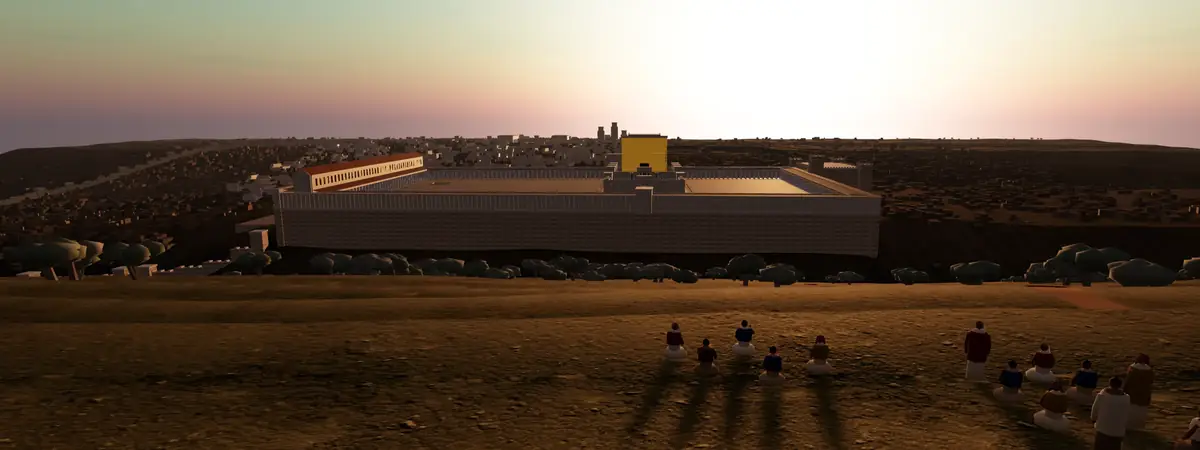
Selling animals for sacrifice and changing money went on in the outer court, most likely in or near the Royal Stoa, the great colonnaded hall along the temple's south side.
The money-changers and sellers worked in the Temple courts; the Royal Stoa is the likeliest place.
Josephus gives 162 columns in four rows (Antiquities 15.411–416). The Gospels place the money-changers in the Temple's outer court.
Pilgrims came with many currencies, but the temple tax was paid in particular silver coins, usually the shekels of Tyre, so changers set up tables in the courts. Jesus quotes Isaiah, 'a house of prayer for all the nations,' and Jeremiah's 'den of robbers.'
17And he taught, saying unto them, Is it not written, My house shall be called of all nations the house of prayer? but ye have made it a den of thieves.
7Even them will I bring to my holy mountain, and make them joyful in my house of prayer: their burnt offerings and their sacrifices shall be accepted upon mine altar; for mine house shall be called an house of prayer for all people.
11Is this house, which is called by my name, become a den of robbers in your eyes? Behold, even I have seen it, saith the LORD.
The money changers exchanged pilgrims' coins for those accepted for the temple tax, usually the silver shekels of Tyre.
The Mishnah says tables were set up in the temple before the tax was due; Tyrian shekels are common in finds of the period.
Jesus drove out the sellers and buyers, overturned the money changers' tables and the dove sellers' seats, and stopped people carrying goods through.
Mark, Matthew and Luke place the cleansing in Jesus' last week; John places a cleansing at the start of his ministry. Two ways of putting them together are shown; we do not choose.
Reading A
Jesus cleared the temple twice, early in his ministry and again in his last week.
Reading B
There was one cleansing, in the last week, which John places first for its meaning.
Doors into the verse
15And they come to Jerusalem: and Jesus went into the temple, and began to cast out them that sold and bought in the temple, and overthrew the tables of the moneychangers, and the seats of them that sold doves;
See this verse's connections in the Knowledge Graph
Every door is drawn from the Bible Labs knowledge graph: each claim keeps its evidence level, and readings that link one passage to another are marked as interpretation. King James Version (1769).