Skip to content
X-Dreamers

The Tabernacle in 3D

Step into an immersive 3D tabernacle, free in your browser: the tent of meeting Israel carried through the wilderness, rebuilt to scale from the cubit measurements of Exodus 25–40. Every object shows how sure we can be, from what the text states to what is an artistic choice.

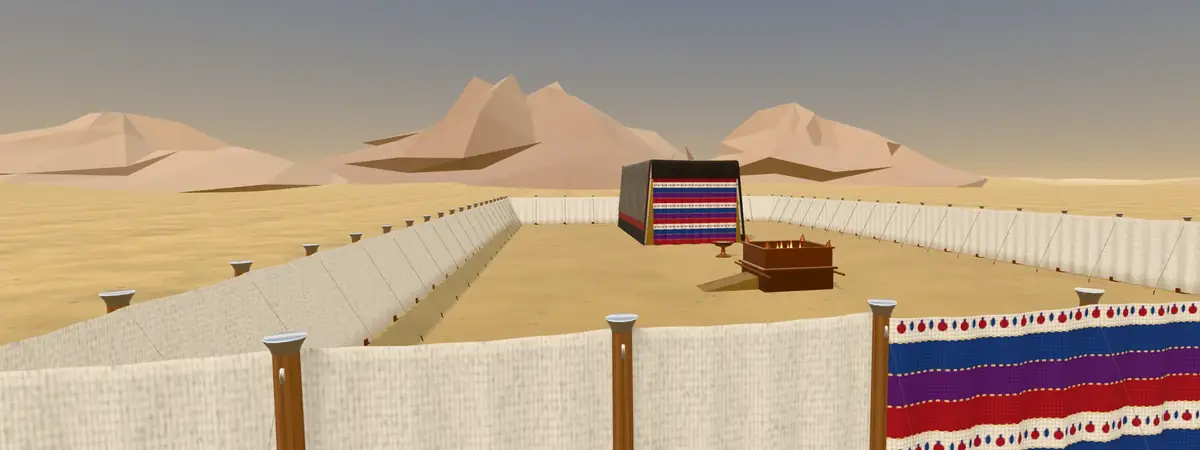
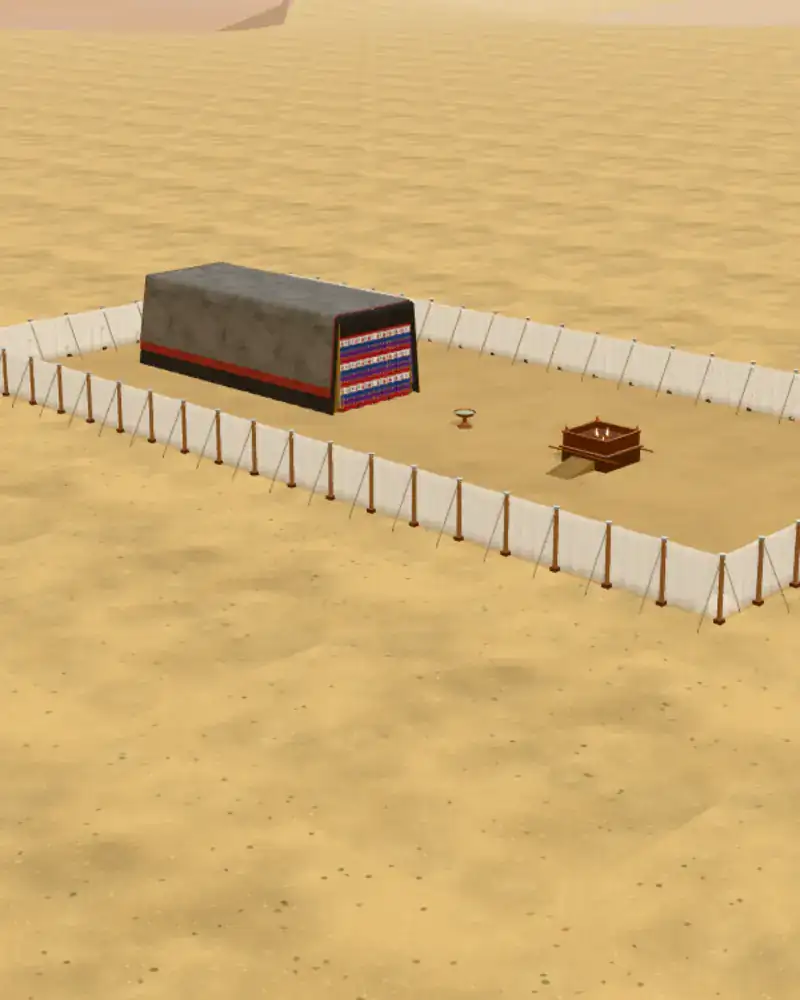
The Tabernacle in its courtyard, seen from above the east gate

The Tabernacle

Walk around the tent of meeting, or step into the Holy Place as a priest.

Walk in 3D · move with the on-screen stick

3D · about 310 KB

Loading the Tabernacle…

Wall and coverings cut away · by lamplight

Stop 20 of 25 · The Holy Place · Menorah (Lampstand)

Opposite the table, the golden lampstand lit the room. Next: the altar of incense before the veil.

Use this in class

25 stops · about 45 minutes

Teach mode puts large captions on the projector, follows a presentation clicker and keeps presenter notes on your own screen.

How to teach with the labs →

Watch a 40-second tour

A silent clip of the guided tour with its captions, made from this lab. Play it before class, or download it to show without a connection.

This is a reconstruction. Exodus gives many measurements and materials but leaves much unsaid: the length of a cubit, the shape of the cherubim, how the coverings lay. Each object shows its claims with an evidence level, from what the text states outright to what is an artistic choice.

Sizes are drawn to scale in cubits. Meters assume a cubit of about 0.45 m; switch to the royal cubit (about 0.52 m) to compare. Scripture quotations are from the King James Version (1769).

See the garments → The priests' garments, layer by layer, in their own lab

The tabernacle: layout, size and furniture

The tabernacle was the tent of meeting Israel carried through the wilderness, built to a pattern shown to Moses on the mountain (Exodus 25:8–9) and first raised in the second year after the Exodus. Exodus gives its measurements in cubits: a court of 100 × 50 cubits (about 45 × 22.5 m; Exodus 27:18) fenced with linen hangings 5 cubits high, a single gate on the east, and a framed tent of 48 gold-covered acacia boards, divided by the veil into the Holy Place and the Most Holy Place.

This lab rebuilds the tabernacle in 3D at scale. Walk from the gate past the bronze altar and the basin into the Holy Place with its lampstand, table and incense altar, then behind the veil to the ark of the covenant. Peel back the four coverings, switch between the common and royal cubit, and see where the tribes camped around it. Each object lists its claims with an evidence level, from what Exodus states outright to what is an artistic choice.

Five sanctuaries at one scaleSee it beside the other Temples →Set the Tabernacle beside Solomon's Temple, the Second Temple and Herod's at one scale, or stand in its holy place as each Temple rises round you.

The tabernacle in numbers

The tabernacle in numbers
Court100 × 50 cubits, hangings 5 cubits high (about 45 × 22.5 m)
Gate20 cubits wide, facing east
TentAbout 30 × 10 × 10 cubits (about 13.5 × 4.5 × 4.5 m)
Holy Place20 × 10 cubits: lampstand, table of showbread, altar of incense
Most Holy PlaceA 10-cubit cube (about 4.5 m): the ark of the covenant
Bronze altar5 × 5 cubits, 3 cubits high
Ark of the covenant2½ × 1½ × 1½ cubits, with the mercy seat and two cherubim
Table of showbread2 × 1 cubits, 1½ cubits high
Altar of incense1 × 1 cubit, 2 cubits high
Walls48 boards, each 10 × 1½ cubits, on 100 silver sockets
CoveringsLinen with cherubim, goats' hair, rams' skins dyed red, an outer hide
Court pillars60, in bronze sockets with silver hooks and bands

Key verses 4

8And let them make me a sanctuary; that I may dwell among them. 9According to all that I shew thee, after the pattern of the tabernacle, and the pattern of all the instruments thereof, even so shall ye make it.

Exodus 25:8–9

18The length of the court shall be an hundred cubits, and the breadth fifty every where, and the height five cubits of fine twined linen, and their sockets of brass.

Exodus 27:18

31And thou shalt make a vail of blue, and purple, and scarlet, and fine twined linen of cunning work: with cherubims shall it be made: 32And thou shalt hang it upon four pillars of shittim wood overlaid with gold: their hooks shall be of gold, upon the four sockets of silver. 33And thou shalt hang up the vail under the taches, that thou mayest bring in thither within the vail the ark of the testimony: and the vail shall divide unto you between the holy place and the most holy.

Exodus 26:31–33

34Then a cloud covered the tent of the congregation, and the glory of the LORD filled the tabernacle. 35And Moses was not able to enter into the tent of the congregation, because the cloud abode thereon, and the glory of the LORD filled the tabernacle. 36And when the cloud was taken up from over the tabernacle, the children of Israel went onward in all their journeys: 37But if the cloud were not taken up, then they journeyed not till the day that it was taken up. 38For the cloud of the LORD was upon the tabernacle by day, and fire was on it by night, in the sight of all the house of Israel, throughout all their journeys.

Exodus 40:34–38

Scripture quotations: King James Version (1769) (KJV).

What the Bible says, what our model adds to it, where good readers disagree, and where the old copies and the translations differ. We set the views side by side and do not pick a winner.

  • Textually stated12
  • Strongly supported3
  • Plausible7
  • Speculative5
  • Artistic6

A few of the model's choices

  • Strongly supported

    The tent's interior was 30 cubits long, 10 wide and 10 high.

  • Strongly supported

    The Holy Place was 20 × 10 cubits.

  • Strongly supported

    The Most Holy Place was a 10-cubit cube.

Show all 41
What the text says12

Stated in Scripture. Quoted from the King James Version (KJV) and the 1919 Chinese Union Version (和合本).

  • The court measured 100 × 50 cubits with hangings 5 cubits high.

    Textually stated

    18The length of the court shall be an hundred cubits, and the breadth fifty every where, and the height five cubits of fine twined linen, and their sockets of brass.

    Exodus 27:18 · KJV
  • Each board was 10 cubits tall and 1.5 cubits wide; 20 boards on each long side.

    Textually stated

    15And thou shalt make boards for the tabernacle of shittim wood standing up. 16Ten cubits shall be the length of a board, and a cubit and a half shall be the breadth of one board. 17Two tenons shall there be in one board, set in order one against another: thus shalt thou make for all the boards of the tabernacle.

    Exodus 26:15–18 · KJV
  • The entrance faced east and the Most Holy Place lay at the west end.

    Textually stated

    13And the breadth of the court on the east side eastward shall be fifty cubits.

    Exodus 27:13 · KJV
  • There were four layers: linen, goats' hair, red rams' skins and an outer hide covering.

    Textually stated

    1Moreover thou shalt make the tabernacle with ten curtains of fine twined linen, and blue, and purple, and scarlet: with cherubims of cunning work shalt thou make them.

    Exodus 26:1 · KJV
  • The ark was 2.5 × 1.5 × 1.5 cubits, of acacia overlaid with pure gold.

    Textually stated

    10And they shall make an ark of shittim wood: two cubits and a half shall be the length thereof, and a cubit and a half the breadth thereof, and a cubit and a half the height thereof. 11And thou shalt overlay it with pure gold, within and without shalt thou overlay it, and shalt make upon it a crown of gold round about.

    Exodus 25:10–11 · KJV
  • The lampstand had a central shaft, six branches and seven lamps; three almond cups on each branch and four on the shaft.

    Textually stated

    31And thou shalt make a candlestick of pure gold: of beaten work shall the candlestick be made: his shaft, and his branches, his bowls, his knops, and his flowers, shall be of the same. 32And six branches shall come out of the sides of it; three branches of the candlestick out of the one side, and three branches of the candlestick out of the other side: 33Three bowls made like unto almonds, with a knop and a flower in one branch; and three bowls made like almonds in the other branch, with a knop and a flower: so in the six branches that come out of the candlestick.

    Exodus 25:31–33 · KJV
  • The table was on the north side and the lampstand on the south side.

    Textually stated

    35And thou shalt set the table without the vail, and the candlestick over against the table on the side of the tabernacle toward the south: and thou shalt put the table on the north side.

    Exodus 26:35 · KJV
  • The altar was 5 × 5 cubits and 3 cubits high, with horns on its four corners.

    Textually stated

    1And thou shalt make an altar of shittim wood, five cubits long, and five cubits broad; the altar shall be foursquare: and the height thereof shall be three cubits. 2And thou shalt make the horns of it upon the four corners thereof: his horns shall be of the same: and thou shalt overlay it with brass.

    Exodus 27:1–2 · KJV
  • One hundred silver sockets were cast from 100 talents of silver, a talent for each.

    Textually stated

    27And of the hundred talents of silver were cast the sockets of the sanctuary, and the sockets of the vail; an hundred sockets of the hundred talents, a talent for a socket.

    Exodus 38:27 · KJV
  • A cloud covered the tent by day and fire was in it by night, in the sight of all Israel.

    Textually stated

    38For the cloud of the LORD was upon the tabernacle by day, and fire was on it by night, in the sight of all the house of Israel, throughout all their journeys.

    Exodus 40:38 · KJV
  • Judah camped on the east toward the sunrise, and Moses, Aaron and his sons camped before the Tent of Meeting on the east.

    Textually stated

    38But those that encamp before the tabernacle toward the east, even before the tabernacle of the congregation eastward, shall be Moses, and Aaron and his sons, keeping the charge of the sanctuary for the charge of the children of Israel; and the stranger that cometh nigh shall be put to death.

    Numbers 3:38 · KJV
  • People in the court: priests serve at the altar and wash at the basin, worshippers bring their offerings to the door of the tent of meeting, and Levites assist the priests.

    Textually stated

    3If his offering be a burnt sacrifice of the herd, let him offer a male without blemish: he shall offer it of his own voluntary will at the door of the tabernacle of the congregation before the LORD. 4And he shall put his hand upon the head of the burnt offering; and it shall be accepted for him to make atonement for him. 5And he shall kill the bullock before the LORD: and the priests, Aaron’s sons, shall bring the blood, and sprinkle the blood round about upon the altar that is by the door of the tabernacle of the congregation.

    Leviticus 1:3–5 · KJV
What the model adds21

Choices the reconstruction has to make where the text is silent, each with its evidence level and the reason for it.

Strongly supported3
  • The tent's interior was 30 cubits long, 10 wide and 10 high.

    Why: Derived from the board counts (20 × 1.5 = 30); the 10-cubit width depends on how the corner boards and board thickness are read.

  • The Holy Place was 20 × 10 cubits.

    Why: Inferred from the veil hanging 'under the clasps' 20 cubits from the entrance; the text does not state the room's size.

  • The Most Holy Place was a 10-cubit cube.

    Why: Inferred from the veil's position and the tent's 10-cubit width and height; compare the cubic inner sanctuary of 1 Kings 6:20.

Plausible7
  • The two corner boards were doubled, squared posts that closed the rear corners.

    Why: Exodus 26:24 says they were 'double beneath' and joined 'to the top… to one ring'; exactly how they were shaped is debated. Rashi describes a board covering the end of the side wall.

  • The middle bar ran through the thickness of the boards; the other four ran outside in rings, two above and two below.

    Why: 'In the midst of the boards' is read by many as through the boards; the half-length upper and lower bars are a common reconstruction, not stated.

  • The coverings lay flat over the frame and draped down the sides.

    Why: Most reconstructions use a flat roof; some (James Fergusson, 19th c.) propose a ridge pole with sloping sides, which would shed rain and stop the linen sagging. The text does not settle it.

  • The linen covered the roof and hung down the sides and back to about a cubit above the ground.

    Why: Follows the Talmud's arithmetic (Shabbat 98b): 28 cubits span 10 of roof and about 9 down each side; 40 cubits span 30 of roof and about 10 down the back. Others think the linen formed only the ceiling or hung inside the boards.

  • Looking inside, the lab shows the tent by night, lit only by the seven lamps of the lampstand.

    Why: Aaron was to keep the lamps burning from evening to morning (Exodus 27:20-21; 30:8), and the tent had no windows, so by night the lampstand was the only light in the Holy Place. By day some light would have come through the door screen; the lab does not show that.

  • One cubit is about 0.45 m (roughly 18 inches).

    Why: Consistent with ancient Near Eastern common cubits and with the Siloam tunnel inscription; the text itself does not give a conversion.

  • The priests are shown barefoot.

    Why: No verse says so. Exodus 28:39–43 lists the priests' linen garments and names no shoes; later Jewish tradition (for example the Talmud, Zevachim 24a) holds that nothing came between a priest's feet and the floor of the sanctuary. The lab follows that tradition.

Speculative5
  • Each board was a solid plank about one cubit thick at the foot, tapering towards the top.

    Why: The Bible gives no thickness. The Talmud (Shabbat 98b) records two views: one cubit throughout (R. Nehemiah) or one cubit at the base narrowing to a finger's breadth at the top (R. Judah). The tapered form is drawn here.

  • Tachash was the hide of a sea animal such as the dugong (sea cow).

    Why: A common modern view from an Arabic cognate and Red Sea fauna; others read a kind of fine or beaded leather, a colour term ('violet', LXX), dolphin or seal. 'Badger' (KJV) is now widely doubted.

  • The basin was about 2 cubits across on a 1.5-cubit stand.

    Why: The text gives no size or shape, only a basin (kiyyor) and its base (ken). These figures are chosen to be usable for washing hands and feet; the round bowl on a pedestal is an artistic convention.

  • The lampstand was about 3 cubits (18 handbreadths) tall.

    Why: Rabbinic tradition (Talmud, Menachot 28b); the biblical text gives no dimensions. It stands on three feet here, following the same tradition; the Arch of Titus shows a stepped base.

  • The ark stood in the centre of the Most Holy Place with its length and poles running east–west, towards the veil.

    Why: The text places the ark behind the veil but not its orientation. In Solomon's temple the pole ends could be seen from the holy place (1 Kings 8:8), which many read as poles pointing east towards the entrance; others turn the ark north–south.

Artistic6
  • The branches curved upward in semicircles to a common height.

    Why: Follows the Arch of Titus relief and later art. Some traditions (e.g. Maimonides' sketch) draw straight diagonal branches instead.

  • The cherubim knelt at the two ends, faces bowed toward the mercy seat, wings arching forward over it.

    Why: The text gives the wings, the facing and the downward gaze; the body, the posture and the height are not described. Solomon's later cherubim stood (1 Kings 6:23-27).

  • Behind the veil the room is almost dark, with a faint glow over the mercy seat so that the ark can be seen.

    Why: The text gives the Holy of Holies no lamp. The glow is the lab's device for seeing the ark; it is not a picture of God's presence, which the text speaks of as appearing in the cloud above the mercy seat (Leviticus 16:2).

  • The camp is drawn compressed, with the lead tribe of each side in the middle of its three.

    Why: Numbers gives sides and order but not distances or shapes; the text says only that they camped 'at a distance' around the tent. One tent stands for about 400 men, drawn as a low tent of dark goats' hair like those desert herders still pitch, doors turned toward the Tabernacle; the hills around are generic bare granite ranges, not a claim about where Sinai was.

  • Paths of trodden earth run between the rows of tents and toward the court gate.

    Why: The text describes no paths. A camp lived in for months would wear tracks between its tents and to the one gate; they are drawn as darker ground only, and their lines are ours.

  • People in the court: the seven figures, where they stand, their poses and the moment shown are a reconstruction, a typical moment for teaching, not a record of one day.

    Why: The text describes the service but never one scene of it. The number of people, their places and their timing are chosen so that each task can be seen; on a feast day many more people would have filled the court.

Competing views5

Where careful readers disagree. Each view with who holds it and the evidence for and against it. No verdict.

Solid boards or open frames?

Exodus 26:15–17

Solid planks, a cubit thick at the foot

Held by The Talmud (Shabbat 98b) and most traditional reconstructions; R. Nehemiah (a cubit throughout) and R. Judah (tapering to a finger's breadth) differ only on the thickness

For

  • Most translations render qeresh as "board" (KJV "boards", 和合本 "豎板"), and the rabbinic tradition describes solid planks.

Against

  • The Bible gives no thickness. Boards 10 × 1½ cubits and a cubit thick would be very heavy to carry on four wagons (Numbers 7:8).
  • Solid walls would hide the linen curtains with their cherubim, the finest work of the tent, from inside.

Sources: Babylonian Talmud, Shabbat 98b–99a (Sefaria); International Standard Bible Encyclopedia (1915), "Tabernacle, A"

What the lab shows (a drawing choice, not a ruling): The lab draws solid boards a cubit thick at the foot, tapering upward (Speculative).

How big was the tent?

Exodus 26:15–25

A smaller tent of about 20 × 6 cubits, with overlapping boards

Held by Richard Elliott Friedman; similar proposals by Yohanan Aharoni and Michael Hayutin

For

  • If each board overlaps its neighbour by a quarter cubit on each edge, the sides shrink by almost a third.

Against

  • The text says nothing of an overlap; the plain count of boards needs no extra assumption.

Sources: Amy Cooper Robertson, "Building the Tabernacle in Your Mind" (TheTorah.com)

What the lab shows (a drawing choice, not a ruling): The lab draws 30 × 10 × 10 cubits (Strongly supported).

A flat roof, or a ridged tent?

Exodus 26:7–13

Ridged: a tent with a ridge-pole and sloping roof over the frame

Held by James Fergusson (19th century) and those who follow him

For

  • It keeps the idea of a "tent" over the "tabernacle", sheds rain, stops the linen sagging, and uses the extra length of the curtains.

Against

  • No ridge-pole or supporting pillars are named, and how the extra curtain length was arranged stays unclear.

Sources: International Standard Bible Encyclopedia (1915), "Tabernacle, A"

What the lab shows (a drawing choice, not a ruling): The lab draws a flat roof with the coverings draped down the sides (Plausible).

What was the tachash covering?

Exodus 26:14

The hide of a sea animal: dugong, dolphin or porpoise

Held by Gesenius, Brown–Driver–Briggs and many modern translations (the 和合本 "海狗" among them)

For

  • Arabic tuḥash names a sea mammal (a porpoise), and such animals live in the Red Sea.

Against

  • It rests on one cognate word; nothing in the text says the skins came from the sea.

Sources: Norman Solomon, "What Was the Tachash Covering the Tabernacle?" (TheTorah.com)

A unique animal of that time, or a badger

Held by Rabbinic tradition and Rashi (a unique, many-coloured animal); Luther and the KJV (badger)

For

  • They take the word as a kind of animal, as the phrase suggests.

Against

  • There is no evidence outside tradition; the badger comes from a likeness to the German word Dachs.

Sources: Norman Solomon, "What Was the Tachash Covering the Tabernacle?" (TheTorah.com)

What the lab shows (a drawing choice, not a ruling): The lab draws a plain grey-brown hide, matching the dugong reading (Speculative; the colour is Artistic).

Curved branches or straight?

Exodus 25:31–36

Curved, rising in arcs to one height

Held by Philo, Josephus and most ancient Jewish sources

For

  • The ancient writers who describe it say the arms were round, and the best-known ancient picture, on the Arch of Titus, shows curved arms.

Against

  • These describe Herod's Temple lampstand, a thousand years after Moses; the Magdala stone, also of that age, shows angular arms.

Sources: Wikipedia, "Temple menorah"

Straight branches, set diagonally

Held by Maimonides, in his own sketch; Rashi, as some read him today

For

  • The text describes branches with cups, knobs and flowers, not curves.

Against

  • It is a medieval sketch, made long after any lampstand could be seen.

Sources: Wikipedia, "Temple menorah"

What the lab shows (a drawing choice, not a ruling): The lab draws curved branches (Artistic).

Textual notes3

Places where manuscripts, ancient versions or translations differ in numbers or wording. KJV and 和合本 are quoted as they stand.

"Badgers’ skins" / 「海狗皮」: one Hebrew word, many translations

Translations

14And thou shalt make a covering for the tent of rams’ skins dyed red, and a covering above of badgers’ skins.

Exodus 26:14 · KJV

14又要用染紅的公羊皮、作罩棚的蓋.再用海狗皮作一層罩棚上的頂蓋。

出埃及記 26:14 · 和合本 (CUV 1919)
Other witnesses
Greek Septuagint; Josephusskins dyed hyacinth (blue-violet)
Luther; King James Versionbadgers' skins

KJV reads "badgers’ skins", the badger reading; the 和合本 reads "海狗皮" (seal skins), the sea-animal reading of tachash. The Greek reads a colour. The word is uncertain: see "Competing views".

Sources: Norman Solomon, "What Was the Tachash Covering the Tabernacle?" (TheTorah.com)

Hebrews 9:4: "altar of incense" or "censer"?

Translations

4Which had the golden censer, and the ark of the covenant overlaid round about with gold, wherein was the golden pot that had manna, and Aaron’s rod that budded, and the tables of the covenant;

Hebrews 9:4 · KJV

4有金香爐、有包金的約櫃、櫃裏有盛嗎哪的金罐、和亞倫發過芽的杖、並兩塊約版.

希伯來書 9:4 · 和合本 (CUV 1919)

6And thou shalt put it before the vail that is by the ark of the testimony, before the mercy seat that is over the testimony, where I will meet with thee.

Exodus 30:6 · KJV

6要把壇放在法櫃前的幔子外、對着法櫃上的施恩座、就是我要與你相會的地方。

出埃及記 30:6 · 和合本 (CUV 1919)

The Greek thymiatērion can mean an altar of incense or a censer. KJV reads "the golden censer" and the 和合本 "金香爐" (a golden censer): both take the censer reading. Meyer argues for the altar, since a description of the tent would hardly leave it out; the Cambridge Bible notes that Philo and Josephus use the word for the altar. Exodus puts the altar before the veil; the Cambridge Bible reads Hebrews as saying the altar belonged to the most holy place in its service, while Ellicott and Meyer admit a difficulty.

Sources: Commentaries on Hebrews 9:4 (Meyer, Cambridge Bible, Ellicott)

How long is a cubit?

Units

10And they shall make an ark of shittim wood: two cubits and a half shall be the length thereof, and a cubit and a half the breadth thereof, and a cubit and a half the height thereof.

Exodus 25:10 · KJV

10要用皂莢木作一櫃、長二肘半、寬一肘半、高一肘半。

出埃及記 25:10 · 和合本 (CUV 1919)

Both translations keep the cubit (肘) without a conversion, and the text gives none. A common cubit is about 44–45 cm (six palms), a royal cubit about 52 cm (seven palms). The lab uses 0.45 m and lets you switch to 0.52 m; every size in metres changes by about 15%.

Sources: Wikipedia, "Cubit"

Frequently asked questions

What did the tabernacle look like?

From outside it was a white linen fence 100 × 50 cubits (about 45 × 22.5 m) and 5 cubits high, with one embroidered gate on the east. Inside the court stood the bronze altar and the basin, then a long tent of gold-covered boards under four coverings. The outer covering was hide, so from the court the tent looked plain and dark; only inside could the priests see the linen curtains woven with cherubim in blue, purple and scarlet. Exodus 25–27 and 36–38 give the measurements and materials; details such as the colour of the hides and the shape of the cherubim are uncertain.

Can I walk through the tabernacle in 3D?

Yes. This lab is a free, interactive 3D tabernacle that runs in the browser on a phone, tablet or computer, with nothing to install. Walk from the gate past the altar and the basin into the Holy Place and behind the veil, peel back the coverings, follow the 25-stop guided tour, or use teach mode on a projector. Each object lists what Exodus says about it and how sure the reconstruction is.

How big was the tabernacle?

Exodus 27:18 gives the court as 100 cubits long and 50 wide, with hangings 5 cubits high: about 45 × 22.5 m at a cubit of 0.45 m. The tent itself was about 30 cubits long, 10 wide and 10 high (about 13.5 × 4.5 × 4.5 m). The tent's size is a strong inference from its boards rather than a number the text states.

What was the layout of the tabernacle?

The only gate faced east. Inside it stood the bronze altar, then the bronze basin, then the tent. The tent's outer room, the Holy Place, held the table on the north side, the lampstand on the south and the incense altar before the veil. Behind the veil, at the west end, was the Most Holy Place with the ark of the covenant.

What is the difference between the Holy Place and the Holy of Holies?

The Holy Place was the outer room, about 20 × 10 cubits, where priests served every day, tending the lamps and burning incense. The Holy of Holies, a 10-cubit cube behind the veil, held only the ark; the high priest entered it once a year, on the Day of Atonement, and not without blood.

How big was the ark of the covenant?

Two and a half cubits long and a cubit and a half wide and high (Exodus 25:10), about 1.1 × 0.7 × 0.7 m: a chest of acacia wood overlaid with pure gold, covered by the mercy seat with two cherubim of hammered gold.

What were the tabernacle's coverings made of?

Four layers: embroidered linen curtains with cherubim, goats'-hair curtains, rams' skins dyed red, and an outer covering of tachash skins (Exodus 26). The layers are stated in the text; what a tachash was, perhaps a sea animal such as the dugong, is uncertain.

Sources & limits

Limits of this lab 5

  • Nothing of the Tabernacle survives. The model is built from Exodus 25–40, with rabbinic tradition and later reconstructions where the text is silent, each marked.
  • Thickness of the boards, the shape of the sockets, the roof and how the curtains hang are not given in the text.
  • Colours, the patterns of the curtains and the look of the cherubim are artistic. God is never depicted; the cloud and fire are drawn as light.
  • The camp of Israel is drawn compressed; Numbers gives the order of the tribes, not distances.
  • Sizes depend on the cubit: 0.45 m by default, 0.52 m as an option.

Sources 12

  1. King James Version (KJV) (Public domain outside the United Kingdom)
  2. 官話和合譯本 (Chinese Union Version, 1919), zh.wikisource (Public domain)
  3. Jewish Encyclopedia (1906), "Tabernacle" (Public domain)
  4. International Standard Bible Encyclopedia (1915), "Tabernacle, A" (Public domain)
  5. Wikipedia, "Tabernacle"
  6. Babylonian Talmud, Shabbat 98b–99a (Sefaria)
  7. Amy Cooper Robertson, "Building the Tabernacle in Your Mind" (TheTorah.com)
  8. Norman Solomon, "What Was the Tachash Covering the Tabernacle?" (TheTorah.com)
  9. Wikipedia, "Temple menorah"
  10. Wikipedia, "Showbread"
  11. Commentaries on Hebrews 9:4 (Meyer, Cambridge Bible, Ellicott) (Public domain)
  12. Wikipedia, "Cubit"

Scripture is quoted only from KJV and the 1919 和合本. Other works are cited for facts and arguments, not quoted at length.

How we build the Labs →Found a mistake? Report it →

What’s new · v2.6.1Version 2.6.1: English Scripture is now quoted from the King James Version (1769).