

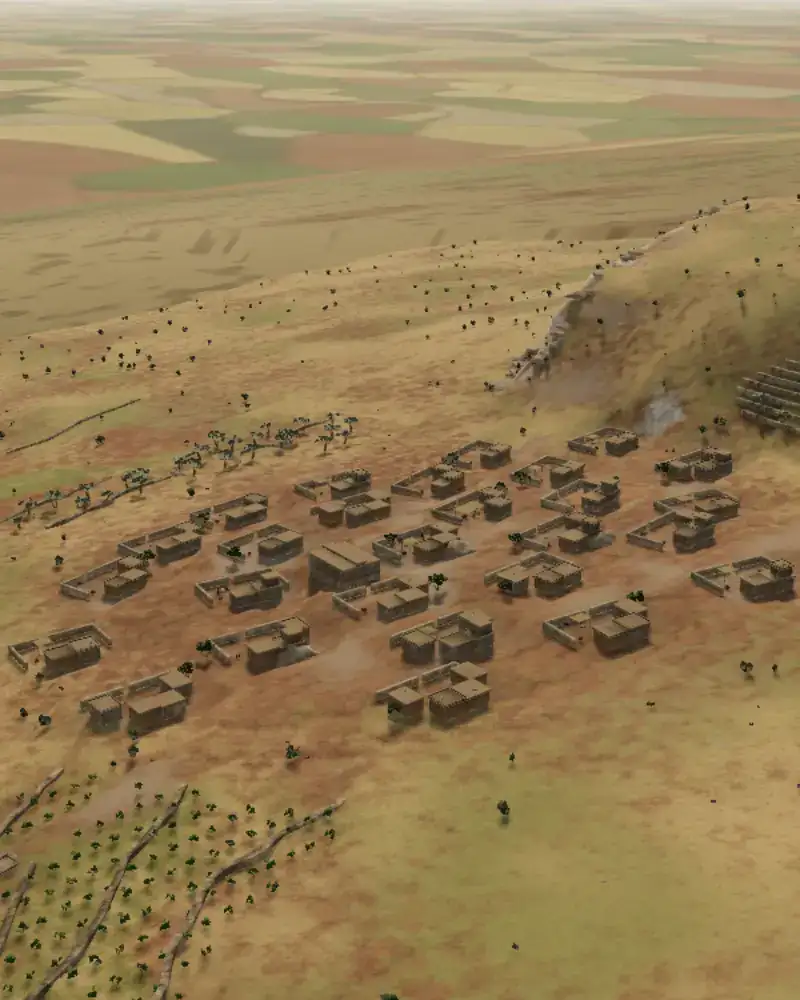
A family courtyard
Rooms of fieldstone and mud plaster around a yard shared by an extended family. Life happened outdoors: grinding grain, baking in the clay oven, weaving, storing oil and wine in jars. The back room opens into a cave in the hillside, as many Nazareth houses did.
How sure can we be?
- Strongly supported
Early Roman houses in Galilean villages were one-storey rooms of local fieldstone, often plastered with mud, grouped around courtyards.
- Jonathan L. Reed, Archaeology and the Galilean Jesus (Trinity Press International, 2000).
- Yardenna Alexandre, “Nazareth,” Hadashot Arkheologiyot 124 (2012): report on the 2009 excavation near the Basilica of the Annunciation.
- Strongly supported
Nazareth's soft limestone was full of caves, silos, cisterns and pits used by households; many were found under the Church of the Annunciation.
- Bellarmino Bagatti, Excavations in Nazareth, vol. 1 (Jerusalem: Franciscan Printing Press, 1969).
- Speculative
Which house was Mary and Joseph's is unknown. This courtyard is a typical house, not a claim about a specific site.