 X-Dreamers
Reading A
A guest room in a house
Plausible
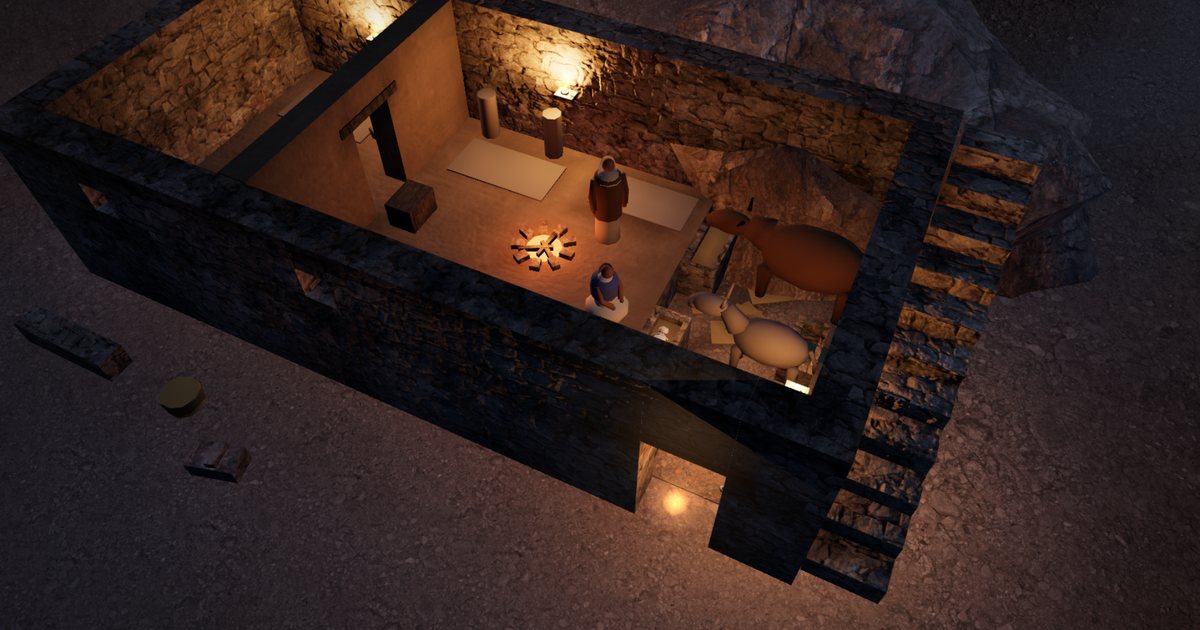
The guest room was full, so the baby was laid in a manger in the family's living space below. Luke uses kataluma for the upper room of the Last Supper (22:11).
Enter from a verse
No room in the inn
7And she brought forth her firstborn son, and wrapped him in swaddling clothes, and laid him in a manger; because there was no room for them in the inn.
Scripture: King James Version (1769).
One sentence carries the whole Christmas story: a firstborn son, swaddling clothes, a manger, and no room. Four doors show what the text says, what it does not say, and where you can see it.
Luke ties the birth to a decree of Caesar Augustus that the whole empire should be registered, the first while Quirinius was governing Syria. Everyone went to his own town, so Joseph went up from Nazareth with Mary. How this census fits with what we know of Quirinius is an old question.
1And it came to pass in those days, that there went out a decree from Cæsar Augustus, that all the world should be taxed. 2(And this taxing was first made when Cyrenius was governor of Syria.) 3And all went to be taxed, every one into his own city.
Josephus dates the census held when Quirinius governed Syria to AD 6, about ten years after the death of Herod the Great, yet Matthew and Luke both place the birth under Herod.
How Luke's census fits is debated. Proposals include reading 2:2 as a census “before” Quirinius governed, an earlier post held by Quirinius, or a registration begun years before it was completed. Each is possible; none is proven.
Joseph was of the house and family of David, so he went to Bethlehem, a small town in the hills about nine kilometres south of Jerusalem. Micah had named Bethlehem as the birthplace of a ruler for Israel.
4And Joseph also went up from Galilee, out of the city of Nazareth, into Judæa, unto the city of David, which is called Bethlehem; (because he was of the house and lineage of David:) 5To be taxed with Mary his espoused wife, being great with child.
2But thou, Beth-lehem Ephratah, though thou be little among the thousands of Judah, yet out of thee shall he come forth unto me that is to be ruler in Israel; whose goings forth have been from of old, from everlasting.
Where the Gospels' Bethlehem was: Bethlehem (Bayt Laḥm), West Bank.
Coordinates: Pleiades 687856 (Bethlehem).
Luke names only a manger, a feeding trough, and gives no innkeeper and no refusal. In village houses of the time the family often slept on a raised floor while the animals were kept at the lower end, with mangers between; the guest room was a separate room.
Luke has no innkeeper and no refusal. There was “no room in the kataluma”, a word Luke uses for a guest room (22:11), not for the inn of the Good Samaritan (10:34).
The common picture: Mary and Joseph were turned away by an innkeeper and sent out to a stable.
Mary wrapped the baby in swaddling clothes herself and laid him in a manger (a feeding trough) because there was no place for them in the kataluma.
No innkeeper appears in Luke's account, and no one turns the couple away.
The ox and the donkey of Christmas scenes come from Isaiah 1:3 read alongside the story (and the Gospel of Pseudo-Matthew, about the 7th century). Luke names no animals, though a manger implies they were near.
The Greek word is kataluma. Readers have pictured the place of the birth in more than one way, and the evidence supports more than one picture. Here they are side by side; we do not choose.
Reading A
The guest room was full, so the baby was laid in a manger in the family's living space below. Luke uses kataluma for the upper room of the Last Supper (22:11).
Reading B
A tradition known to Justin Martyr about AD 155 places the birth in a cave, now under the Church of the Nativity. A cave behind a house may have been part of the house.
The cave tradition is early. About AD 155 Justin Martyr says Joseph, having no lodging in the village, took shelter in a cave near it; about 248 Origen says the cave and its manger were shown at Bethlehem.
A cave behind a house was often part of the house and used for animals, so “the house” and “the cave” may describe one place.
Doors into the verse
7And she brought forth her firstborn son, and wrapped him in swaddling clothes, and laid him in a manger; because there was no room for them in the inn.
See this verse's connections in the Knowledge Graph
Every door is drawn from the Bible Labs knowledge graph: each claim keeps its evidence level, and readings that link one passage to another are marked as interpretation. King James Version (1769).