

The house venerated as Peter’s
Also: Insula sacra; Room 1
An ordinary basalt courtyard house whose main room was set apart and venerated from an early date, and later built over by a house-church and an octagonal church.
About
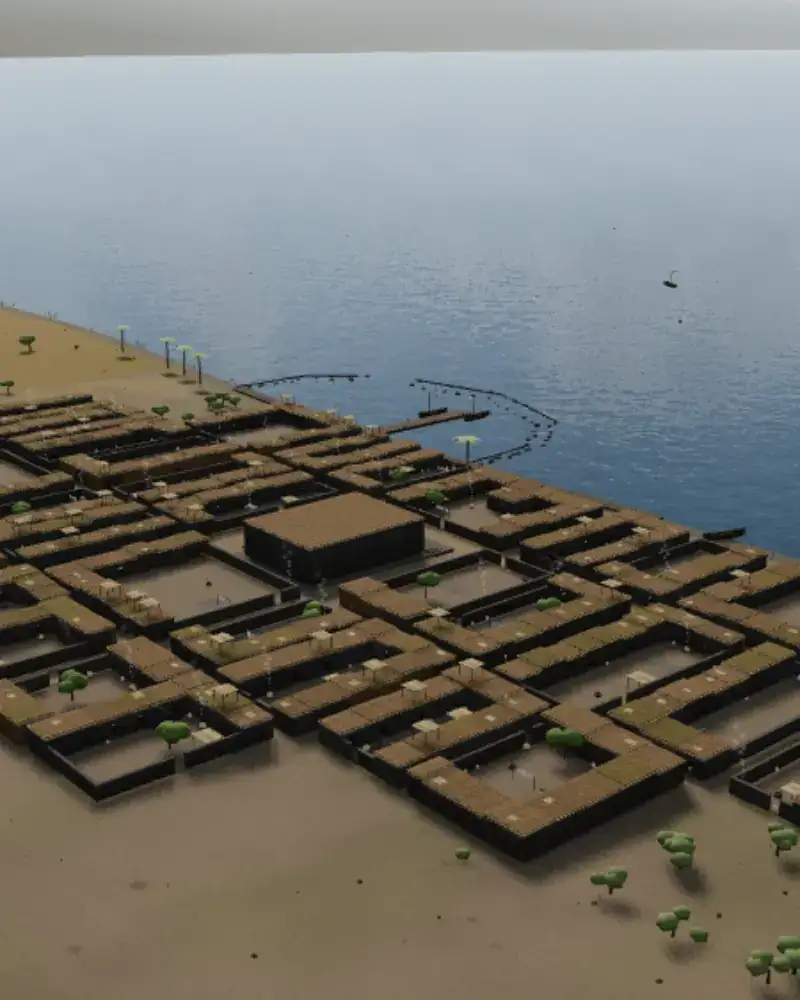
In the “sacred insula” south of the synagogue, excavators found a modest house built around courtyards like its neighbours. One room (room 1) was later treated differently: its floor was re-laid and its walls plastered, and Christian graffiti were scratched on them. In the 4th century the house became a church with its walls still standing, as the pilgrim Egeria reported, and in the 5th century an octagonal church was built directly over the room. The model shows the house as it may have looked in Jesus’ day, before any of this: a fisherman’s household of basalt and mud, under a roof of beams, branches and packed earth. Switch on the later layers to see the plastered room and the churches, each labelled with its date.
Materials
- basalt fieldstones
- beaten-earth and basalt-cobble floors
- wooden beams
- reeds
- packed earth
How sure are we?
- Strongly supported
A basalt courtyard house stood here in the first century, built like its neighbours.
Excavated by V. Corbo and S. Loffreda (from 1968): house walls, courtyards, ovens and pottery of the late Hellenistic and early Roman periods.
- Plausible
From the later first century one room was set apart for gatherings and veneration.
The room was repeatedly plastered, domestic pottery gave way to lamps and storage jars, and graffiti invoking Jesus were found. The excavators read this as early Christian use; how early it began is debated.
Alternatives: veneration began only in the 3rd–4th century
- Strongly supported
A 4th-century house-church and a 5th-century octagonal church were built over the room.
Excavated remains, and pilgrim reports: Egeria (c. 383, via Peter the Deacon) and the Piacenza Pilgrim (c. 570).
- Plausible
This was the house of Simon Peter.
The tradition is attested by the 4th century and the site was venerated earlier still. Its location fits the Gospels, which put the house next to the synagogue. Nothing on the site names its first-century owner, and readings of the graffiti are disputed.
Mark 1:29
- Strongly supported
The walls are basalt fieldstones laid in rough courses, with mud and small stones packed into the joints; the floor is basalt cobbles set in beaten earth.
V. Corbo (Cafarnao I, 1975) and S. Loffreda (Recovering Capharnaum, 1993) describe the insula’s walls as unworked or roughly shaped basalt fieldstones set in mud, without lime mortar, and its floors as basalt cobbles and beaten earth. Basalt is the local stone. The size and colour of each stone in the model are illustrative.
- Plausible
The roof is wooden beams across the room, a layer of branches and reeds, and packed mud on top, reached by an outside stone stair, with a low parapet.
No roof tiles or stone roof slabs were found, and the light fieldstone walls could not carry a heavy roof. Mark says the friends “uncovered the roof” and “had broken it up” to let the mat down (Mark 2:4), which fits branches and mud. The stair, the parapet (Deuteronomy 22:8) and the stone roller for re-packing the mud follow other Galilean houses and the Law; where they stand here is reconstruction.
Mark 2:4
- Plausible
Inside: oil lamps, storage jars and a cooking pot, a basalt hand mill, sleeping mats, and fishing gear: a net with floats and sinkers, and bronze hooks.
Wheel-made oil lamps, storage jars, Galilean cooking pots and basalt grinding stones are common finds at Capernaum, and the excavators report fishhooks from the floors of the insula sacra. The Gospels place fishermen in this household (Mark 1:16–20, 29). Which things stood where is reconstruction.
Mark 1:16–20 · Mark 1:29–34
- Plausible
With the later layers on, room 1 is shown as it was venerated: plastered walls with a painted dado and scratched graffiti (late 1st–4th century), a plastered floor, and the arch set across the room in the 4th century.
Corbo found the walls and floor of room 1 plastered several times over, and many graffiti scratched into the plaster, mostly in Greek with some in Syriac and Latin: crosses, a boat and invocations of the Lord Jesus Christ (published by E. Testa, 1972). When the house became a church in the 4th century an arch was built across the room to carry a higher roof. The dating of the earliest plaster is debated; the colours and the individual marks drawn here are illustrative.
Alternatives: the plastering and graffiti belong mostly to the 3rd–4th century
- Artistic
The arrangement of rooms, doors and stairs in the model.
Based loosely on the published plan; the heights, roofs and furnishings are reconstruction.
- Artistic
A soft extra light falls on the place each stop is about, so it reads on a phone or a projector.
A teaching aid, not part of the reconstruction.
Scripture
29And forthwith, when they were come out of the synagogue, they entered into the house of Simon and Andrew, with James and John. 30But Simon’s wife’s mother lay sick of a fever, and anon they tell him of her. 31And he came and took her by the hand, and lifted her up; and immediately the fever left her, and she ministered unto them.
See also: Matthew 8:14 · Mark 2:1
Scripture quotations are from the King James Version (1769).