Skip to content
X-Dreamers

Leviticus 23 · Numbers 29 · Nehemiah 8 · John 7

The Feast of Tabernacles in 3D

Sukkot · the feast of booths and ingathering

Sukkot, the Feast of Tabernacles: seven autumn days after the harvest when Israel lived in booths of branches and rejoiced before the LORD, remembering the road out of Egypt (Leviticus 23). Step into a booth in immersive 3D and count the offerings day by day.

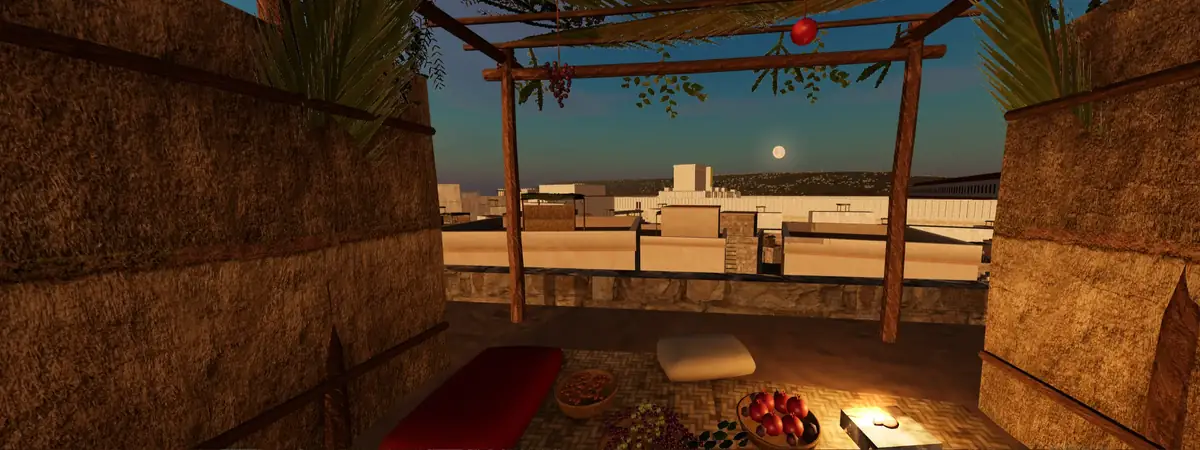
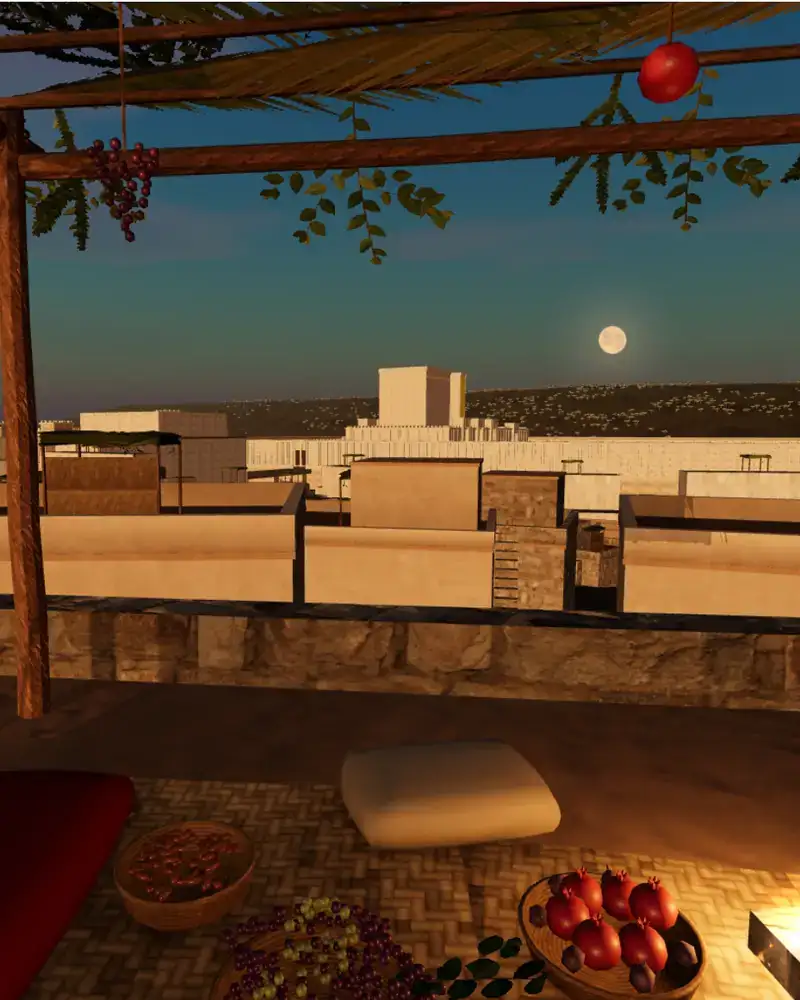
Inside a booth of palm fronds and leafy branches on a Jerusalem roof at sunset: mats, cushions, a lit oil lamp and baskets of fruit, the Temple and the rising full moon beyond

The Feast of Tabernacles

Sit in a booth on a Jerusalem roof as the full moon rises, turn the four species, count the offerings and follow the last great day at the Temple.

3D · about 950 KB

The camp keeps the feast

Israel's wilderness camp around the Tabernacle, with booths among the tents and the pillar of cloud by day and of fire by night: what Leviticus 23:43 asks every later generation to remember.

Loading the Feast of Tabernacles…

SpeculativeArtistic choice
Booths among the tents are an illustration: the text says Israel lived in booths but never describes them.

Stop 10 of 20 · The wilderness camp · Overview

The booths remember the wilderness. Here is Israel's camp.

This is Israel's camp in the wilderness: the tribes around the Tabernacle, under the pillar of cloud. Tap Next to walk among the tents.

  • Textually statedBiblical text

    The cloud over the Tabernacle by day, fire in it by night (Exodus 40:38). How it looked is not described.

  • SpeculativeArtistic choice

    Booths among the tents are an illustration: the text says Israel lived in booths but never describes them.

How sure are we?

Concept

Booths in the wilderness

Also: Tents or booths?

Leviticus says Israel lived in booths in the wilderness, while the narratives speak of tents.

The wilderness accounts usually describe Israel's dwellings as tents (Numbers 24:5), yet Leviticus 23:43 says God made Israel live in booths. The rabbis debated this: Rabbi Akiva said they were real booths; Rabbi Eliezer said they were the clouds of glory. Booths were also used at Succoth, Israel's first stop out of Egypt (Exodus 12:37; compare Genesis 33:17).

How sure are we?

  • Textually statedBiblical text

    Israel lived in tents in the wilderness camp.

    The narratives speak of tents (Numbers 24:5; Exodus 33:8).

    Numbers 24:5 · Exodus 33:8

  • SpeculativeArtistic choice

    In this view, some families live in branch booths among the tents.

    Leviticus 23:43 says Israel lived in booths, but nothing describes them. Whether booths stood beside tents, were the same as tents, or were (as Rabbi Eliezer held, Talmud Sukkah 11b) the clouds of glory is unknown. The booths shown are an illustration.

    Alternatives: 'Booths' is another word for the tents; The booths were the clouds of glory (Rabbi Eliezer)

    Leviticus 23:43

  • Textually statedBiblical text

    The cloud was over the Tabernacle by day and fire was in it by night, in the sight of all Israel; the tribes camped round the tent, each by its standard.

    Exodus 40:38; Numbers 9:15–16; Numbers 2:2. How the cloud and the fire looked is not described; the view shows them as a column over the tent.

    Exodus 40:38 · Numbers 9:15–16 · Numbers 2:2

CONCEPT:WILDERNESS_BOOTHS · Connected to: PLACE:CAMP_OF_ISRAEL, PERIOD:WILDERNESS, STRUCTURE:TABERNACLE

Scripture

43That your generations may know that I made the children of Israel to dwell in booths, when I brought them out of the land of Egypt: I am the LORD your God.

Leviticus 23:43 (KJV)

38For the cloud of the LORD was upon the tabernacle by day, and fire was on it by night, in the sight of all the house of Israel, throughout all their journeys.

Exodus 40:38 (KJV)

2Every man of the children of Israel shall pitch by his own standard, with the ensign of their father’s house: far off about the tabernacle of the congregation shall they pitch.

Numbers 2:2 (KJV)

5How goodly are thy tents, O Jacob, and thy tabernacles, O Israel!

Numbers 24:5 (KJV)

English quotations are from the King James Version (1769).

Concept

Booths in the wilderness

Also: Tents or booths?

Leviticus says Israel lived in booths in the wilderness, while the narratives speak of tents.

The wilderness accounts usually describe Israel's dwellings as tents (Numbers 24:5), yet Leviticus 23:43 says God made Israel live in booths. The rabbis debated this: Rabbi Akiva said they were real booths; Rabbi Eliezer said they were the clouds of glory. Booths were also used at Succoth, Israel's first stop out of Egypt (Exodus 12:37; compare Genesis 33:17).

How sure are we?

  • Textually statedBiblical text

    Israel lived in tents in the wilderness camp.

    The narratives speak of tents (Numbers 24:5; Exodus 33:8).

    Numbers 24:5 · Exodus 33:8

  • SpeculativeArtistic choice

    In this view, some families live in branch booths among the tents.

    Leviticus 23:43 says Israel lived in booths, but nothing describes them. Whether booths stood beside tents, were the same as tents, or were (as Rabbi Eliezer held, Talmud Sukkah 11b) the clouds of glory is unknown. The booths shown are an illustration.

    Alternatives: 'Booths' is another word for the tents; The booths were the clouds of glory (Rabbi Eliezer)

    Leviticus 23:43

  • Textually statedBiblical text

    The cloud was over the Tabernacle by day and fire was in it by night, in the sight of all Israel; the tribes camped round the tent, each by its standard.

    Exodus 40:38; Numbers 9:15–16; Numbers 2:2. How the cloud and the fire looked is not described; the view shows them as a column over the tent.

    Exodus 40:38 · Numbers 9:15–16 · Numbers 2:2

CONCEPT:WILDERNESS_BOOTHS · Connected to: PLACE:CAMP_OF_ISRAEL, PERIOD:WILDERNESS, STRUCTURE:TABERNACLE

Evidence levels

  • Textually stated

    Textually stated: Said directly in the biblical text.

  • Strongly supported

    Strongly supported: A close inference from the text or firm evidence.

  • Plausible

    Plausible: A reasonable reconstruction among live options.

  • Speculative

    Speculative: An informed guess; the text is silent.

  • Artistic

    Artistic: A stylistic choice made for the reconstruction.

Where each claim comes from

  • Biblical text
  • Later Jewish tradition
  • Artistic choice

Sources

Scripture is quoted verbatim. Jewish sources are cited where later tradition fills in what the Bible leaves unsaid; they are labelled as such.

  1. King James Version (KJV) · Public domain outside the United Kingdom
  2. 官話和合譯本 (Chinese Union Version, 1919), zh.wikisource · Public domain
  3. Mishnah, tractate Sukkah (c. 200 AD), chapters 1–5

    Rules for the booth (1:1), the four kinds (ch. 3), the willows and water libation (4:5, 4:9–10), the water-drawing celebration and lamps (5:1–4).

  4. Babylonian Talmud, Sukkah 11b

    Rabbi Eliezer (clouds of glory) and Rabbi Akiva (real booths) on Leviticus 23:43.

  5. Babylonian Talmud, Sukkah 22b

    A roof so dense that the stars cannot be seen through it is still valid.

  6. Babylonian Talmud, Sukkah 52b

    The height of the lampstands: fifty cubits.

  7. Babylonian Talmud, Sukkah 55b

    The seventy bulls correspond to the seventy nations.

  8. Josephus, Antiquities of the Jews 3.244–247 and 13.372

    Branches of myrtle, willow and palm with the fruit of the persea (citron); Alexander Jannaeus pelted with citrons at the altar.

  9. The Etrog: Celebrating Sukkot with a Persian Apple (TheTorah.com)

    When and how the citron came to be the 'fruit of goodly trees'.

  10. I. Finkelstein, 'Jerusalem in the Persian (and Early Hellenistic) Period and the Wall of Nehemiah', JSOT 32 (2008)

    A small Persian-period city on the eastern ridge; others argue for a larger circuit.

  11. Jewish Encyclopedia (1906), 'Tabernacles, Feast of' · Public domain
  12. Babylonian Talmud, Sukkah 37b

    The lulav is waved "to and fro … up and down"; the reasons given for the directions.

  13. Babylonian Talmud, Sukkah 32b

    The "thick-leaved tree" is the myrtle, whose leaves grow in threes from each node.

This is a reconstruction. The Bible commands the booths, the four kinds and the offerings, but says little about how they looked. Later Jewish sources (the Mishnah and Talmud, written after the Temple fell) describe customs such as the water-drawing and the great lamps; they are shown here as tradition, not as biblical text.

English quotations are from the King James Version (1769).

What is the Feast of Tabernacles (Sukkot)?

The Feast of Tabernacles, Sukkot in Hebrew, is the seven-day autumn feast that began on the fifteenth day of the seventh month, after the grain and the grapes were gathered in, followed by a solemn assembly on the eighth day (Leviticus 23:33–36). Israel lived in booths of branches for the seven days to remember that God made them live in booths when he brought them out of Egypt, and they rejoiced before the LORD with the fruit of goodly trees, palm branches, leafy boughs and willows of the brook.

This lab lets you sit inside a booth and look up through the branches, turn the four species in your hands, count the offerings of Numbers 29 day by day, see booths among the tents of the wilderness camp and watch Jerusalem keep the feast in Nehemiah 8. The Bible commands the booths, the four kinds and the offerings but says little about how they looked; later Jewish customs such as the water-drawing and the great lamps are shown as tradition, not as biblical text.

Enter from a verseStart from the verse: John 7:37 →“If any man thirst, let him come unto me, and drink.” Open five doors into the last great day: when, where, the temple courts, the water and the lamps, and how the words are read.

The Feast of Tabernacles at a glance

The Feast of Tabernacles at a glance
WhenFrom the 15th day of the 7th month, for seven days, near the full moon
Eighth dayA solemn assembly (Leviticus 23:36)
Other namesFeast of Booths; Feast of Ingathering (Exodus 23:16)
Booths built fromOlive, wild olive, myrtle, palm and thick-leaved branches (Nehemiah 8:15)
The four kindsFruit of goodly trees, palm branches, boughs of thick trees, willows of the brook
Bulls offered13 on the first day down to 7 on the seventh: 70, plus 1 on the eighth day
Each of the seven days2 rams, 14 lambs and 1 goat for a sin offering
Whole feast71 bulls, 15 rams, 105 lambs, 8 goats
Reading of the LawEvery seventh year at the feast (Deuteronomy 31:10–13)

Key verses 5

39Also in the fifteenth day of the seventh month, when ye have gathered in the fruit of the land, ye shall keep a feast unto the LORD seven days: on the first day shall be a sabbath, and on the eighth day shall be a sabbath.

Leviticus 23:39

40And ye shall take you on the first day the boughs of goodly trees, branches of palm trees, and the boughs of thick trees, and willows of the brook; and ye shall rejoice before the LORD your God seven days.

Leviticus 23:40

42Ye shall dwell in booths seven days; all that are Israelites born shall dwell in booths: 43That your generations may know that I made the children of Israel to dwell in booths, when I brought them out of the land of Egypt: I am the LORD your God.

Leviticus 23:42–43

16So the people went forth, and brought them, and made themselves booths, every one upon the roof of his house, and in their courts, and in the courts of the house of God, and in the street of the water gate, and in the street of the gate of Ephraim. 17And all the congregation of them that were come again out of the captivity made booths, and sat under the booths: for since the days of Jeshua the son of Nun unto that day had not the children of Israel done so. And there was very great gladness.

Nehemiah 8:16–17

37In the last day, that great day of the feast, Jesus stood and cried, saying, If any man thirst, let him come unto me, and drink. 38He that believeth on me, as the scripture hath said, out of his belly shall flow rivers of living water. 39(But this spake he of the Spirit, which they that believe on him should receive: for the Holy Ghost was not yet given; because that Jesus was not yet glorified.)

John 7:37–39

Scripture quotations: King James Version (1769) (KJV).

What the Bible says, what our model adds to it, where good readers disagree, and where the old copies and the translations differ. We set the views side by side and do not pick a winner.

  • Textually stated9
  • Plausible10
  • Speculative4
  • Artistic1

A few of the model's choices

  • Plausible

    The 'last, great day' is the seventh day of the feast.

  • Plausible

    “That great day of the feast” is the eighth day, the solemn assembly.

  • Plausible

    Jesus' words about living water, and soon after about the light of the world, echo the water-drawing and lamp-lighting of the feast.

Show all 28
What the text says9

Stated in Scripture. Quoted from the King James Version (KJV) and the 1919 Chinese Union Version (和合本).

  • The feast ran seven days from the fifteenth day of the seventh month, with a solemn assembly on the eighth day.

    Textually stated

    34Speak unto the children of Israel, saying, The fifteenth day of this seventh month shall be the feast of tabernacles for seven days unto the LORD. 35On the first day shall be an holy convocation: ye shall do no servile work therein. 36Seven days ye shall offer an offering made by fire unto the LORD: on the eighth day shall be an holy convocation unto you; and ye shall offer an offering made by fire unto the LORD: it is a solemn assembly; and ye shall do no servile work therein.

    Leviticus 23:34–36 · KJV
  • Israelites lived in booths for the seven days of the feast, to remember the Exodus.

    Textually stated

    42Ye shall dwell in booths seven days; all that are Israelites born shall dwell in booths: 43That your generations may know that I made the children of Israel to dwell in booths, when I brought them out of the land of Egypt: I am the LORD your God.

    Leviticus 23:42–43 · KJV
  • Israel was to take the fruit (peri) of 'goodly trees' on the first day of the feast.

    Textually stated

    40And ye shall take you on the first day the boughs of goodly trees, branches of palm trees, and the boughs of thick trees, and willows of the brook; and ye shall rejoice before the LORD your God seven days.

    Leviticus 23:40 · KJV
  • Bulls fall from 13 to 7 over seven days (70 in all), with 2 rams, 14 lambs and 1 goat each day; the eighth day has 1 bull, 1 ram, 7 lambs and 1 goat.

    Textually stated

    12And on the fifteenth day of the seventh month ye shall have an holy convocation; ye shall do no servile work, and ye shall keep a feast unto the LORD seven days: 13And ye shall offer a burnt offering, a sacrifice made by fire, of a sweet savour unto the LORD; thirteen young bullocks, two rams, and fourteen lambs of the first year; they shall be without blemish:

    Numbers 29:12–13 · KJV
  • Booths were built from olive, wild olive, myrtle, palm and thick-leaved branches.

    Textually stated

    15And that they should publish and proclaim in all their cities, and in Jerusalem, saying, Go forth unto the mount, and fetch olive branches, and pine branches, and myrtle branches, and palm branches, and branches of thick trees, to make booths, as it is written.

    Nehemiah 8:15 · KJV
  • Booths stood on roofs, in courtyards, in the courts of God's house and in the squares of the Water Gate and the Gate of Ephraim.

    Textually stated

    16So the people went forth, and brought them, and made themselves booths, every one upon the roof of his house, and in their courts, and in the courts of the house of God, and in the street of the water gate, and in the street of the gate of Ephraim.

    Nehemiah 8:16 · KJV
  • Ezra read the Law daily throughout the feast, and on the eighth day there was a solemn assembly.

    Textually stated

    18Also day by day, from the first day unto the last day, he read in the book of the law of God. And they kept the feast seven days; and on the eighth day was a solemn assembly, according unto the manner.

    Nehemiah 8:18 · KJV
  • On the last, great day of the feast Jesus invited the thirsty to come to him and drink.

    Textually stated

    37In the last day, that great day of the feast, Jesus stood and cried, saying, If any man thirst, let him come unto me, and drink. 38He that believeth on me, as the scripture hath said, out of his belly shall flow rivers of living water.

    John 7:37–38 · KJV
  • The nations will go up to Jerusalem to keep the Feast of Tabernacles.

    Textually stated

    16And it shall come to pass, that every one that is left of all the nations which came against Jerusalem shall even go up from year to year to worship the King, the LORD of hosts, and to keep the feast of tabernacles.

    Zechariah 14:16 · KJV
What the model adds15

Choices the reconstruction has to make where the text is silent, each with its evidence level and the reason for it.

Plausible10
  • The 'last, great day' is the seventh day of the feast.

    Why: The seventh day was the climax of the willow and water rites in later Jewish sources; others take it as the eighth day, the solemn assembly of Leviticus 23:36.

  • “That great day of the feast” is the eighth day, the solemn assembly.

    Why: Leviticus 23:36 and Numbers 29:35 make the eighth day a holy convocation that closes the feast. If this is the day, Jesus spoke after the water rites had ended: the Mishnah gives the water libation seven days (Sukkah 4:1).

  • Jesus' words about living water, and soon after about the light of the world, echo the water-drawing and lamp-lighting of the feast.

    Why: A widely held reading. The customs themselves are described only in later sources (Mishnah Sukkah 4–5, about 200 AD), which present them as late Second Temple practice. John does not mention them.

  • Water from Siloam was poured on the altar each morning of the feast in the late Second Temple period.

    Why: Described in the Mishnah (Sukkah 4:9–10), written about 130 years after the Temple fell; a story of a priest who poured the water on his feet (compare Josephus, Antiquities 13.372) points to an older custom. The Bible does not command it.

  • Great lampstands lit the Court of Women on the nights of the feast.

    Why: Described in the Mishnah (Sukkah 5:2–4) as Temple practice; not mentioned in the Bible or Josephus.

  • Willow branches were set around the altar and the altar was circled each day, seven times on the seventh day.

    Why: Described in the Mishnah (Sukkah 4:5) as Temple practice; not in the Bible.

  • The fruit is the citron (etrog).

    Why: Firm for Jewish practice by the first century (Josephus, Antiquities 3.245 and 13.372; Bar Kokhba coins; Mishnah Sukkah 3). Whether Moses' first hearers understood the citron is uncertain: the citron seems to have reached the Levant from Persia in the Persian period.

  • The thick-leaved bough is the myrtle.

    Why: The rabbinic identification (Mishnah Sukkah 3; Talmud Sukkah 32b). Nehemiah 8:15 names myrtle alongside 'thick trees' as separate items, so the Bible itself may mean any densely leaved tree.

  • The four kinds are held together and waved toward each direction, forward and back, up and down, during the Hallel psalms.

    Why: Leviticus 23:40 says only to take them and rejoice. The Mishnah (Sukkah 3:9) says when the bundle is waved; the Talmud (Sukkah 37b) says how. Josephus already describes Jews at the feast carrying a bundle of myrtle and willow with a palm branch and a citron (Antiquities 13.372). The order of the directions differs between communities.

  • The Water Gate was on the east side, above the Gihon spring.

    Why: Nehemiah 3:26 says 'toward the east'; the link to the Gihon spring is a common inference, and the exact spot is not known.

Speculative4
  • The lampstands were fifty cubits high.

    Why: Given in the Babylonian Talmud (Sukkah 52b), centuries after the Temple. The scene below scales them down.

  • The roof is of cut branches, gives more shade than sun, and leaves gaps where the sky (and at night the stars) can be seen.

    Why: These are rules of later Jewish law: the Mishnah (Sukkah 1:1, about 200 AD) requires more shade than sun; the Talmud (Sukkah 22b) discusses roofs so dense that the stars cannot be seen, and later codes prefer that they can. The Bible gives no such rules, and whether earlier booths followed them is unknown.

  • The seventy bulls stand for the seventy nations of the world.

    Why: A later rabbinic interpretation (Talmud, Sukkah 55b), linked to the seventy nations of Genesis 10. The text of Numbers gives no reason for the numbers.

  • In this view, some families live in branch booths among the tents.

    Why: Leviticus 23:43 says Israel lived in booths, but nothing describes them. Whether booths stood beside tents, were the same as tents, or were (as Rabbi Eliezer held, Talmud Sukkah 11b) the clouds of glory is unknown. The booths shown are an illustration.

Artistic1
  • The city in this view: a narrow walled ridge south of the temple, with flat-roofed houses.

    Why: The general shape follows the archaeology of Persian-period Jerusalem (a small city on the eastern ridge), but walls, streets and houses here are stylized.

Competing views3

Where careful readers disagree. Each view with who holds it and the evidence for and against it. No verdict.

Which was "the last day, that great day of the feast" of John 7:37?

John 7:37; Leviticus 23:36

The seventh day, the last of the seven days of the feast

Held by Bengel; readers who follow later Jewish sources, where the seventh day (later called Hoshana Rabbah) is the climax of the willow and water rites

For

  • In the Mishnah the altar was circled seven times on the seventh day, the high point of the feast's rites.
  • The water libation, which Jesus' words about living water seem to echo, belonged to the seven days.

Against

  • Leviticus 23:36 and Numbers 29:35 make the eighth day a holy convocation that closes the feast, which fits "the last day" better.

Sources: Commentaries on John 7:37 (Ellicott, Meyer, Jamieson–Fausset–Brown, Cambridge Bible, Bengel, Pulpit Commentary); Mishnah, tractate Sukkah (c. 200 AD), chapters 1–5

The eighth day, the solemn assembly

Held by Most older commentators on John: Ellicott ("the best modern authorities"), Meyer, Jamieson–Fausset–Brown, the Cambridge Bible

For

  • The Law marks the eighth day as a holy convocation and solemn assembly, kept like a Sabbath.

Against

  • The Mishnah gives the water libation seven days (Sukkah 4:1); the Cambridge Bible and the Pulpit Commentary doubt it was done on the eighth, so Jesus would have spoken after the water rite had ended.

Sources: Commentaries on John 7:37 (Ellicott, Meyer, Jamieson–Fausset–Brown, Cambridge Bible, Bengel, Pulpit Commentary); Mishnah, tractate Sukkah (c. 200 AD), chapters 1–5

What the lab shows (a drawing choice, not a ruling): The lab's "Last day" view shows the water-drawing procession, so it pictures the rite Jesus' words recall without deciding which day he spoke.

John 7:38: do the rivers of living water flow from the believer, or from Jesus?

John 7:37–38

From the one who believes

Held by Most translations, including KJV and the 和合本, and many Greek writers since Origen; Meyer

For

  • It follows the usual punctuation; John 4:14 says the water Jesus gives becomes a spring within the one who drinks.

Against

  • "As the scripture hath said" is hard to match with any verse about water flowing from a believer.

Sources: Commentaries on John 7:38 (Meyer and others)

From Jesus himself

Held by Some early Latin writers and many modern commentators, who read "let him come unto me, and drink. He that believeth on me" as one couplet

For

  • Jesus is the source of living water in John 4:10, and water flows from his side in John 19:34.

Against

  • It needs a less usual punctuation of the Greek, and Meyer argues the words describe the believer becoming a fountain for others.

Sources: Commentaries on John 7:38 (Meyer and others)

What the lab shows (a drawing choice, not a ruling): The lab quotes the verse as KJV and the 和合本 punctuate it and draws no water from anyone: the scene shows only the feast's water-drawing.

Were the four kinds of Leviticus 23:40 carried in the hand, or used to build the booths?

Leviticus 23:40; Nehemiah 8:15

Taken in the hand and waved during the feast

Held by Rabbinic Judaism (Mishnah Sukkah 3) and Jewish practice to this day

For

  • Leviticus says to "take" them on the first day and rejoice before the LORD, which reads naturally as holding them.
  • The four kinds already appear on Jewish coins of the revolt of AD 66–70.

Against

  • The text does not say what to do with them; the rules for waving come from later sources.

Sources: Wikipedia, "Four species"; Mishnah, tractate Sukkah (c. 200 AD), chapters 1–5

Building material for the booths

Held by Karaite Judaism

For

  • In Nehemiah 8:15 the people gather branches "to make booths, as it is written".

Against

  • Nehemiah's list (olive, wild olive, myrtle, palm, thick trees) is not the list of Leviticus 23:40 (fruit, palm, thick trees, willows).

Sources: Wikipedia, "Four species"

What the lab shows (a drawing choice, not a ruling): The lab shows both: booths of branches as in Nehemiah 8, and the four kinds held in the hand as in Jewish practice.

Textual notes1

Places where manuscripts, ancient versions or translations differ in numbers or wording. KJV and 和合本 are quoted as they stand.

John 7:8: "not yet" or "not"?

Manuscripts

8Go ye up unto this feast: I go not up yet unto this feast; for my time is not yet full come.

John 7:8 · KJV

8你們上去過節罷.我現在不上去過這節.因爲我的時候還沒有滿。

約翰福音 7:8 · 和合本 (CUV 1919)
Other witnesses
The reading KJV follows, which the Cambridge Bible calls very ancient"I go not up yet (oupō)"
Other copies, as Gill notes"I go not (ouk) up", without "yet"

KJV reads "I go not up yet unto this feast"; the 和合本 reads 「我現在不上去過這節」, "I am not going up now", which keeps the plain "not" but adds "now". Jesus then went up in secret (7:10), so the wording matters. The Cambridge Bible calls "yet" very ancient but possibly not original, perhaps added to answer the pagan critic Porphyry; Bengel reads the plain "not" as "not now, with you".

Sources: Commentaries on John 7:8 (Cambridge Bible, Bengel, Gill, Pulpit Commentary)

Frequently asked questions

What is the Feast of Tabernacles?

It is the third of Israel's pilgrim feasts: seven days of living in booths and rejoicing before the LORD after the autumn harvest, with an eighth day of solemn assembly. The booths recall the journey out of Egypt (Leviticus 23:42–43).

When is the Feast of Tabernacles?

Leviticus 23:34 sets it from the fifteenth day of the seventh month, so the first night fell near the full moon, in the autumn after the harvest. The feast lasted seven days, with a solemn assembly on the eighth.

What are the four species of Sukkot?

Leviticus 23:40 names the fruit of goodly trees (the KJV reads boughs), branches of palm trees, boughs of thick trees and willows of the brook. The text names them; later Jewish tradition identifies the fruit as the citron (etrog) and the leafy bough as myrtle, which is plausible but not stated in Scripture.

How many bulls were offered at the Feast of Tabernacles?

Seventy over the seven days, falling from thirteen on the first day to seven on the seventh, and one more on the eighth day (Numbers 29:12–38). The idea that the seventy bulls stand for the seventy nations comes from later tradition and is speculative.

Did Jesus keep the Feast of Tabernacles?

Yes. John 7 tells how Jesus went up to Jerusalem at the feast and taught in the temple, and on the last, great day invited the thirsty to come to him and drink. Linking his words to the water-drawing and lamp-lighting customs is a plausible reading based on later Jewish sources.

What does the Feast of Tabernacles mean?

The text gives two meanings. Living in booths recalls that God made Israel live in booths when he brought them out of Egypt (Leviticus 23:42–43), and the feast gives thanks for the finished harvest with seven days of joy (Deuteronomy 16:13–15). The prophets look further: Zechariah 14:16 sees the nations going up to keep it. Christians often link it with John 1:14, where the Word “dwelt among us”, literally pitched his tent; that is a reading of John, not a command of the feast.

What does a sukkah look like?

Scripture says booths of branches: olive, wild olive, myrtle, palm and other leafy trees (Nehemiah 8:15), built on roofs, in courtyards, in the temple courts and in the squares (8:16). It gives no shape or size. Later Jewish law in the Mishnah (Sukkah 1:1) asks for at least three walls, a roof of branches giving more shade than sun, and a height of at least ten handbreadths and no more than twenty cubits (Rabbi Judah allowed taller). The booth in this lab follows those rules; its exact build is a reconstruction choice.

Sources & limits

Limits of this lab 4

  • The Bible says what the feast commanded, not how it looked. The water-drawing, the lamps and the willow rites are known from the Mishnah, written about 200 AD, and are marked as later tradition.
  • Jerusalem in Nehemiah's day was small and little of it is excavated; its streets, gates and houses in the scene are a reconstruction.
  • The booth's rules (more shade than sun, gaps for the stars) are later Jewish law, not the text of Leviticus.
  • People, clothes, colours and the size of the crowds are artistic.

Sources 18

  1. King James Version (KJV) (Public domain outside the United Kingdom)
  2. 官話和合譯本 (Chinese Union Version, 1919), zh.wikisource (Public domain)
  3. King James Version (KJV) (Public domain outside the United Kingdom)
  4. Mishnah, tractate Sukkah (c. 200 AD), chapters 1–5
  5. Babylonian Talmud, Sukkah 11b
  6. Babylonian Talmud, Sukkah 22b
  7. Babylonian Talmud, Sukkah 52b
  8. Babylonian Talmud, Sukkah 55b
  9. Josephus, Antiquities of the Jews 3.244–247 and 13.372
  10. The Etrog: Celebrating Sukkot with a Persian Apple (TheTorah.com)
  11. I. Finkelstein, 'Jerusalem in the Persian (and Early Hellenistic) Period and the Wall of Nehemiah', JSOT 32 (2008)
  12. Jewish Encyclopedia (1906), 'Tabernacles, Feast of' (Public domain)
  13. Babylonian Talmud, Sukkah 37b
  14. Babylonian Talmud, Sukkah 32b
  15. Commentaries on John 7:37 (Ellicott, Meyer, Jamieson–Fausset–Brown, Cambridge Bible, Bengel, Pulpit Commentary) (Public domain)
  16. Commentaries on John 7:38 (Meyer and others) (Public domain)
  17. Commentaries on John 7:8 (Cambridge Bible, Bengel, Gill, Pulpit Commentary) (Public domain)
  18. Wikipedia, "Four species"

Scripture is quoted only from KJV and the 1919 和合本. Other works are cited for facts and arguments, not quoted at length.

How we build the Labs →Found a mistake? Report it →

What’s new · v2.7.1Version 2.7.1: English Scripture is now quoted from the King James Version (1769).