
How Do Bible People, Places and Events Connect? A Knowledge Graph You Can Explore
A Bible knowledge graph: tap a person, place or verse to see what connects to it, with every claim marked by how sure we can be and a link into the 3D lab.
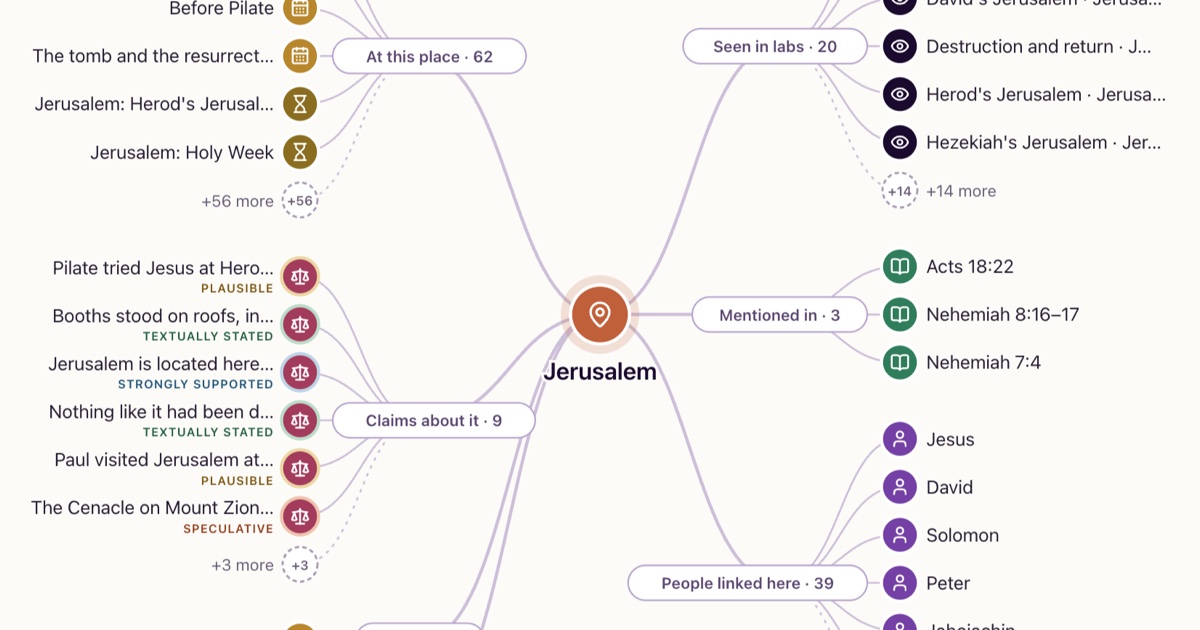
The Knowledge Graph Explorer is one map of everything the Bible Labs know: 6,024 people, places, events, objects, verses, claims and lab views, joined by 9,148 named links. Tap a name and it moves to the middle of a mind map, with its links sorted into branches you can read: the verses that mention it, where it happened, who took part, the claims about it and the labs where you can see it. Every claim carries an evidence level, from stated in the text to an artistic choice. Where scholars disagree, the readings sit side by side and the explorer does not pick one. Start from John 7:37, for example, and in three taps you reach the Feast of Tabernacles, the two ways of punctuating verse 38, and the lab that shows the feast in 3D.
Open the Knowledge Graph Explorer →
What is in the graph
Nothing in it was typed in for the explorer. Every node is read from a lab’s own data: the people of the Family Tree, the stops of Holy Week, the parts of the Tabernacle, the stones on the high priest’s breastpiece, the places Paul passed through. Every lab view is a deep link that opens that lab where the node is shown.
| Kind of thing | Nodes | Kind of link | Links | |
|---|---|---|---|---|
| Bible passage | 2,073 | Mentions | 2,008 | |
| Claim with evidence | 1,501 | Cites (a claim rests on a verse or source) | 1,946 | |
| Lab view | 1,014 | About (a claim about something) | 1,631 | |
| Event | 399 | Shown in a lab | 1,481 | |
| Person | 339 | Related (family, roles) | 685 | |
| Source | 305 | Participant | 411 | |
| Place | 184 | Located at | 378 | |
| Object | 138 | Part of | 291 | |
| Period | 33 | During | 270 | |
| Idea | 24 | Read alongside (interpretation) | 47 | |
| Hebrew/Greek word | 14 | |||
| Total | 6,024 | Total | 9,148 |
Counts are from the graph as built on 3 October 2026 and grow as labs are added. Place ids come from Pleiades and OpenBible.info, family relations from Theographic Bible Metadata.
One worked example: from a verse to a debate
Say you are preparing a study on John 7. Search for “John 7” and pick John 7:37–38:
In the last day, that great day of the feast, Jesus stood and cried, saying, If any man thirst, let him come unto me, and drink. He that believeth on me, as the scripture hath said, out of his belly shall flow rivers of living water. (John 7:37–38)
The passage sits in the middle, and its branches show six claims, each with its own level. That John explains the saying as the Spirit is Textually stated, because verse 39 says so. That “the last day, that great day of the feast” (John 7:37) is the eighth day of the feast is Plausible. That “as the scripture hath said” gathers several Old Testament promises of water, rather than quoting one verse, is Plausible too. That the water words echo the feast’s water-drawing is Plausible and marked as later Jewish tradition: the custom is described only in the Mishnah, about AD 200, and John does not mention it.
The last two answer the hard question: from whom do the rivers flow? Most translations take the “his” of “out of his belly” to be the believer; some early Latin writers and many modern commentators read it as Jesus. Both are Plausible, and each draws its own dashed line, labelled Read alongside, to the passage it leans on: John 4:14 for the believer, John 19:34, the water from his side, for Jesus (a Speculative link). Neither is marked as the answer.
One more tap on the Feast of Tabernacles, switched to the cloud, shows how the feast ties the Tabernacle in the wilderness to John 7, and the verse journey for John 7:37 takes the same verse door by door.
How to use it
Start with a name. Thirteen quick-start chips, from Jerusalem and Jesus to the Ark of the Covenant and John 7:37, or search for any name, place or verse.
Read the branches. Each branch is one kind of link, named in plain words: Mentioned in, Located at, Participants, Claims about it, Seen in labs. A branch shows up to eight nodes, then “+n more”.
Tap to move. Tap any circle to put it in the middle; your path is kept, so you can step back.
Filter. The presets Everything, People and places, Scripture and Evidence cut the map down when a node has many neighbours.
Switch to the cloud. The cloud shows clusters and bridges around a node, two steps out; on a computer you can also lay out the whole graph.
Open the lab. The details panel quotes the verses and gives an Open in the lab link for each view.
On a phone the mind map becomes a tidy tree and details open from the bottom. New visitors get a five-step, twenty-second tour, Show me how, which runs from Jerusalem to Holy Week and ends in the 3D scene at Golgotha.
What we know and what is reconstructed
The graph keeps three things apart that Bible maps often blur: what the text says, what research or tradition adds, and what a lab had to draw anyway.
| Evidence level | Claims |
|---|---|
| Textually stated | 294 |
| Strongly supported | 503 |
| Plausible | 447 |
| Speculative | 216 |
| Artistic | 41 |
Many claims also say where they come from: research (566), a reading of the text (128), later Jewish tradition (25) or an artistic choice (8). The 47 Read alongside links are dashed and carry a level and the claim that makes them.
Golgotha shows how this works. That it lay “without the gate” (Hebrews 13:12), by a road, is Textually stated:
And he bearing his cross went forth into a place called the place of a skull, which is called in the Hebrew Golgotha: (John 19:17)
Where it was is debated. The Church of the Holy Sepulchre is Strongly supported: in Jesus’ day the area was a disused quarry just outside the wall, with tombs cut into its sides. The Garden Tomb, north of the Damascus Gate, proposed in the nineteenth century, is Speculative. Each has its basis and sources, and each opens its own scene: the Holy Sepulchre or the Garden Tomb. Even the lab’s own picture is labelled: the low rock outcrop it draws is Artistic, since the Gospels never call Golgotha a hill.
That Philippians was written in prison is Textually stated (1:7, 13). Which prison is debated: Philippians links to Rome, Ephesus and Caesarea, all three Plausible, the way Paul’s Roads sets them out.
Chapter guides and verse journeys
Chapter guides, built from the same graph, cover 385 chapters that have at least one lab view. Each says what happens in the chapter, opens the scenes and maps that show it, lists its people and places, and ends with How sure can we be? For a letter, the guide also sets out who wrote it, where and when. See John 7, John 19 or Philippians 1, with its three prisons side by side. Every guide links back into the explorer.
Verse journeys start from one verse and open five doors in order: when, where, the space it happened in, the background and the readings. There are eleven so far, among them John 7:37 and 2 Kings 20:20 on Hezekiah’s tunnel.
Frequently asked questions
What is a knowledge graph? A network of things and the named links between them. Here the things are people, places, events, objects, words, passages, claims and lab views.
Can I share what I am looking at? Yes. The address keeps the node in the middle and the view, so a link like the Golgotha node opens on the same map for your group.
Does the explorer decide which reading is right? No. It shows each reading with its level, basis and sources. The Bereans were commended because they “searched the scriptures daily, whether those things were so” (Acts 17:11); the graph is meant to send you back to the text.
Start from Jerusalem in the Knowledge Graph →, or take the tour from the Show me how button.
Related
- Where Was Jesus Crucified?, Holy Week day by day, with the four debated places.
- What Was the Feast of Tabernacles?, the feast behind John 7:37.
- Map of Paul’s Missionary Journeys, with the letters and where they were written.
- The Whole Bible as One Story, the Story Map, another way to see how it fits together.
Found this helpful? Pass it on.