 X-Dreamers
Map of Paul’s Missionary Journeys: Every Road from Damascus to Rome
Every road Paul took on one map: the early years, three missionary journeys, the voyage to Rome and the debated later travels, with his co-workers and letters.
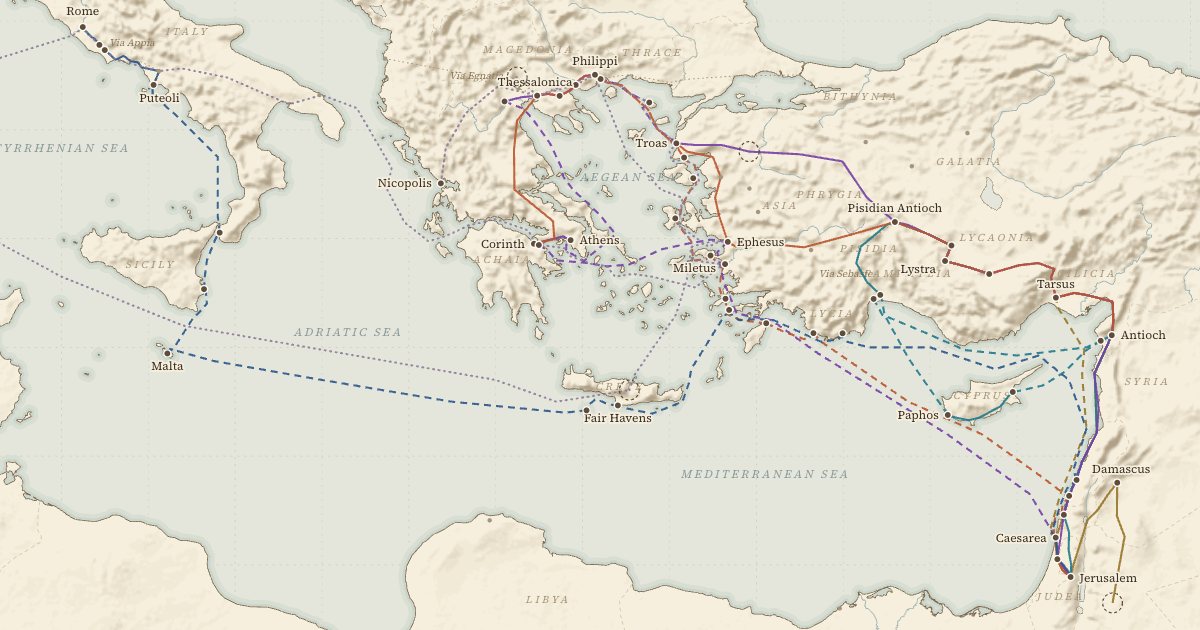
Acts follows Paul on three missionary journeys: Cyprus and southern Galatia with Barnabas (Acts 13–14, about AD 46–48), Macedonia and Greece with Silas (15:36–18:22, about 49–52), and nearly three years in Ephesus followed by a loop through Greece (18:23–21:17, about 52–57). Before them come the early years; after them, the arrest and the voyage to Rome (21:18–28:31). Acts ends with Paul under guard in Rome around AD 60–62; whether he was released and travelled again, perhaps to Spain, is debated. Drawn on one map, the routes come to about 25,000 km. Acts gives no years, though: every date counts from one inscription, and every road between the named cities is a reconstruction.
Paul’s travels at a glance
| Route | Text | About | Stops | Drawn length | How sure |
|---|---|---|---|---|---|
| Damascus and the early years | Acts 9–12; Galatians 1 | AD 34–46 | 10 | 2,800 km | Order and dates uncertain |
| First journey | Acts 13–15 | AD 46–49 | 15 | 3,200 km | Cities from Acts, roads reconstructed |
| Second journey | Acts 15:36–18:22 | AD 49–52 | 21 | 4,200 km | Cities from Acts, roads reconstructed |
| Third journey | Acts 18:23–21:17 | AD 52–57 | 20 | 4,200 km | Cities from Acts, roads reconstructed |
| Arrest and the voyage to Rome | Acts 21:18–28:31 | AD 57–62 | 15 | 3,400 km | Cities from Acts, roads reconstructed |
| Later travels | Romans 15; the Pastoral Letters; tradition | AD 62–67 | 10 | 7,200 km | Speculative |
Lengths are measured along the lab’s lines and rounded. Acts itself never numbers the journeys.
The one fixed date
An inscription found at Delphi quotes a letter of the emperor Claudius naming Gallio as proconsul of Achaia, which puts his year in office at about AD 51–52. Acts puts Paul in front of him at Corinth: “But when Gallio was proconsul of Achaia, the Jews with one accord rose up against Paul” (Acts 18:12). Every other date is counted forwards or backwards from that hearing, using the intervals Acts and Galatians give. The lab marks Gallio on its timeline of AD 33–67, and the map follows as you drag.
Route by route
The early years. After the Damascus road, Paul writes, “I went away into Arabia. Then I returned to Damascus.” (Galatians 1:17) Where and for how long nobody knows, so the lab draws Arabia as a dashed circle. The governor under King Aretas guarded Damascus to arrest him, and Paul went over the wall in a basket. Then come fifteen days with Peter, perhaps seven or eight silent years in Tarsus, and a year of teaching in Antioch, where “The disciples were first called Christians in Antioch.” (Acts 11:26) The conversion is dated about AD 33/34 (Plausible); others put it anywhere from 31 to 36. Chapter guides: Acts 9 and Galatians 1.
The first journey. The church at Antioch heard the Spirit say, “Separate Barnabas and Saul for me, for the work to which I have called them.” (Acts 13:2) They sailed to Cyprus. At Paphos the proconsul Sergius Paulus believed, and from there Luke calls Saul by his Roman name. John Mark turned back at Perga; the others went inland to Pisidian Antioch, Iconium, Lystra and Derbe, then back through the same towns. The route ends at the Jerusalem council, about AD 48/49, which ruled that Gentile believers need not be circumcised. Guides: Acts 13 and Acts 15.
The second journey. Paul and Barnabas fell out over Mark: “the contention grew so sharp that they separated from each other” (Acts 15:39). Paul took Silas, picked up Timothy at Lystra and crossed into Europe. It has its own lab and article; here it is one line on the map.
The third journey. Paul went back through Galatia and Phrygia to Ephesus and stayed two years and three months, “three years” as he later counted it (Acts 20:31). The silversmiths’ riot filled the theatre (see the verse journey on Acts 19:29 and the Ephesus city plan). Then came Macedonia, three months at Corinth, Eutychus at Troas, and the farewell to the Ephesian elders at Miletus. Guide: Acts 19.
Arrest and the voyage to Rome. Arrested in the Temple and held two years at Caesarea, Paul appealed to Caesar. By Fair Havens the Fast was past and sailing was dangerous; a storm caught the ship off Cauda. After fourteen nights it ran aground on Malta: “So they all escaped safely to the land.” (Acts 27:44) St Paul’s Bay is the traditional site (Plausible), though other bays have been proposed. After three months they went on by Puteoli to Rome, where “Paul stayed two whole years in his own rented house” (Acts 28:30). Guides: Acts 27 and Acts 28.
After Acts. Paul had planned to go west: “I will go on by way of you to Spain.” (Romans 15:28) The Pastoral Letters mention Crete, a winter at Nicopolis, and a cloak left behind: “Bring the cloak that I left at Troas with Carpus when you come” (2 Timothy 4:13). The lab strings these into one common sequence, Spain first, and marks every stop Speculative. It ends at Rome, where 1 Clement and Eusebius place his death under Nero, about AD 64–67 (Plausible). Guides: Romans 15 and 2 Timothy 4.
The people on the road
Switch the lab to People and 21 co-workers appear around Paul, joined by 15 ties the text gives. Choose one to light up their roads. Timothy joins at Lystra and is co-sender of six letters. Priscilla and Aquila share Paul’s trade at Corinth and move with him to Ephesus. John Mark leaves at Perga and is later wanted back: “he is useful to me for service” (2 Timothy 4:11). Titus never appears in Acts; we know him only from the letters.
Where the letters went
Letters mode draws thirteen letters on the same map, from where it may have been written to where it went. Where scholars disagree, the options stand side by side, with no verdict:
- 1 Thessalonians: from Corinth, about AD 50–51, just after Timothy came back with news (Strongly supported); probably the earliest letter to survive.
- Galatians: sent to the southern cities of the first journey or to the Galatian homeland in the north, and written from Antioch (48–49), Corinth, Ephesus or Macedonia (55–56). Every option is Plausible; a southern destination allows the early date.
- Philippians: written in chains, but from which prison? Rome is traditional; Ephesus and Caesarea are serious alternatives. All three are Plausible.
Six letters (Ephesians, Colossians, 2 Thessalonians and the three Pastorals) carry the label Authorship debated; the lab shows the setting each gives and takes no side.
What we know and what is reconstructed
| Detail | Evidence level |
|---|---|
| The cities and the order of the three journeys and the voyage | Textually stated |
| Gallio’s year, AD 51–52, and so the second journey’s dates | Strongly supported |
| The conversion about AD 33/34; the council about 48/49 | Plausible |
| The roads between cities, travel days, most years | Reconstruction (estimates) |
| South or North Galatia; which prison Philippians came from | Plausible, side by side |
| Release, Spain, the order of the later travels | Speculative |
Philippians and Philemon expect a release (“prepare a guest room for me”, Philemon 1:22), and 1 Clement and Eusebius tell of a later ministry and a second imprisonment. Many scholars think Paul died at the end of the two years in Acts 28, and that the Pastoral Letters were written later in his name.
Frequently asked questions
How many missionary journeys did Paul make? Three in Acts, then the voyage to Rome as a prisoner. If he was released, more travels followed.
How far did Paul travel? About 17,800 km along the lab’s lines for the routes in Acts, 25,000 with the later travels. Paul counted dangers instead: “Three times I suffered shipwreck. I have been a night and a day in the deep.” (2 Corinthians 11:25)
How many times did Paul go to Jerusalem? The lab has seven stops there, from Stephen’s death to the arrest. Jerusalem on the map lists them all.
Did Paul go to Spain? He planned to. Whether he went is Speculative: 1 Clement’s “limit of the west” may mean Spain or simply Rome.
Start on the Damascus road → and step through with Next, or open the first journey and press Play.
Related
- The Seven Churches: Ephesus a generation later, and six cities near it.
- The Bible on One Timeline and Paul on the Time Map.
Found this helpful? Pass it on.