 X-Dreamers
The Whole Bible as One Story, in Twelve Big Stories
How the Bible's sixty-six books tell one story from creation to new creation, traced through twelve big stories and the key verse that anchors each one.
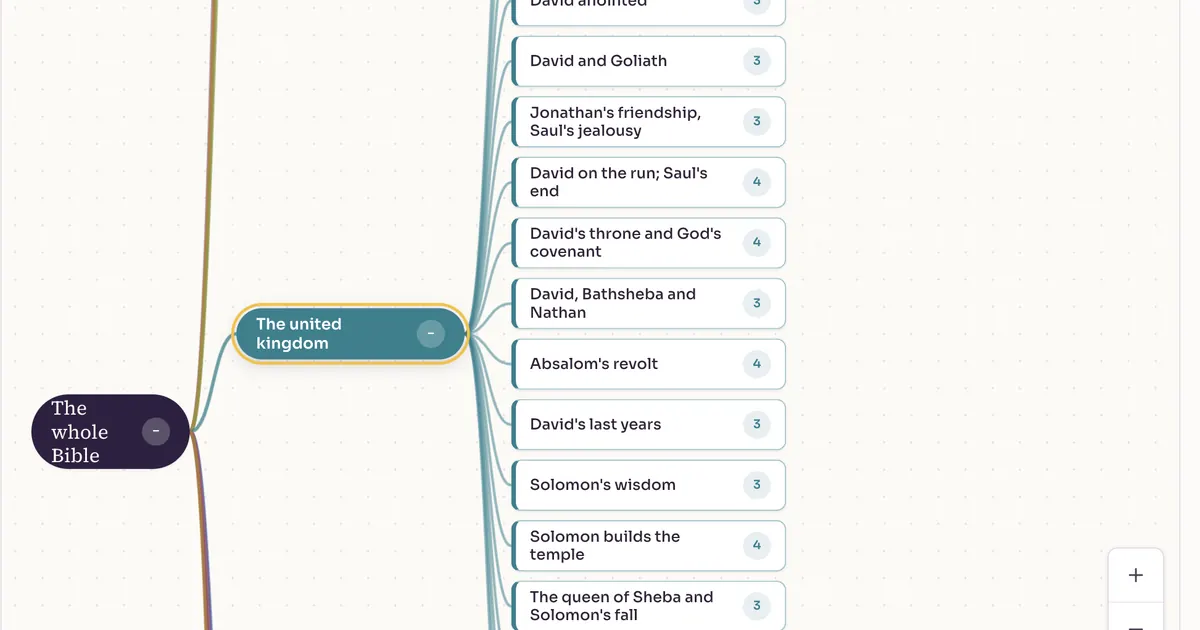
The Bible is sixty-six books written over many centuries, but it tells one story: God makes a world, calls a people, keeps his promises through their failures, sends his Son, and makes all things new. Jesus read it that way himself. On the road to Emmaus, “Beginning from Moses and from all the prophets, he explained to them in all the Scriptures the things concerning himself” (Luke 24:27). The Bible Story Map draws that story as a mind map: twelve big stories, 163 stories and 573 episodes, each with its passage and a key verse.
The twelve big stories at a glance
The big stories follow the eras of the Bible Time Map, with one more branch at the end for Christ’s return and the new creation.
| Big story | Where to read | Key verse |
|---|---|---|
| Creation and the early world | Genesis 1–11 | Genesis 1:1 |
| The patriarchs | Genesis 12–50 | Genesis 12:2–3 |
| Exodus and the wilderness | Exodus to Deuteronomy | Exodus 20:2 |
| Conquest and the judges | Joshua, Judges, Ruth | Judges 2:16 |
| The united kingdom | 1 Samuel to 1 Kings 11 | 2 Samuel 7:16 |
| The divided kingdom | 1 Kings 12 to 2 Kings 23 | 2 Kings 17:13 |
| Exile | 2 Kings 24–25, Jeremiah, Ezekiel, Daniel | Jeremiah 29:10–11 |
| Return | Ezra, Nehemiah, Esther | Ezra 1:2–3 |
| Between the Testaments | Daniel 11, Malachi | Galatians 4:4 |
| The life of Jesus | the four Gospels | Mark 1:15 |
| The early church | Acts and the letters | Acts 1:8 |
| The end and the new creation | Revelation | Revelation 21:5 |
How the story hangs together
Read the key verses in order and the plot comes out almost by itself.
A world, a fall and a promise
The story opens with “In the beginning, God created the heavens and the earth” (Genesis 1:1). Within three chapters the good world is spoiled, and Genesis 1–11 moves on through Cain and Abel, the flood and Babel.
Then, in chapter 12, God speaks to one man:
I will make of you a great nation. I will bless you and make your name great. You will be a blessing. (Genesis 12:2)
The promise ends, “All the families of the earth will be blessed through you” (Genesis 12:3). Land, offspring and blessing for the nations: much of the rest of the Bible is the story of how God keeps that promise.
A people rescued and bound to God
Abraham’s family ends up enslaved in Egypt. God brings them out under Moses and meets them at Sinai, and the Ten Commandments begin with a rescue, not a rule: “I am the LORD your God, who brought you out of the land of Egypt, out of the house of bondage” (Exodus 20:2). Law follows grace.
Joshua leads them into Canaan, but the next generation forgets. Judges turns on a cycle of sin, oppression, crying out and rescue: “The LORD raised up judges, who saved them out of the hand of those who plundered them” (Judges 2:16). The book closes with “In those days there was no king in Israel” (Judges 21:25), and the reader starts looking for a king.
Kings, prophets and exile
Saul is anointed, then David, and God promises David a house that will not end: “Your throne will be established forever” (2 Samuel 7:16). Solomon builds the temple, but after him the kingdom splits in two. The divided kingdom is where most of the prophets appear on the map, and one verse sums up what they said:
Yet the LORD testified to Israel and to Judah, by every prophet and every seer, saying, “Turn from your evil ways, and keep my commandments and my statutes, according to all the law which I commanded your fathers, and which I sent to you by my servants the prophets.” (2 Kings 17:13)
They did not turn. Assyria took the north, and Babylon burned Jerusalem. Even so, God promised the exiles “hope and a future” (Jeremiah 29:11). After seventy years Cyrus of Persia let them go home to “build the house of the LORD, the God of Israel” (Ezra 1:3).
The fullness of time
After Malachi come some four hundred years without a new prophet. The map still gives them a branch, because Daniel foresaw the empires that rose in them and Paul looks back on them: “when the fullness of the time came, God sent out his Son” (Galatians 4:4). Jesus begins by announcing, “The time is fulfilled, and God’s Kingdom is at hand!” (Mark 1:15). With twenty stories and seventy-six episodes, his life is the largest branch on the map.
To the ends of the earth
The risen Jesus sends his disciples out: “You will be witnesses to me in Jerusalem, in all Judea and Samaria, and to the uttermost parts of the earth” (Acts 1:8). The promise to Abraham begins to reach the nations. The last branch is Revelation, where the story closes with God and his world again: “Behold, I am making all things new” (Revelation 21:5).
Where do the Psalms, the prophets and the letters go?
The Bible is not arranged in story order, and this is where many readers lose the thread. The map places each book where it fits the plot:
- Psalms and wisdom books sit with David and Solomon.
- Prophets sit with the kings they addressed: Amos and Hosea in the northern kingdom, Isaiah with Hezekiah, Ezekiel and Daniel in the exile, Haggai and Zechariah in the return.
- Letters sit with the churches they were written to.
- Job, which gives no date, sits with the patriarchs, where tradition sets it.
What the text says and what the map infers
Where a date or a place is uncertain, the branch carries an evidence level and a short note under “How sure is the date or place?”. Thirty-eight branches have one.
| Example | Evidence level | Why |
|---|---|---|
| John on Patmos; the Psalms as David’s songs | Strongly supported | Patmos is named and still bears the name; many psalms are headed “of David”, though some are by Asaph, the sons of Korah or Moses |
| The Passover and the Exodus | Plausible | The year is debated: about 1446 BC or about 1260 BC |
| The birth of Jesus | Plausible | Herod’s death (c. 4 BC) places it about 6–4 BC |
| Isaiah 40–66 | Plausible | Kept with Isaiah as the book presents it; many scholars date it to the exile or later |
| Eden, Mount Sinai, the crossing of the sea | Speculative | The places named cannot now be matched to one site |
| Joel, Job | Speculative | Neither book gives a date |
The twelve-part division and the placing of each book are editorial choices: a way to read, not a claim the Bible makes.
How to use the map
Start at the root, “The whole Bible”, and open one big story. Its stories spread out; open one of those to reach the episodes. Each branch has a panel with a summary, the passage and a key verse. On a phone the tree becomes an indented outline, and ⓘ opens the details. Search finds stories, people and references.
Every branch has its own address. Try Abram’s call, the Passover, the exile, Light and life in Jerusalem or a new heaven and a new earth.
Frequently asked questions
What is the story of the Bible in one sentence? God makes a world, calls a people, keeps his promises through their failures, sends his Son, and makes all things new.
Are the stories in chronological order? The big stories follow the eras of the Bible Time Map, and the stories inside them keep the order of the biblical narrative.
How is this different from a Bible timeline? A timeline asks when. The story map asks what happens next, and shows no dates on the tree. For dates, read The Bible on One Timeline.
See the whole story at once
For a small group, open one big story a week and read the passage behind each branch.
Related
- The Bible Time Map: the same eras on a timeline and a map, with dates and empires.
- Noah’s Ark: the flood from the first big story, built to scale; see also How big was Noah’s ark?
- Places of Jesus: the Gospel stories on the ground in Galilee and Jerusalem.
Found this helpful? Pass it on.