 X-Dreamers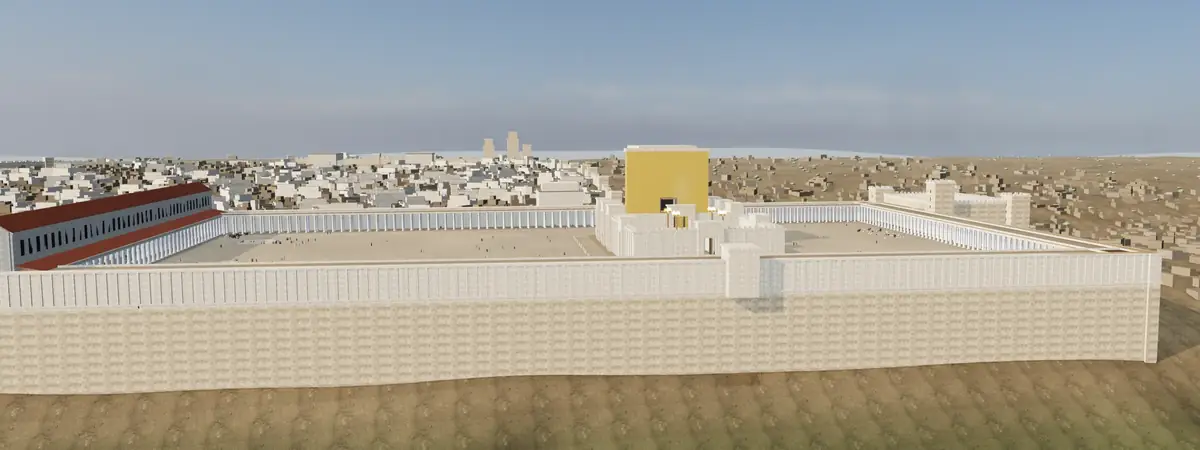

Approach
Southern Steps and the Hulda Gates
The main pilgrim entrance, climbing to two gates in the south wall.
What happened here
Most worshippers came up from the lower city and climbed a broad stairway, about 64 m wide, to the Double Gate; a second stair led to the Triple Gate further east. The Mishnah calls these the two Hulda Gates, one used for entering and the other for leaving. Through the gates, sloping vaulted passages rose under the Royal Stoa and came out into the open court. As a boy of twelve Jesus came up at Passover with his family, and pilgrims sang the Psalms of Ascents on the way.
Scripture
41Now his parents went to Jerusalem every year at the feast of the passover. 42And when he was twelve years old, they went up to Jerusalem after the custom of the feast.
1I was glad when they said unto me, Let us go into the house of the LORD. 2Our feet shall stand within thy gates, O Jerusalem.
Claims
- Strongly supported A monumental stair about 64 m wide climbed to the Double Gate.
- Plausible The two Hulda gates served the people, entering by one and leaving by the other.
- Plausible The passages rose beneath the Royal Stoa into the court; their exact exit points are reconstructed.
Archaeology and sources
The western part of the stair was uncovered by Benjamin Mazar’s excavations after 1967 and partly restored. Its treads alternate short and long, which forces a slow, deliberate climb. The Double Gate’s blocked arches and its domed, carved vestibule survive inside the wall under the later al-Aqsa mosque.
Sources
- Excavations south and west of the Temple Mount: B. Mazar and M. Ben-Dov (1968–1978); E. Mazar, The Walls of the Temple Mount (2011)
- Leen Ritmeyer, The Quest: Revealing the Temple Mount in Jerusalem (Carta, 2006)
- Mishnah, tractate Middot (“Measurements”), compiled c. AD 200 — rabbinic tradition