 X-Dreamers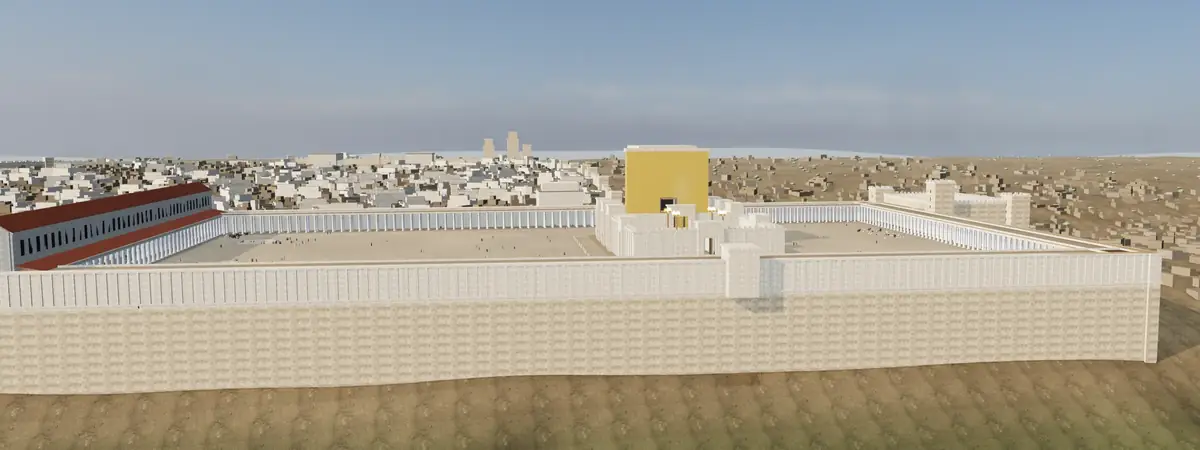
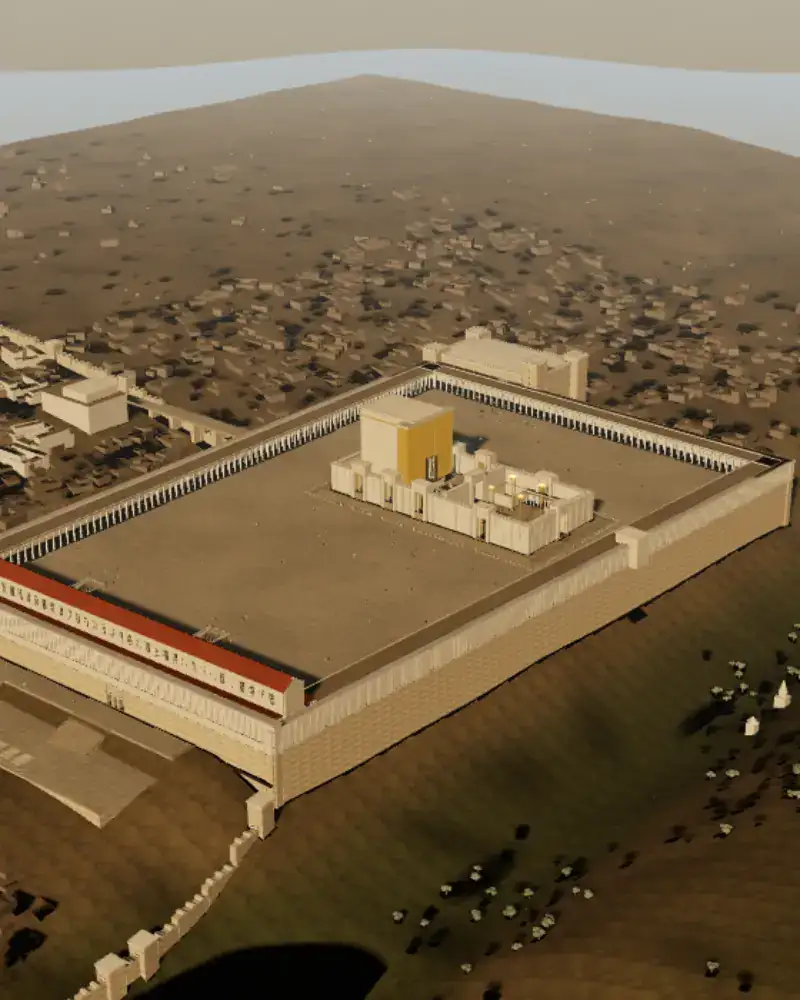
The inner courts
The Sanctuary
The Holy Place and Holy of Holies behind a golden façade 100 cubits high.
What happened here
The sanctuary rose 100 cubits, its front covered with plates of gold that dazzled in the sun; from a distance, Josephus says, it looked like a snowy mountain. Behind the porch lay the Holy Place and, beyond the veil, the Holy of Holies. Here the priest Zechariah was burning incense when the angel appeared to him. At Jesus’ death the veil of the Temple was torn in two from top to bottom. He had spoken of “the temple of his body.”
Scripture
8And it came to pass, that while he executed the priest’s office before God in the order of his course, 9According to the custom of the priest’s office, his lot was to burn incense when he went into the temple of the Lord. 10And the whole multitude of the people were praying without at the time of incense. 11And there appeared unto him an angel of the Lord standing on the right side of the altar of incense.
50Jesus, when he had cried again with a loud voice, yielded up the ghost. 51And, behold, the veil of the temple was rent in twain from the top to the bottom; and the earth did quake, and the rocks rent;
19Jesus answered and said unto them, Destroy this temple, and in three days I will raise it up. 20Then said the Jews, Forty and six years was this temple in building, and wilt thou rear it up in three days? 21But he spake of the temple of his body.
Claims
- Strongly supported The sanctuary was 100 cubits high and 100 wide at the front, and the front was covered with heavy plates of gold, with a golden vine above the entrance.
- Artistic The white stone pilasters and courses that frame the gold plates are our reconstruction, so that the front reads from a distance; Josephus describes the plating, not how it was divided. The open gateway follows Josephus, 70 cubits high and 25 broad; the Mishnah gives 40 by 20.
- Speculative Its exact site on the Mount is uncertain; this model follows the common placement near the rock.
Archaeology and sources
No trace of the sanctuary survives, and its exact position is debated. Most reconstructions place it near the rock now under the Dome of the Rock; others propose sites to the north or south. The front was broader than the building behind it — “like a lion,” say the rabbis.
Sources
- Josephus, Jewish War 5.5 (written c. AD 75)
- Mishnah, tractate Middot (“Measurements”), compiled c. AD 200 — rabbinic tradition
- Leen Ritmeyer, The Quest: Revealing the Temple Mount in Jerusalem (Carta, 2006)