Skip to content
X-Dreamers

Places of Jesus · Jerusalem, c. AD 30

Herod's Temple Mount in 3D

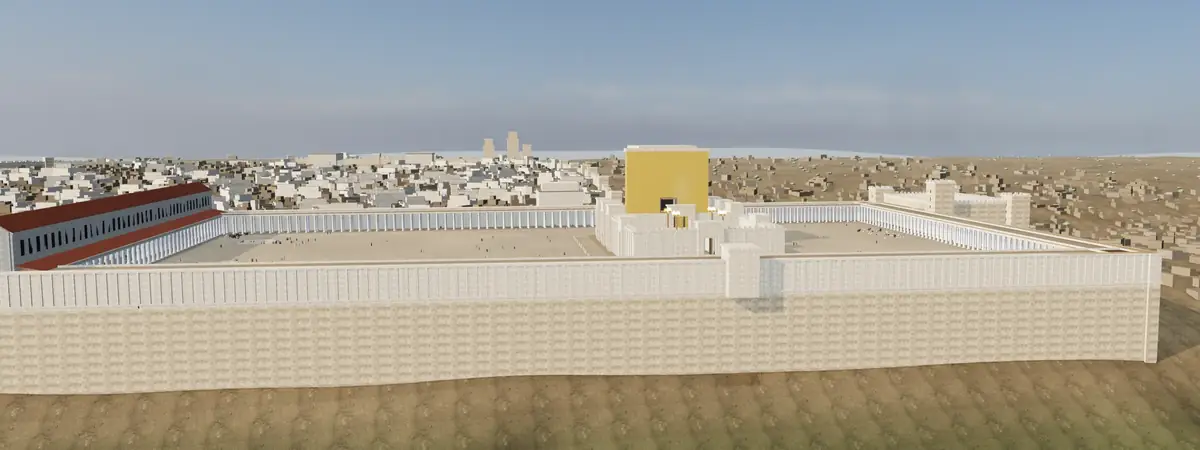
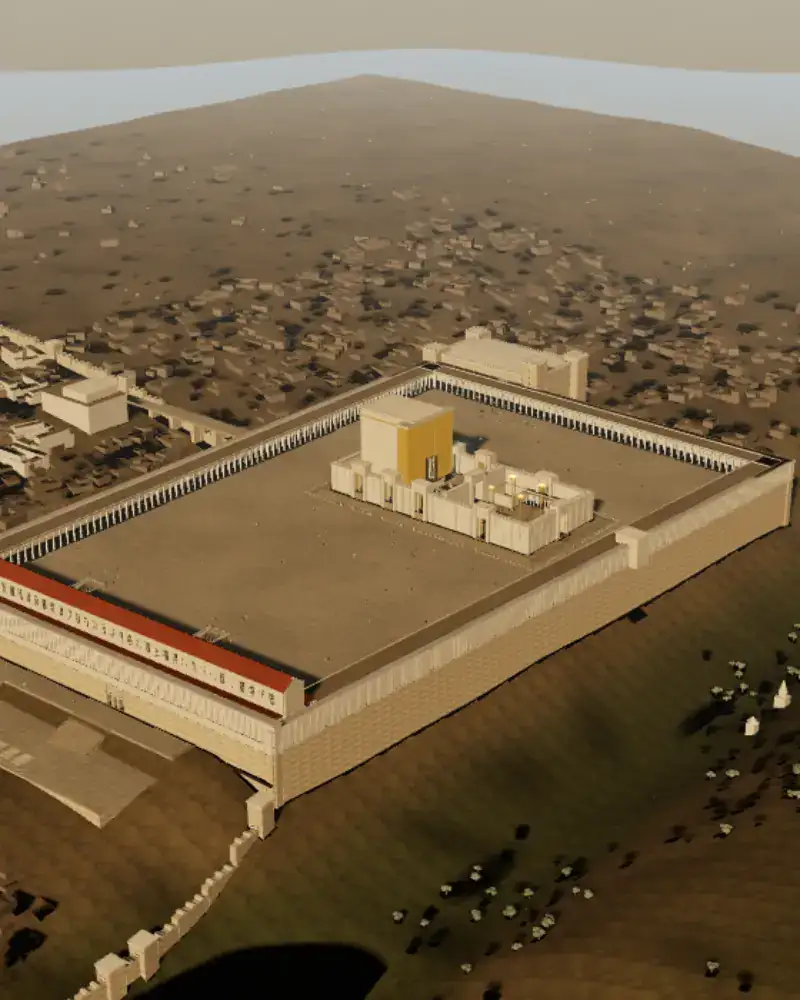
Herod's Temple as Jesus knew it, rebuilt in immersive 3D from its surviving walls, Josephus and the Mishnah: climb the Southern Steps, cross the Court of the Gentiles and stop at the barrier no Gentile could pass.

Herod's Temple Mount from the air, with the sanctuary rising above the courts

The Temple Mount in Jesus’ Day

Climb the Southern Steps into Herod's courts, or walk the tour stop by stop.

Walk in 3D · move with the on-screen stick

3D · about 2.2 MB

Loading the Temple Mount…

This is a reconstruction. The walls and gates rest on excavated evidence; the courts, the sanctuary and many details come from Josephus and the Mishnah (rabbinic tradition, written down about AD 200), which do not always agree. Every place shows its claims with an evidence level, from what Scripture states to what is an artistic choice.

Drawn to scale in meters, with a cubit of about 0.45 m. Scripture quotations are from the King James Version (1769). Textures are procedural or CC0 from Poly Haven; the model is built procedurally in Blender.Textures: procedural and CC0 (Poly Haven: marble_01, clay_roof_tiles_02, dry_ground_rocks, aerial_rocks_02, clay_plaster; sky kloofendal_43d_clear_puresky).

One place across the agesSee Jerusalem through the ages →See this platform from the Mount of Olives, then drag the years: the natural hill under it in David's day, and what stands on it today.Five sanctuaries at one scaleSee it beside the other Temples →Herod's sanctuary beside Solomon's Temple, the Second Temple and the Tabernacle, at one scale: 100 cubits high, yet the same holy place inside.

How big was the Temple Mount in Jesus' day?

Herod the Great began rebuilding the Temple about 20 BC. He doubled the old Temple Mount by building huge retaining walls down into the valleys and filling them in, which made a platform of about 144,000 m², roughly 485 m on the west, 470 m on the east, 315 m on the north and 280 m on the south. The work was still going on when Jesus came to Jerusalem: “Forty and six years was this temple in building” (John 2:20). Those walls still stand. The Western Wall is part of them.

This scene rebuilds the platform from the surviving walls and walks it in 16 stops: up the Southern Steps, into the Royal Stoa, across the Court of the Gentiles to the barrier no Gentile could pass, into the Court of Women and up to the sanctuary. Nothing of the courts or the sanctuary survives, so they follow Josephus, who saw them, and the Mishnah, written down about AD 200. Where the two disagree, the scene says so.

Herod's Temple Mount at a glance

Herod's Temple Mount at a glance
PlatformAbout 485 × 470 × 315 × 280 m (west, east, north, south): about 144,000 m²
BuiltBegun about 20 BC; still under way at Jesus' first Passover (John 2:20); finished about AD 63
DestroyedAD 70, by the Roman army under Titus
The sanctuary100 cubits high and 100 wide at the front (about 45 m), covered with gold
The Royal StoaA basilica along the south wall: 162 columns in four rows
What survivesThe retaining walls (including the Western Wall), the Southern Steps, Robinson's Arch and two Greek warning stones

Key verses 5

1And as he went out of the temple, one of his disciples saith unto him, Master, see what manner of stones and what buildings are here!

Mark 13:1

19Jesus answered and said unto them, Destroy this temple, and in three days I will raise it up. 20Then said the Jews, Forty and six years was this temple in building, and wilt thou rear it up in three days? 21But he spake of the temple of his body.

John 2:19–21

15And they come to Jerusalem: and Jesus went into the temple, and began to cast out them that sold and bought in the temple, and overthrew the tables of the moneychangers, and the seats of them that sold doves; 16And would not suffer that any man should carry any vessel through the temple. 17And he taught, saying unto them, Is it not written, My house shall be called of all nations the house of prayer? but ye have made it a den of thieves.

Mark 11:15–17

23And Jesus walked in the temple in Solomon’s porch.

John 10:23

11And as the lame man which was healed held Peter and John, all the people ran together unto them in the porch that is called Solomon’s, greatly wondering.

Acts 3:11

Scripture quotations: King James Version (KJV).

What the Bible says, what our model adds to it, where good readers disagree, and where the old copies and the translations differ. We set the views side by side and do not pick a winner.

  • Textually stated9
  • Strongly supported5
  • Plausible3
  • Speculative4
  • Artistic1

A few of the model's choices

  • Strongly supported

    The platform measures about 485 × 470 × 315 × 280 m.

  • Strongly supported

    A stair about 64 m wide climbed to the Double Gate in the south wall.

  • Strongly supported

    The Royal Stoa had 162 columns in four rows.

Show all 26
What the text says9

Stated in Scripture. Quoted from the King James Version (KJV) and the 1919 Chinese Union Version (和合本).

  • Josephus links the eastern portico with Solomon; Scripture names “Solomon’s Porch.”

    Textually stated

    23And Jesus walked in the temple in Solomon’s porch.

    John 10:23 · KJV
  • The Mount of Olives overlooks the Temple Mount from the east, across the Kidron.

    Textually stated

    3And as he sat upon the mount of Olives over against the temple, Peter and James and John and Andrew asked him privately,

    Mark 13:3 · KJV
  • The disciples admired the great stones and buildings of the Temple.

    Textually stated

    1And as he went out of the temple, one of his disciples saith unto him, Master, see what manner of stones and what buildings are here!

    Mark 13:1 · KJV
  • By Jesus' first Passover the Temple had been 46 years in building.

    Textually stated

    20Then said the Jews, Forty and six years was this temple in building, and wilt thou rear it up in three days?

    John 2:20 · KJV
  • Jesus overturned the tables of the money changers and the seats of the dove sellers in the Temple.

    Textually stated

    15And they come to Jerusalem: and Jesus went into the temple, and began to cast out them that sold and bought in the temple, and overthrew the tables of the moneychangers, and the seats of them that sold doves;

    Mark 11:15 · KJV
  • Jesus sat opposite the treasury and watched a poor widow put in two small coins.

    Textually stated

    41And Jesus sat over against the treasury, and beheld how the people cast money into the treasury: and many that were rich cast in much. 42And there came a certain poor widow, and she threw in two mites, which make a farthing.

    Mark 12:41–42 · KJV
  • A lame man was laid daily at the Temple gate called Beautiful.

    Textually stated

    2And a certain man lame from his mother’s womb was carried, whom they laid daily at the gate of the temple which is called Beautiful, to ask alms of them that entered into the temple;

    Acts 3:2 · KJV
  • The commander had Paul taken into the barracks, and he was carried up the stairs.

    Textually stated

    34And some cried one thing, some another, among the multitude: and when he could not know the certainty for the tumult, he commanded him to be carried into the castle. 35And when he came upon the stairs, so it was, that he was borne of the soldiers for the violence of the people.

    Acts 21:34–35 · KJV
  • The devil set Jesus on the pinnacle of the Temple.

    Textually stated

    5Then the devil taketh him up into the holy city, and setteth him on a pinnacle of the temple,

    Matthew 4:5 · KJV
What the model adds13

Choices the reconstruction has to make where the text is silent, each with its evidence level and the reason for it.

Strongly supported5
  • The platform measures about 485 × 470 × 315 × 280 m.

    Why: Herod's retaining walls still stand; Warren's shafts and later excavations traced them to bedrock.

  • A stair about 64 m wide climbed to the Double Gate in the south wall.

    Why: Uncovered in the excavations of B. Mazar and M. Ben-Dov (1968–1978).

  • The Royal Stoa had 162 columns in four rows.

    Why: Josephus describes it (Antiquities 15.11); fragments of its columns and capitals lie in the rubble below the south-west corner.

  • A low balustrade with warning slabs kept Gentiles out of the inner courts.

    Why: Josephus describes it, and two of the Greek warning stones survive (found 1871 and 1935).

  • The sanctuary is 100 cubits high and 100 wide at the front, covered with gold.

    Why: Josephus and the Mishnah agree on the 100 cubits; no trace of the building survives.

Plausible3
  • The money changers and sellers worked in or beside the Royal Stoa.

    Why: The Gospels say only "in the temple"; the stoa is the likeliest covered space in the outer court.

  • The Court of Women is drawn 135 × 135 cubits with a chamber at each corner.

    Why: Nothing of the inner courts survives; the size comes from the Mishnah, compiled about AD 200.

  • Four golden lampstands 50 cubits high stand in the Court of Women at the Feast of Tabernacles.

    Why: From the Mishnah (Sukkah 5:2–4), a later tradition; the Gospels do not mention them.

Speculative4
  • The thirteen offering chests stand under the colonnade of the Court of Women.

    Why: The Mishnah lists thirteen trumpet-shaped chests; their place is inferred from the Gospels and later tradition.

  • The sanctuary is placed near the rock now under the Dome of the Rock.

    Why: Its exact site is debated and cannot be excavated; this is the most common placement (see Competing views).

  • The size and plan of the Antonia Fortress are drawn as a guess.

    Why: Josephus gives four corner towers; how far the fortress extended is disputed.

  • The "pinnacle" is placed at the south-east corner, high above the Kidron.

    Why: Which point Matthew means is not known; the south-west corner, where the "place of trumpeting" stone fell, has also been suggested.

Artistic1
  • The stalls, animals, lattice patterns and people are illustrations.

    Why: Nothing describes them in enough detail to draw; they show how the courts were used, not what they looked like.

Competing views4

Where careful readers disagree. Each view with who holds it and the evidence for and against it. No verdict.

Where on the platform did Herod's Temple stand?

Mark 13:1–2

On the site of the Dome of the Rock, with the rock under the most holy place

Held by Most archaeologists and historians; Leen Ritmeyer and Dan Bahat; most rabbis in Israel today

For

  • Ritmeyer reports flat-cut bands in the rock matching the wall of the most holy place, and a cutting he reads as the ark's place.
  • The rock is the summit of the hill, a natural place for the sanctuary.

Against

  • The cuttings cannot be dated, and no excavation is possible on the platform.

Sources: "Where Was the Temple?", sidebar to David Jacobson, "Sacred Geometry: Unlocking the Secret of the Temple Mount", Biblical Archaeology Review (BAS Library); Wikipedia, "Foundation Stone"; Lambert Dolphin, "Four Temple Location Theories" (templemount.org); Leen Ritmeyer, The Quest: Revealing the Temple Mount in Jerusalem (Carta, 2006)

To the north-west, at the small Dome of the Spirits

Held by Asher Kaufman (physicist)

For

  • Kaufman argues from the lie of the land and the bedrock exposed under the cupola.

Against

  • It rests on surface features; nothing has been excavated to confirm it.

Sources: "Where Was the Temple?", sidebar to David Jacobson, "Sacred Geometry: Unlocking the Secret of the Temple Mount", Biblical Archaeology Review (BAS Library); Wikipedia, "Dome of the Spirits"; Lambert Dolphin, "Four Temple Location Theories" (templemount.org)

Further south, near the al-Kas fountain between the Dome and al-Aqsa

Held by Tuvia Sagiv (architect)

For

  • Sagiv argues from the levels of the ancient aqueducts that the Temple stood about 20 m lower, which puts it to the south.

Against

  • It needs other ways of reading the water levels and the Mishnah's measurements, and it too cannot be tested by digging.

Sources: Lambert Dolphin, "Four Temple Location Theories" (templemount.org)

What the lab shows (a drawing choice, not a ruling): The scene places the sanctuary near the rock, the most common placement, marked Speculative.

How big was the Temple Mount: 500 cubits square, a furlong (stadion) a side, or the platform we see?

The Mishnah's 500 × 500 cubits: the older, sacred square inside Herod's platform

Held by Mishnah Middot 2:1; Leen Ritmeyer, who traces the square on today's platform

For

  • Middot gives the Mount as 500 cubits by 500, far smaller than the platform, which fits an older square kept as the holy area.

Against

  • The Mishnah was written down about AD 200, long after the Temple fell, and does not say which period it describes.

Sources: Mishnah Middot 2:1 (Sefaria); Leen Ritmeyer, The Quest: Revealing the Temple Mount in Jerusalem (Carta, 2006); Lambert Dolphin, "Four Temple Location Theories" (templemount.org)

Josephus: four furlongs round, a furlong (about 400 cubits) each side

Held by Josephus, Antiquities 15.11.3

For

  • Josephus knew the Temple before AD 70 and describes Herod's work directly.

Against

  • A furlong a side, about 400 cubits, is much smaller than the surviving platform (about 485 × 470 × 315 × 280 m), so his figure is a round one or refers to part of it.

Sources: Josephus, Antiquities of the Jews 15.11 (Whiston translation); Josephus, Jewish Antiquities 15.11 (written c. AD 93–94)

What the lab shows (a drawing choice, not a ruling): The scene builds the platform from the walls that survive today (Strongly supported) and the courts inside it from Josephus and the Mishnah.

Was Solomon's Porch really Solomon's?

John 10:23; Acts 3:11

It stood on an old eastern wall credited to Solomon

Held by Josephus, as Jamieson–Fausset–Brown and Ellicott read him

For

  • Josephus links the eastern side with Solomon's work.
  • The eastern wall above the Kidron preserves masonry older than Herod's (the "seam" north of the south-east corner).

Against

  • Ellicott doubts that Josephus calls anything but the wall Solomon's.

Sources: Commentaries on John 10:23 (Jamieson–Fausset–Brown, Barnes, Ellicott, Cambridge Bible, Gill); Josephus, Jewish Antiquities 15.11 (written c. AD 93–94)

What the lab shows (a drawing choice, not a ruling): The scene draws Solomon's Porch as Josephus describes the eastern porticoes: double colonnades 30 cubits wide.

Which gate was "the Beautiful Gate"?

Acts 3:2

The Nicanor Gate, with its doors of Corinthian bronze

Held by Ellicott and many commentators

For

  • Josephus singles out one gate of Corinthian bronze as far more valuable than those plated with silver and gold.
  • An ossuary from Mount Scopus names "Nicanor of Alexandria, who made the doors".

Against

  • Acts names no material or builder; the link with the bronze gate is a deduction.

Sources: Commentaries on Acts 3:2 (Ellicott, Benson and others); Josephus, Jewish War 5.5 (written c. AD 75)

The eastern gate of the Court of Women

Held by Wright and other commentators

For

  • It led into the court where the people gathered for the services, a natural place for a beggar.

Against

  • It rests on where a beggar would sit, not on any ancient use of the name.

Sources: Commentaries on Acts 3:2 (Ellicott, Benson and others)

What the lab shows (a drawing choice, not a ruling): The scene labels the Nicanor Gate and notes that Acts' "Beautiful Gate" may be it or the eastern gate (Speculative).

Textual notes

Places where manuscripts, ancient versions or translations differ in numbers or wording. KJV and 和合本 are quoted as they stand.

No textual notes. None of the passages this scene draws on differ between KJV and the 和合本 in a way that changes the reconstruction. The open questions here are about places, not wording; see "Competing views".

Frequently asked questions

What did Herod's Temple look like?

From the Mount of Olives it was a walled platform with colonnades on every side and the Royal Stoa along the south. Inside, the Court of the Gentiles surrounded a raised inner area, closed to Gentiles by a low barrier with warning stones. Beyond it were the Court of Women, the Court of Israel, the altar and the sanctuary, 100 cubits high and wide at the front (about 45 m) and covered with gold. These details come from Josephus and the Mishnah; nothing of the courts or sanctuary survives.

How big was the Temple Mount?

Herod's platform measures about 485 m on the west, 470 m on the east, 315 m on the north and 280 m on the south, about 144,000 m². That is roughly the size of 20 football pitches. The Mishnah's “500 by 500 cubits” is much smaller; many scholars read it as the older, holier square inside Herod's enlargement.

Where on the platform did the Temple stand?

No one can dig on the platform, so its exact site is debated. Most archaeologists put the sanctuary on the summit, with the rock now under the Dome of the Rock beneath the most holy place. Others have argued for a site further north or further south. The scene follows the usual placement and marks it as speculative.

Where did Jesus overturn the tables of the money changers?

The Gospels say only “in the temple” (Mark 11:15). That means the outer court, open to everyone, not the inner courts. The likeliest covered place for the money changers and dove sellers was in or beside the Royal Stoa along the south side, which is where the scene puts them.

What was Solomon's Porch?

A long double colonnade along the east side of the Temple Mount. Jesus walked there at the Feast of Dedication (John 10:23), and the first Christians met there (Acts 3:11; 5:12). Josephus links the eastern wall with Solomon. The colonnade itself was probably built in Herod's time and took its name from that wall.

Can you still see any of the Temple Mount Jesus knew?

Yes, the outside of it. The retaining walls, including the Western Wall, the Southern Steps where pilgrims went up, and the spring of Robinson's Arch are all Herod's work. The sanctuary and the courts were destroyed in AD 70, as Jesus said: “There shall not be left one stone upon another” (Mark 13:2).

Was Herod's Temple the Second Temple?

Yes. Jews count it as the Second Temple, rebuilt and greatly enlarged rather than replaced: Herod began about 20 BC, the work was still going on in Jesus' day (John 2:20), and it was finished only about AD 63, seven years before the Romans burned it in AD 70. The older, smaller building of Zerubbabel's day stood on the same site.

Sources & limits

Limits of this lab 4

  • Nothing of the sanctuary or the inner courts survives, and the platform cannot be excavated; their plan follows Josephus and the Mishnah, which do not always agree.
  • The Mishnah was written down about AD 200, after the Temple's destruction; it is used as later tradition and marked as such.
  • The outer walls, the southern steps and Robinson's Arch rest on excavation; roofs, colours and decoration are reconstructed.
  • People, animals and market stalls are illustrations of how the courts were used.

Sources 22

  1. King James Version (KJV) (Public domain outside the United Kingdom)
  2. 官話和合譯本 (Chinese Union Version, 1919), zh.wikisource (Public domain)
  3. Excavations south and west of the Temple Mount: B. Mazar and M. Ben-Dov (1968–1978); E. Mazar, The Walls of the Temple Mount (2011)
  4. Leen Ritmeyer, The Quest: Revealing the Temple Mount in Jerusalem (Carta, 2006)
  5. Mishnah, tractate Middot (“Measurements”), compiled c. AD 200 — rabbinic tradition
  6. Ritual baths excavated south of the Temple Mount (R. Reich, Miqwa’ot in the Second Temple Period, 1990)
  7. R. Reich and Y. Billig, excavations at Robinson’s Arch and the Herodian street (1994–1996)
  8. Charles Warren, shafts along the walls of the Haram (1867–1870)
  9. Josephus, Jewish Antiquities 15.11 (written c. AD 93–94)
  10. Josephus, Jewish War 5.5 (written c. AD 75)
  11. Temple warning inscription: complete stone found by C. Clermont-Ganneau, 1871 (Istanbul Archaeology Museums); fragment found 1935 (Israel Museum)
  12. Mishnah Shekalim 6:1, 5 — rabbinic tradition
  13. Mishnah Sukkah 5:2–4 — rabbinic tradition
  14. “To the place of trumpeting” inscription, fallen from the south-west corner (found 1968)
  15. "Where Was the Temple?", sidebar to David Jacobson, "Sacred Geometry: Unlocking the Secret of the Temple Mount", Biblical Archaeology Review (BAS Library)
  16. Wikipedia, "Foundation Stone"
  17. Wikipedia, "Dome of the Spirits"
  18. Lambert Dolphin, "Four Temple Location Theories" (templemount.org)
  19. Josephus, Antiquities of the Jews 15.11 (Whiston translation) (Public domain)
  20. Mishnah Middot 2:1 (Sefaria)
  21. Commentaries on Acts 3:2 (Ellicott, Benson and others) (Public domain)
  22. Commentaries on John 10:23 (Jamieson–Fausset–Brown, Barnes, Ellicott, Cambridge Bible, Gill) (Public domain)

Scripture is quoted only from KJV and the 1919 和合本. Other works are cited for facts and arguments, not quoted at length.

How we build the Labs →Found a mistake? Report it →

What’s new · v1.7.1Version 1.7.1: English Scripture is now quoted from the King James Version (1769).