Skip to content
X-Dreamers

Hebrew Bible Word Study

A Hebrew word study tool for the whole Old Testament: tap any word of the Hebrew Bible, from Genesis to Malachi, to see how it is built, what it means and every other verse where it appears.

Twelve words that carry a lot of weight in the Hebrew Bible.

Or open any verse

A verse of the Hebrew Bible as word chips, with the English gloss under each word

Hebrew Word Explorer

Any verse of the Hebrew Bible, word by word: tap a word to see how it is built and where else it occurs.

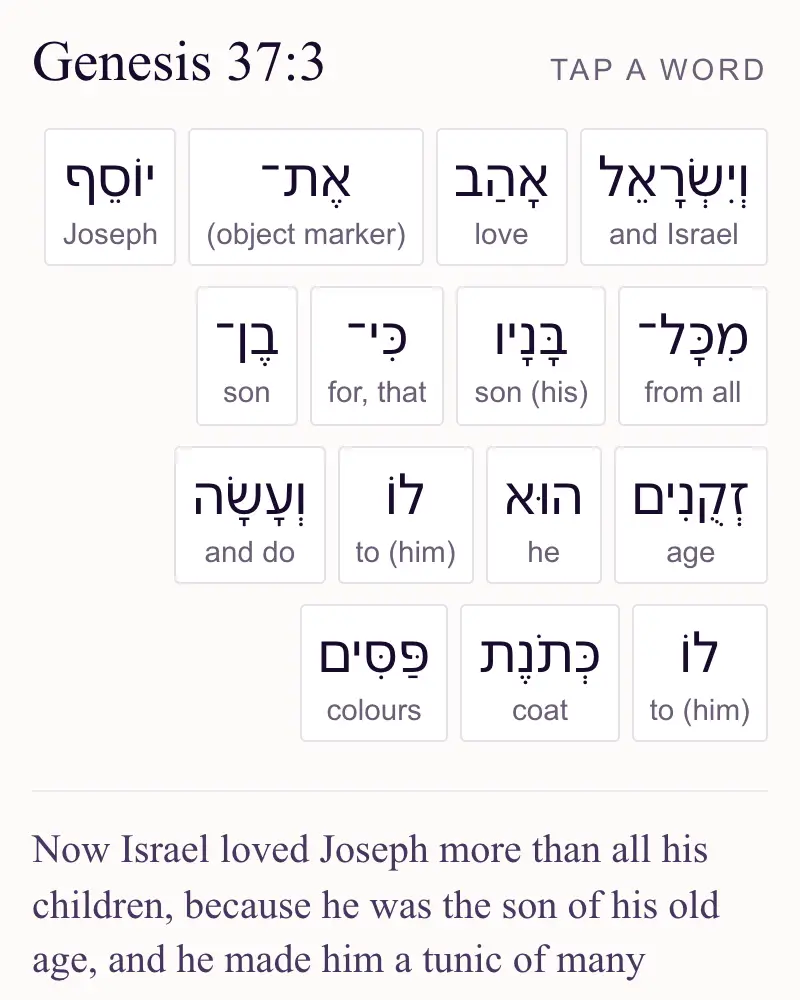
Genesis 37:3

Tap a word

Glosses under the words are the KJV's most frequent rendering of each dictionary form (or Strong's definition), a rough guide rather than a translation of this verse. Verse numbers follow the Hebrew text.

How this works. The Hebrew is the Westminster Leningrad Codex with lemma and morphology tags from the Open Scriptures Hebrew Bible, so every word links to its dictionary form and to every other place that form occurs. Parsing, transliteration and the pronunciation guide are generated, and approximate.

Hebrew text: Westminster Leningrad Codex (public domain). Lemmas and morphology: Open Scriptures Hebrew Bible Project, CC BY 4.0. Dictionary: Strong's Hebrew Dictionary (public domain) via the OSHB lexicon (CC BY 4.0). English: King James Version (1769); ASV and YLT renderings, public domain.

Hebrew word study: from one word to every place it occurs

The Hebrew Word Explorer opens any verse of the Hebrew Bible, from Genesis to Malachi, and lets you tap a word to see how it is built: its prefixes and suffixes, its dictionary form (lemma) with Strong's number, a transliteration and pronunciation guide, the parsing of the verb or noun, and a short dictionary meaning.

From there you can follow the word through Scripture: every verse where the same dictionary form occurs, with the King James Version text alongside, and the King James, American Standard and Young's Literal renderings of the word for comparison. Twelve featured words, such as ḥesed (steadfast love), šālôm (peace) and rûaḥ (spirit), come with curated notes. The Hebrew is the Westminster Leningrad Codex tagged by the Open Scriptures Hebrew Bible; parsing and transliteration are generated and approximate.

Twelve featured Hebrew words and how often they occur

Twelve featured Hebrew words and how often they occur
כְּתֹנֶת (kətōnet)tunic, robe · 29×
חֶסֶד (ḥesed)steadfast love, loyal kindness · 245×
שָׁלוֹם (šālôm)peace, wholeness, welfare · 237×
בְּרִית (bərît)covenant · 284×
רוּחַ (rûaḥ)wind, breath, spirit · 378×
אֱמוּנָה (ʾĕmûnâ)steadiness, faithfulness · 49×
תּוֹרָה (tôrâ)instruction, law · 219×
קָדוֹשׁ (qādôš)holy, set apart · 118×
לֵב (lēb)heart, mind · 593×
נֶפֶשׁ (nepeš)life, living being, soul · 754×
כָּבוֹד (kābôd)glory, honour, weight · 200×
יָשַׁע (yāšaʿ)save, deliver · 206×

Key verses 3

3Now Israel loved Joseph more than all his children, because he was the son of his old age: and he made him a coat of many colours.

Genesis 37:3

1O give thanks unto the LORD; for he is good: for his mercy endureth for ever.

Psalm 136:1

26The LORD lift up his countenance upon thee, and give thee peace.

Numbers 6:26

Scripture quotations: King James Version (KJV).

What the Bible says, what our model adds to it, where good readers disagree, and where the old copies and the translations differ. We set the views side by side and do not pick a winner.

  • Textually stated4
  • Strongly supported9
  • Plausible4

A few of the model's choices

  • Strongly supported

    A kĕtōnet was a tunic, the basic garment worn against the body.

  • Plausible

    It was a robe of many colours.

  • Plausible

    It reached to the palms and soles, a long robe with sleeves.

Show all 20
What the text says4

Stated in Scripture. Quoted from the King James Version (KJV) and the 1919 Chinese Union Version (和合本).

  • In Hebrew, a covenant is 'cut' (kārat bĕrît).

    Textually stated

    18In the same day the LORD made a covenant with Abram, saying, Unto thy seed have I given this land, from the river of Egypt unto the great river, the river Euphrates:

    Genesis 15:18 · KJV
  • The basic idea of ʾĕmûnâ is steadiness.

    Textually stated

    12But Moses’ hands were heavy; and they took a stone, and put it under him, and he sat thereon; and Aaron and Hur stayed up his hands, the one on the one side, and the other on the other side; and his hands were steady until the going down of the sun.

    Exodus 17:12 · KJV
  • The robe marked Joseph out as his father's favourite.

    Textually stated

    3Now Israel loved Joseph more than all his children, because he was the son of his old age: and he made him a coat of many colours. 4And when his brethren saw that their father loved him more than all his brethren, they hated him, and could not speak peaceably unto him.

    Genesis 37:3–4 · KJV
  • The seraphim call "Holy, holy, holy" (qādôš, three times).

    Textually stated

    3And one cried unto another, and said, Holy, holy, holy, is the LORD of hosts: the whole earth is full of his glory.

    Isaiah 6:3 · KJV
What the model adds13

Choices the reconstruction has to make where the text is silent, each with its evidence level and the reason for it.

Strongly supported9
  • A kĕtōnet was a tunic, the basic garment worn against the body.

    Why: God clothes Adam and Eve in kotnôt of skin, the priests wear a linen kĕtōnet under their robes, and Tamar wears one in 2 Samuel 13.

  • Ḥesed is kindness shown out of loyalty and commitment, not passing sentiment.

    Why: It is paired with ʾĕmet ('faithfulness') in Exodus 34:6 and with covenant-keeping in Deuteronomy 7:9. No single English word covers it, so the KJV uses 'mercy', 'kindness' and 'lovingkindness'.

  • Šālôm covers health, welfare and good relationships, not just the absence of conflict.

    Why: Joseph asks his brothers about their šālôm and their father's (Gen 43:27), and his brothers cannot speak to him lĕšālôm, 'peaceably' (Gen 37:4).

  • The basic sense of tôrâ is instruction, more than legislation.

    Why: Proverbs 1:8 speaks of 'your mother's tôrâ', and Strong's derives the word from yārâ, 'to point out, teach'.

  • Saying 'holy' three times is a Hebrew way of saying 'utterly holy'.

    Why: Hebrew often intensifies by repeating a word; Genesis 14:10 says 'pits, pits' for a valley full of pits. Isaiah 6:3 repeats qādôš three times.

  • The Hebrew heart is the seat of thought and will as well as feeling.

    Why: Solomon asks for 'an understanding heart' to judge and to discern between good and evil (1 Kgs 3:9). The KJV sometimes translates lēb as 'mind' or 'understanding'.

  • In Genesis 2:7 the man becomes a living being; he is not given a soul as a separate part.

    Why: The same phrase, nepeš ḥayyâ, describes the animals in Genesis 1:20 and 1:24.

  • Kābôd comes from a root meaning 'to be heavy'.

    Why: Strong's derives it from kābad, 'be heavy' (H3513), and the same root describes Eli as 'heavy' (1 Sam 4:18).

  • Joshua (Yĕhôšuaʿ) means 'the LORD saves'.

    Why: Strong's derives Joshua (H3091) from the divine name and yāšaʿ, and Isaiah (H3470) from yāšaʿ and Yah. Names built from a verb plus God's name are common in Hebrew.

Plausible4
  • It was a robe of many colours.

    Why: The Septuagint translates it as a 'varied' or 'many-coloured' tunic (chitōn poikilos), and the KJV follows that tradition. The Hebrew itself does not mention colour.

  • It reached to the palms and soles, a long robe with sleeves.

    Why: Pas can mean the palm of the hand or the sole of the foot (compare the Aramaic pas in Daniel 5:5). Strong's defines it as 'a long and sleeved tunic', which would suit someone who did not do manual work.

  • In Genesis 1:2, rûaḥ ʾĕlōhîm is the Spirit of God hovering over the waters.

    Why: This is the traditional reading (KJV). Some scholars read 'a wind from God' or 'a mighty wind', since rûaḥ means wind in Genesis 8:1 and ʾĕlōhîm can work as a superlative.

  • In Habakkuk 2:4 the righteous live by their faithfulness, which also includes trust.

    Why: The word usually means faithfulness, and many modern versions translate it that way. The Septuagint, and Paul quoting it (Rom 1:17), read it as faith.

Competing views2

Where careful readers disagree. Each view with who holds it and the evidence for and against it. No verdict.

Genesis 1:2: the Spirit of God, or a wind from God?

Genesis 1:2; Genesis 8:1

"The Spirit of God" hovering over the waters

Held by Most Christian translations (KJV, 和合本); Matthew Poole and the Pulpit Commentary

For

  • The Pulpit Commentary takes it as the Holy Spirit, the source of life and order in the world.
  • Matthew Poole argues it cannot be the wind, which was not yet created.

Against

  • The Cambridge Bible warns against reading the later doctrine of the Holy Spirit into the phrase.

Sources: Commentaries on Genesis 1:2 (Ellicott, Matthew Poole, Pulpit Commentary, Gill, Cambridge Bible)

What the lab shows (a drawing choice, not a ruling): The word card gives the traditional reading and names the other (Plausible).

Habakkuk 2:4: does the righteous live by faith, or by faithfulness?

Habakkuk 2:4; Romans 1:17

What the lab shows (a drawing choice, not a ruling): The word card says the word usually means faithfulness and that the Septuagint and Paul read it as faith (Plausible).

Textual notes1

Places where manuscripts, ancient versions or translations differ in numbers or wording. KJV and 和合本 are quoted as they stand.

Habakkuk 2:4 in the Greek and in the 和合本

Translations

4Behold, his soul which is lifted up is not upright in him: but the just shall live by his faith.

Habakkuk 2:4 · KJV

4迦勒底人自高自大、心不正直.惟義人因信得生。

哈巴谷書 2:4 · 和合本 (CUV 1919)
Other witnesses
Hebrew (Masoretic) textthe righteous will live by his faith (faithfulness)
Greek Septuagintthe righteous will live by my faith ("faith in me")

KJV reads "his faith"; the 和合本 reads 因信 ("by faith", without "his") and also names the proud man of the first half as 迦勒底人 (the Chaldeans), from the context of chapter 1. Paul's quotation (Romans 1:17) leaves out the Septuagint's "my", as Keil and Delitzsch note.

Sources: Commentaries on Habakkuk 2:4 (Cambridge Bible, Keil and Delitzsch, Pulpit Commentary, Barnes)

Frequently asked questions

How do I do a Hebrew word study without knowing Hebrew?

Open the verse, tap the word, and read its dictionary form, meaning and parsing. Then open its list of occurrences to see how the same word is used and translated elsewhere. The English beside each verse shows the sense without needing to read Hebrew.

What does hesed mean in Hebrew?

Ḥesed (חֶסֶד) is steadfast love or loyal kindness: love shown within a committed relationship. The KJV often renders it “mercy”, the ASV “lovingkindness”. The lab counts 245 occurrences of the word, for example Psalm 136:1.

How many times does ruach appear in the Old Testament?

The Hebrew rûaḥ (רוּחַ), wind, breath or spirit, occurs 378 times in the Westminster Leningrad Codex as tagged by the Open Scriptures Hebrew Bible. Counts follow that tagging and can differ slightly in other concordances.

Does the explorer show Hebrew roots?

It shows each word's dictionary form (lemma) with its Strong's number, which is how most lexicons group words, and the prefixes and suffixes attached to it. The curated notes on the featured words mention a root where it helps, such as ʾĕmûnâ, from the root behind “amen”, and mark how sure each claim is.

Can I read the Hebrew Bible word by word in English?

Roughly, yes. Under each Hebrew word is a short English gloss, the King James Version's most frequent rendering of that dictionary form, or Strong's definition. It is a reading aid, not a translation of the verse, so read it with the King James Version text, which you can show beside each verse.

How do I pronounce a Hebrew word?

Tap the word: its details give a transliteration and a “Say it” line that spells the sounds in plain letters. Both are generated from the Hebrew and approximate. They follow modern Hebrew sounds, which differ from how the words were spoken in biblical times, and they do not mark stress, which usually falls on the last syllable.

Sources & limits

Limits of this lab 4

  • Glosses follow Strong's dictionary (1890) with Brown–Driver–Briggs; a gloss is a starting point, and the meaning in any verse comes from its context.
  • Occurrences are counted by lemma in the Open Scriptures Hebrew Bible (Westminster Leningrad Codex); other editions may count a few differently.
  • A root shared by two words does not prove they share a meaning; the notes say where a link is only suggestive.
  • Only a small set of words is explained so far.

Sources 7

  1. King James Version (KJV) (Public domain outside the United Kingdom)
  2. 官話和合譯本 (Chinese Union Version, 1919), zh.wikisource (Public domain)
  3. Open Scriptures Hebrew Lexicon (Strong's and Brown–Driver–Briggs) (CC BY-SA)
  4. Commentaries on Genesis 1:2 (Ellicott, Matthew Poole, Pulpit Commentary, Gill, Cambridge Bible) (Public domain)
  5. Commentaries on Habakkuk 2:4 (Cambridge Bible, Keil and Delitzsch, Pulpit Commentary, Barnes) (Public domain)
  6. Open Scriptures Hebrew Bible (morphhb) (CC BY 4.0)
  7. Strong's H6446 pas / H3801 kethoneth (with Brown–Driver–Briggs)

Scripture is quoted only from KJV and the 1919 和合本. Other works are cited for facts and arguments, not quoted at length.

How we build the Labs →Found a mistake? Report it →

What’s new · v1.0.1Version 1.0.1: English Scripture is now quoted from the King James Version (1769).