 X-Dreamers
What Does Hesed Mean? Reading One Hebrew Word Slowly
Ḥesed occurs 245 times in the Hebrew Bible and the KJV needs five English words for it. Take it one verse at a time, from Psalm 136 to Ruth and Micah.
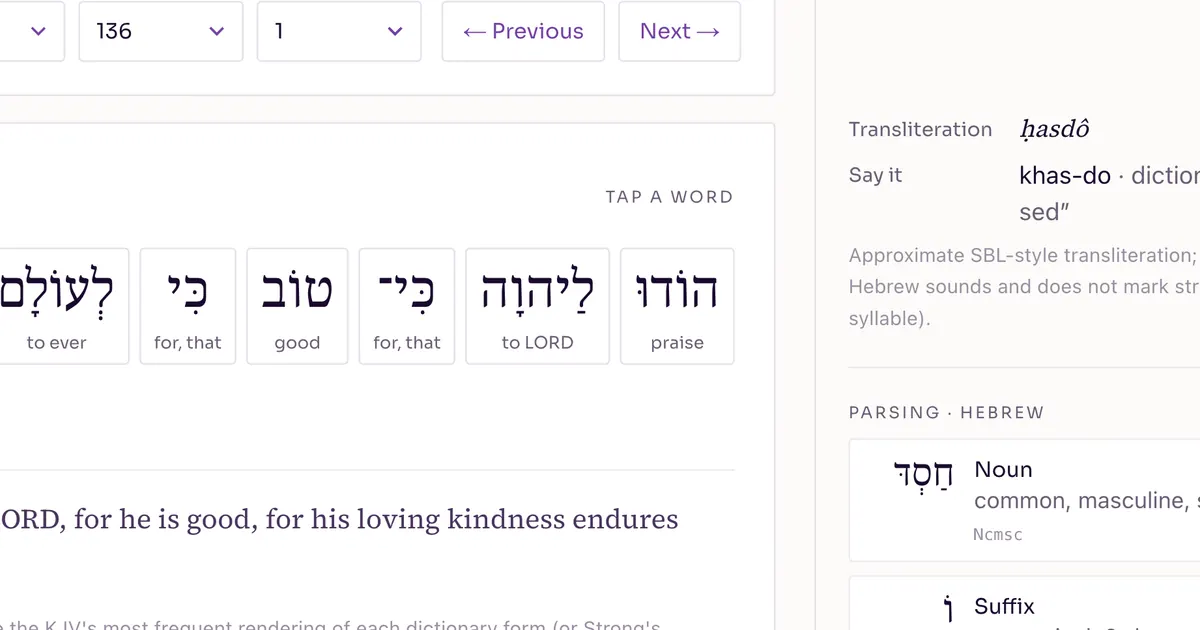
Ḥesed (חֶסֶד) is the Hebrew word behind “loving kindness” and “steadfast love”: kindness that comes out of loyalty and commitment, the love of someone who has bound himself to you and keeps his word. It occurs 245 times in the Hebrew Bible, more than half of them in the Psalms, and no single English word covers it. The King James Version spreads it over “mercy”, “kindness”, “lovingkindness”, “mercies” and “goodness”. The best way to understand a word like this is to read it slowly, one verse at a time, and watch what it does.
Start with one verse
Psalm 136 is a good place to begin, because it says the same thing twenty-six times. Every verse ends with the same three Hebrew words. Here is the first:
Give thanks to the LORD, for he is good, for his loving kindness endures forever. (Psalm 136:1)
In Hebrew that verse is only seven words long, and the last one is חַסְדּוֹ, ḥasdô. When you tap it in the Hebrew Word Explorer, the lab takes it apart. The main part is a noun, masculine, singular, in the construct form, and the small ending -ô is a suffix meaning “his”. So the word is not just “loving kindness” but “his loving kindness”. The dictionary form underneath is חֶסֶד, ḥesed, listed as H2617a.
That little suffix matters. In Psalm 136 the word never floats free as an abstract virtue. It is always his: the kindness of one who made the heavens (verse 5), struck down the Egyptian firstborn (verse 10) and led his people through the wilderness (verse 16).
One word, five English words
Scroll down to In translation and the lab shows how older English versions handled this one verse. The KJV has “his mercy endureth for ever”, the ASV “his lovingkindness”, and Young’s Literal “His kindness”. Below that, the lab lists the KJV’s choices across the whole Old Testament: “mercy” 137 times, “kindness” 37, “lovingkindness” 26, “mercies” 12 and “goodness” 12.
None of those is wrong, but each one leaves something out. “Mercy” suggests pity for someone who deserves punishment. “Kindness” can sound like a passing good mood. Ḥesed is neither. The lab’s note on the word puts it this way, and rates the claim Strongly supported: ḥesed is kindness shown out of loyalty and commitment, not passing sentiment.
The evidence is in the words it keeps company with. When the LORD proclaims his own name to Moses, ḥesed sits next to ʾĕmet, truth or faithfulness:
The LORD passed by before him, and proclaimed, “The LORD! The LORD, a merciful and gracious God, slow to anger, and abundant in loving kindness and truth, (Exodus 34:6)
And in Deuteronomy it is tied to covenant-keeping. God is “the faithful God, who keeps covenant and loving kindness to a thousand generations with those who love him and keep his commandments” (Deuteronomy 7:9). Ḥesed is the kind of love a covenant promises and a faithful partner keeps.
Where the word lives
Open Occurrences of H2617a and the lab counts them: 245 occurrences in 239 verses across 27 books. The bar chart beside the list tells its own story. The Psalms account for 127 of them, more than all the other books put together. Next, far behind, come 2 Samuel with 12 and Genesis with 11. Ḥesed is, above all, a word Israel sang.
The list pages through every verse with the WEBU text alongside, so you can follow the word out of the Psalms and into ordinary life. Two stops are worth making.
Ruth. When Naomi sends her widowed daughters-in-law home, she prays, “May the LORD deal kindly with you, as you have dealt with the dead and with me” (Ruth 1:8). “Deal kindly” is literally “do ḥesed”. Naomi asks God to show them the same loyal love they had shown to her family, long after anyone could have expected it. Open Ruth 1:8 at the word →
Micah. The prophet sums up what God wants: “to act justly, to love mercy, and to walk humbly with your God” (Micah 6:8). The “mercy” there is ḥesed again. God asks his people not only to receive this loyal kindness but to love it and practise it. Open Micah 6:8 at the word →
A second word: šālôm
The same slow reading works on any of the twelve featured words. Šālôm (שָׁלוֹם) is the obvious companion. It closes the priestly blessing:
The LORD lift up his face toward you, and give you peace.’ (Numbers 6:26)
The lab counts 237 occurrences in 209 verses across 31 books, with Jeremiah using it most (31 times). That makes sense once you see verses like this one, about the prophets of his day: “They have healed also the hurt of my people superficially, saying, ‘Peace, peace!’ when there is no peace.” (Jeremiah 6:14) In that one verse, šālôm appears three times.
The lab’s note, also rated Strongly supported, says šālôm covers health, welfare and good relationships, not just the absence of conflict. Genesis shows it in two small moments. Joseph’s brothers hated him and “couldn’t speak peaceably to him” (Genesis 37:4). Years later, in Egypt, the word comes back twice in one verse. Joseph “asked them of their welfare” (Genesis 43:27), then asked whether their father was well. “Welfare” and “well” are both šālôm.
Open šālôm in the priestly blessing →
Related words
At the bottom of the word card, Related words follows the derivations Strong’s dictionary gives. Ḥesed comes from the verb חָסַד, ḥāsad, and from the same source comes חָסִיד, ḥāsîd, a godly or faithful person, which the KJV translates “saints” nineteen times. A “saint” in the Psalms is someone marked by ḥesed.
The lab also keeps apart a rare word spelled the same way. H2617b, a different ḥesed meaning shame or reproach, occurs only twice, in Leviticus 20:17 and Proverbs 14:34 (“sin is a disgrace to any people”). A simple letter search would lump them together. The lemma tagging does not.
What the lab shows and what is approximate
| What you see | How reliable it is |
|---|---|
| The Hebrew text and the dictionary form of each word | Westminster Leningrad Codex, tagged by the Open Scriptures Hebrew Bible |
| Occurrence counts (245 for ḥesed, 237 for šālôm) | Exact for that tagging; other concordances may differ slightly |
| KJV renderings and counts, Strong’s definitions and related words | From Strong’s public-domain dictionary, an older and fairly rough guide |
| “Ḥesed is loyal, committed kindness” and “šālôm is wholeness and welfare” | Strongly supported, with the verses the lab cites |
| Transliteration, the “Say it” guide and the parsing labels | Generated, and approximate |
Two cautions are worth keeping in mind. First, the small English glosses printed under each Hebrew word are the KJV’s most common rendering for that dictionary form, not a translation of the verse in front of you. Second, verse numbers follow the Hebrew, which occasionally differs from English Bibles, especially in psalm titles.
Frequently asked questions
What does hesed mean? Loyal, committed love: kindness shown because of a relationship and a promise. English versions render it “steadfast love”, “loving kindness”, “mercy” or “kindness”.
How many times does hesed appear in the Bible? 245 times as the lab counts it, in 239 verses. 127 of those are in the Psalms, and 26 in Psalm 136 alone.
Is hesed the same as grace? Not quite. Hebrew has another word, ḥēn, that the KJV usually translates “grace” or “favour”. Exodus 34:6 has both ideas side by side: God is “gracious” and “abundant in loving kindness”.
Do I need to know Hebrew to use the explorer? No. Every verse has the WEBU beside it, and every word shows its dictionary form, parsing and meaning in English.
Read a word slowly yourself
Pick a verse you love, tap one word, and follow it through the Bible. Or start with one of the twelve featured words on the lab’s front page.
Start with ḥesed in Psalm 136 →
Related labs and articles
- Bible Word Usage: see where words like love, grace and law cluster across the whole Bible.
- Joseph’s Robe: another featured word, kĕtōnet, and what the “coat of many colours” was.
- Seasons of Waiting: how the Hebrew words for “wait” and “hope” overlap.
Found this helpful? Pass it on.