Skip to content
X-Dreamers

Exodus 12–20 · Numbers 33

The Exodus Route in 3D

Through the sea to Sinai

Which way did Israel go after the Passover? Follow the Exodus route in immersive 3D from Rameses, through the sea on dry ground, to Mount Sinai, with every proposed crossing and mountain marked by how sure it is.

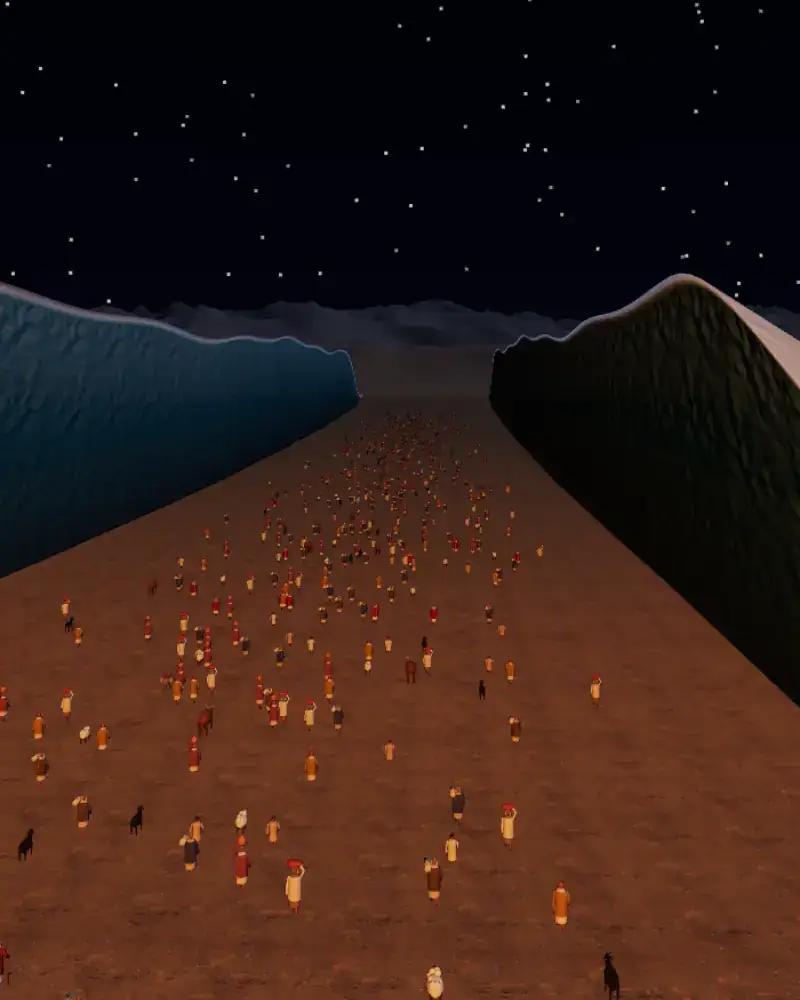
The crossing of the sea at night: Israel walking on dry ground between two walls of water, lit by the pillar of fire

The Exodus

Walk the journey stop by stop: the Passover night, the walls of water, manna at dawn, the storm on the mountain. A route map of Numbers 33 with the main theories.

3D · about 1.3 MB

Loading the Exodus…

Textually statedBiblical text
Dew lay round about the camp, and when it went up the manna was left on the ground (Exodus 16:13–14).
Artistic depiction

Stop 14 of 22 · Into the wilderness · Dew at dawn

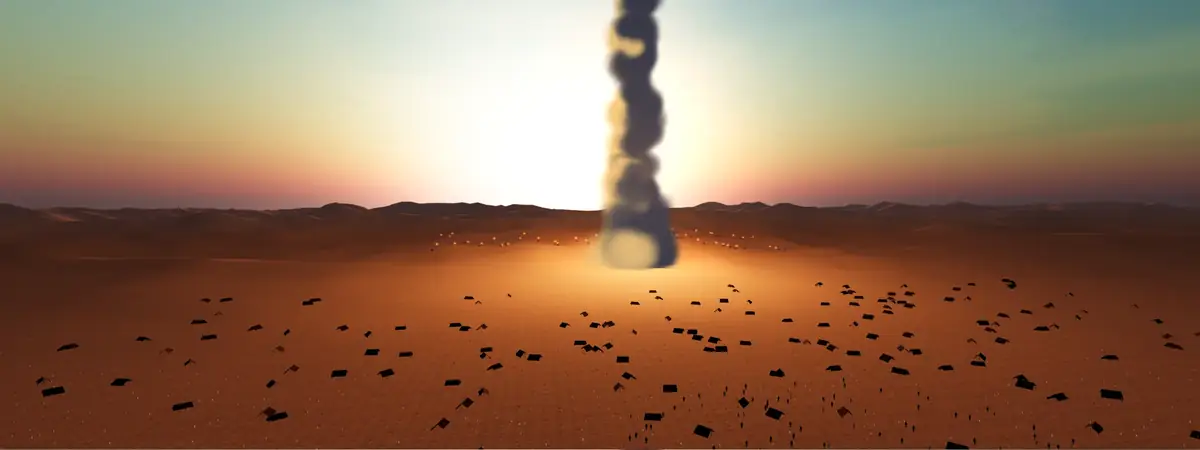
Dawn in the wilderness of Sin: dew lies all round the camp. Tap Next to see what is left when it lifts.

  • Textually statedBiblical text

    Dew lay round about the camp, and when it went up the manna was left on the ground (Exodus 16:13–14).

  • ArtisticArtistic choice

    An artistic depiction: shapes, colours, people and places are drawn from the text, not from a known site.

The route (Numbers 33)

  • Route of the chosen theory
  • Other theories
  • Crossing proposed by a theory
  • The coast road Israel did not take (Exodus 13:17)
  • Candidate for Mount Sinai

Every place except Rameses is a proposal; evidence levels are on each one.

PlausibleEarly date about 1446 BC · late date about 1260 BCSee both dates on the Bible Time Map →

Camps of Numbers 33

  • By Yam SuphSpeculativeThe coastal plain of el-Markha?

    And they removed from Elim, and encamped by the Red sea. Numbers 33:10

  • Wilderness of SinSpeculativeBetween Elim and Sinai

    And they removed from the Red sea, and encamped in the wilderness of Sin. Numbers 33:11

How sure are we?

Event

Manna

Also: Man hu: what is it? (Exodus 16:15) · Bread from heaven

In the wilderness of Sin, when the dew lifted in the morning, a fine flake-like thing lay on the ground. Each gathered what he needed; on the sixth day twice as much, and none on the Sabbath.

It was white like coriander seed and tasted like wafers made with honey. Israel ate it for forty years, until they came to the border of Canaan. Jesus called himself the true bread from heaven.

  • An omer a head (Exodus 16:16)
  • A jar of manna kept before the testimony (Exodus 16:33–34)

How sure are we?

  • Textually statedBiblical text

    When the layer of dew went up, a small round thing, fine as frost, lay on the ground; it melted when the sun grew hot.

    Exodus 16:13–14 and 16:21.

    Exodus 16:13–14 · Exodus 16:21

  • SpeculativeArchaeology & research

    Manna was the sweet honeydew that scale insects leave on tamarisk bushes in Sinai.

    Bedouin still gather this 'man' in early summer (Bodenheimer 1947). It is found only in small amounts, in some seasons, and does not explain daily supply for forty years, the double portion on the sixth day or the Sabbath, as the text describes.

Event

Quail at evening

Also: Numbers 11:31

At evening quail came up and covered the camp.

The LORD answered the people's complaint for meat. Numbers 11 tells of a second, larger fall of quail, brought by a wind from the sea.

How sure are we?

  • Textually statedBiblical text

    Quail came up at evening and covered the camp.

    Exodus 16:13.

    Exodus 16:13

  • Strongly supportedArchaeology & research

    Common quail cross Sinai in great numbers on their spring and autumn migrations and land exhausted near the coasts.

    Their migration across Sinai is well documented. The date in Exodus 16:1 (the second month, in spring) fits the northward migration.

Stop 7 of 10 · 2nd month, 15th day

Manna and quail

In the wilderness of Sin the people grumbled for bread and meat. At evening quail covered the camp; in the morning, when the dew lifted, a fine flake-like thing lay on the ground. They did not know what it was. Moses said: 'This is the bread which the LORD hath given you to eat.'

  • Textually statedBiblical text

    Dew lay round about the camp, and when it went up the manna was left on the ground (Exodus 16:13–14).

  • ArtisticArtistic choice

    An artistic depiction: shapes, colours, people and places are drawn from the text, not from a known site.

Camps of Numbers 33

  • By Yam SuphSpeculativeThe coastal plain of el-Markha?

    And they removed from Elim, and encamped by the Red sea. Numbers 33:10

  • Wilderness of SinSpeculativeBetween Elim and Sinai

    And they removed from the Red sea, and encamped in the wilderness of Sin. Numbers 33:11

Scripture

1And they took their journey from Elim, and all the congregation of the children of Israel came unto the wilderness of Sin, which is between Elim and Sinai, on the fifteenth day of the second month after their departing out of the land of Egypt. 2And the whole congregation of the children of Israel murmured against Moses and Aaron in the wilderness: 3And the children of Israel said unto them, Would to God we had died by the hand of the LORD in the land of Egypt, when we sat by the flesh pots, and when we did eat bread to the full; for ye have brought us forth into this wilderness, to kill this whole assembly with hunger. 4Then said the LORD unto Moses, Behold, I will rain bread from heaven for you; and the people shall go out and gather a certain rate every day, that I may prove them, whether they will walk in my law, or no.

Exodus 16:1–4 (KJV)

12I have heard the murmurings of the children of Israel: speak unto them, saying, At even ye shall eat flesh, and in the morning ye shall be filled with bread; and ye shall know that I am the LORD your God. 13And it came to pass, that at even the quails came up, and covered the camp: and in the morning the dew lay round about the host.

Exodus 16:12–13 (KJV)

13And it came to pass, that at even the quails came up, and covered the camp: and in the morning the dew lay round about the host. 14And when the dew that lay was gone up, behold, upon the face of the wilderness there lay a small round thing, as small as the hoar frost on the ground. 15And when the children of Israel saw it, they said one to another, It is manna: for they wist not what it was. And Moses said unto them, This is the bread which the LORD hath given you to eat.

Exodus 16:13–15 (KJV)

21And they gathered it every morning, every man according to his eating: and when the sun waxed hot, it melted. 22And it came to pass, that on the sixth day they gathered twice as much bread, two omers for one man: and all the rulers of the congregation came and told Moses. 23And he said unto them, This is that which the LORD hath said, To morrow is the rest of the holy sabbath unto the LORD: bake that which ye will bake to day, and seethe that ye will seethe; and that which remaineth over lay up for you to be kept until the morning.

Exodus 16:21–23 (KJV)

31And the house of Israel called the name thereof Manna: and it was like coriander seed, white; and the taste of it was like wafers made with honey.

Exodus 16:31 (KJV)

35And the children of Israel did eat manna forty years, until they came to a land inhabited; they did eat manna, until they came unto the borders of the land of Canaan.

Exodus 16:35 (KJV)

31Our fathers did eat manna in the desert; as it is written, He gave them bread from heaven to eat. 32Then Jesus said unto them, Verily, verily, I say unto you, Moses gave you not that bread from heaven; but my Father giveth you the true bread from heaven. 33For the bread of God is he which cometh down from heaven, and giveth life unto the world. 34Then said they unto him, Lord, evermore give us this bread. 35And Jesus said unto them, I am the bread of life: he that cometh to me shall never hunger; and he that believeth on me shall never thirst.

John 6:31–35 (KJV)

English quotations are from the King James Version (1769).

Event

Manna

Also: Man hu: what is it? (Exodus 16:15) · Bread from heaven

In the wilderness of Sin, when the dew lifted in the morning, a fine flake-like thing lay on the ground. Each gathered what he needed; on the sixth day twice as much, and none on the Sabbath.

It was white like coriander seed and tasted like wafers made with honey. Israel ate it for forty years, until they came to the border of Canaan. Jesus called himself the true bread from heaven.

  • An omer a head (Exodus 16:16)
  • A jar of manna kept before the testimony (Exodus 16:33–34)

How sure are we?

  • Textually statedBiblical text

    When the layer of dew went up, a small round thing, fine as frost, lay on the ground; it melted when the sun grew hot.

    Exodus 16:13–14 and 16:21.

    Exodus 16:13–14 · Exodus 16:21

  • SpeculativeArchaeology & research

    Manna was the sweet honeydew that scale insects leave on tamarisk bushes in Sinai.

    Bedouin still gather this 'man' in early summer (Bodenheimer 1947). It is found only in small amounts, in some seasons, and does not explain daily supply for forty years, the double portion on the sixth day or the Sabbath, as the text describes.

Event

Quail at evening

Also: Numbers 11:31

At evening quail came up and covered the camp.

The LORD answered the people's complaint for meat. Numbers 11 tells of a second, larger fall of quail, brought by a wind from the sea.

How sure are we?

  • Textually statedBiblical text

    Quail came up at evening and covered the camp.

    Exodus 16:13.

    Exodus 16:13

  • Strongly supportedArchaeology & research

    Common quail cross Sinai in great numbers on their spring and autumn migrations and land exhausted near the coasts.

    Their migration across Sinai is well documented. The date in Exodus 16:1 (the second month, in spring) fits the northward migration.

Evidence levels

  • Textually stated

    Textually stated: Said directly in the biblical text.

  • Strongly supported

    Strongly supported: A close inference from the text or firm evidence.

  • Plausible

    Plausible: A reasonable reconstruction among live options.

  • Speculative

    Speculative: An informed guess; the text is silent.

  • Artistic

    Artistic: A stylistic choice made for the reconstruction.

Where each claim comes from

  • Biblical text
  • Archaeology & research
  • Later tradition
  • Artistic choice

Sources and credits

Scripture is quoted verbatim. Scholarly sources are cited for the places, dates and numbers, including views that doubt the story; the terrain, coastlines and textures are open data.

  1. King James Version (KJV) · Public domain
  2. 官話和合譯本 (Chinese Union Version, 1919), from Wikisource · Public domain
  3. James K. Hoffmeier, Israel in Egypt: The Evidence for the Authenticity of the Exodus Tradition (Oxford University Press, 1997)

    Rameses, Succoth, the eastern frontier and the lakes.

  4. James K. Hoffmeier, Ancient Israel in Sinai (Oxford University Press, 2005)

    The Ballah Lakes, Egyptian forts and the wilderness itinerary.

  5. Kenneth A. Kitchen, On the Reliability of the Old Testament (Eerdmans, 2003)

    The date of the exodus and the route.

  6. Manfred Bietak, Avaris: The Capital of the Hyksos (British Museum Press, 1996), with the Qantir excavation reports

    Tell el-Dab'a and Pi-Ramesse.

  7. Colin J. Humphreys, The Miracles of Exodus (HarperOne, 2003)

    Proposes a smaller total and a Midian location; cited here for the 'eleph' reading.

  8. George E. Mendenhall, 'The Census Lists of Numbers 1 and 26', Journal of Biblical Literature 77 (1958)
  9. Doron Nof and Nathan Paldor, 'Are There Oceanographic Explanations for the Israelites' Crossing of the Red Sea?', Bulletin of the American Meteorological Society 73 (1992)
  10. Carl Drews and Weiqing Han, 'Dynamics of Wind Setdown at Suez and the Eastern Nile Delta', PLoS ONE 5(8): e12481 (2010) · CC BY 4.0
  11. F. S. Bodenheimer, 'The Manna of Sinai', The Biblical Archaeologist 10 (1947)
  12. Egeria's Travels, translated by John Wilkinson (3rd ed., Aris & Phillips, 1999)

    A pilgrim's account of Sinai, about AD 383.

  13. Emmanuel Anati, The Mountain of God: Har Karkom (Rizzoli, 1986)
  14. The Merneptah Stele (Egyptian Museum, Cairo, JE 31408), about 1208 BC
  15. Israel Finkelstein and Neil Asher Silberman, The Bible Unearthed (Free Press, 2001)

    The case that the exodus as told is not historical.

  16. Copernicus DEM GLO-30 and GLO-90: © DLR e.V. 2010–2014 and © Airbus Defence and Space GmbH 2014–2018, provided under COPERNICUS by the European Union and ESA; all rights reserved · Free use with attribution

    Terrain of Jebel Musa and the relief of the route map.

  17. Natural Earth 1:10m land, lakes and rivers · Public domain

    Coastlines of the route map.

  18. Poly Haven textures (sand, stone, mud and others) · CC0

    Photographic surfaces of the 3D scenes; every model is procedural and no AI image generation is used.

Use this in class

22 stops · about 40 minutes

Teach mode puts large captions on the projector, follows a presentation clicker and keeps presenter notes on your own screen.

How to teach with the labs →

Watch a 40-second tour

A silent clip of the guided tour with its captions, made from this lab. Play it before class, or download it to show without a connection.

This is an illustration, not a map of certainties. The Bible tells the journey in detail but names places few can locate today. The 3D scenes are artistic depictions of the text, down to the clouds and the soft light on each tour stop; the desert between the stops (its dry riverbeds, gravel plains, low dunes, rock outcrops and acacias) is illustrative, not a survey of any place. The map places each camp by the theory you choose. Every claim carries its evidence level.

English quotations are from the King James Version (1769).

What route did the Israelites take in the Exodus?

Exodus 12–20 tells how Israel left Egypt the morning after the first Passover, went out from Rameses to Succoth, was led by a pillar of cloud and fire, crossed the sea on dry ground, and came through Marah, Elim, the wilderness of Sin and Rephidim to Mount Sinai in the third month. Numbers 33 lists the camps. Only Rameses, the delta city of Pi-Ramesse at Qantir, is securely located; the other camps depend on where the sea and the mountain were.

This lab follows the journey stop by stop in 3D, from a mud-brick house on the Passover night to the storm on the mountain and the two tablets. A route map shows the three main theories for the crossing (a northern lake, the Bitter Lakes or Gulf of Suez, and the Gulf of Aqaba) and four candidates for Mount Sinai, each with an honest evidence level. The 3D scenes are artistic depictions of the text; the Sinai scenes use the real terrain of the traditional site, Jebel Musa.

The Exodus at a glance

The Exodus at a glance
ScriptureExodus 12–20; the camps in Numbers 33:3–15
Setting outThe day after the Passover, the 15th of the first month (Numbers 33:3)
Camps to SinaiRameses, Succoth, Etham, Pi-hahiroth, Marah, Elim, by Yam Suph, the wilderness of Sin, Dophkah, Alush, Rephidim, the wilderness of Sinai
Arrival at SinaiIn the third month (Exodus 19:1)
Yam SuphHebrew for 'sea of reeds'; the Greek Bible called it the Red Sea
Crossing theoriesA northern lake; the Bitter Lakes or Gulf of Suez; the Gulf of Aqaba
Sinai candidatesJebel Musa (traditional), Jebel Serbal, Jebel al-Lawz, Har Karkom
DatesAbout 1446 BC (1 Kings 6:1) or about 1260 BC (under Ramesses II)
PeopleAbout 600,000 men on foot besides children (Exodus 12:37); the reading of the number is debated

Key verses 5

37And the children of Israel journeyed from Rameses to Succoth, about six hundred thousand on foot that were men, beside children. 38And a mixed multitude went up also with them; and flocks, and herds, even very much cattle.

Exodus 12:37–38

21And the LORD went before them by day in a pillar of a cloud, to lead them the way; and by night in a pillar of fire, to give them light; to go by day and night: 22He took not away the pillar of the cloud by day, nor the pillar of fire by night, from before the people.

Exodus 13:21–22

21And Moses stretched out his hand over the sea; and the LORD caused the sea to go back by a strong east wind all that night, and made the sea dry land, and the waters were divided. 22And the children of Israel went into the midst of the sea upon the dry ground: and the waters were a wall unto them on their right hand, and on their left.

Exodus 14:21–22

20And Miriam the prophetess, the sister of Aaron, took a timbrel in her hand; and all the women went out after her with timbrels and with dances. 21And Miriam answered them, Sing ye to the LORD, for he hath triumphed gloriously; the horse and his rider hath he thrown into the sea.

Exodus 15:20–21

16And it came to pass on the third day in the morning, that there were thunders and lightnings, and a thick cloud upon the mount, and the voice of the trumpet exceeding loud; so that all the people that was in the camp trembled. 17And Moses brought forth the people out of the camp to meet with God; and they stood at the nether part of the mount. 18And mount Sinai was altogether on a smoke, because the LORD descended upon it in fire: and the smoke thereof ascended as the smoke of a furnace, and the whole mount quaked greatly. 19And when the voice of the trumpet sounded long, and waxed louder and louder, Moses spake, and God answered him by a voice. 20And the LORD came down upon mount Sinai, on the top of the mount: and the LORD called Moses up to the top of the mount; and Moses went up.

Exodus 19:16–20

Scripture quotations: King James Version (1769) (KJV).

What the Bible says, what our model adds to it, where good readers disagree, and where the old copies and the translations differ. We set the views side by side and do not pick a winner.

  • Textually stated9
  • Strongly supported3
  • Plausible5
  • Speculative2
  • Artistic4

A few of the model's choices

  • Plausible

    The night of the fourteenth to the fifteenth of the month fell at or near the full moon.

  • Plausible

    The house is built of sun-dried mud brick with a flat roof of beams, reeds and plaster.

  • Strongly supported

    Pi-Ramesse lay at Qantir and Tell el-Dab'a in the eastern Nile delta.

Show all 31
What the text says9

Stated in Scripture. Quoted from the King James Version (KJV) and the 1919 Chinese Union Version (和合本).

  • The blood was put on the two doorposts and the lintel of each house, applied with a bunch of hyssop.

    Textually stated

    7And they shall take of the blood, and strike it on the two side posts and on the upper door post of the houses, wherein they shall eat it.

    Exodus 12:7 · KJV
  • The text says about 600,000 men on foot, besides children.

    Textually stated

    37And the children of Israel journeyed from Rameses to Succoth, about six hundred thousand on foot that were men, beside children.

    Exodus 12:37 · KJV
  • A pillar of cloud led by day and a pillar of fire by night, and it did not depart.

    Textually stated

    21And the LORD went before them by day in a pillar of a cloud, to lead them the way; and by night in a pillar of fire, to give them light; to go by day and night:

    Exodus 13:21 · KJV
  • A strong east wind blew all night, the waters were divided, and Israel went through on dry ground with the water a wall on their right and on their left.

    Textually stated

    21And Moses stretched out his hand over the sea; and the LORD caused the sea to go back by a strong east wind all that night, and made the sea dry land, and the waters were divided. 22And the children of Israel went into the midst of the sea upon the dry ground: and the waters were a wall unto them on their right hand, and on their left.

    Exodus 14:21–22 · KJV
  • Elim had twelve springs of water and seventy palm trees.

    Textually stated

    27And they came to Elim, where were twelve wells of water, and threescore and ten palm trees: and they encamped there by the waters.

    Exodus 15:27 · KJV
  • When the layer of dew went up, a small round thing, fine as frost, lay on the ground; it melted when the sun grew hot.

    Textually stated

    14And when the dew that lay was gone up, behold, upon the face of the wilderness there lay a small round thing, as small as the hoar frost on the ground.

    Exodus 16:14 · KJV
  • Thunder, lightning, a thick cloud, a very loud trumpet blast, smoke like a furnace and fire, and the whole mountain quaking.

    Textually stated

    16And it came to pass on the third day in the morning, that there were thunders and lightnings, and a thick cloud upon the mount, and the voice of the trumpet exceeding loud; so that all the people that was in the camp trembled.

    Exodus 19:16 · KJV
  • The tablets were written on both sides, the work of God.

    Textually stated

    15And Moses turned, and went down from the mount, and the two tables of the testimony were in his hand: the tables were written on both their sides; on the one side and on the other were they written.

    Exodus 32:15 · KJV
  • Numbers 33 lists the camps from Rameses to the wilderness of Sinai.

    Textually stated

    3And they departed from Rameses in the first month, on the fifteenth day of the first month; on the morrow after the passover the children of Israel went out with an high hand in the sight of all the Egyptians.

    Numbers 33:3 · KJV
What the model adds14

Choices the reconstruction has to make where the text is silent, each with its evidence level and the reason for it.

Strongly supported3
  • Pi-Ramesse lay at Qantir and Tell el-Dab'a in the eastern Nile delta.

    Why: Excavations by Manfred Bietak, Edgar Pusch and others found the city's palaces, workshops and stables there. That this is the biblical Rameses is widely held.

  • Common quail cross Sinai in great numbers on their spring and autumn migrations and land exhausted near the coasts.

    Why: Their migration across Sinai is well documented. The date in Exodus 16:1 (the second month, in spring) fits the northward migration.

  • Jebel Musa has been venerated as Sinai since at least the 4th century AD.

    Why: Egeria's travel account and the monastery built under Justinian.

Plausible5
  • The night of the fourteenth to the fifteenth of the month fell at or near the full moon.

    Why: Months began with the new moon, so the middle of the month is the full moon. The text itself never mentions the moon.

  • The house is built of sun-dried mud brick with a flat roof of beams, reeds and plaster.

    Why: Mud brick was the building material of the Nile delta (Exodus 1:14; 5:7), and excavations at Tell el-Dab'a (Avaris) found houses of Asiatic settlers built that way. The layout, furniture and street here are artistic.

  • Succoth is the region of Tjeku in the Wadi Tumilat, perhaps at Tell el-Maskhuta.

    Why: The names are close and the geography fits a route east from Rameses, but no inscription names the Israelites' camp.

  • A strong wind blowing all night can push back shallow water and bare the bottom for some hours.

    Why: Oceanographic models (Nof and Paldor 1992 for the Gulf of Suez; Drews and Han 2010 for a lagoon of the eastern delta) show that such 'wind setdown' is physically possible. They show a possible means, not what happened, and the text presents the event as the LORD's act.

  • The Song of the Sea is among the oldest poetry in the Hebrew Bible.

    Why: Its grammar and vocabulary are archaic; scholars of many views (for example Cross and Freedman) date it early, though estimates vary.

Speculative2
  • Manna was the sweet honeydew that scale insects leave on tamarisk bushes in Sinai.

    Why: Bedouin still gather this 'man' in early summer (Bodenheimer 1947). It is found only in small amounts, in some seasons, and does not explain daily supply for forty years, the double portion on the sixth day or the Sabbath, as the text describes.

  • Apart from Rameses, where the camps lay on the map is uncertain; the lab places each one by the route theory you choose.

    Why: Most names are descriptive ('bitter', 'booths') and were never recorded again. The dots on the map are the usual proposals for each theory, not findings.

Artistic4
  • Its height, shape and colour here are artistic.

    Why: The text says what it did, not how it looked. It is drawn as a towering column, soft white by day and glowing by night.

  • The 3D crossing does not show any particular place.

    Why: The shores, the width of the passage and the height of the water are an artistic depiction of the text. The map shows where the main theories place it.

  • The split granite boulder and the stream here are artistic.

    Why: Pilgrims have been shown a split 'Rock of Moses' near Jebel Musa since the Middle Ages; the text gives no description.

  • Their size, shape and script here are artistic; the carved lines are not letters.

    Why: The text gives no measurements. The familiar round-topped tablets come from medieval and later art; many scholars think each tablet may have carried a full copy of the covenant, as ancient treaties were made in duplicate.

Competing views4

Where careful readers disagree. Each view with who holds it and the evidence for and against it. No verdict.

Which mountain was Sinai?

Deuteronomy 1:2; Galatians 4:25

Jebel Musa, in the south of the Sinai peninsula

Held by Christian tradition since at least the 4th century (Egeria; St Catherine's Monastery under Justinian) and local Bedouin tradition

For

  • It fits the southern route and an eleven-day journey to Kadesh-barnea (Deuteronomy 1:2).
  • The plain of er-Raha at its foot could hold a large camp, and the area has water and pasture.

Against

  • The tradition is some 1,700 years after the events, and no finds tie the mountain to Israel.

Sources: Egeria's Travels, translated by John Wilkinson (3rd ed., Aris & Phillips, 1999); Wikipedia, "Biblical Mount Sinai"

Jebel Serbal, in the west of the peninsula

Held by Some early Christian hermits and monks of the 4th century; a minority view today

For

  • Early monastic settlement gathered there before the tradition settled on Jebel Musa.

Against

  • It has no large plain at its foot, and the older tradition chose Jebel Musa.
  • Josephus calls Sinai the highest mountain of the area; Serbal is lower than its neighbours.

Sources: Wikipedia, "Biblical Mount Sinai"

Jebel al-Lawz, in north-west Arabia (ancient Midian)

Held by Ron Wyatt (1984), Bob Cornuke, Lennart Möller and others

For

  • Moses met God near Midian, where Jethro lived (Exodus 3:1), and Paul speaks of "Mount Sinai in Arabia" (Galatians 4:25).
  • Its supporters point to a dark summit and stone structures at its foot.

Against

  • The features cited have not been confirmed by professional survey; the summit is naturally dark rock, and the structures may belong to other periods. Hoffmeier lists serious errors in the case.
  • In Paul's day "Arabia" included the Nabataean lands, which reached into the Sinai peninsula, and the view requires a crossing of the Gulf of Aqaba.

Sources: Wikipedia, "Biblical Mount Sinai"; James K. Hoffmeier, Ancient Israel in Sinai (Oxford University Press, 2005)

Har Karkom, in the Negev

Held by Emmanuel Anati

For

  • It was a major cult centre, with shrines, stone circles and tens of thousands of rock engravings.

Against

  • Its busiest religious activity (about 2350–2000 BC) is long before any proposed date of the exodus.
  • It lies close to Kadesh-barnea, not eleven days away (Deuteronomy 1:2).

Sources: Emmanuel Anati, The Mountain of God: Har Karkom (Rizzoli, 1986); Wikipedia, "Biblical Mount Sinai"

What the lab shows (a drawing choice, not a ruling): The 3D Sinai is built on the real terrain of Jebel Musa, and the map shows the candidate each route theory implies (Jebel Musa for the two Egyptian routes, Jebel al-Lawz for Aqaba). All are marked; the Bible's own clues do not settle it.

Where did Israel cross the sea?

Exodus 14:2; Numbers 33:5–10

The northern lakes on Egypt's eastern border (the Ballah Lakes)

Held by James Hoffmeier; Kenneth Kitchen supports a crossing in the Suez isthmus

For

  • Survey of the eastern frontier found old lake beds and Egyptian forts; the lakes were a reedy barrier in the New Kingdom.
  • Hoffmeier links yam suph with the Egyptian pa-tjufy, a name for lakes of the eastern delta.

Against

  • That Israel crossed there is a proposal, not a finding; none of the camp names (Pi-hahiroth, Migdol, Baal-zephon) has been securely located.

Sources: James K. Hoffmeier, Ancient Israel in Sinai (Oxford University Press, 2005); Wikipedia, "Crossing the Red Sea"

The Bitter Lakes or the head of the Gulf of Suez

Held by Many reconstructions of a southern route through western Sinai

For

  • It fits a march east from the Wadi Tumilat, a turn back to camp by the sea, and the stations of Numbers 33 down the west of Sinai.
  • Oceanographic models show that a strong wind all night can push back shallow water there for some hours (Nof and Paldor).

Against

  • The models show a possible means, not what happened, and the camp names before the crossing are still unlocated.

Sources: Doron Nof and Nathan Paldor, 'Are There Oceanographic Explanations for the Israelites' Crossing of the Red Sea?', Bulletin of the American Meteorological Society 73 (1992); Carl Drews and Weiqing Han, 'Dynamics of Wind Setdown at Suez and the Eastern Nile Delta', PLoS ONE 5(8): e12481 (2010); Wikipedia, "Crossing the Red Sea"

The Gulf of Aqaba at Nuweiba

Held by Ron Wyatt, Lennart Möller, Bob Cornuke and Glen Fritz

For

  • Yam Suph is used for the Gulf of Aqaba (1 Kings 9:26), and it leads on to a Sinai in Midian.
  • Its supporters report chariot wheels and remains on the gulf floor.

Against

  • Nuweiba is over 300 km from the delta, far more than the three camps Numbers 33 lists before the sea; the gulf there is hundreds of metres deep.
  • No remains have been recovered, dated or published by professional archaeologists.

Sources: Wikipedia, "Crossing the Red Sea"

What the lab shows (a drawing choice, not a ruling): The map draws all three routes and opens on the Bitter Lakes route; the 3D crossing does not show any particular place.

When was the exodus, and is it history?

1 Kings 6:1; Exodus 1:11; Judges 11:26

About 1446 BC

Held by Readers who take 1 Kings 6:1 and Judges 11:26 as continuous chronology

For

  • 1 Kings 6:1 puts the exodus 480 years before Solomon began the Temple (about 966 BC), and Jephthah speaks of 300 years in the land (Judges 11:26).

Against

  • Critics read 480 as twelve generations of forty years, a round figure; the Greek text reads 440 (see the textual notes).
  • The store city Rameses (Exodus 1:11) fits the 13th century better.
About 1270–1250 BC, under Ramesses II

Held by Kenneth Kitchen, James Hoffmeier and many archaeologists

For

  • Pi-Ramesse, the city of Rameses, was built in the 13th century BC at Qantir (Bietak's excavations).
  • The Merneptah Stele, about 1208 BC, already names Israel as a people in Canaan.

Against

  • Genesis 47:11 already speaks of "the land of Rameses" in Joseph's day, so the name may be a later writer's name for an older place.

Sources: Kenneth A. Kitchen, On the Reliability of the Old Testament (Eerdmans, 2003); James K. Hoffmeier, Israel in Egypt: The Evidence for the Authenticity of the Exodus Tradition (Oxford University Press, 1997); Manfred Bietak, Avaris: The Capital of the Hyksos (British Museum Press, 1996), with the Qantir excavation reports; The Merneptah Stele (Egyptian Museum, Cairo, JE 31408), about 1208 BC

Not an accurate account of Israel's origins

Held by Israel Finkelstein and Neil Asher Silberman; the majority of critical scholars

For

  • No archaeological trace of Israel's wilderness camps has been found, and Israel appears to emerge in the central highlands of Canaan.

Against

  • Tents and campsites of nomads rarely survive, so absence of remains is weak evidence; Egyptian details in the story fit the New Kingdom (Hoffmeier, Kitchen).

Sources: Israel Finkelstein and Neil Asher Silberman, The Bible Unearthed (Free Press, 2001); Wikipedia, "The Exodus"; James K. Hoffmeier, Israel in Egypt: The Evidence for the Authenticity of the Exodus Tradition (Oxford University Press, 1997)

What the lab shows (a drawing choice, not a ruling): The lab tells the story as the text gives it; its date note sets the early date, the late date and the doubts side by side.

How many left Egypt?

Exodus 12:37; Judges 6:15

About 600,000 men, two million or more in all

Held by The traditional reading

For

  • Exodus 12:37 gives about 600,000 men on foot, and the census of Numbers 1:46 adds up to 603,550 in thousands and hundreds.

Against

  • With women and children that is 2.5 to 3 million, far more than the Sinai could support; the text answers this with God's provision.

Sources: Wikipedia, "The Exodus"

"Thousand" (eleph) means a clan or a unit: perhaps tens of thousands

Held by Flinders Petrie, George Mendenhall, Colin Humphreys

For

  • Eleph can mean a clan, as in Gideon's "my family (eleph) is poor in Manasseh" (Judges 6:15).

Against

  • The census sums in Numbers still add up as thousands, which this view must explain.

Sources: George E. Mendenhall, 'The Census Lists of Numbers 1 and 26', Journal of Biblical Literature 77 (1958); Colin J. Humphreys, The Miracles of Exodus (HarperOne, 2003)

What the lab shows (a drawing choice, not a ruling): The lab quotes the number as the text gives it; its scenes do not try to show the whole people.

Textual notes4

Places where manuscripts, ancient versions or translations differ in numbers or wording. KJV and 和合本 are quoted as they stand.

430 years "in Egypt", or in Egypt and Canaan?

Manuscripts

40Now the sojourning of the children of Israel, who dwelt in Egypt, was four hundred and thirty years.

Exodus 12:40 · KJV

40以色列人住在埃及共有四百三十年。

出埃及記 12:40 · 和合本 (CUV 1919)

17And this I say, that the covenant, that was confirmed before of God in Christ, the law, which was four hundred and thirty years after, cannot disannul, that it should make the promise of none effect.

Galatians 3:17 · KJV

17我是這麼說、 神豫先所立的約、不能被那四百三十年以後的律法廢掉、叫應許歸於虛空。

加拉太書 3:17 · 和合本 (CUV 1919)
Other witnesses
Hebrew (Masoretic) textlived in Egypt 430 years
Greek Septuagint (Vatican copy)the sojourning of the children (and of their fathers) in the land of Canaan and in the land of Egypt
Samaritan Pentateuchin the land of Canaan and in the land of Egypt

KJV and the 和合本 both follow the Hebrew: 430 years in Egypt. The Greek and Samaritan texts count the patriarchs' time in Canaan as well, which halves the stay in Egypt. Paul's 430 years from the promise to the law (Galatians 3:17) agrees with the longer count; Benson's commentary makes the same link.

Sources: Commentaries on Exodus 12:40 (Benson, Jamieson–Fausset–Brown, Gill)

"Red Sea" / 「紅海」 or "Sea of Reeds"?

Translations

4Pharaoh’s chariots and his host hath he cast into the sea: his chosen captains also are drowned in the Red sea.

Exodus 15:4 · KJV

4法老的車輛、軍兵、耶和華已拋在海中、他特選的軍長、都沉於紅海。

出埃及記 15:4 · 和合本 (CUV 1919)

3And when she could not longer hide him, she took for him an ark of bulrushes, and daubed it with slime and with pitch, and put the child therein; and she laid it in the flags by the river’s brink.

Exodus 2:3 · KJV

3後來不能再藏、就取了一個蒲草箱、抹上石漆和石油、將孩子放在裏頭、把箱子擱在河邊的蘆荻中。

出埃及記 2:3 · 和合本 (CUV 1919)
Other witnesses
Hebrewyam suph, "sea of reeds" (suph is the word for the reeds of Exodus 2:3)
Greek Septuagint; Acts 7:36 and Hebrews 11:29erythra thalassa, "Red Sea"

KJV and the 和合本 both follow the Greek with "Red sea" / 「紅海」, as most English and Chinese Bibles do; some modern translations put "Sea of Reeds". The same Hebrew name is used for the Gulf of Aqaba (1 Kings 9:26) and apparently the Gulf of Suez (Numbers 33:10), so the name alone does not locate the crossing.

Sources: Wikipedia, "Yam Suph"

600,000: what is a "thousand"?

Units

37And the children of Israel journeyed from Rameses to Succoth, about six hundred thousand on foot that were men, beside children.

Exodus 12:37 · KJV

37以色列人從蘭塞起行、往疎割去.除了婦人孩子、步行的男人約有六十萬。

出埃及記 12:37 · 和合本 (CUV 1919)

Both translations read "six hundred thousand" / 「六十萬」, and the text supports it. The question is the unit: the Hebrew eleph is the ordinary word for "thousand", but it can also mean a clan (Judges 6:15). Petrie, Mendenhall and Humphreys read the census lists in clans or units and arrive at about 5,000 to 6,000 fighting men, which Humphreys puts at about 20,000 people in all; other readings of eleph give somewhat larger totals. See "Competing views".

Sources: George E. Mendenhall, 'The Census Lists of Numbers 1 and 26', Journal of Biblical Literature 77 (1958); Colin J. Humphreys, The Miracles of Exodus (HarperOne, 2003)

480 years to the Temple (Greek: 440)

Manuscripts

1And it came to pass in the four hundred and eightieth year after the children of Israel were come out of the land of Egypt, in the fourth year of Solomon’s reign over Israel, in the month Zif, which is the second month, that he began to build the house of the LORD.

1 Kings 6:1 · KJV

1以色列人出埃及地後四百八十年、所羅門作以色列王、第四年西弗月、就是二月、開工建造耶和華的殿。

列王紀上 6:1 · 和合本 (CUV 1919)
Other witnesses
Hebrew (Masoretic) text480th year
Greek Septuagint440th year

Both translations read 480, the figure behind the early date of about 1446 BC. Ellicott, Barnes and the Cambridge Bible note the Greek 440 (Josephus gives 592); Keil and Delitzsch defend the 480.

Sources: Commentaries on 1 Kings 6:1 (Ellicott, Barnes, Cambridge Bible, Keil and Delitzsch)

Frequently asked questions

What route did the Israelites take out of Egypt?

Numbers 33 lists the camps from Rameses to the wilderness of Sinai. Exodus 13:17 says God did not lead them by the coast road to Canaan but round by the wilderness toward the sea. Apart from Rameses, where the camps lay is uncertain, so the lab draws the route of each main theory.

Where did the Israelites cross the Red Sea?

No one knows for certain. The main proposals are a northern lake near the Mediterranean (the Ballah Lakes or Lake Sirbonis), the Bitter Lakes or the head of the Gulf of Suez, and the Gulf of Aqaba at Nuweiba. The first two are plausible; the Aqaba theory and its claimed chariot wheels are speculative.

What does Yam Suph mean?

Yam Suph, the Hebrew name of the sea, means 'sea of reeds': suph is the word for the reeds where Moses was hidden. The Greek Septuagint translated it 'Red Sea'. The same name is used for the Gulf of Aqaba (1 Kings 9:26), so the name alone does not locate the crossing.

Where is Mount Sinai?

Its location is unknown. Jebel Musa in the southern Sinai has been venerated as Sinai since at least the 4th century AD and is a plausible candidate. Jebel Serbal, Jebel al-Lawz in Saudi Arabia and Har Karkom in the Negev have also been proposed; the evidence for them is speculative.

When did the Exodus happen?

Scholars who accept a historical exodus mostly favour about 1446 BC, counting 480 years back from Solomon's fourth year (1 Kings 6:1), or about 1260 BC, under Ramesses II, who built the city of Rameses. The Merneptah Stele shows Israel in Canaan by about 1208 BC.

How many Israelites left Egypt?

Exodus 12:37 counts about 600,000 men on foot besides children, which read as ordinary numbers means two million or more. Some scholars read the Hebrew 'eleph' ('thousand') as a clan or military unit, giving tens of thousands. The text's number is certain; its meaning is debated.

How long did it take to get from Egypt to Mount Sinai?

Six weeks to two months. Israel set out on the 15th day of the first month, the day after the Passover (Numbers 33:3), reached the wilderness of Sin on the 15th of the second month (Exodus 16:1), and came to the wilderness of Sinai in the third month (Exodus 19:1). Reading “the same day” there as the first of the month gives about 45 days. The dates are stated; the exact day count depends on that reading.

Did a wind part the Red Sea?

Exodus 14:21 gives both: the LORD drove the sea back “by a strong east wind all that night” and the waters were divided. Computer models published in 2010 showed that a strong, steady east wind could push back the water of a shallow delta lagoon for some hours, which fits the northern-lake theory; that is plausible as a mechanism but debated. The text presents the crossing as God's act, with walls of water on either side (14:22), which goes beyond a simple wind setdown.

Sources & limits

Limits of this lab 5

  • Apart from Rameses, none of the camps on the way to Sinai has been located for certain; the map places them by the route theory you choose.
  • No archaeological remains of the journey have been found, so the scenes rest on the text and on Egypt and Sinai of the New Kingdom period.
  • The crossing scene does not depict any particular place, and the walls of water, the cloud and the fire are artistic.
  • People are stylized, and no violence is shown in the battle with Amalek.
  • The 3D Sinai uses the real terrain of Jebel Musa, a choice for the scene, not a ruling on which mountain it was.

Sources 25

  1. King James Version (KJV) (Public domain outside the United Kingdom)
  2. 官話和合譯本 (Chinese Union Version, 1919), zh.wikisource (Public domain)
  3. King James Version (KJV) (Public domain)
  4. James K. Hoffmeier, Israel in Egypt: The Evidence for the Authenticity of the Exodus Tradition (Oxford University Press, 1997)
  5. James K. Hoffmeier, Ancient Israel in Sinai (Oxford University Press, 2005)
  6. Kenneth A. Kitchen, On the Reliability of the Old Testament (Eerdmans, 2003)
  7. Manfred Bietak, Avaris: The Capital of the Hyksos (British Museum Press, 1996), with the Qantir excavation reports
  8. Colin J. Humphreys, The Miracles of Exodus (HarperOne, 2003)
  9. George E. Mendenhall, 'The Census Lists of Numbers 1 and 26', Journal of Biblical Literature 77 (1958)
  10. Doron Nof and Nathan Paldor, 'Are There Oceanographic Explanations for the Israelites' Crossing of the Red Sea?', Bulletin of the American Meteorological Society 73 (1992)
  11. Carl Drews and Weiqing Han, 'Dynamics of Wind Setdown at Suez and the Eastern Nile Delta', PLoS ONE 5(8): e12481 (2010) (CC BY 4.0)
  12. F. S. Bodenheimer, 'The Manna of Sinai', The Biblical Archaeologist 10 (1947)
  13. Egeria's Travels, translated by John Wilkinson (3rd ed., Aris & Phillips, 1999)
  14. Emmanuel Anati, The Mountain of God: Har Karkom (Rizzoli, 1986)
  15. The Merneptah Stele (Egyptian Museum, Cairo, JE 31408), about 1208 BC
  16. Israel Finkelstein and Neil Asher Silberman, The Bible Unearthed (Free Press, 2001)
  17. Copernicus DEM GLO-30 and GLO-90: © DLR e.V. 2010–2014 and © Airbus Defence and Space GmbH 2014–2018, provided under COPERNICUS by the European Union and ESA; all rights reserved (Free use with attribution)
  18. Natural Earth 1:10m land, lakes and rivers (Public domain)
  19. Poly Haven textures (sand, stone, mud and others) (CC0)
  20. Commentaries on 1 Kings 6:1 (Ellicott, Barnes, Cambridge Bible, Keil and Delitzsch) (Public domain)
  21. Wikipedia, "Yam Suph"
  22. Wikipedia, "Crossing the Red Sea"
  23. Wikipedia, "Biblical Mount Sinai"
  24. Wikipedia, "The Exodus"
  25. Commentaries on Exodus 12:40 (Benson, Jamieson–Fausset–Brown, Gill) (Public domain)

Scripture is quoted only from KJV and the 1919 和合本. Other works are cited for facts and arguments, not quoted at length.

How we build the Labs →Found a mistake? Report it →

What’s new · v2.3.2Version 2.3.2: English Scripture is now quoted from the King James Version (1769).