 X-Dreamers
Paul's Second Missionary Journey, Step by Step (Acts 15:36–18:22)
Paul's second missionary journey stop by stop: Antioch to Troas, over to Philippi, Thessalonica, Athens and Corinth, and home, with dates and how sure we are.
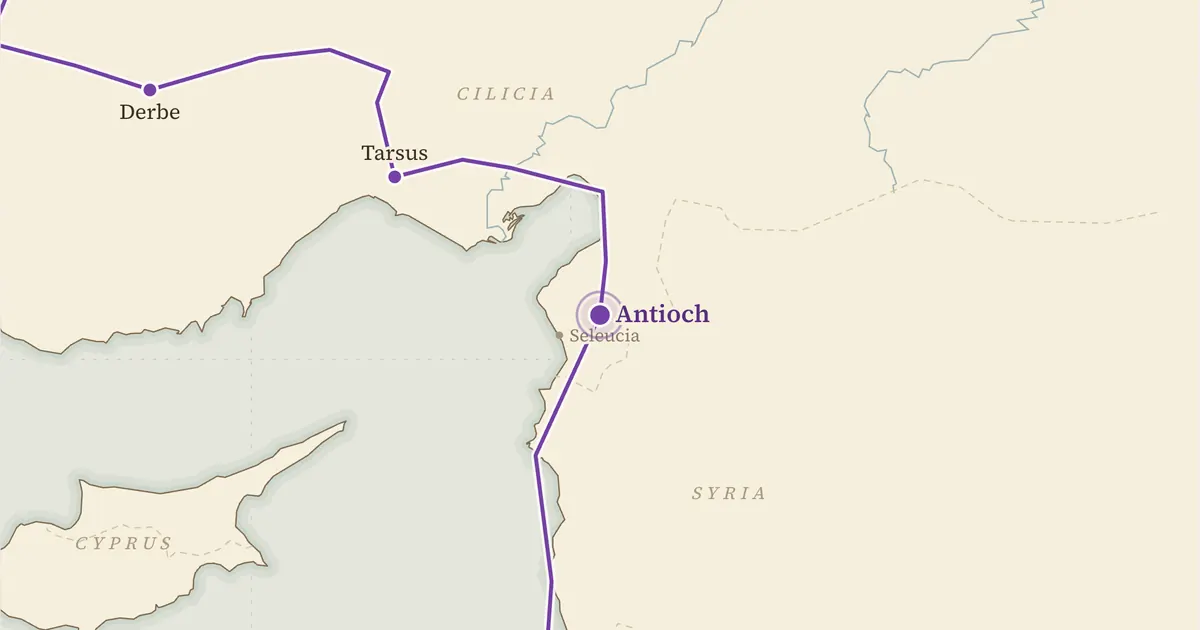
Paul’s second missionary journey, told in Acts 15:36–18:22, took him from Syrian Antioch overland through Cilicia and southern Galatia, where Timothy joined him, then north-west to Troas on the Aegean. After a vision of a man of Macedonia he crossed into Europe and planted churches at Philippi, Thessalonica, Berea and Corinth, with a speech at the Areopagus in Athens on the way. He stayed a year and a half in Corinth, then sailed home by way of Ephesus and Caesarea. It was roughly three years, about AD 49/50 to 52, and some 4,500 km by road and sea.
This is one of several journeys: see all of Paul's missionary journeys on one map.
Follow the journey on the map →
The journey at a glance
| Stage | Acts | Travel (the lab’s estimate) | What happened |
|---|---|---|---|
| Antioch | 15:36–40 | Start | Paul and Barnabas part; Paul chooses Silas |
| Syria, Cilicia, Derbe, Lystra | 15:41–16:5 | About 485 km on foot | Timothy joins at Lystra |
| Phrygia and Galatia to Troas | 16:6–10 | About 655 km on foot | Barred from Asia and Bithynia; the man of Macedonia |
| Troas to Philippi | 16:11–40 | Two days by sea, then about 15 km | Lydia, the slave girl, the jailer |
| Via Egnatia to Thessalonica | 17:1–9 | About 100 Roman miles | Three Sabbaths; a riot |
| Berea and Athens | 17:10–34 | Probably 4–8 days by sea | The Bereans; the Areopagus |
| Corinth | 18:1–17 | About 80 km | A year and six months; Gallio |
| Home by Ephesus and Caesarea | 18:18–22 | Some 1,400 km by sea, then by road | “I will return” |
Why a second journey?
It began as a pastoral visit:
After some days Paul said to Barnabas, “Let’s return now and visit our brothers in every city in which we proclaimed the word of the Lord, to see how they are doing.” (Acts 15:36)
Barnabas wanted to take John Mark, who had left them during the first journey. Paul refused, and “the contention grew so sharp that they separated from each other” (Acts 15:39). Barnabas sailed for Cyprus with Mark; Paul chose Silas and went north by land.
Through Cilicia to Lystra: Timothy joins
Acts says only that they went “through Syria and Cilicia”. The lab marks the stage at Tarsus, Paul’s home city on the obvious road, but rates the visit only plausible. The road then crossed the Taurus mountains by the Cilician Gates to Derbe. Coming from the east, Paul reached Derbe before Lystra, the reverse of the first journey.
At Lystra they met a disciple “named Timothy, the son of a Jewess who believed, but his father was a Greek” (Acts 16:1), who became one of Paul’s closest co-workers.
Two closed doors and a vision at Troas
The natural next step was west to Ephesus, but “they were forbidden by the Holy Spirit to speak the word in Asia” (Acts 16:6). They tried Bithynia, and again “the Spirit didn’t allow them” (Acts 16:7). So they came down to the coast at Troas, with nowhere left to go but across the sea.
A vision appeared to Paul in the night. There was a man of Macedonia standing, begging him and saying, “Come over into Macedonia and help us.” (Acts 16:9)
The next verse slips into the first person: “immediately we sought to go out to Macedonia” (Acts 16:10). Most readers take this as Luke joining the team.
Philippi: the first church in Europe
They reached Samothrace in a day and Neapolis the next, then walked about ten Roman miles up the Via Egnatia to Philippi, a colony of Roman veterans. There were few Jews, and on the Sabbath the team found a group of women at a place of prayer by the river. Lydia, a dealer in purple cloth from Thyatira, listened, “The Lord opened her heart to listen to the things which were spoken by Paul” (Acts 16:14), and her house became the church’s first meeting place.
When Paul freed a slave girl from a spirit of divination, her owners had him and Silas beaten and jailed. At midnight they were singing hymns when an earthquake opened the doors, and the jailer asked what he must do to be saved: “Believe in the Lord Jesus Christ, and you will be saved, you and your household” (Acts 16:31).
Along the Via Egnatia: Thessalonica and Berea
Amphipolis and Apollonia (Acts 17:1) were stations on the Via Egnatia. The “we” stops here, so Luke seems to have stayed in Philippi.
In Thessalonica Paul reasoned in the synagogue for three Sabbaths. When a mob could not find him, they dragged his host Jason before the city rulers shouting, “These who have turned the world upside down have come here also” (Acts 17:6). Luke calls them politarchs, a title inscriptions from Thessalonica confirm.
Sent away by night, Paul and Silas went to Berea, where the Jews “received the word with all readiness of mind, examining the Scriptures daily to see whether these things were so” (Acts 17:11). When agitators followed, the believers sent Paul to the coast, probably to sail for Athens.
Athens: an altar to an unknown God
In Athens Paul argued in the synagogue and the marketplace, and the philosophers brought him before the Areopagus. He began with what he had seen:
For as I passed along and observed the objects of your worship, I also found an altar with this inscription: ‘TO AN UNKNOWN GOD.’ What therefore you worship in ignorance, I announce to you. (Acts 17:23)
When he came to the resurrection, “some mocked” (Acts 17:32), but Dionysius, a member of the council, and a woman named Damaris believed.
Corinth: eighteen months and a date
In Corinth Paul lodged and worked as a tentmaker with Aquila and Priscilla, Jews recently expelled from Rome by Claudius. Opposed in the synagogue, he moved next door, and Crispus, the synagogue ruler, believed. The Lord told him in the night, “Don’t be afraid, but speak and don’t be silent” (Acts 18:9).
He lived there a year and six months, teaching the word of God among them. (Acts 18:11)
Corinth also dates the whole journey. Acts gives no years, but Paul was accused “when Gallio was proconsul of Achaia” (Acts 18:12), and a letter of Claudius inscribed at Delphi puts Gallio’s year in office at about AD 51–52. It is the firmest date in Paul’s life.
Home by sea
Paul sailed from Cenchreae, Corinth’s eastern port. At Ephesus he would not stay, but promised to return “if God wills” (Acts 18:21), as he did on the third journey. Landing at Caesarea, “he went up and greeted the assembly, and went down to Antioch” (Acts 18:22). “Went up” usually means to Jerusalem, though the city is not named.
What we know and what is reconstructed
The lab rates every place and route. Some examples:
| Detail | Evidence level |
|---|---|
| Derbe before Lystra; Troas to Neapolis in two days; Paul lands at Caesarea | Stated in the text |
| Cilician Gates route; the Via Egnatia distances; politarchs at Thessalonica; the Gallio date | Strongly supported |
| Paul passed Tarsus; the “region of Phrygia and Galatia” was southern Galatia; Luke joined at Troas; Paul went up to Jerusalem | Plausible |
| A stop at Pisidian Antioch; the road towards Bithynia; walking from Athens to Corinth | Speculative |
| The marker in the middle of Mysia | Artistic |
Frequently asked questions
How long did Paul’s second missionary journey last? About three years, roughly AD 49/50 to 52, half of it in Corinth. If Gallio’s year was AD 50–51, as some argue, everything moves back a year.
Who went with Paul? Silas from the start, Timothy from Lystra, and probably Luke from Troas to Philippi.
Did Paul write any letters on this journey? Probably 1 and 2 Thessalonians, from Corinth, to the church he had to leave so suddenly.
Walk it yourself
Go stop by stop in Guided journey with Acts beside the map, press Play, or switch to Explore the map and pick any city. Each stop has a “How sure can we be?” panel.
Related
- Paul’s second journey on the Bible Story Map: where Acts 15–18 sits in the whole story.
- The Bible Time Map: the second journey beside Paul’s other journeys and letters.
- The Bible on one timeline: how the dates from Abraham to the early church fit together.
Found this helpful? Pass it on.