Skip to content
X-Dreamers

World · Jerusalem's water

Hezekiah's Tunnel in 3D

533 metres through the rock, by lamplight

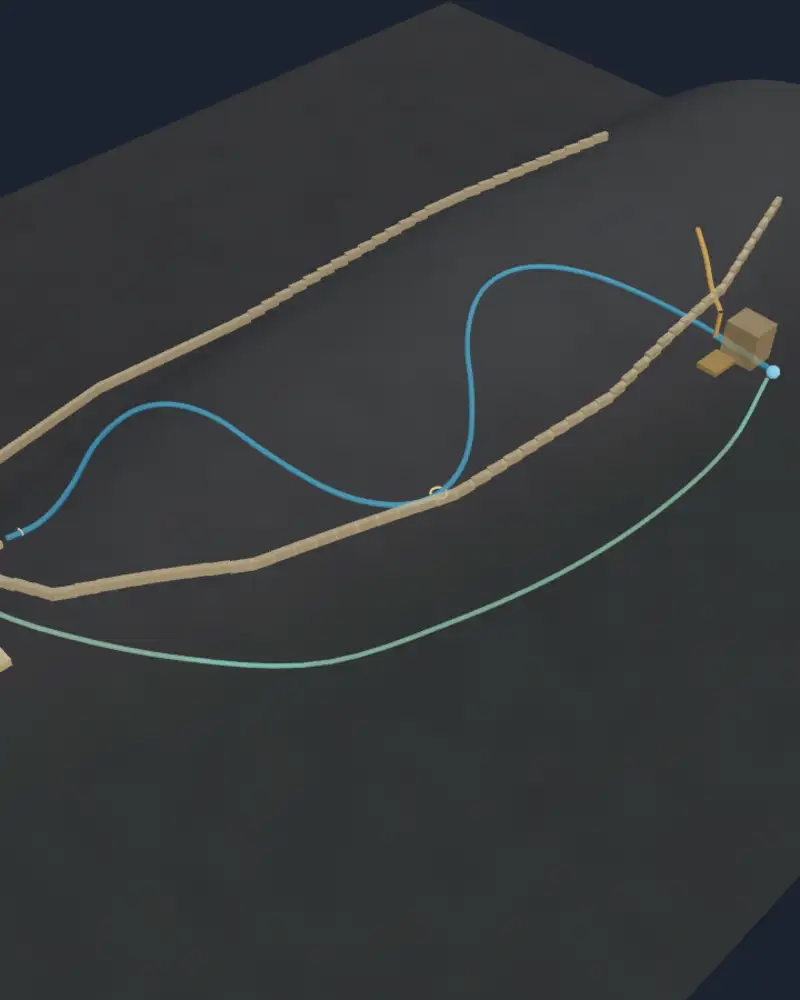
Hezekiah's tunnel carries the Gihon spring's water 533 m through the rock under the City of David to the Pool of Siloam. See its course in a see-through 3D map of the ridge, then take the immersive walk through it by lamplight.

A see-through view of the City of David's ridge with the S-shaped tunnel from the Gihon spring to the Pool of Siloam

Hezekiah's Tunnel

See through the ridge, then walk the tunnel by lamplight.

Explore in 3D · drag to turn, pinch to zoom

3D · about 400 KB

Loading Hezekiah's Tunnel…

Reconstruction
The tunnel straightened outfall drawn ×6

Tunnels drawn wider than life, so they can be seen

Take the guided tour: 10 stops from the spring to the pool.

The tunnel in numbers

Length along the floor
≈ 533 m
Straight line between the ends
≈ 320 m
Fall from end to end
≈ 30 cm (0.06%)
Head height
1.1 m – 5 m
Width
≈ 60 cm

The water works

Tap a marker in the scene, or choose here.

The Siloam inscription

Hebrew (in square script; brackets mark damage)

1[…] הנקבה. וזה היה דבר הנקבה. בעוד […]

2הגרזן אש אל רעו ובעוד שלש אמת להנ[קב …] קל אש ק[ר]

3א אל רעו כי הית זדה בצר מימן ומ[שמאל]. וביום ה

4נקבה הכו החצבם אש לקרת רעו גרזן על [ג]רזן וילכו

5המים מן המוצא אל הברכה במאתים ואלף אמה ומ[א]

6ת אמה היה גבה הצר על ראש החצב[ם]

Our translation

… the tunnel. And this is the story of the tunnel. While [the hewers were swinging] the pick, each toward his fellow, and while there were still three cubits to cut, the voice of a man was heard calling to his fellow, for there was a fissure in the rock on the right and on the left. And on the day of the tunnelling the hewers struck, each to meet his fellow, pick against pick. And the water flowed from the spring to the pool, twelve hundred cubits, and a hundred cubits was the height of the rock over the heads of the hewers.

Today: Istanbul Archaeology Museums. A cast marks the spot in the tunnel.

What the Bible says

20And the rest of the acts of Hezekiah, and all his might, and how he made a pool, and a conduit, and brought water into the city, are they not written in the book of the chronicles of the kings of Judah?

2 Kings 20:20

2And when Hezekiah saw that Sennacherib was come, and that he was purposed to fight against Jerusalem, 3He took counsel with his princes and his mighty men to stop the waters of the fountains which were without the city: and they did help him. 4So there was gathered much people together, who stopped all the fountains, and the brook that ran through the midst of the land, saying, Why should the kings of Assyria come, and find much water?

2 Chronicles 32:2–4

30This same Hezekiah also stopped the upper watercourse of Gihon, and brought it straight down to the west side of the city of David. And Hezekiah prospered in all his works.

2 Chronicles 32:30

9Ye have seen also the breaches of the city of David, that they are many: and ye gathered together the waters of the lower pool. 10And ye have numbered the houses of Jerusalem, and the houses have ye broken down to fortify the wall. 11Ye made also a ditch between the two walls for the water of the old pool: but ye have not looked unto the maker thereof, neither had respect unto him that fashioned it long ago.

Isaiah 22:9–11

How sure is each feature?

  • Textually stated

    Textually stated: Said directly in the biblical text.

  • Strongly supported

    Strongly supported: A close inference from the text or firm evidence.

  • Plausible

    Plausible: A reasonable reconstruction among live options.

  • Speculative

    Speculative: An informed guess; the text is silent.

  • Artistic

    Artistic: A stylistic choice made for the reconstruction.

Sources

  1. C. Warren, Underground Jerusalem (1876)
  2. H. Vincent, Underground Jerusalem: Discoveries on the Hill of Ophel (1909–11) (1911)
  3. F. J. Bliss and A. C. Dickie, Excavations at Jerusalem 1894–1897 (1898)
  4. Y. Shiloh, Excavations at the City of David I, 1978–1982 (Qedem 19, 1984)
  5. R. Reich and E. Shukron, “Light at the End of the Tunnel”, Biblical Archaeology Review 25:1 (1999)
  6. R. Reich and E. Shukron, “The Date of the Siloam Tunnel Reconsidered”, Tel Aviv 38 (2011)
  7. A. Frumkin, A. Shimron and J. Rosenbaum, “Radiometric Dating of the Siloam Tunnel, Jerusalem”, Nature 425 (2003)
  8. A. Frumkin and A. Shimron, “Tunnel Engineering in the Iron Age: Geoarchaeology of the Siloam Tunnel, Jerusalem”, Journal of Archaeological Science 33 (2006)
  9. D. Gill, “Subterranean Waterworks of Biblical Jerusalem: Adaptation of a Karst System”, Science 254 (1991)
  10. A. Sneh, R. Weinberger and E. Shalev, “The Why, How, and When of the Siloam Tunnel Reevaluated”, BASOR 359 (2010)
  11. J. Rogerson and P. R. Davies, “Was the Siloam Tunnel Built by Hezekiah?”, Biblical Archaeologist 59 (1996)
  12. H. Donner and W. Röllig, Kanaanäische und aramäische Inschriften, no. 189: the Siloam inscription
  13. H. Shanks, “The Siloam Pool: Where Jesus Cured the Blind Man”, Biblical Archaeology Review 31:5 (2005)

Use this in class

10 stops · about 25 minutes

Teach mode puts large captions on the projector, follows a presentation clicker and keeps presenter notes on your own screen.

How to teach with the labs →

Watch a 40-second tour

A silent clip of the guided tour with its captions, made from this lab. Play it before class, or download it to show without a connection.

How sure is this? The tunnel's course, length, fall and heights follow the surveys, simplified; the ridge above it is a smooth sketch, and the tunnel is drawn wider in the see-through view so it can be seen. Older works that are not Hezekiah's are marked as earlier. Every feature says how sure it is and what is debated.

Scripture quotations are from the King James Version (1769).

One place across the agesSee Jerusalem through the ages →See the tunnel in its city: Hezekiah's Jerusalem from the Mount of Olives, with the Broad Wall and the Western Hill, and drag the years on to Jesus' day and today.

What is Hezekiah's tunnel, and how was it dug?

Jerusalem's only spring, the Gihon, rises at the foot of the City of David's eastern slope, outside the line of the walls. Long before Hezekiah, a great tower guarded it and a channel carried its water along the slope. When the Assyrian king Sennacherib threatened Judah about 701 BC, the Bible says Hezekiah stopped the springs outside the city and brought the water in (2 Chronicles 32:3–4, 30; 2 Kings 20:20). The tunnel that bears his name runs 533 m through the rock, in a great S, from the spring to the Pool of Siloam.

Two crews dug from opposite ends and met in the middle; an inscription carved near the southern end tells how they heard each other's voices with three cubits to go, then struck pick against pick. This lab lets you see through the ridge to all the water works, walk the tunnel by lamplight as the roof drops to about 1.1 m and rises to 5 m, stand at the breakthrough, and weigh the debates about its date, its winding course and its length, each shown without a verdict.

Hezekiah's tunnel at a glance

Hezekiah's tunnel at a glance
LengthAbout 533 m along its floor; the inscription says 1,200 cubits
EndsAbout 320 m apart in a straight line
FallAbout 30 cm from end to end (0.06%)
SizeAbout 60 cm wide; 1.1 m to 5 m high
DateAbout 700 BC (most); about 800 BC or 2nd century BC (some)
InscriptionFound 1880; in the Istanbul Archaeology Museums since the 1890s
Older worksThe Spring Tower, Warren's Shaft and the Siloam Channel, before Hezekiah

Key verses 4

20And the rest of the acts of Hezekiah, and all his might, and how he made a pool, and a conduit, and brought water into the city, are they not written in the book of the chronicles of the kings of Judah?

2 Kings 20:20

2And when Hezekiah saw that Sennacherib was come, and that he was purposed to fight against Jerusalem, 3He took counsel with his princes and his mighty men to stop the waters of the fountains which were without the city: and they did help him. 4So there was gathered much people together, who stopped all the fountains, and the brook that ran through the midst of the land, saying, Why should the kings of Assyria come, and find much water?

2 Chronicles 32:2–4

30This same Hezekiah also stopped the upper watercourse of Gihon, and brought it straight down to the west side of the city of David. And Hezekiah prospered in all his works.

2 Chronicles 32:30

9Ye have seen also the breaches of the city of David, that they are many: and ye gathered together the waters of the lower pool. 10And ye have numbered the houses of Jerusalem, and the houses have ye broken down to fortify the wall. 11Ye made also a ditch between the two walls for the water of the old pool: but ye have not looked unto the maker thereof, neither had respect unto him that fashioned it long ago.

Isaiah 22:9–11

Scripture quotations: King James Version (1769) (KJV).

What the Bible says, what our model adds to it, where good readers disagree, and where the old copies and the translations differ. We set the views side by side and do not pick a winner.

  • Textually stated7
  • Strongly supported7
  • Plausible2

A few of the model's choices

  • Strongly supported

    The Gihon spring: The spring is there today; the cave is simplified here.

  • Strongly supported

    The Spring Tower and the rock-cut pool: Excavated; its full height and plan are reconstructed.

  • Strongly supported

    Warren's Shaft: The passage and the shaft are there; what they were used for is debated.

Show all 23
What the text says7

Stated in Scripture. Quoted from the King James Version (KJV) and the 1919 Chinese Union Version (和合本).

  • Hezekiah made the pool and the conduit and brought water into the city.

    Textually stated

    20And the rest of the acts of Hezekiah, and all his might, and how he made a pool, and a conduit, and brought water into the city, are they not written in the book of the chronicles of the kings of Judah?

    2 Kings 20:20 · KJV
  • He stopped the upper spring of the Gihon and brought the water straight down to the west side of the City of David.

    Textually stated

    30This same Hezekiah also stopped the upper watercourse of Gihon, and brought it straight down to the west side of the city of David. And Hezekiah prospered in all his works.

    2 Chronicles 32:30 · KJV
  • Before the Assyrian siege he stopped the springs outside the city.

    Textually stated

    3He took counsel with his princes and his mighty men to stop the waters of the fountains which were without the city: and they did help him.

    2 Chronicles 32:3 · KJV
  • Isaiah speaks of a reservoir made between the two walls for the water of the old pool.

    Textually stated

    11Ye made also a ditch between the two walls for the water of the old pool: but ye have not looked unto the maker thereof, neither had respect unto him that fashioned it long ago.

    Isaiah 22:11 · KJV
  • Isaiah names "the waters of Shiloah that go softly".

    Textually stated

    6Forasmuch as this people refuseth the waters of Shiloah that go softly, and rejoice in Rezin and Remaliah’s son;

    Isaiah 8:6 · KJV
  • Solomon was taken down to the Gihon to be anointed king.

    Textually stated

    33The king also said unto them, Take with you the servants of your lord, and cause Solomon my son to ride upon mine own mule, and bring him down to Gihon:

    1 Kings 1:33 · KJV
  • Jesus sent the blind man to wash in the pool of Siloam, "which is by interpretation, Sent".

    Textually stated

    7And said unto him, Go, wash in the pool of Siloam, (which is by interpretation, Sent.) He went his way therefore, and washed, and came seeing.

    John 9:7 · KJV
What the model adds9

Choices the reconstruction has to make where the text is silent, each with its evidence level and the reason for it.

Strongly supported7
  • The Gihon spring: The spring is there today; the cave is simplified here.

    Why: Montague Parker and Louis-Hugues Vincent (1909–1911): The spring cave and its outlets were cleared and surveyed with the tunnels.

  • The Spring Tower and the rock-cut pool: Excavated; its full height and plan are reconstructed.

    Why: Ronny Reich and Eli Shukron (1995–2008): The tower, the pool and a passage leading down to them from the city were excavated round the spring.

  • Warren's Shaft: The passage and the shaft are there; what they were used for is debated.

    Why: Ronny Reich and Eli Shukron (1998): Excavation showed the passage's original floor ran above the shaft: the shaft, a natural karst fissure, came to light only when the floor was lowered later.

  • The Siloam Channel (Channel II): Found along much of its course; drawn here as a line near the surface.

    Why: Ronny Reich and Eli Shukron (1995–2008): Re-excavation near the spring dated its first phase to the Middle Bronze Age.

  • Hezekiah's tunnel: The tunnel is there and can be walked; its date and the reason for its curves are debated. In the walk, the rock's surface is a photographed rock face and the lamplight is illustrative.

    Why: Amos Frumkin, Aryeh Shimron and Jeff Rosenbaum (2003): Radiocarbon dating of plant remains in the plaster and uranium–thorium dating of stalactites gave about 700 BC.

  • The Siloam inscription: The inscription survives, in Istanbul; a cast marks its place in the tunnel. In the walk its six lines are drawn as marks with dots between the words; they are not the letters.

    Why: Conrad Schick (1880): Found by a boy wading in the tunnel and first copied by Conrad Schick; the first readings followed in 1881.

  • The Pool of Siloam of Jesus' day: In the ground; most of it is still unexcavated and is sketched here.

    Why: Eli Shukron and Ronny Reich (2004–2005): Workers repairing a sewer struck its steps; three flights and a corner were then excavated.

Plausible2
  • Where the two crews met: That they met is certain; the exact spot shown here is approximate.

    Why: Montague Parker and Louis-Hugues Vincent (1909–1911): The survey recorded the opposite pick marks and the jog where the two sections join.

  • The pool at the tunnel's end: A pool here is textual; its form and exact place are reconstructed.

    Why: Frederick J. Bliss and Archibald Dickie (1894–1897): The outlet and the later pool there were cleared.

Competing views4

Where careful readers disagree. Each view with who holds it and the evidence for and against it. No verdict.

When was the tunnel cut?

2 Kings 20:20; 2 Chronicles 32:30

About 700 BC, by Hezekiah, as Kings and Chronicles say: the radiometric dates and the script of the inscription agree.

Held by Most scholars; Frumkin, Shimron and Rosenbaum (2003).

For

  • Radiocarbon dates of plant remains in the plaster and uranium–thorium dates of stalactites point to about 700 BC.
  • Kings and Chronicles credit Hezekiah with bringing the Gihon's water into the city.

Against

  • Neither book names this tunnel; Reich and Shukron read the pottery at its northern end as earlier.

Sources: A. Frumkin, A. Shimron and J. Rosenbaum, “Radiometric Dating of the Siloam Tunnel, Jerusalem”, Nature 425 (2003); R. Reich and E. Shukron, “The Date of the Siloam Tunnel Reconsidered”, Tel Aviv 38 (2011)

Earlier, about 800 BC, from the pottery at its northern end; Hezekiah may have used or finished it.

Held by Ronny Reich and Eli Shukron (2011).

For

  • Pottery found at the tunnel's northern end dates to about 800 BC.

Against

  • The radiometric dates from the plaster inside the tunnel point to about 700 BC.

Sources: R. Reich and E. Shukron, “The Date of the Siloam Tunnel Reconsidered”, Tel Aviv 38 (2011); A. Frumkin, A. Shimron and J. Rosenbaum, “Radiometric Dating of the Siloam Tunnel, Jerusalem”, Nature 425 (2003)

Much later, in the 2nd century BC, judging the inscription's script to be Hasmonean.

Held by John Rogerson and Philip Davies (1996).

For

  • They judged the inscription's script to be Hasmonean.

Against

  • The radiometric dates, and most specialists in the script, place the tunnel and the inscription around 700 BC.

Sources: J. Rogerson and P. R. Davies, “Was the Siloam Tunnel Built by Hezekiah?”, Biblical Archaeologist 59 (1996); A. Frumkin, A. Shimron and J. Rosenbaum, “Radiometric Dating of the Siloam Tunnel, Jerusalem”, Nature 425 (2003)

What the lab shows (a drawing choice, not a ruling): The lab shows the tunnel in Hezekiah's era, about 700 BC, with the other dates set beside it.

Why does the tunnel wind in an S?

The hewers followed natural fissures and karst channels in the limestone, which also carried sound and air.

Held by The geologist Dan Gill (1991); Amihai Sneh, Ram Weinberger and Eyal Shalev (2010).

For

  • The limestone of the ridge is karstic, full of natural channels; a fissure would also carry sound and air to the hewers.

Against

  • Frumkin and Shimron found no such guiding fissure along the tunnel's course.

Sources: D. Gill, “Subterranean Waterworks of Biblical Jerusalem: Adaptation of a Karst System”, Science 254 (1991); A. Sneh, R. Weinberger and E. Shalev, “The Why, How, and When of the Siloam Tunnel Reevaluated”, BASOR 359 (2010); A. Frumkin and A. Shimron, “Tunnel Engineering in the Iron Age: Geoarchaeology of the Siloam Tunnel, Jerusalem”, Journal of Archaeological Science 33 (2006)

No such fissure guided them: they cut through solid rock, and the curves show how the two crews steered and corrected toward each other.

Held by Amos Frumkin and Aryeh Shimron (2006), from the tunnel's geology.

For

  • The tunnel's geology shows solid rock, and the jog where the two sections meet shows crews correcting toward each other.

Against

  • Gill and Sneh and colleagues read the same rock as karstic, with channels the hewers could follow.

Sources: A. Frumkin and A. Shimron, “Tunnel Engineering in the Iron Age: Geoarchaeology of the Siloam Tunnel, Jerusalem”, Journal of Archaeological Science 33 (2006); H. Vincent, Underground Jerusalem: Discoveries on the Hill of Ophel (1909–11) (1911)

The tunnel went round something under the ridge, perhaps the tombs of the kings of Judah.

Held by Charles Clermont-Ganneau and others since the 19th century.

For

  • The great curve passes under the ridge where some have looked for the royal tombs of the City of David.

Against

  • No royal tombs have been identified there, and the geological explanations need no obstacle.

What the lab shows (a drawing choice, not a ruling): The lab draws the tunnel's measured S-shaped course; it does not show any fissure or tomb.

Was water ever drawn up Warren's Shaft?

Yes: buckets were let down the shaft to the water below, safe inside the walls.

Held by Charles Warren (1867), and Yigal Shiloh's excavations (1978–1985).

For

  • The shaft's foot reaches the water flowing from the spring, and the passage above it starts inside the city.

Against

  • Reich and Shukron showed that the passage's original floor ran above the shaft, which came to light only when the floor was lowered later.

Sources: C. Warren, Underground Jerusalem (1876); Y. Shiloh, Excavations at the City of David I, 1978–1982 (Qedem 19, 1984); R. Reich and E. Shukron, “Light at the End of the Tunnel”, Biblical Archaeology Review 25:1 (1999)

No: the shaft is a natural fissure the passage did not reach until much later; the city drew water at the rock-cut pool by the Spring Tower.

Held by Ronny Reich and Eli Shukron (1999), from the levels of the passage's floor.

For

  • The levels of the passage's floor, and the rock-cut pool by the Spring Tower where water could be drawn behind walls.

Against

  • Warren and Shiloh, who excavated the system before them, read the shaft as the city's water point.

Sources: R. Reich and E. Shukron, “Light at the End of the Tunnel”, Biblical Archaeology Review 25:1 (1999)

What the lab shows (a drawing choice, not a ruling): The lab marks Warren's Shaft as older than Hezekiah and shows the passage and the shaft as excavated.

Is the inscription's “1,200 cubits” the tunnel's exact length?

Yes: 533 m divided by 1,200 gives a cubit of about 44.4 cm, a measure for the common cubit of Judah.

Held by Scholars who use the tunnel to estimate the length of the cubit.

For

  • The measured length of about 533 m gives a cubit of about 44.4 cm, close to other estimates of the common cubit.

Against

  • The same inscription gives "100 cubits" of rock above the hewers' heads, which looks like a round figure.

Sources: H. Vincent, Underground Jerusalem: Discoveries on the Hill of Ophel (1909–11) (1911); H. Donner and W. Röllig, Kanaanäische und aramäische Inschriften, no. 189: the Siloam inscription

No: 1,200 cubits is a round figure, like the “100 cubits” of rock above the hewers' heads; it cannot fix the cubit.

Held by Others, reading both figures in the inscription as round numbers.

For

  • Both figures in the inscription are round hundreds.

Against

  • Even as a round figure, 1,200 cubits for 533 m fits a common cubit of about 44–45 cm.

Sources: H. Donner and W. Röllig, Kanaanäische und aramäische Inschriften, no. 189: the Siloam inscription

What the lab shows (a drawing choice, not a ruling): The lab gives the measured 533 m and quotes the inscription's 1,200 cubits beside it.

Textual notes3

Places where manuscripts, ancient versions or translations differ in numbers or wording. KJV and 和合本 are quoted as they stand.

"A pool, and a conduit": which tunnel?

Parallel accounts

20And the rest of the acts of Hezekiah, and all his might, and how he made a pool, and a conduit, and brought water into the city, are they not written in the book of the chronicles of the kings of Judah?

2 Kings 20:20 · KJV

20希西家其餘的事、和他的勇力、他怎樣挖池、挖溝、引水入城、都寫在猶大列王記上。

列王紀下 20:20 · 和合本 (CUV 1919)

30This same Hezekiah also stopped the upper watercourse of Gihon, and brought it straight down to the west side of the city of David. And Hezekiah prospered in all his works.

2 Chronicles 32:30 · KJV

30這希西家也塞住基訓的上源、引水直下、流在大衞城的西邊.希西家所行的事、盡都亨通。

歷代志下 32:30 · 和合本 (CUV 1919)

Kings says Hezekiah made "a pool, and a conduit" (和合本: 挖池、挖溝); Chronicles that he stopped the upper spring of the Gihon and brought the water down to the west of the City of David. Neither names this tunnel or gives its length; the identification rests on the course of the tunnel, the Siloam inscription and the radiometric dates.

Sources: A. Frumkin, A. Shimron and J. Rosenbaum, “Radiometric Dating of the Siloam Tunnel, Jerusalem”, Nature 425 (2003); H. Donner and W. Röllig, Kanaanäische und aramäische Inschriften, no. 189: the Siloam inscription

Shelah, "the pool of Siloah" or 「西羅亞池」?

Translations

15But the gate of the fountain repaired Shallun the son of Col-hozeh, the ruler of part of Mizpah; he built it, and covered it, and set up the doors thereof, the locks thereof, and the bars thereof, and the wall of the pool of Siloah by the king’s garden, and unto the stairs that go down from the city of David.

Nehemiah 3:15 · KJV

15管理米斯巴、各荷西的兒子沙崙、修造泉門.立門、蓋門頂、安門扇、和閂鎖、又修造靠近王園西羅亞池的牆垣、直到那從大衞城下來的臺階。

尼希米記 3:15 · 和合本 (CUV 1919)

The Hebrew name here is Shelah (Shelach). KJV writes "the pool of Siloah" and the 和合本 「西羅亞池」, the pool of Siloam. The Cambridge Bible and Keil and Delitzsch explain that Shelach recalls the Shiloah of Isaiah 8:6, "sent" water: the pool fed by the channel from the spring.

Sources: Commentaries on Nehemiah 3:15 (Cambridge Bible, Keil and Delitzsch, Barnes)

David's "gutter" and Warren's Shaft (2 Samuel 5:8)

Translations

8And David said on that day, Whosoever getteth up to the gutter, and smiteth the Jebusites, and the lame and the blind, that are hated of David’s soul, he shall be chief and captain. Wherefore they said, The blind and the lame shall not come into the house.

2 Samuel 5:8 · KJV

8當日、大衞說、誰攻打耶布斯人、當上水溝攻打我心裏所恨惡的瘸子、瞎子.從此有俗語說、在那裏有瞎子、瘸子、他不能進屋去。

撒母耳記下 5:8 · 和合本 (CUV 1919)

KJV reads "gutter" and the 和合本 「水溝」 for the rare Hebrew tsinnor, whose meaning is uncertain (a channel, an underground passage, a waterfall). Warren and many after him linked it with his shaft; Reich and Shukron showed the shaft was not open in David's day.

Sources: Commentaries on 2 Samuel 5:8 (Ellicott, Benson, Keil and Delitzsch, Pulpit Commentary); R. Reich and E. Shukron, “Light at the End of the Tunnel”, Biblical Archaeology Review 25:1 (1999)

Frequently asked questions

Where is Hezekiah's tunnel?

In Jerusalem, under the City of David, the ridge running south from the Temple Mount. It starts at the Gihon spring at the foot of the ridge's eastern slope and winds about 533 m in an S-shape to the Pool of Siloam near its southern tip, where the Central and Kidron valleys meet. Both ends are in today's City of David archaeological park. The see-through view in this lab shows the tunnel with the older Spring Tower, Warren's Shaft and the Siloam Channel.

Can you walk through Hezekiah's tunnel?

In Jerusalem, yes: visitors to the City of David wade through it from the Gihon Spring to the Pool of Siloam, in water that is usually about knee-deep, a walk of around half an hour. In this lab you can walk it in 3D in the browser, by lantern light, and read the Siloam inscription where it was cut.

How long is Hezekiah's tunnel?

About 533 m measured along its floor, although its two ends are only about 320 m apart. The Siloam inscription gives 1,200 cubits; whether that figure is exact or round is debated.

Why does Hezekiah's tunnel curve?

Scholars disagree. Some think the hewers followed natural fissures in the limestone; others think they cut through solid rock and the curves record how the two crews steered toward each other; an older idea is that they went round something, perhaps royal tombs.

When was the tunnel dug?

Most date it to about 700 BC, in Hezekiah's reign, as the Bible says: radiocarbon and uranium–thorium dating published in 2003 agree. Some excavators argue for about 800 BC from pottery, and a few have argued for the 2nd century BC.

Why did Hezekiah build the tunnel?

To bring Jerusalem's water inside the city before the Assyrians came. 2 Chronicles 32:2–4 says Hezekiah's people stopped the springs outside the city, asking “Why should the kings of Assyria come, and find much water?”, and 32:30 that he stopped the upper spring of Gihon and brought its water straight down to the west side of the City of David (also 2 Kings 20:20). The purpose is stated; that a new wall enclosed the Pool of Siloam (2 Chronicles 32:5; Isaiah 22:11) is a strong inference, but where that wall ran is debated.

What does the Siloam inscription say?

It tells how the two crews, with three cubits still to cut, heard each other through a fissure, then broke through pick against pick, and how the water flowed 1,200 cubits from the spring to the pool, with 100 cubits of rock above the hewers. It does not name the king.

Was Warren's Shaft used to draw water?

For a century after Charles Warren found it in 1867 it was thought so. Excavations from the 1990s suggest the shaft is a natural fissure the passage reached only later, and that water was drawn at a pool by the Spring Tower. Both views are shown.

Sources & limits

Limits of this lab 4

  • The tunnel's course and length are measured; the rock around it, the spring cave and the older works are simplified.
  • Where the two crews met is shown approximately; that they met is certain from the inscription and the pick marks.
  • Hezekiah's own pool has not been found; its form and place are reconstructed. The pool of Jesus' day is mostly unexcavated.
  • The inscription in the tunnel is a cast marking where the original was found; the original is in Istanbul.

Sources 17

  1. King James Version (KJV) (Public domain outside the United Kingdom)
  2. 官話和合譯本 (Chinese Union Version, 1919), zh.wikisource (Public domain)
  3. C. Warren, Underground Jerusalem (1876)
  4. H. Vincent, Underground Jerusalem: Discoveries on the Hill of Ophel (1909–11) (1911)
  5. F. J. Bliss and A. C. Dickie, Excavations at Jerusalem 1894–1897 (1898)
  6. Y. Shiloh, Excavations at the City of David I, 1978–1982 (Qedem 19, 1984)
  7. R. Reich and E. Shukron, “Light at the End of the Tunnel”, Biblical Archaeology Review 25:1 (1999)
  8. R. Reich and E. Shukron, “The Date of the Siloam Tunnel Reconsidered”, Tel Aviv 38 (2011)
  9. A. Frumkin, A. Shimron and J. Rosenbaum, “Radiometric Dating of the Siloam Tunnel, Jerusalem”, Nature 425 (2003)
  10. A. Frumkin and A. Shimron, “Tunnel Engineering in the Iron Age: Geoarchaeology of the Siloam Tunnel, Jerusalem”, Journal of Archaeological Science 33 (2006)
  11. D. Gill, “Subterranean Waterworks of Biblical Jerusalem: Adaptation of a Karst System”, Science 254 (1991)
  12. A. Sneh, R. Weinberger and E. Shalev, “The Why, How, and When of the Siloam Tunnel Reevaluated”, BASOR 359 (2010)
  13. J. Rogerson and P. R. Davies, “Was the Siloam Tunnel Built by Hezekiah?”, Biblical Archaeologist 59 (1996)
  14. H. Donner and W. Röllig, Kanaanäische und aramäische Inschriften, no. 189: the Siloam inscription
  15. H. Shanks, “The Siloam Pool: Where Jesus Cured the Blind Man”, Biblical Archaeology Review 31:5 (2005)
  16. Commentaries on Nehemiah 3:15 (Cambridge Bible, Keil and Delitzsch, Barnes) (Public domain)
  17. Commentaries on 2 Samuel 5:8 (Ellicott, Benson, Keil and Delitzsch, Pulpit Commentary) (Public domain)

Scripture is quoted only from KJV and the 1919 和合本. Other works are cited for facts and arguments, not quoted at length.

How we build the Labs →Found a mistake? Report it →

What’s new · v0.9.6Version 0.9.6: English Scripture is now quoted from the King James Version (1769).

This lab is in beta: tell us what to improve →