
Where Were the Seven Churches of Revelation? A Map from Patmos to Laodicea
The seven churches of Revelation 2–3 on a map: where each city lies in Turkey today, what each letter says, and Ephesus as Paul knew it.
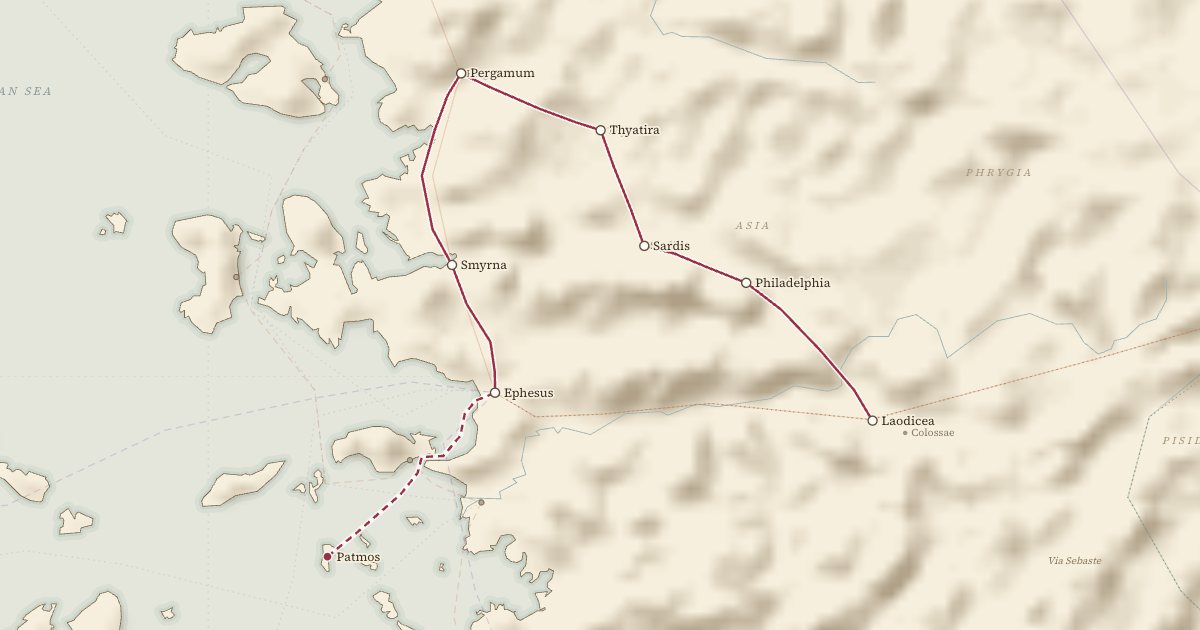
The seven churches of Revelation were real congregations in seven cities of the Roman province of Asia, in the west of modern Turkey. John names them in one breath: “send it unto the seven churches which are in Asia; unto Ephesus, and unto Smyrna, and unto Pergamos, and unto Thyatira, and unto Sardis, and unto Philadelphia, and unto Laodicea.” (Revelation 1:11) He was writing from Patmos, a small Greek island about 110 km by sea from Ephesus, probably around AD 95. On a map the seven cities make a rough ring: up the coast from Ephesus to Smyrna and Pergamum, then south-east inland through Thyatira, Sardis and Philadelphia to Laodicea. All seven sites are known.
Start at Patmos and follow the seven letters on the map →
The seven churches at a glance
| Church | Today | The letter in a phrase | Local detail in the lab |
|---|---|---|---|
| Ephesus | near Selçuk | “thou hast left thy first love” | Paul’s warning about wolves, forty years on |
| Smyrna | İzmir | “be thou faithful unto death” | A city proud of its loyalty to Rome |
| Pergamum | Bergama | “where Satan’s seat is” | Asia’s first temple to Rome and Augustus (29 BC) |
| Thyatira | Akhisar | “that woman Jezebel” | A town of trade guilds and their feasts |
| Sardis | Sart | “Be watchful” | A citadel taken by surprise, twice |
| Philadelphia | Alaşehir | “an open door” | Earthquakes, and a new name |
| Laodicea | near Denizli | “neither cold nor hot” | A rich city that rebuilt without Rome’s help |
Every site identification is Strongly supported in the lab. Smyrna and Philadelphia are the only two churches that receive no rebuke.
Why this order?
The order is the text’s own: the list in 1:11 and the letters of chapters 2 and 3 run the same way. That it follows a road a messenger would take, landing at Ephesus and walking the circuit, is W. M. Ramsay’s suggestion from 1904. It is widely accepted but not stated (Plausible). The line on the map follows the main Roman roads between the cities.
The date is also a reading. Irenaeus, writing about AD 180, says John saw the vision “towards the end of Domitian’s reign”, and most scholars follow him (Plausible). Some prefer about AD 68–69, after Nero’s death.
City by city
Ephesus comes first, the nearest port to Patmos. The church is praised for testing false apostles, then told, “Nevertheless I have somewhat against thee, because thou hast left thy first love.” (Revelation 2:4) The threat is to “remove thy candlestick out of his place” (Revelation 2:5). Since 1:20 says the seven candlesticks are the seven churches, most read this as the church ceasing to shine (Plausible). Some hear an echo of a harbour that silted up and a city that moved, but no ancient source makes that link (Speculative).
Smyrna had built a temple to the goddess Roma in 195 BC and won the right to a temple to Tiberius in AD 26. To a city proud of its loyalty the word is a different loyalty: “be thou faithful unto death, and I will give thee a crown of life.” (Revelation 2:10) The crown may be a victor’s wreath from the games (Plausible) or the ring of buildings on Mount Pagos that later writers called the city’s crown (Speculative).
Pergamum is told, “I know thy works, and where thou dwellest, even where Satan’s seat is” (Revelation 2:13). The Greek word for seat is thronos, a throne. What was it? The lab sets four readings side by side, all Plausible: the Great Altar of Zeus on the acropolis, shaped like a throne; the worship of Rome and the emperor, since Pergamum led Asia in it; the sanctuary of Asclepius, the healing god with the serpent; and the seat of Roman judgement, where the proconsul held the power of the sword. They are not exclusive; the lab gives no verdict.
Thyatira has more trade guilds in its inscriptions than almost any city of Asia, whose meetings honoured their gods with shared meals. The church suffers “that woman Jezebel, which calleth herself a prophetess” (Revelation 2:20), who leads people to eat food sacrificed to idols. Was she a real teacher, or a name for a movement, as “Balaam” is at Pergamum? Both readings are Plausible. Lydia, whom Paul met at Philippi, came from this town; the lab links to her on Paul’s Roads.
Sardis sat below a citadel that looked impregnable yet fell by surprise to Cyrus in 547 BC and to Antiochus III in 214 BC. The letter says, “If therefore thou shalt not watch, I will come on thee as a thief” (Revelation 3:3). A local echo of the city’s history is Plausible; that the image comes from Jesus’ own saying about the thief is Strongly supported, and it needs no local history at all.
Philadelphia was shattered by the earthquake of AD 17 and took the name Neocaesarea for a time. Whoever overcomes is promised to be made a pillar in the temple of God that “shall go no more out” (Revelation 3:12), and a new name. The “open door” of 3:8 is read as a gateway for the gospel on the road east, or as entry to the kingdom through the one who holds the key of David. Both Plausible.
Laodicea was a banking city that rebuilt from its own money after the earthquake of AD 60. It hears its own boast: “I am rich, and increased with goods, and have need of nothing” (Revelation 3:17).
Lukewarm: three readings
“So then because thou art lukewarm, and neither cold nor hot, I will spue thee out of my mouth.” (Revelation 3:16) The lab gives three readings:
- Lukewarm water from the aqueduct: Laodicea had no good spring and piped its water in, tepid and thick with lime. Plausible.
- Hot Hierapolis and cold Colossae: both hot and cold water are useful, lukewarm is not. Speculative, since the evidence for Colossae’s cold water is thin.
- An image that needs no local background: lukewarm water is unpleasant anywhere. Plausible.
What we know and what is reconstructed
| Detail | Evidence level |
|---|---|
| The seven cities and their order | Textually stated |
| Where each city was | Strongly supported |
| Pergamum’s temple to Rome and Augustus | Strongly supported |
| John was exiled to Patmos | Plausible |
| Written about AD 95 | Plausible |
| The order follows a messenger’s road | Plausible |
| Most local echoes (Smyrna’s loyalty, Sardis, Laodicea) | Plausible |
| The harbour behind the lamp stand, Smyrna’s crown of buildings, hot and cold springs | Speculative |
| The Cave of the Apocalypse on Patmos | Speculative (tradition) |
Who John was is left open too. Justin Martyr and Irenaeus identify him with the apostle; Dionysius of Alexandria doubted it in the third century. The lab calls him John, as the text does.
Ephesus in Paul’s day
Paul spent about three years in Ephesus. Switch to the Ephesus city view for a plan of the city with five moments from Acts 18–20. Paul taught daily for two years in the school of Tyrannus, whose location is unknown, so the plan does not mark it. Then came the riot in the theatre: “the whole city was filled with confusion … they rushed with one accord into the theatre” (Acts 19:29).
The plan also marks what came later. The Library of Celsus, the façade on most photographs of Ephesus, dates from about AD 110–135, later than both Paul and John. Of the Temple of Artemis, one of the Seven Wonders, one re-erected column stands.
At Miletus Paul warned the Ephesian elders, “grievous wolves enter in among you” (Acts 20:29). Forty years later the church is praised for testing false apostles. Linking the two is a Plausible reading, not stated in either text. Follow Paul to Ephesus on his third journey and to the farewell at Miletus, or see the riot verse in its own verse journey on Acts 19:29.
Frequently asked questions
Where are the seven churches of Revelation today? All in western Turkey: Ephesus near Selçuk, Smyrna under İzmir, Pergamum above Bergama, Thyatira under Akhisar, Sardis at Sart, Philadelphia under Alaşehir and Laodicea near Denizli. Patmos is a Greek island.
Were there only seven churches in Asia? No. Colossae and Hierapolis were a few hours from Laodicea, and Paul asks the Colossians to read “the epistle from Laodicea” (Colossians 4:16).
Which churches were not rebuked? Smyrna and Philadelphia.
Walk the whole circuit from Ephesus to Laodicea →
Related
- Chapter guides: Revelation 1, Revelation 2, Revelation 3 and Acts 19.
- A map of Paul’s missionary journeys, and Paul’s second journey, step by step, which first brought him to Ephesus.
Found this helpful? Pass it on.