Skip to content
X-Dreamers
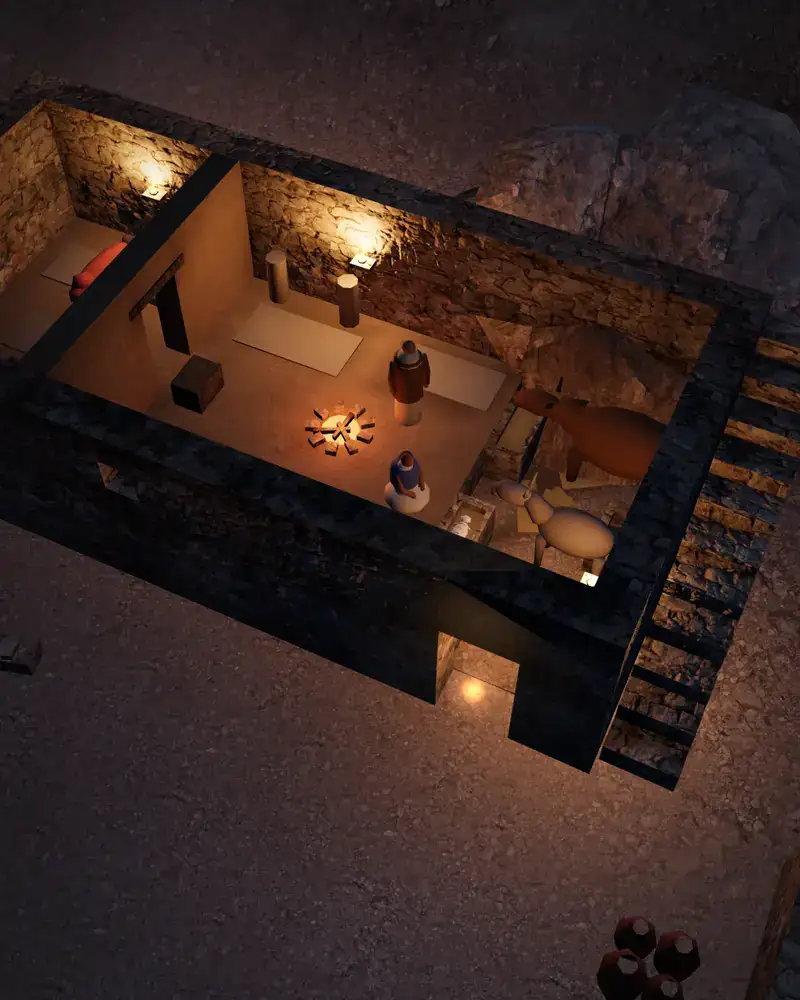
A real-time render of Bethlehem at night: a village house with its roof lifted away, lamplight inside, a stone manger at the edge of the raised family floor, and animals in the lower end.

Places of Jesus · Luke 2 and Matthew 2

Bethlehem When Jesus Was Born

What was Bethlehem like when Jesus was born, and was he born in a stable? Follow Luke and Matthew through an immersive 3D village on a Judean ridge and see which parts of the Christmas picture come from the text.

  • 9 km south of Jerusalem
  • about 770 m above sea level
  • about 150 km from Nazareth

Frame from the real-time 3D scene below. A reconstruction, not a photograph or a painting of the ancient village.

Bethlehem at night in 3D: a village house with its roof lifted away, lamplight inside and a stone manger at the edge of the raised floor

Bethlehem

Follow Luke and Matthew through a 3D Bethlehem: the crowded house and its manger, the shepherds' fields at night, and the Magi some time later.

Walk in 3D · move with the on-screen stick

3D · about 2.4 MB

Loading Bethlehem…

Shepherds keep watch over their flock by night (2:8).

Stop 6 of 13 · The shepherds' fields · The watch

Now out to the fields below the village, the same night.

Shepherds keep watch over their flock by the fire, the fold behind them. Tap Next to see the angel.

Use this in class

13 stops · about 30 minutes

Teach mode puts large captions on the projector, follows a presentation clicker and keeps presenter notes on your own screen.

How to teach with the labs →

Watch a 40-second tour

A silent clip of the guided tour with its captions, made from this lab. Play it before class, or download it to show without a connection.

This is a reconstruction. Almost nothing of first-century Bethlehem has been excavated, and the Gospels do not say which house, which cave or which field. The layout, the houses and many details are informed guesses from Judean village archaeology and from the text. Each stop shows its claims with an evidence level.

The landscape is compressed: the shepherds' fields near Beit Sahour lie about 2 km east of Bethlehem and 100 m lower; here they are about 330 m away. The Herodium, Jerusalem's ridge and the Mountains of Moab are at their real distances.

Modelled procedurally in Blender (reproducible scripts), lit with baked ambient occlusion and real-time light, and rendered in your browser with three.js. Stone, earth and wood textures are CC0 from Poly Haven, shared with the Nazareth lab; foliage is drawn procedurally. The Temple is the Temple Mount lab's model. No AI-generated imagery is used.

Scripture quotations: King James Version (1769); the 1919 Chinese Union Version (官話和合譯本), public domain.

Sources

  • Kenneth E. Bailey, Jesus Through Middle Eastern Eyes (IVP Academic, 2008), ch. 1; and “The Manger and the Inn,” Theological Review 2 (1979).
  • Stephen C. Carlson, “The Accommodations of Joseph and Mary in Bethlehem: κατάλυμα in Luke 2.7,” New Testament Studies 56 (2010): 326–342.
  • Yizhar Hirschfeld, The Palestinian Dwelling in the Roman-Byzantine Period (Jerusalem: Franciscan Printing Press, 1995).
  • Gustaf Dalman, Arbeit und Sitte in Palästina, vol. 7: Das Haus (1942).
  • Justin Martyr, Dialogue with Trypho 78 (about AD 155).
  • Origen, Against Celsus 1.51 (about AD 248).
  • Protevangelium of James 17–18 (2nd century).
  • Gospel of Pseudo-Matthew 14 (about 7th century).
  • Josephus, Antiquities 17.167–191 (Herod's last illness and death); 18.1–2 (the census of Quirinius).
  • Josephus, Jewish War 1.419–421, 1.673 (the Herodium and Herod's burial).
  • Ehud Netzer, The Architecture of Herod, the Great Builder (Mohr Siebeck, 2006); the tomb at Herodium, identified in 2007.
  • Raymond E. Brown, The Birth of the Messiah, updated edition (Doubleday, 1993).
  • Barry J. Beitzel, The New Moody Atlas of the Bible (Moody, 2009): roads of Roman Palestine.
  • Virgilio Corbo, Gli scavi di Kh. Siyar el-Ghanam (Campo dei Pastori) (Jerusalem, 1955).
  • Mishnah, Sheqalim 6:5 and 7:4 (written down about AD 200).
  • Mishnah, Sotah 1:5 (written down about AD 200).
  • Alfred Edersheim, The Life and Times of Jesus the Messiah (1883), book 2, ch. 6.
  • Tertullian, Against Marcion 3.13 (about AD 207).
  • The Chronograph of 354, list of martyrs' feasts (Depositio Martyrum), dated to 336.
  • Clement of Alexandria, Stromata 1.21 (about AD 200).
  • Johannes Kepler, De Stella Nova (1606).
  • Colin J. Humphreys, “The Star of Bethlehem, a Comet in 5 BC,” Quarterly Journal of the Royal Astronomical Society 32 (1991): 389–407.
  • Michael R. Molnar, The Star of Bethlehem: The Legacy of the Magi (Rutgers University Press, 1999).
  • Dale C. Allison Jr., “The Magi's Angel,” in Studies in Matthew (Baker, 2005).
  • The Holy Family's journey in Egypt, from the “Vision of Theophilus” (ascribed to a 4th-century patriarch; known from later manuscripts).

Was Jesus born in a stable? What Luke and Matthew say

This lab rebuilds Bethlehem as a small Judean village on its ridge and follows the birth of Jesus through Luke 2 and Matthew 2 in seven stops: the journey from Nazareth, the village, the house and the manger, the shepherds in the fields at night, the presentation in the Temple, the Magi, and the flight to Egypt. Each stop quotes the text (KJV and the 1919 Chinese Union Version) and marks every detail with how sure we can be.

The key question is Luke 2:7: “there was no room for them in the inn”. Luke's word, kataluma, is the word he uses for a guest room (22:11), not for a commercial inn (10:34). Many scholars read it as the full guest room of a family house, where animals were kept in a lower end by the door and fed from mangers along the raised family floor. The earliest tradition, from about AD 155, places the birth in a cave near the village. The lab lets you switch between the two readings.

Bethlehem and the birth of Jesus at a glance

Bethlehem and the birth of Jesus at a glance
WhereBethlehem of Judea, about 9 km south of Jerusalem, about 770 m above sea level
WhenBefore Herod the Great's death (4 BC by the usual reckoning): probably about 7–4 BC. No day or season is given.
The journeyAbout 150 km from Nazareth by the Jordan valley, or about 125 km through Samaria: four to seven days on foot
The “inn”Greek kataluma: a guest room or lodging space (Luke 22:11); a commercial inn is pandocheion (Luke 10:34)
The MagiNumber not given; three gifts; they came later, to a house (Matthew 2:11, 16)

Key verses 5

6And so it was, that, while they were there, the days were accomplished that she should be delivered. 7And she brought forth her firstborn son, and wrapped him in swaddling clothes, and laid him in a manger; because there was no room for them in the inn.

Luke 2:6–7

11And ye shall say unto the goodman of the house, The Master saith unto thee, Where is the guestchamber, where I shall eat the passover with my disciples?

Luke 22:11

8And there were in the same country shepherds abiding in the field, keeping watch over their flock by night. 9And, lo, the angel of the Lord came upon them, and the glory of the Lord shone round about them: and they were sore afraid. 10And the angel said unto them, Fear not: for, behold, I bring you good tidings of great joy, which shall be to all people. 11For unto you is born this day in the city of David a Saviour, which is Christ the Lord. 12And this shall be a sign unto you; Ye shall find the babe wrapped in swaddling clothes, lying in a manger. 13And suddenly there was with the angel a multitude of the heavenly host praising God, and saying, 14Glory to God in the highest, and on earth peace, good will toward men.

Luke 2:8–14

9When they had heard the king, they departed; and, lo, the star, which they saw in the east, went before them, till it came and stood over where the young child was. 10When they saw the star, they rejoiced with exceeding great joy. 11And when they were come into the house, they saw the young child with Mary his mother, and fell down, and worshipped him: and when they had opened their treasures, they presented unto him gifts; gold, and frankincense, and myrrh.

Matthew 2:9–11

16Then Herod, when he saw that he was mocked of the wise men, was exceeding wroth, and sent forth, and slew all the children that were in Bethlehem, and in all the coasts thereof, from two years old and under, according to the time which he had diligently enquired of the wise men.

Matthew 2:16

Scripture quotations: King James Version (KJV).

What the Bible says, what our model adds to it, where good readers disagree, and where the old copies and the translations differ. We set the views side by side and do not pick a winner.

  • Textually stated10
  • Strongly supported3
  • Plausible3
  • Speculative5
  • Artistic2

A few of the model's choices

  • Speculative

    The lanes and houses of the village, and how many there were.

  • Plausible

    A small village of a few hundred people, at most about a thousand.

  • Plausible

    The manger stands at the edge of the raised family floor, above the lower end where animals spent the night.

Show all 31
What the text says10

Stated in Scripture. Quoted from the King James Version (KJV) and the 1919 Chinese Union Version (和合本).

  • Joseph went from Nazareth to Bethlehem with Mary because of an enrolment ordered by Caesar Augustus, since he was of the house and family of David.

    Textually stated

    4And Joseph also went up from Galilee, out of the city of Nazareth, into Judæa, unto the city of David, which is called Bethlehem; (because he was of the house and lineage of David:) 5To be taxed with Mary his espoused wife, being great with child.

    Luke 2:4–5 · KJV
  • Luke does not say the birth happened on the night they arrived: “while they were there, the days were accomplished that she should be delivered”.

    Textually stated

    6And so it was, that, while they were there, the days were accomplished that she should be delivered.

    Luke 2:6 · KJV
  • Mary wrapped the baby in swaddling clothes herself and laid him in a manger (a feeding trough) because there was no place for them in the kataluma.

    Textually stated

    7And she brought forth her firstborn son, and wrapped him in swaddling clothes, and laid him in a manger; because there was no room for them in the inn.

    Luke 2:7 · KJV
  • No innkeeper appears in Luke's account, and no one turns the couple away.

    Textually stated

    7And she brought forth her firstborn son, and wrapped him in swaddling clothes, and laid him in a manger; because there was no room for them in the inn.

    Luke 2:7 · KJV
  • Shepherds were staying in the fields near Bethlehem, keeping watch over their flock by night.

    Textually stated

    8And there were in the same country shepherds abiding in the field, keeping watch over their flock by night.

    Luke 2:8 · KJV
  • The shepherds went with haste, found Mary, Joseph and the baby lying in the manger, and told what they had been told about him.

    Textually stated

    16And they came with haste, and found Mary, and Joseph, and the babe lying in a manger. 17And when they had seen it, they made known abroad the saying which was told them concerning this child.

    Luke 2:16–17 · KJV
  • Jesus was presented in the Temple after the days of purification, and the family offered a pair of turtledoves or two young pigeons.

    Textually stated

    22And when the days of her purification according to the law of Moses were accomplished, they brought him to Jerusalem, to present him to the Lord; 23(As it is written in the law of the Lord, Every male that openeth the womb shall be called holy to the Lord;) 24And to offer a sacrifice according to that which is said in the law of the Lord, A pair of turtledoves, or two young pigeons.

    Luke 2:22–24 · KJV
  • Magi from the east came to Jerusalem and then to Bethlehem, entered the house, worshipped the child and gave gold, frankincense and myrrh.

    Textually stated

    11And when they were come into the house, they saw the young child with Mary his mother, and fell down, and worshipped him: and when they had opened their treasures, they presented unto him gifts; gold, and frankincense, and myrrh.

    Matthew 2:11 · KJV
  • Matthew does not say how many Magi there were; he names three gifts.

    Textually stated

    11And when they were come into the house, they saw the young child with Mary his mother, and fell down, and worshipped him: and when they had opened their treasures, they presented unto him gifts; gold, and frankincense, and myrrh.

    Matthew 2:11 · KJV
  • Joseph took the child and his mother by night to Egypt and stayed until Herod's death, then settled in Nazareth.

    Textually stated

    13And when they were departed, behold, the angel of the Lord appeareth to Joseph in a dream, saying, Arise, and take the young child and his mother, and flee into Egypt, and be thou there until I bring thee word: for Herod will seek the young child to destroy him. 14When he arose, he took the young child and his mother by night, and departed into Egypt: 15And was there until the death of Herod: that it might be fulfilled which was spoken of the Lord by the prophet, saying, Out of Egypt have I called my son.

    Matthew 2:13–15 · KJV
What the model adds13

Choices the reconstruction has to make where the text is silent, each with its evidence level and the reason for it.

Strongly supported3
  • The journey from Nazareth is about 150 km by the Jordan valley or about 125 km through Samaria.

    Why: Measured along the Roman-period roads (Beitzel, New Moody Atlas of the Bible).

  • The Magi arrive later, at a house, not at the manger on the night of the birth.

    Why: Matthew says they found a young child in a house, and Herod reckoned from the time of the star, killing boys up to two years old (2:11, 16).

  • The birth is placed before Herod's death, probably between about 7 and 4 BC.

    Why: Matthew and Luke both place it in Herod's reign, and Herod died in 4 BC by the usual reckoning (see Competing views).

Plausible3
  • A small village of a few hundred people, at most about a thousand.

    Why: An estimate from the size of Judean villages; Micah calls Bethlehem little among the clans of Judah (Micah 5:2).

  • The manger stands at the edge of the raised family floor, above the lower end where animals spent the night.

    Why: Well documented in traditional Palestinian village houses (Dalman, Hirschfeld) and fits biblical hints of animals kept in the house (1 Samuel 28:24).

  • The flight to Egypt goes down to the coast road through Gaza.

    Why: It was the main road into Egypt; Matthew names no route.

Speculative5
  • The lanes and houses of the village, and how many there were.

    Why: Little of first-century Bethlehem has been excavated; the houses follow excavated Judean and Galilean villages (Hirschfeld).

  • There is no timber barn standing apart from the house.

    Why: The barn of many European paintings has no support in the text or in Judean building, which used stone and caves.

  • No ox and donkey stand by the manger as in Christmas scenes; animals are kept in the lower end.

    Why: Luke names no animals; the pair comes from Isaiah 1:3 read with the story and from the Gospel of Pseudo-Matthew (about the 7th century).

  • Mary is not shown riding a donkey.

    Why: Luke does not say how they travelled; the donkey comes from the Protevangelium of James (2nd century).

  • The shepherds' fields are placed east of the village, toward Beit Sahour.

    Why: Where they were is unknown; tradition and Byzantine monasteries mark a "Shepherds' Field" there (Corbo).

Artistic2
  • The size of the house, the number of mangers, the lamps and the guests are choices made for the scene.

    Why: Luke gives none of these details.

  • The angel and the heavenly host are drawn as soft light.

    Why: Luke tells what they said and that the glory of the Lord shone; he describes no wings, faces or singing.

Competing views4

Where careful readers disagree. Each view with who holds it and the evidence for and against it. No verdict.

Where was the manger: in a family house, or in a cave?

Luke 2:7; Matthew 2:11

In a family house: the guest room was full, so the baby was laid in a manger in the family room

Held by Kenneth Bailey; Stephen Carlson

For

  • Luke uses kataluma for the guest room of the Last Supper (22:11) and a different word for the Samaritan's inn (10:34), and mentions no innkeeper.
  • Village houses had mangers at the edge of the family floor, above the animals' end.

Against

  • Older commentators (Ellicott, the Cambridge Bible) took kataluma here as an inn or caravanserai.

Sources: Kenneth E. Bailey, Jesus Through Middle Eastern Eyes (IVP Academic, 2008), ch. 1; and “The Manger and the Inn,” Theological Review 2 (1979).; Stephen C. Carlson, “The Accommodations of Joseph and Mary in Bethlehem: κατάλυμα in Luke 2.7,” New Testament Studies 56 (2010): 326–342.; Gustaf Dalman, Arbeit und Sitte in Palästina, vol. 7: Das Haus (1942).

In a cave near the village, used as a stable

Held by Justin Martyr (about AD 155); Origen (about 248); the grotto under the Church of the Nativity

For

  • It is the earliest tradition outside the Gospels, within about 150 years of the birth, and Origen says the cave and its manger were shown at Bethlehem.

Against

  • Matthew says the Magi came into "the house" (2:11), and Justin links the cave with a Greek reading of Isaiah 33:16, which may have shaped the tradition.

Sources: Justin Martyr, Dialogue with Trypho 78 (about AD 155).; Origen, Against Celsus 1.51 (about AD 248).; Commentaries on Luke 2:7 (Ellicott, Cambridge Bible, Vincent's Word Studies)

Both: a cave at the back of the house

Held by Readers who follow excavated houses of the Bethlehem hills (Hirschfeld, Bailey)

For

  • Many houses in these hills were built against caves used for storage and animals, so "the house" and "the cave" may be one place.

Against

  • It is a reconciliation, not something either the Gospels or Justin say.

Sources: Yizhar Hirschfeld, The Palestinian Dwelling in the Roman-Byzantine Period (Jerusalem: Franciscan Printing Press, 1995).; Kenneth E. Bailey, Jesus Through Middle Eastern Eyes (IVP Academic, 2008), ch. 1; and “The Manger and the Inn,” Theological Review 2 (1979).

What the lab shows (a drawing choice, not a ruling): The scene shows both readings: the family house with its guest room, and the cave behind the house; you can switch between them.

How does Luke's census fit Herod's reign?

Luke 2:1–2; Matthew 2:1

Luke is right, read another way

Held by Scholars who defend Luke's account

For

  • The Greek of 2:2 can be read as a registration "before" Quirinius governed.
  • Quirinius may have held an earlier post, or a registration begun under Herod may have been completed later.

Against

  • No record shows Quirinius governing Syria before AD 6; each proposal is possible but none is proven.

Sources: Wikipedia, "Census of Quirinius"; Raymond E. Brown, The Birth of the Messiah, updated edition (Doubleday, 1993).

Luke joined the birth to the later census of AD 6

Held by Most critical scholars

For

  • Josephus dates Quirinius' census to AD 6, about ten years after Herod died, and both Gospels put the birth under Herod.

Against

  • It assumes Luke made an error about a census his first readers could remember.

Sources: Josephus, Antiquities 17.167–191 (Herod's last illness and death); 18.1–2 (the census of Quirinius).; Wikipedia, "Census of Quirinius"

What the lab shows (a drawing choice, not a ruling): The scene shows the journey for the enrolment as Luke tells it and dates the birth before Herod's death, without settling the census question.

When did Herod die?

Matthew 2:19

In 4 BC

Held by Most scholars since Emil Schürer (1896)

For

  • Josephus mentions an eclipse of the moon shortly before Herod's death and a Passover after it; the eclipse of 13 March 4 BC fits.

Against

  • Critics say the events Josephus places between the eclipse and the Passover need more than the month this allows.

Sources: Wikipedia, "Herod the Great" (the date of his death); Josephus, Antiquities 17.167–191 (Herod's last illness and death); 18.1–2 (the census of Quirinius).

In 1 BC

Held by W. E. Filmer; Andrew Steinmann; Robert Young

For

  • Herod's sons may have backdated their reigns to overlap his; read so, their coins allow a later death, which was also the older traditional date.

Against

  • It needs the backdating to be assumed; most chronologists keep 4 BC.

Sources: Wikipedia, "Herod the Great" (the date of his death)

What the lab shows (a drawing choice, not a ruling): The lab follows the usual 4 BC and dates the birth about 7–4 BC (Strongly supported, with the minority view noted).

What was the star?

Matthew 2:2; Matthew 2:9

A unique sign given for this purpose

Held by Many readers, from the plain words of Matthew 2:9

For

  • It "went before them" and "stood over where the young child was", which no ordinary star or planet does.

Against

  • Herod had to ask the Magi when it appeared (2:7), so it was not plain to everyone.
Jupiter and Saturn meeting three times in Pisces in 7 BC

Held by Johannes Kepler (1606)

For

  • A rare event that astrologers could read as a royal birth in Judea.

Against

  • A conjunction does not go before travellers and stop over one house.

Sources: Johannes Kepler, De Stella Nova (1606).

A comet or new star seen in 5 BC

Held by Colin Humphreys (1991)

For

  • Chinese records note a "broom star" seen for more than 70 days in 5 BC.

Against

  • It still has to be read into Matthew's star that "stood over" the house.

Sources: Colin J. Humphreys, “The Star of Bethlehem, a Comet in 5 BC,” Quarterly Journal of the Royal Astronomical Society 32 (1991): 389–407.

Jupiter rising in Aries in 6 BC, read by astrologers

Held by Michael Molnar (1999)

For

  • Ancient astrologers linked Aries with Judea, and "in the east" may mean "at its rising".

Against

  • It depends on how ancient astrologers read the sky, which the Magi do not explain.

Sources: Michael R. Molnar, The Star of Bethlehem: The Legacy of the Magi (Rutgers University Press, 1999).

An angel

Held by Some early Christians (discussed by Dale Allison)

For

  • It moved, led and stopped, and Scripture links stars with angels.

Against

  • Matthew calls it a star, not an angel, though he speaks of angels elsewhere in the same chapters.

Sources: Dale C. Allison Jr., “The Magi's Angel,” in Studies in Matthew (Baker, 2005).

What the lab shows (a drawing choice, not a ruling): The scene lets you compare these readings of the star; none is marked as the answer.

Textual notes4

Places where manuscripts, ancient versions or translations differ in numbers or wording. KJV and 和合本 are quoted as they stand.

"No room in the inn" (客店): inn or guest room? (Luke 2:7)

Translations

7And she brought forth her firstborn son, and wrapped him in swaddling clothes, and laid him in a manger; because there was no room for them in the inn.

Luke 2:7 · KJV

7就生了頭胎的兒子、用布包起來、放在馬槽裏、因爲客店裏沒有地方。

路加福音 2:7 · 和合本 (CUV 1919)

11And ye shall say unto the goodman of the house, The Master saith unto thee, Where is the guestchamber, where I shall eat the passover with my disciples?

Luke 22:11 · KJV

11對那家的主人說、夫子說、客房在那裏、我與門徒好在那裏喫逾越節的筵席。

路加福音 22:11 · 和合本 (CUV 1919)

KJV reads "inn" at 2:7 but "guestchamber" at 22:11, and the 和合本 reads 客店 and 客房, though Luke uses the same Greek word, kataluma, in both. Ellicott and the Cambridge Bible keep "inn" at 2:7 (a khan or caravanserai); Bailey and Carlson argue for a guest room in a house. See "Competing views".

Sources: Commentaries on Luke 2:7 (Ellicott, Cambridge Bible, Vincent's Word Studies); Stephen C. Carlson, “The Accommodations of Joseph and Mary in Bethlehem: κατάλυμα in Luke 2.7,” New Testament Studies 56 (2010): 326–342.; Kenneth E. Bailey, Jesus Through Middle Eastern Eyes (IVP Academic, 2008), ch. 1; and “The Manger and the Inn,” Theological Review 2 (1979).

Three kings left out of Matthew's list (Matthew 1:8)

Parallel accounts

8And Asa begat Josaphat; and Josaphat begat Joram; and Joram begat Ozias;

Matthew 1:8 · KJV

8亞撒生約沙法.約沙法生約蘭.約蘭生烏西亞.

馬太福音 1:8 · 和合本 (CUV 1919)

11Joram his son, Ahaziah his son, Joash his son, 12Amaziah his son, Azariah his son, Jotham his son,

1 Chronicles 3:11–12 · KJV

11約沙法的兒子是約蘭、約蘭的兒子是亞哈謝、亞哈謝的兒子是約阿施、12約阿施的兒子是亞瑪謝、亞瑪謝的兒子是亞撒利雅、亞撒利雅的兒子是約坦、

歷代志上 3:11–12 · 和合本 (CUV 1919)

Matthew goes from Joram straight to Uzziah; Chronicles lists Ahaziah, Joash and Amaziah between them (Azariah is Uzziah). Both translations keep the difference. Commentators suggest Matthew shortened the list to make three sets of fourteen (1:17), or left out kings descended from Ahab through Athaliah, or copied an existing list as he found it.

Sources: Commentaries on Matthew 1:8 (Jamieson–Fausset–Brown, Poole, Gill, Meyer); Wikipedia, "Genealogy of Jesus"

"Son of Aram" or "son of Admin, son of Arni"? (Luke 3:33)

Manuscripts

33Which was the son of Aminadab, which was the son of Aram, which was the son of Esrom, which was the son of Phares, which was the son of Juda,

Luke 3:33 · KJV

33拿順是亞米拿達的兒子、亞米拿達是亞蘭的兒子、亞蘭是希斯崙的兒子、希斯崙是法勒斯的兒子、法勒斯是猶大的兒子、

路加福音 3:33 · 和合本 (CUV 1919)
Other witnesses
Many manuscripts; KJVAmminadab, son of Aram
The Nestle–Aland critical text; ESV, BSB, NETAmminadab, son of Admin, son of Arni
NIVAmminadab, son of Ram

KJV and the 和合本 both follow "son of Aram" (亞蘭), the reading that matches the Old Testament line (Ruth 4:19). Modern critical editions accept the longer reading with Admin and Arni, which adds a name.

Sources: Wikipedia, "Genealogy of Jesus"; Luke 3:33 in parallel translations (NASB, ESV, NIV, BSB, KJV, NET), Bible Hub

Cainan in Luke's list but not in Genesis (Luke 3:36)

Manuscripts

36Which was the son of Cainan, which was the son of Arphaxad, which was the son of Sem, which was the son of Noe, which was the son of Lamech,

Luke 3:36 · KJV

36沙拉是該南的兒子、該南是亞法撒的兒子、亞法撒是閃的兒子、閃是挪亞的兒子、挪亞是拉麥的兒子、

路加福音 3:36 · 和合本 (CUV 1919)

12And Arphaxad lived five and thirty years, and begat Salah:

Genesis 11:12 · KJV

12亞法撒活到三十五歲、生了沙拉.

創世記 11:12 · 和合本 (CUV 1919)
Other witnesses
Hebrew (Masoretic) Genesis 11:12Arpachshad fathered Shelah
Greek Septuagint Genesis 11; the Book of JubileesArpachshad fathered Cainan, and Cainan fathered Shelah

Luke's list follows the Greek Genesis and names Cainan between Arphaxad and Shelah. KJV and the 和合本 translate Genesis from the Hebrew, which has no Cainan, so the two lists differ in both translations.

Sources: Wikipedia, "Cainan"; Wikipedia, "Genealogy of Jesus"

Frequently asked questions

What was Bethlehem like in Jesus' time?

A small village on a ridge about 9 km south of Jerusalem and about 770 m above sea level, with perhaps a few hundred people, at most about a thousand (an estimate). Families lived in stone houses with a raised living floor and a lower end where animals were brought in at night. Micah 5:2 calls it small among the clans of Judah; its fame came from David, not from its size.

Was Jesus born in a stable?

Luke mentions only a manger (a feeding trough) and a kataluma with no room. The most likely settings are the lower end of a family house, where animals were brought in at night (plausible), or a cave used as a stable, the tradition attested by Justin Martyr about AD 155 (plausible). A timber barn apart from the house is not in the text.

Was there an innkeeper who turned Mary and Joseph away?

No innkeeper appears in Luke. “No room in the kataluma” most likely means the guest room of the house was already full, not that the family was turned away.

How many wise men were there, and were they kings?

Matthew does not count the Magi or call them kings. Three gifts led to the tradition of three; “kings” came later from Psalm 72 and Isaiah 60. Their names are from the 6th century.

Did the wise men visit Jesus at the manger?

No. Matthew says they came into “the house” and saw “the young child”, and Herod killed boys “two years old and under”, so the visit was some time after the birth, perhaps months, possibly up to two years (strongly supported).

Was Jesus born on 25 December?

The Gospels give no date or season. 25 December is first recorded as the feast of the birth in Rome in 336; other early writers proposed other dates.

Is the Church of the Nativity where Jesus was born?

It may be. Justin Martyr, about AD 155, says the birth took place in a cave near the village, and Origen, about 248, says the cave and its manger were shown at Bethlehem. Constantine built a church over that grotto in the 330s. A tradition this early is worth taking seriously, but no evidence can prove the exact spot, so the lab marks it as plausible.

Sources & limits

Limits of this lab 4

  • Little of first-century Bethlehem has been excavated; the village, the house and the cave follow excavated Judean villages and later tradition, each marked.
  • The year of the birth, the census and the star are debated; the lab shows the options and dates the birth only within a range.
  • Luke and Matthew tell different parts of the story; the order of the presentation and the Magi's visit is a harmony, not stated in either.
  • Angels are drawn only as light, and the people and animals are stylized.

Sources 34

  1. King James Version (KJV) (Public domain outside the United Kingdom)
  2. 官話和合譯本 (Chinese Union Version, 1919), zh.wikisource (Public domain)
  3. Kenneth E. Bailey, Jesus Through Middle Eastern Eyes (IVP Academic, 2008), ch. 1; and “The Manger and the Inn,” Theological Review 2 (1979).
  4. Stephen C. Carlson, “The Accommodations of Joseph and Mary in Bethlehem: κατάλυμα in Luke 2.7,” New Testament Studies 56 (2010): 326–342.
  5. Yizhar Hirschfeld, The Palestinian Dwelling in the Roman-Byzantine Period (Jerusalem: Franciscan Printing Press, 1995).
  6. Gustaf Dalman, Arbeit und Sitte in Palästina, vol. 7: Das Haus (1942).
  7. Justin Martyr, Dialogue with Trypho 78 (about AD 155).
  8. Origen, Against Celsus 1.51 (about AD 248).
  9. Protevangelium of James 17–18 (2nd century).
  10. Gospel of Pseudo-Matthew 14 (about 7th century).
  11. Josephus, Antiquities 17.167–191 (Herod's last illness and death); 18.1–2 (the census of Quirinius).
  12. Josephus, Jewish War 1.419–421, 1.673 (the Herodium and Herod's burial).
  13. Ehud Netzer, The Architecture of Herod, the Great Builder (Mohr Siebeck, 2006); the tomb at Herodium, identified in 2007.
  14. Raymond E. Brown, The Birth of the Messiah, updated edition (Doubleday, 1993).
  15. Barry J. Beitzel, The New Moody Atlas of the Bible (Moody, 2009): roads of Roman Palestine.
  16. Virgilio Corbo, Gli scavi di Kh. Siyar el-Ghanam (Campo dei Pastori) (Jerusalem, 1955).
  17. Mishnah, Sheqalim 6:5 and 7:4 (written down about AD 200).
  18. Mishnah, Sotah 1:5 (written down about AD 200).
  19. Alfred Edersheim, The Life and Times of Jesus the Messiah (1883), book 2, ch. 6.
  20. Tertullian, Against Marcion 3.13 (about AD 207).
  21. The Chronograph of 354, list of martyrs' feasts (Depositio Martyrum), dated to 336.
  22. Clement of Alexandria, Stromata 1.21 (about AD 200).
  23. Johannes Kepler, De Stella Nova (1606).
  24. Colin J. Humphreys, “The Star of Bethlehem, a Comet in 5 BC,” Quarterly Journal of the Royal Astronomical Society 32 (1991): 389–407.
  25. Michael R. Molnar, The Star of Bethlehem: The Legacy of the Magi (Rutgers University Press, 1999).
  26. Dale C. Allison Jr., “The Magi's Angel,” in Studies in Matthew (Baker, 2005).
  27. The Holy Family's journey in Egypt, from the “Vision of Theophilus” (ascribed to a 4th-century patriarch; known from later manuscripts).
  28. Commentaries on Luke 2:7 (Ellicott, Cambridge Bible, Vincent's Word Studies) (Public domain)
  29. Commentaries on Matthew 1:8 (Jamieson–Fausset–Brown, Poole, Gill, Meyer) (Public domain)
  30. Luke 3:33 in parallel translations (NASB, ESV, NIV, BSB, KJV, NET), Bible Hub
  31. Wikipedia, "Genealogy of Jesus"
  32. Wikipedia, "Herod the Great" (the date of his death)
  33. Wikipedia, "Census of Quirinius"
  34. Wikipedia, "Cainan"

Scripture is quoted only from KJV and the 1919 和合本. Other works are cited for facts and arguments, not quoted at length.

How we build the Labs →Found a mistake? Report it →

What’s new · v2.4.1Version 2.4.1: English Scripture is now quoted from the King James Version (1769).