 X-Dreamers
Stop 6 of 7
The Magi come to the house
Matthew 2:1–2 · Matthew 2:9–11 · Matthew 2:16
Wise men came from the east to Jerusalem, asking, “Where is he that is born King of the Jews? for we have seen his star in the east, and are come to worship him.” Herod, troubled, sends them to Bethlehem. The star goes before them to the place. “When they were come into the house, they saw the young child with Mary his mother,” and offered gold, frankincense and myrrh.
In the scene
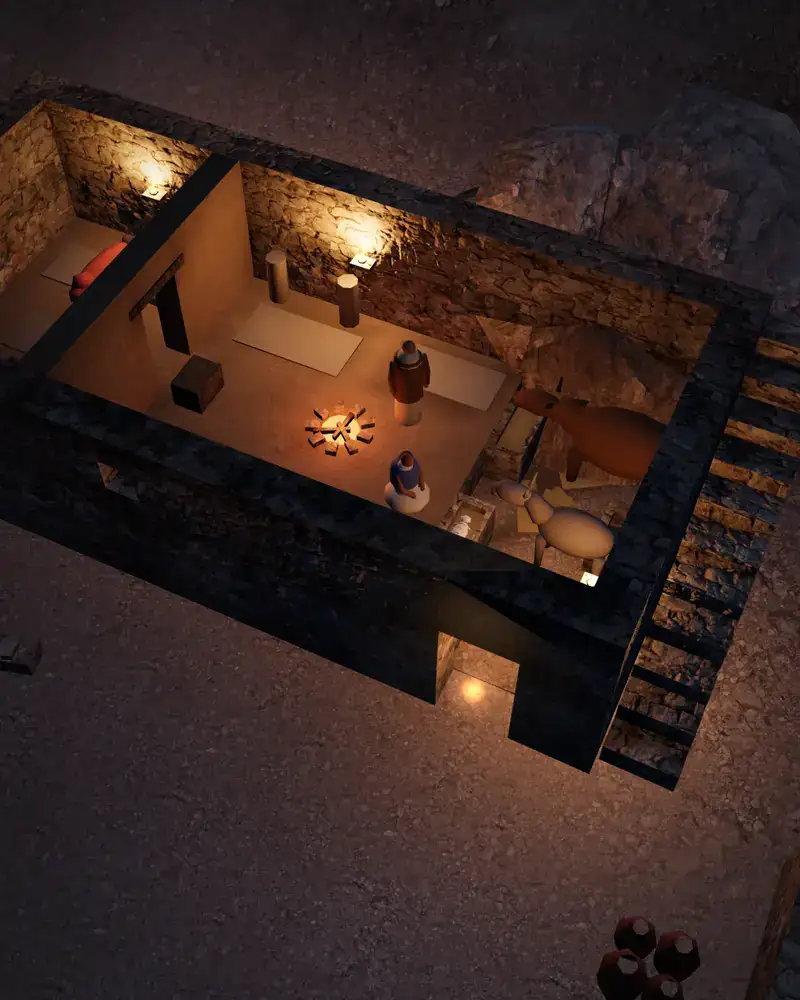
Two moments: Herod's Jerusalem, where the Magi asked for the newborn king (the Temple Mount lab's model), and the house in Bethlehem by day, with travellers from the east at its door. The scene shows more than three travellers, with their servants: Matthew does not count them.
Moment
“When they were come into the house, they saw the young child with Mary his mother” (2:11).
Scripture
Matthew 2:1–2
1Now when Jesus was born in Bethlehem of Judaea in the days of Herod the king, behold, there came wise men from the east to Jerusalem, 2Saying, Where is he that is born King of the Jews? for we have seen his star in the east, and are come to worship him.
Matthew 2:9–11
9When they had heard the king, they departed; and, lo, the star, which they saw in the east, went before them, till it came and stood over where the young child was. 10When they saw the star, they rejoiced with exceeding great joy. 11And when they were come into the house, they saw the young child with Mary his mother, and fell down, and worshipped him: and when they had opened their treasures, they presented unto him gifts; gold, and frankincense, and myrrh.
Matthew 2:16
16Then Herod, when he saw that he was mocked of the wise men, was exceeding wroth, and sent forth, and slew all the children that were in Bethlehem, and in all the coasts thereof, from two years old and under, according to the time which he had diligently enquired of the wise men.
+ Matthew 2:3–8; Psalm 72:10–11; Isaiah 60:6
King James Version (1769)
Background
- Who were the Magi?
- Magoi were a Persian priestly class known for astrology and the reading of dreams; by the 1st century the word could mean any learned star-watcher, or a sorcerer (Acts 13:6). Matthew says only that they came “from the east”: Persia, Babylonia and Arabia have all been proposed.
- Later, and at a house
- When the Magi arrive, the family is in a house and Jesus is “the young child”. Herod's order to kill the boys “from two years old and under, according to the time which he had diligently enquired of the wise men” (2:16) points to a visit months after the birth, perhaps up to two years.
- Three kings?
- Three gifts are named, so tradition settled on three visitors; by the 6th century they had names (Caspar, Melchior, Balthasar). They became kings through Psalm 72:10–11 and Isaiah 60:3–6, read as prophecy. Matthew calls them magi, not kings, and does not say how many there were.
What was the star?
Matthew says the Magi saw “his star” rise and that it went before them to Bethlehem. He does not say what it was. The main proposals:
- A unique signPlausible
Matthew's star “went before them” and “stood over where the young child was” (2:9), which no ordinary star or planet does. Many read it as a sign given for this purpose.
- A planetary conjunctionSpeculative
Jupiter and Saturn met three times in Pisces in 7 BC, a sign that astrologers could read as a royal birth in Judea. Kepler proposed it in 1606.
- Johannes Kepler, De Stella Nova (1606).
- A comet or a new starSpeculative
Chinese records note a “broom star” (a comet or nova) seen for more than 70 days in 5 BC.
- Colin J. Humphreys, “The Star of Bethlehem, a Comet in 5 BC,” Quarterly Journal of the Royal Astronomical Society 32 (1991): 389–407.
- A sign in the astrologers' heavensSpeculative
Jupiter rose in the east in Aries, a sign linked with Judea, in 6 BC, as ancient astrologers would have read it.
- Michael R. Molnar, The Star of Bethlehem: The Legacy of the Magi (Rutgers University Press, 1999).
- An angelSpeculative
Some early Christians took the star to be an angel, since it moved, led and stopped, and Scripture links stars with angels.
- Dale C. Allison Jr., “The Magi's Angel,” in Studies in Matthew (Baker, 2005).
The scene draws no special star. The night sky shows ordinary stars only.
How sure can we be?
- Textually stated
Magi from the east came to Jerusalem and then to Bethlehem, entered the house, worshipped the child and gave gold, frankincense and myrrh. (Matthew 2:1–2; Matthew 2:9–11)
- Textually stated
Matthew does not say how many Magi there were; he names three gifts. (Matthew 2:11)
- Strongly supported
The Magi did not come on the night of the birth: they found a young child in a house, and Herod reckoned by the time the star had appeared, killing boys up to two years old. (Matthew 2:11; Matthew 2:16)
- Raymond E. Brown, The Birth of the Messiah, updated edition (Doubleday, 1993).
- Speculative
That they were kings comes from later reading of Psalm 72 and Isaiah 60; Tertullian already says the East held magi to be “almost kings”. (Psalm 72:10–11; Isaiah 60:6)
- Tertullian, Against Marcion 3.13 (about AD 207).
- Speculative
The camels are traditional, from Isaiah 60:6; Matthew does not say how the Magi travelled. (Isaiah 60:6)
- Plausible
Luke moves from the presentation straight to Nazareth (2:39) and mentions neither the Magi nor Egypt; Matthew does not mention the presentation. A visit after the presentation, while the family was again in Bethlehem, is one common way of fitting the two together. (Luke 2:39)
- Raymond E. Brown, The Birth of the Messiah, updated edition (Doubleday, 1993).
The common picture vs the text
Common picture
The Magi knelt at the manger beside the shepherds.What the text saysStrongly supportedThe Magi came later, to a house, and found a young child. Herod's “two years old and under” suggests the visit could have been up to two years after the birth. (Matthew 2:11; Matthew 2:16)
Common picture
Three kings.What the text saysTextually statedMatthew neither counts the Magi nor calls them kings. Three gifts led to three visitors; “kings” came from Psalm 72 and Isaiah 60. (Matthew 2:1; Matthew 2:11)
Common picture
The star shone over the stable on the night of the birth.What the text saysTextually statedThe star led the Magi to the house “where the young child was” (2:9–11), some time after the birth. (Matthew 2:9–11)