 X-Dreamers
Stop 3 of 7
The house, the manger and the “inn”
Luke 2:6–7 · Luke 22:11 · Luke 10:34
“She brought forth her firstborn son, and wrapped him in swaddling clothes, and laid him in a manger; because there was no room for them in the inn.” That is all Luke says about the place: a manger, and a kataluma with no room. No innkeeper, no stable, no animals are named.
In the scene
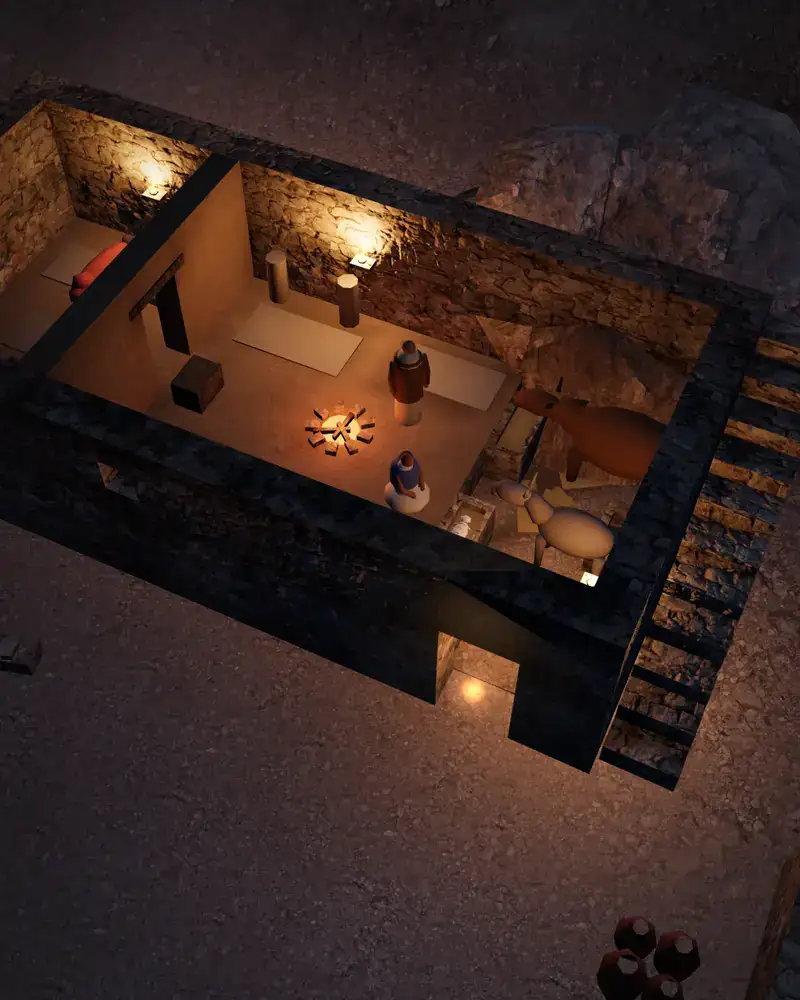
A village house at night, its roof lifted away. Choose how to read Luke 2:7: a family house, with the family room on a raised floor, the animals' lower end by the door and stone mangers along the edge, and the guest room already full; or the cave behind the house, where the earliest tradition places the birth.
How to read Luke 2:7
Evidence for this reading · A cave stable
The earliest tradition outside the Gospels places the birth in a cave near the village. Many houses in the Bethlehem hills were built against caves used for storage and animals, so a cave at the back of a house fits both readings.
- Strongly supported
The cave tradition is early. About AD 155 Justin Martyr says Joseph, having no lodging in the village, took shelter in a cave near it; about 248 Origen says the cave and its manger were shown at Bethlehem.
- Justin Martyr, Dialogue with Trypho 78 (about AD 155).
- Origen, Against Celsus 1.51 (about AD 248).
- Plausible
The grotto under the Church of the Nativity, built over by Constantine in the 330s, is the cave the tradition meant. Whether it is the place of the birth cannot be checked.
- Origen, Against Celsus 1.51 (about AD 248).
- Plausible
A cave behind a house was often part of the house and used for animals, so “the house” and “the cave” may describe one place.
- Kenneth E. Bailey, Jesus Through Middle Eastern Eyes (IVP Academic, 2008), ch. 1; and “The Manger and the Inn,” Theological Review 2 (1979).
- Yizhar Hirschfeld, The Palestinian Dwelling in the Roman-Byzantine Period (Jerusalem: Franciscan Printing Press, 1995).
Scripture
Luke 2:6–7
6And so it was, that, while they were there, the days were accomplished that she should be delivered. 7And she brought forth her firstborn son, and wrapped him in swaddling clothes, and laid him in a manger; because there was no room for them in the inn.
Luke 22:11
11And ye shall say unto the goodman of the house, The Master saith unto thee, Where is the guestchamber, where I shall eat the passover with my disciples?
Luke 10:34
34And went to him, and bound up his wounds, pouring in oil and wine, and set him on his own beast, and brought him to an inn, and took care of him.
+ 1 Samuel 28:24; Luke 13:15
King James Version (1769)
Background
- Kataluma
- Luke's word means a place to stay or lodge. Luke uses it again for the “guestchamber” where Jesus ate the Passover (22:11), and uses another word, pandocheion, for a commercial inn (10:34). So many scholars read 2:7 as “there was no space in the guest room”: the house's guest space was already full, and the birth took place in the main room among the household.
- Animals in the house
- In Palestinian village houses into the 20th century, the family lived on a raised floor, and animals were brought into a lower area by the door at night, for safety and warmth. Mangers, stone troughs or hollows along the edge of the raised floor, could be reached from both levels. Compare the fattened calf “in the house” (1 Samuel 28:24), and Luke 13:15, where the ox or donkey is untied “from the stall”: the same Greek word as the manger of 2:7.
- Welcome, not rejection
- Joseph was coming to his family's town. In a village culture of hospitality a descendant of David with a pregnant wife would be taken in. Luke's line is about crowded space, not about being turned away.
How sure can we be?
- Textually stated
Mary wrapped the baby in swaddling clothes herself and laid him in a manger (a feeding trough) because there was no place for them in the kataluma. (Luke 2:7)
- Textually stated
No innkeeper appears in Luke's account, and no one turns the couple away. (Luke 2:7)
- Speculative
A timber barn standing apart from the house, as in many European paintings, has no support in the text or in Judean village building, which used stone and caves.
- Yizhar Hirschfeld, The Palestinian Dwelling in the Roman-Byzantine Period (Jerusalem: Franciscan Printing Press, 1995).
- Speculative
The ox and the donkey of Christmas scenes come from Isaiah 1:3 read alongside the story (and the Gospel of Pseudo-Matthew, about the 7th century). Luke names no animals, though a manger implies they were near. (Isaiah 1:3)
- Gospel of Pseudo-Matthew 14 (about 7th century).
- Artistic
The house's size, the number of mangers, the lamps and the people in the guest room are choices made for the reconstruction.
- Plausible
The mangers are drawn as limestone troughs with a hollowed basin, filled with hay to the lip, and the one in the cave as a trough cut into a rock bench. Stone feeding troughs are known from houses and stables of the land, some cut into the rock of caves, but Luke does not describe this manger. (Luke 2:7)
- Yizhar Hirschfeld, The Palestinian Dwelling in the Roman-Byzantine Period (Jerusalem: Franciscan Printing Press, 1995).
- Artistic
A soft extra light falls on the manger in the night views so it can be seen on a phone or a projector. It is a teaching aid: that night the room had only its oil lamps and the embers of the hearth.
The common picture vs the text
Common picture
Mary and Joseph were turned away by an innkeeper and sent out to a stable.What the text saysTextually statedLuke has no innkeeper and no refusal. There was “no room in the kataluma”, a word Luke uses for a guest room (22:11), not for the inn of the Good Samaritan (10:34). (Luke 2:7; Luke 22:11; Luke 10:34)
Common picture
A wooden barn or stable, apart from the house.What the text saysPlausibleLuke mentions only a manger. The lower end of a family house where animals slept, or a cave used as a stable, fits Judean villages; a timber barn does not. (Luke 2:7)
Common picture
An ox and a donkey watched over the manger.What the text saysSpeculativeLuke names no animals. The pair comes from Isaiah 1:3 in later tradition, although a manger implies animals nearby. (Isaiah 1:3)