Skip to content
X-Dreamers

Labs · Places of Jesus · 3D

Holy Week, Day by Day

From Palm Sunday to the empty tomb, day by day

What happened on each day of Holy Week, and where? Follow Jesus' last week from Palm Sunday to the empty tomb across an immersive 3D Jerusalem, with the Gospel passages and how sure we are of each place.

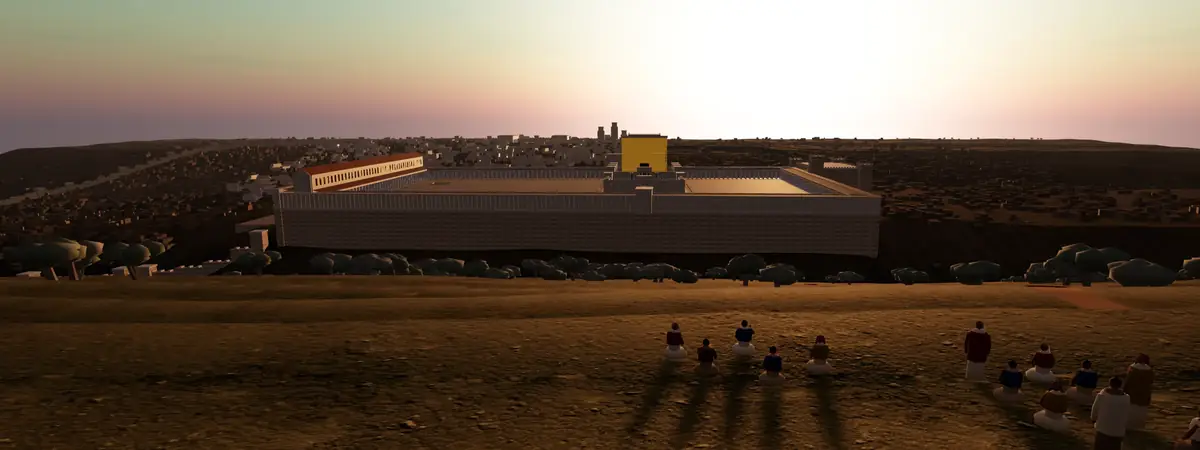
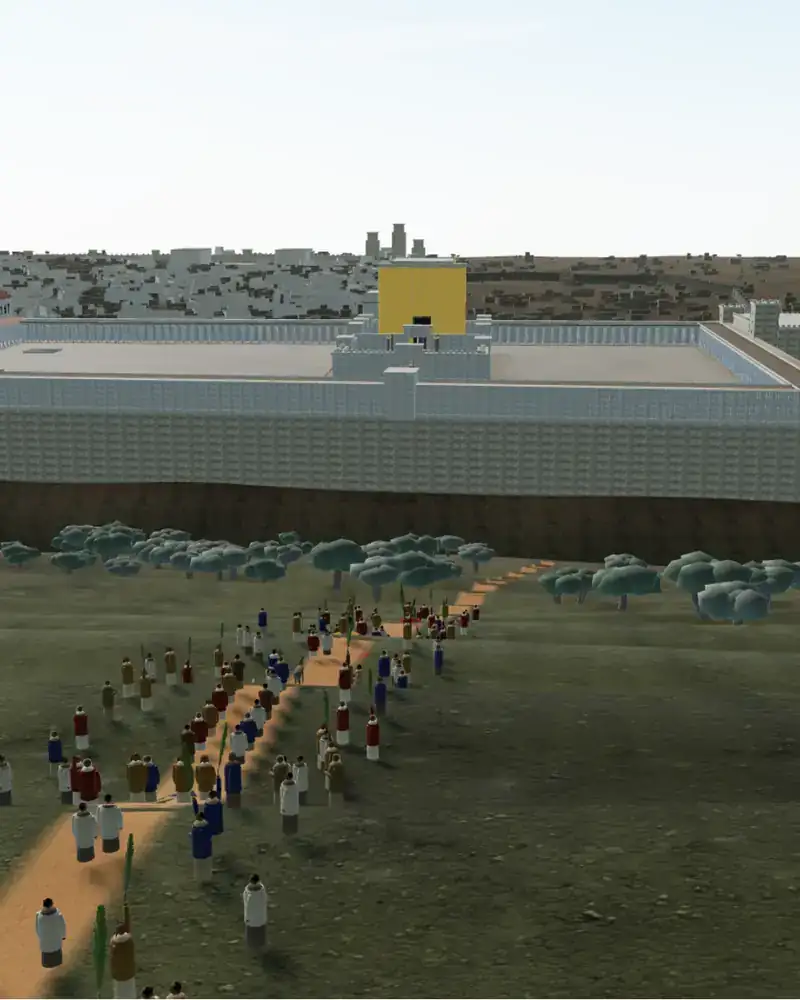
Jerusalem seen from the Mount of Olives in the afternoon light: the Temple across the Kidron Valley, and a crowd with branches on the road below

Holy Week in Jerusalem

From the branches of Palm Sunday to the open tomb at dawn: ten stops in and around the Jerusalem of Jesus' day.

Explore in 3D · drag to turn, pinch to zoom

3D · about 3.3 MB

Loading Holy Week…

Textually stated
Jesus lays aside his outer garment, ties a towel round himself, and washes the disciples' feet.

Stop 9 of 19 · Thursday · Upper room · The foot washing

Now to Thursday evening, in the upper room.

In the upper room Jesus washes his disciples' feet. Tap Next for the bread and the cup.

What you see, and how sure we are

  • Textually stated

    The meal was in a large upper room, furnished and ready, in a house in the city.

    Mark 14:13–15 · Luke 22:10–12

  • Strongly supported

    They reclined, not sat: diners lay on cushions or couches on their left side around low tables, leaning on the left elbow, as at a Greek or Roman banquet. The disciple Jesus loved lay next to him.

    The Gospels use the Greek words for reclining at table; the Mishnah says that on Passover night even the poorest must recline.

    Mark 14:18 · John 13:23–25

    The Mishnah (c. AD 200): Pesachim 10, Shekalim, Middot

  • Plausible

    We set the tables in a U, a triclinium, with Jesus near the middle. The Gospels do not describe the tables; the arrangement is a common reconstruction.

  • Plausible

    Who lies where: the disciple Jesus loved is just in front of him, so that leaning back he is at Jesus' breast; Judas is near enough on his other side to be handed the piece of bread; Peter is across the corner of the tables, facing them, near enough to signal to John. The Gospels give only these hints.

    John 13:23-26: the beloved disciple reclines next to Jesus and leans back on his breast, Peter beckons to him, and Jesus dips the piece of bread and gives it to Judas. Which side each lay on, and where Peter was, is read from these verses; they do not say it.

    John 13:21–30

  • Speculative

    Tradition places the upper room on Mount Zion, where the Cenacle stands today; the present hall is from the Crusader era. The Gospels say only that it was in the city.

    A church on Mount Zion linked with the upper room is mentioned from the 4th century.

    Mark 14:13

    Epiphanius, On Weights and Measures 14 (AD 392); Egeria, Travels (c. AD 381–384)

  • Artistic

    The lamps, the plaster and beams of the room, the bread and cup, the places of the other disciples, and Jesus sitting up to break the bread are our choices. The room is lit more brightly than a few clay lamps would light it, with a soft light on Jesus, so that faces and hands read on a screen; it is a way of showing the scene, not a halo.

Where the Gospels tell it differently

The difference itself is in the text; the level shows how sure the proposed explanation is.

  • Plausible

    Was the Last Supper a Passover meal?

    Matthew, Mark and Luke present the supper as the Passover meal. John has the leaders avoiding defilement on Friday morning so that they could still eat the Passover, and places the crucifixion on the day of Preparation of the Passover. Proposed answers: John's "Passover" can mean the whole week-long feast and "Preparation" the Friday of that week (plausible); Jesus held the meal a day early, knowing he would die (plausible); the two accounts follow different calendars, for example the one used at Qumran (speculative). Either way, John shows Jesus dying as the Passover lambs were being prepared.

    Mark 14:12 · Luke 22:15 · John 13:1 · John 18:28 · John 19:14 · John 19:31

    Annie Jaubert, The Date of the Last Supper (1965); Colin J. Humphreys and W. G. Waddington, "Dating the Crucifixion", Nature 306 (1983)

  • Plausible

    One cup or two?

    Luke mentions a cup before the bread and another after supper; Matthew and Mark one cup after the bread. The Passover meal as the Mishnah later describes it had four cups of wine, so Luke may name two of them.

    Luke 22:17–20 · Mark 14:23–24

    The Mishnah (c. AD 200): Pesachim 10, Shekalim, Middot

The week, day by day

Thursday evening

The Last Supper

A large upper room in the city

On the first day of Unleavened Bread two disciples followed a man carrying a jar of water to a house with a large upper room, furnished and ready, and there prepared the Passover. In the evening Jesus came with the Twelve. John tells how he laid aside his outer garment and washed their feet. As they reclined and ate, he said one of them would betray him; then he took bread, gave thanks, broke it and gave it to them, and afterwards the cup. When they had sung a hymn, they went out to the Mount of Olives.

Scripture

4He riseth from supper, and laid aside his garments; and took a towel, and girded himself. 5After that he poureth water into a bason, and began to wash the disciples’ feet, and to wipe them with the towel wherewith he was girded.

John 13:4–5 (KJV)

12So after he had washed their feet, and had taken his garments, and was set down again, he said unto them, Know ye what I have done to you? 13Ye call me Master and Lord: and ye say well; for so I am. 14If I then, your Lord and Master, have washed your feet; ye also ought to wash one another’s feet. 15For I have given you an example, that ye should do as I have done to you.

John 13:12–15 (KJV)
Also told in

What you see, and how sure we are

  • Textually stated

    The meal was in a large upper room, furnished and ready, in a house in the city.

    Mark 14:13–15 · Luke 22:10–12

  • Strongly supported

    They reclined, not sat: diners lay on cushions or couches on their left side around low tables, leaning on the left elbow, as at a Greek or Roman banquet. The disciple Jesus loved lay next to him.

    The Gospels use the Greek words for reclining at table; the Mishnah says that on Passover night even the poorest must recline.

    Mark 14:18 · John 13:23–25

    The Mishnah (c. AD 200): Pesachim 10, Shekalim, Middot

  • Plausible

    We set the tables in a U, a triclinium, with Jesus near the middle. The Gospels do not describe the tables; the arrangement is a common reconstruction.

  • Plausible

    Who lies where: the disciple Jesus loved is just in front of him, so that leaning back he is at Jesus' breast; Judas is near enough on his other side to be handed the piece of bread; Peter is across the corner of the tables, facing them, near enough to signal to John. The Gospels give only these hints.

    John 13:23-26: the beloved disciple reclines next to Jesus and leans back on his breast, Peter beckons to him, and Jesus dips the piece of bread and gives it to Judas. Which side each lay on, and where Peter was, is read from these verses; they do not say it.

    John 13:21–30

  • Speculative

    Tradition places the upper room on Mount Zion, where the Cenacle stands today; the present hall is from the Crusader era. The Gospels say only that it was in the city.

    A church on Mount Zion linked with the upper room is mentioned from the 4th century.

    Mark 14:13

    Epiphanius, On Weights and Measures 14 (AD 392); Egeria, Travels (c. AD 381–384)

  • Artistic

    The lamps, the plaster and beams of the room, the bread and cup, the places of the other disciples, and Jesus sitting up to break the bread are our choices. The room is lit more brightly than a few clay lamps would light it, with a soft light on Jesus, so that faces and hands read on a screen; it is a way of showing the scene, not a halo.

Where the Gospels tell it differently

The difference itself is in the text; the level shows how sure the proposed explanation is.

  • Plausible

    Was the Last Supper a Passover meal?

    Matthew, Mark and Luke present the supper as the Passover meal. John has the leaders avoiding defilement on Friday morning so that they could still eat the Passover, and places the crucifixion on the day of Preparation of the Passover. Proposed answers: John's "Passover" can mean the whole week-long feast and "Preparation" the Friday of that week (plausible); Jesus held the meal a day early, knowing he would die (plausible); the two accounts follow different calendars, for example the one used at Qumran (speculative). Either way, John shows Jesus dying as the Passover lambs were being prepared.

    Mark 14:12 · Luke 22:15 · John 13:1 · John 18:28 · John 19:14 · John 19:31

    Annie Jaubert, The Date of the Last Supper (1965); Colin J. Humphreys and W. G. Waddington, "Dating the Crucifixion", Nature 306 (1983)

  • Plausible

    One cup or two?

    Luke mentions a cup before the bread and another after supper; Matthew and Mark one cup after the bread. The Passover meal as the Mishnah later describes it had four cups of wine, so Luke may name two of them.

    Luke 22:17–20 · Mark 14:23–24

    The Mishnah (c. AD 200): Pesachim 10, Shekalim, Middot

Evidence levels

  • Textually stated

    Textually stated: Said directly in the biblical text.

  • Strongly supported

    Strongly supported: A close inference from the text or firm evidence.

  • Plausible

    Plausible: A reasonable reconstruction among live options.

  • Speculative

    Speculative: An informed guess; the text is silent.

  • Artistic

    Artistic: A stylistic choice made for the reconstruction.

Sources

Scripture comes first. Archaeology, ancient writers and later tradition are cited where they shape the reconstruction, and each claim is marked with how sure we can be.

  1. Josephus, The Jewish War (c. AD 75)

    Jerusalem, Herod's palace and the siege of AD 70.

  2. Josephus, Jewish Antiquities 15.11 (c. AD 93)

    Herod's rebuilding of the temple and the Royal Stoa.

  3. Philo of Alexandria, On the Embassy to Gaius 299–305 (c. AD 41)

    Pilate's shields in Herod's palace.

  4. The Mishnah (c. AD 200): Pesachim 10, Shekalim, Middot

    Later rabbinic tradition on Passover, the temple tax and the temple.

  5. Eusebius, Life of Constantine 3.25–40 (c. AD 339)

    The uncovering of the tomb and the building of the first church.

  6. The Bordeaux Pilgrim, Itinerary (AD 333)

    The earliest Christian pilgrim's description of Jerusalem.

  7. Eusebius, Onomasticon (early 4th century)

    Bethany and the tomb of Lazarus shown there.

  8. Pliny the Elder, Natural History 12.26 (c. AD 77)

    Nard, its source in India and its price.

  9. Gregory the Great, Homily 33 on the Gospels (AD 591)

    The sermon that joined Mary of Bethany, Mary Magdalene and the woman of Luke 7.

  10. Egeria, Travels (c. AD 381–384)

    The Holy Week services of 4th-century Jerusalem.

  11. Epiphanius, On Weights and Measures 14 (AD 392)

    A small church on Mount Zion linked with the upper room.

  12. Nahman Avigad, Discovering Jerusalem (1983)

    The excavated mansions of the Upper City.

  13. Gabriel Barkay, "The Garden Tomb: Was Jesus Buried Here?", Biblical Archaeology Review 12:2 (1986)

    Dates the Garden Tomb to the Iron Age.

  14. Shimon Gibson and Joan E. Taylor, Beneath the Church of the Holy Sepulchre, Jerusalem (1994)

    The quarry, the tombs and the Second Wall under the church.

  15. Shimon Gibson, The Final Days of Jesus: The Archaeological Evidence (2009)

    The archaeology of the places of the Passion.

  16. Leen Ritmeyer, The Quest: Revealing the Temple Mount in Jerusalem (2006)

    The Herodian Temple Mount.

  17. Colin J. Humphreys and W. G. Waddington, "Dating the Crucifixion", Nature 306 (1983)

    The astronomy of the Passover moons of AD 26–36.

  18. Annie Jaubert, The Date of the Last Supper (1965)

    The proposal of two calendars.

  19. King James Version (1769)
  20. 官話和合譯本 (Chinese Union Version, 1919, Shen edition), public domain

Use this in class

19 stops · about 50 minutes

Teach mode puts large captions on the projector, follows a presentation clicker and keeps presenter notes on your own screen.

How to teach with the labs →

Watch a 40-second tour

A silent clip of the guided tour with its captions, made from this lab. Play it before class, or download it to show without a connection.

A study aid, not a photograph. The city is a reconstruction, the figures are stylized and faceless, and the crucifixion is shown with reverence, at a distance. Several places, such as the upper room, the high priest's house, Pilate's praetorium and Golgotha itself, are debated; each is marked with how sure we can be, and the options are shown side by side.

English Scripture: King James Version (1769).The Temple Mount and city are the model from our Temple Mount lab. Rock and paving textures: Poly Haven (CC0). Everything else is procedural; no AI imagery is used.

What happened in Holy Week?

Holy Week is the last week of Jesus' earthly life, from his entry into Jerusalem on Palm Sunday to his resurrection on the first day of the next week. All four Gospels give it far more space than any other part of his life. Jesus rode a colt down the Mount of Olives, cleansed the temple, taught in its courts, ate the Passover with his disciples in an upper room, prayed in Gethsemane, was arrested and tried before the high priest and Pontius Pilate, was crucified at Golgotha outside the city wall, and was laid in a new rock-cut tomb, which the women found open at dawn.

This lab follows those days on a 3D model of Jerusalem in Jesus' day. Each stop shows the Gospel passages, notes where the Gospels tell things differently, and marks how sure we can be of each place. Some sites are strongly supported, such as Herod's palace for Pilate's judgment and the Church of the Holy Sepulchre for Golgotha; others, like the upper room on Mount Zion or the Garden Tomb, rest on later tradition or guesswork, and are labelled so.

One place across the agesSee Jerusalem through the ages →See the city of Holy Week from the Mount of Olives with every stop marked, and drag the years back to David or on to today.

Holy Week at a glance

Holy Week at a glance
Palm SundayEntry into Jerusalem from the Mount of Olives (Mark 11:1–11)
MondayThe fig tree and the cleansing of the temple (Mark 11:12–19)
TuesdayTeaching in the temple courts; the Olivet discourse (Mark 11:27–13:37)
WednesdayThe plot, the anointing at Bethany, Judas's bargain (Mark 14:1–11)
ThursdayThe Last Supper, Gethsemane, the arrest, Peter's denial (Mark 14:12–72)
FridayPilate, the crucifixion, the burial (Mark 15)
SaturdayThe Sabbath rest; the tomb sealed and guarded (Luke 23:56; Matthew 27:62–66)
Easter SundayThe empty tomb at dawn (Mark 16:1–8; John 20:1)
Pilate's praetoriumHerod's palace (strongly supported) or the Antonia Fortress (speculative)
Golgotha and the tombChurch of the Holy Sepulchre (strongly supported) or the Garden Tomb (speculative)
The upper roomMount Zion by tradition (speculative); the Gospels say only "in the city"

Key verses 6

9And they that went before, and they that followed, cried, saying, Hosanna; Blessed is he that cometh in the name of the Lord: 10Blessed be the kingdom of our father David, that cometh in the name of the Lord: Hosanna in the highest.

Mark 11:9–10

22And as they did eat, Jesus took bread, and blessed, and brake it, and gave to them, and said, Take, eat: this is my body. 23And he took the cup, and when he had given thanks, he gave it to them: and they all drank of it. 24And he said unto them, This is my blood of the new testament, which is shed for many.

Mark 14:22–24

36And he said, Abba, Father, all things are possible unto thee; take away this cup from me: nevertheless not what I will, but what thou wilt.

Mark 14:36

37And Jesus cried with a loud voice, and gave up the ghost. 38And the veil of the temple was rent in twain from the top to the bottom. 39And when the centurion, which stood over against him, saw that he so cried out, and gave up the ghost, he said, Truly this man was the Son of God.

Mark 15:37–39

6And he saith unto them, Be not affrighted: Ye seek Jesus of Nazareth, which was crucified: he is risen; he is not here: behold the place where they laid him.

Mark 16:6

1The first day of the week cometh Mary Magdalene early, when it was yet dark, unto the sepulchre, and seeth the stone taken away from the sepulchre.

John 20:1

Scripture quotations: King James Version (1769) (KJV).

What the Bible says, what our model adds to it, where good readers disagree, and where the old copies and the translations differ. We set the views side by side and do not pick a winner.

  • Textually stated8
  • Strongly supported4
  • Plausible9
  • Speculative1
  • Artistic2

A few of the model's choices

  • Plausible

    Our road runs from the ridge of the Mount of Olives down its western slope and across the Kidron. The Gospels name Bethphage, Bethany and the descent of the Mount of Olives, but not the exact path.

  • Strongly supported

    The entry was on the Sunday before Passover: John puts the dinner at Bethany six days before the Passover and the entry on the next day.

  • Plausible

    The trading most likely went on in the Court of the Gentiles, perhaps in or beside the Royal Stoa along the south side. The Gospels say only "the temple", the whole sacred precinct.

Show all 31
What the text says8

Stated in Scripture. Quoted from the King James Version (KJV) and the 1919 Chinese Union Version (和合本).

  • Jesus rode a colt, and the people spread their cloaks and cut branches on the road ahead of him.

    Textually stated

    7And they brought the colt to Jesus, and cast their garments on him; and he sat upon him. 8And many spread their garments in the way: and others cut down branches off the trees, and strawed them in the way.

    Mark 11:7–8 · KJV
  • Jesus drove out the sellers and buyers, overturned the money changers' tables and the dove sellers' seats, and stopped people carrying goods through.

    Textually stated

    15And they come to Jerusalem: and Jesus went into the temple, and began to cast out them that sold and bought in the temple, and overthrew the tables of the moneychangers, and the seats of them that sold doves; 16And would not suffer that any man should carry any vessel through the temple.

    Mark 11:15–16 · KJV
  • The meal was in a large upper room, furnished and ready, in a house in the city.

    Textually stated

    15And he will shew you a large upper room furnished and prepared: there make ready for us.

    Mark 14:15 · KJV
  • John says Jesus was taken first to Annas, a former high priest and Caiaphas's father-in-law, and then sent bound to Caiaphas.

    Textually stated

    13And led him away to Annas first; for he was father in law to Caiaphas, which was the high priest that same year.

    John 18:13 · KJV
  • John names the place: the Stone Pavement, Gabbatha in Hebrew, where Pilate sat on the judgment seat. Where it was is not said.

    Textually stated

    13When Pilate therefore heard that saying, he brought Jesus forth, and sat down in the judgment seat in a place that is called the Pavement, but in the Hebrew, Gabbatha.

    John 19:13 · KJV
  • The leaders did not enter the praetorium, so as not to be defiled before the Passover; Pilate went out to them and back in to Jesus.

    Textually stated

    28Then led they Jesus from Caiaphas unto the hall of judgment: and it was early; and they themselves went not into the judgment hall, lest they should be defiled; but that they might eat the passover.

    John 18:28 · KJV
  • Golgotha was near the city and outside its gate, by a road where people passed by.

    Textually stated

    20This title then read many of the Jews: for the place where Jesus was crucified was nigh to the city: and it was written in Hebrew, and Greek, and Latin.

    John 19:20 · KJV
  • In the place where Jesus was crucified there was a garden, and in it a new tomb where no one had yet been laid, cut in the rock.

    Textually stated

    41Now in the place where he was crucified there was a garden; and in the garden a new sepulchre, wherein was never man yet laid.

    John 19:41 · KJV
What the model adds16

Choices the reconstruction has to make where the text is silent, each with its evidence level and the reason for it.

Strongly supported4
  • The entry was on the Sunday before Passover: John puts the dinner at Bethany six days before the Passover and the entry on the next day.

    Why: John 12:1; John 12:12

  • Roman governors stayed in Herod's palace when they came up to Jerusalem: Philo tells of Pilate setting up shields there, and Josephus of the governor Florus judging from a tribunal set before it.

    Why: Philo, On the Embassy to Gaius 299–305; Josephus, The Jewish War.

  • It was the day of Preparation, the day before the Sabbath: a Friday. The year was most likely AD 30 or AD 33, when the 14th of Nisan fell on a Friday (plausible).

    Why: Mark 15:42; John 19:31

  • A large stone was rolled against the door. Round rolling stones are known from wealthy tombs of the period, though most tombs were closed with a squared block.

    Why: Mark 15:46; Mark 16:3–4

Plausible9
  • Our road runs from the ridge of the Mount of Olives down its western slope and across the Kidron. The Gospels name Bethphage, Bethany and the descent of the Mount of Olives, but not the exact path.

    Why: Bethany lies over the ridge to the east, so any road from it to the city crosses the Mount of Olives.

  • The trading most likely went on in the Court of the Gentiles, perhaps in or beside the Royal Stoa along the south side. The Gospels say only "the temple", the whole sacred precinct.

    Why: Josephus describes the Royal Stoa as a great basilica on the south side of the court; the Gospels do not locate the stalls.

  • We set the tables in a U, a triclinium, with Jesus near the middle. The Gospels do not describe the tables; the arrangement is a common reconstruction.

    Why: Reclining diners at a Greek or Roman banquet lay around a U of couches; the Gospels only say they reclined.

  • Who lies where: the disciple Jesus loved is just in front of him, so that leaning back he is at Jesus' breast; Judas is near enough on his other side to be handed the piece of bread; Peter is across the corner of the tables, facing them, near enough to signal to John. The Gospels give only these hints.

    Why: John 13:23-26: the beloved disciple reclines next to Jesus and leans back on his breast, Peter beckons to him, and Jesus dips the piece of bread and gives it to Judas. Which side each lay on, and where Peter was, is read from these verses; they do not say it.

  • The traditional site at the foot of the Mount of Olives, by today's Church of All Nations, fits the Gospels: across the Kidron, on the Mount of Olives. The exact spot is not known.

    Why: John 18:1; Luke 22:39

  • Passover fell in the middle of the month of Nisan, at the full moon, so the night was probably bright, unless clouds covered the moon. John still mentions torches and lanterns.

    Why: The Jewish months began at the new moon; the 14th and 15th are at or near the full moon.

  • Our house follows the priestly mansions excavated in the Upper City: rooms and an upper storey around a paved courtyard, with a gateway passage to the street.

    Why: Wealthy houses of the 1st century excavated in the Jewish Quarter had courtyards, ritual baths and fine rooms.

  • Was the Last Supper a Passover meal?: Matthew, Mark and Luke present the supper as the Passover meal. John has the leaders avoiding defilement on Friday morning so that they could still eat the Passover, and places the crucifixion on the day of Preparation of the Passover. Proposed answers: John's "Passover" can mean the whole week-long feast and "Preparation" the Friday of that week (plausible); Jesus held the meal a day early, knowing he would die (plausible); the two accounts follow different calendars, for example the one used at Qumran (speculative). Either way, John shows Jesus dying as the Passover lambs were being prepared.

    Why: Mark 14:12; Luke 22:15; John 13:1; John 18:28; John 19:14; John 19:31

  • The third hour or the sixth?: Mark says it was the third hour when they crucified him; John says Pilate's verdict came at about the sixth hour. Proposed answers: people reckoned time loosely in blocks of three hours, so a mid-morning event could be named by either (plausible); John counts from midnight in the Roman way (speculative); an early copying error in the numerals (speculative).

    Why: Mark 15:25; John 19:14

Speculative1
  • Tradition places the upper room on Mount Zion, where the Cenacle stands today; the present hall is from the Crusader era. The Gospels say only that it was in the city.

    Why: A church on Mount Zion linked with the upper room is mentioned from the 4th century.

Artistic2
  • We show a low rock outcrop beside the road. The Gospels never call Golgotha a hill; the name means "skull", and the green hill of hymns is later imagery.

    Why: Mark 15:22

  • The figures are stylized and seen from a distance, and no wounds are shown. The Gospels themselves tell the crucifixion in very few words.

    Why: A choice made out of reverence, following the restraint of the Gospels.

Competing views4

Where careful readers disagree. Each view with who holds it and the evidence for and against it. No verdict.

Where did Pilate judge Jesus?

John 18:28; John 19:13; Acts 21:31–35

Herod's palace on the western hill

Held by Most scholars today, following Philo and Josephus

For

  • Philo says Pilate set up gilded shields in Herod's palace in Jerusalem, where he resided.
  • Josephus tells how the governor Florus lodged at the palace and had a tribunal set up in front of it to judge the city's leaders.
  • Excavations in the Tower of David citadel and the Armenian Garden have found parts of the palace's foundations.

Against

  • No pavement matching John's Stone Pavement has been identified there, and the palace plan is known only in part.

Sources: Philo of Alexandria, On the Embassy to Gaius 299–305 (c. AD 41); Josephus, The Jewish War (c. AD 75); Shimon Gibson, The Final Days of Jesus: The Archaeological Evidence (2009)

The Antonia Fortress, north-west of the Temple

Held by The medieval and later tradition of the Via Dolorosa

For

  • A Roman garrison was stationed there, and soldiers came down from it into the temple courts (Acts 21:31-35).
  • It is the traditional starting point of the Via Dolorosa.

Against

  • The pavement under the convent belongs to a square built by Hadrian in the 2nd century, over a pool that was open in Jesus' day.
  • The Antonia was a barracks; governors are recorded residing in Herod's palace.

Sources: Josephus, The Jewish War (c. AD 75); Shimon Gibson, The Final Days of Jesus: The Archaeological Evidence (2009)

What the lab shows (a drawing choice, not a ruling): The lab draws the trial at Herod's palace and lets you switch to the Antonia.

Where was Jesus crucified and buried?

John 19:20; John 19:41–42; John 19:41

The Church of the Holy Sepulchre

Held by The Jerusalem church since the 4th century (Eusebius); the archaeological study of the site by Gibson and Taylor

For

  • Excavations show the area was outside the Second Wall before the city expanded in the 40s AD.
  • It was an old quarry with Jewish tombs of the period (kokhim tombs are still visible inside the church).
  • The Christians of Jerusalem remembered the place; Eusebius tells how Constantine's builders removed a Roman temple in the 320s and uncovered the tomb.

Against

  • Today it lies inside the Old City walls, which surprises visitors; the rock and the tomb have been cut back and rebuilt over the centuries.

Sources: Eusebius, Life of Constantine 3.25–40 (c. AD 339); Shimon Gibson and Joan E. Taylor, Beneath the Church of the Holy Sepulchre, Jerusalem (1994); The Bordeaux Pilgrim, Itinerary (AD 333)

The Garden Tomb, north of the Damascus Gate

Held by General Charles Gordon and other visitors since the 19th century

For

  • It is outside the city walls, by a road, with a garden and a rock-cut tomb, as the Gospels describe.

Against

  • The tomb belongs to a group of tombs cut in the 8th to 7th centuries BC, in the Iron Age, so it was not a new tomb in Jesus' day.
  • The skull-like face of the cliff is modern erosion, and no tradition before the 19th century connects the site with the crucifixion.

Sources: Gabriel Barkay, "The Garden Tomb: Was Jesus Buried Here?", Biblical Archaeology Review 12:2 (1986)

What the lab shows (a drawing choice, not a ruling): The lab draws Golgotha and the tomb at the Holy Sepulchre site and lets you switch to the Garden Tomb.

Where was the high priest's house?

The Upper City, near the traditional Mount Zion

Held by Byzantine and later Armenian tradition; archaeologists who excavated the Upper City's priestly mansions (Avigad)

For

  • Mansions of the priestly class, with ritual baths and fine rooms, have been excavated in the Upper City.
  • Josephus mentions the house of the high priest Ananias burned by rebels in AD 66, together with the royal palaces of the upper part of the city.
  • It is close to the traditional site of the upper room, so the night's events stay within a short walk.

Against

  • No inscription or find names Caiaphas at any house, and the tradition for the site is centuries later.

Sources: Nahman Avigad, Discovering Jerusalem (1983); Josephus, The Jewish War (c. AD 75); The Bordeaux Pilgrim, Itinerary (AD 333)

St Peter in Gallicantu, on the eastern slope of Mount Zion

Held by The tradition kept at the church of St Peter in Gallicantu

For

  • A Byzantine church here commemorated Peter's repentance, and a stepped street of the period runs down the slope beside it.

Against

  • The chambers are more likely cisterns, storerooms or tombs, and the earliest pilgrims placed Caiaphas's house higher on Mount Zion, not here.

Sources: Shimon Gibson, The Final Days of Jesus: The Archaeological Evidence (2009)

What the lab shows (a drawing choice, not a ruling): The lab draws the house in the Upper City and lets you switch to Gallicantu.

Was the Last Supper a Passover meal?

Mark 14:12; John 18:28; John 19:14

Yes: it was the Passover meal, on the evening of the 15th of Nisan

Held by Readers who follow Matthew, Mark and Luke; Joachim Jeremias

For

  • Mark 14:12 dates the preparations to the day the Passover lamb was sacrificed, and Luke 22:15 has Jesus say "this Passover".
  • John's "Passover" can mean the whole week-long feast, and "Preparation" the Friday of that week.

Against

  • John 18:28 has the leaders still waiting to eat the Passover on Friday morning.

Sources: The Mishnah (c. AD 200): Pesachim 10, Shekalim, Middot; Joachim Jeremias, The Eucharistic Words of Jesus (English translation, 1966)

No: a meal on the evening before Passover; Jesus died as the lambs were killed

Held by Readers who follow John's dating

For

  • John 18:28 and 19:14 put the Passover meal after the crucifixion.

Against

  • The Synoptic Gospels call the meal the Passover plainly; this reading must take their wording loosely.
Both: two calendars, so Jesus kept Passover earlier than the Temple

Held by Annie Jaubert (the calendar used at Qumran)

For

  • A solar calendar like the one in Jubilees and at Qumran put Passover on a fixed weekday (in Jaubert's view, Tuesday evening), earlier in the week than the Temple's.

Against

  • There is no evidence that Jesus or his disciples followed that calendar.

Sources: Annie Jaubert, The Date of the Last Supper (1965)

What the lab shows (a drawing choice, not a ruling): The lab shows the supper on Thursday evening and the crucifixion on Friday, the day of Preparation, without choosing between these readings.

Textual notes3

Places where manuscripts, ancient versions or translations differ in numbers or wording. KJV and 和合本 are quoted as they stand.

The third hour or the sixth?

Manuscripts

25And it was the third hour, and they crucified him.

Mark 15:25 · KJV

25釘他在十字架上、是巳初的時候。

馬可福音 15:25 · 和合本 (CUV 1919)

14And it was the preparation of the passover, and about the sixth hour: and he saith unto the Jews, Behold your King!

John 19:14 · KJV

14那日是豫備逾越節的日子、約有午正。彼拉多對猶太人說、看哪、這是你們的王。

約翰福音 19:14 · 和合本 (CUV 1919)
Other witnesses
Almost all Greek manuscripts of John 19:14about the sixth hour
A later corrector of Codex Sinaiticus; the supplement to Codex Bezaeabout the third hour

KJV keeps the Greek hours ("third", "sixth"); the 和合本 turns them into Chinese double-hours, 巳初 (about 9 a.m.) and 午正 (noon), which already assumes how they were counted. Eusebius thought a copyist had changed the Greek numeral Γ (3) into ϛ (6); others think John counted hours the Roman way, from midnight.

Sources: Commentaries on John 19:14 (Bengel, Pulpit Commentary)

The angel and the sweat like drops of blood (Luke 22:43–44)

Manuscripts

43And there appeared an angel unto him from heaven, strengthening him. 44And being in an agony he prayed more earnestly: and his sweat was as it were great drops of blood falling down to the ground.

Luke 22:43–44 · KJV

43有一位天使從天上顯現、加添他的力量。44耶穌極其傷痛、禱告更加懇切.汗珠如大血點、滴在地上。

路加福音 22:43–44 · 和合本 (CUV 1919)
Other witnesses
Papyri 69 and 75; Codex Alexandrinus, Codex Vaticanusverses absent
Codex Sinaiticus (first hand), Codex Bezae; Uncial 0171 (about AD 200)verses present

Both KJV and the 和合本 print the two verses. Modern Greek editions put them in double brackets, and some manuscripts mark them as doubtful. The lab tells Gethsemane from all four Gospels and does not depend on these verses.

Sources: Wikipedia, "Luke 22:43–44"

The ending of Mark (Mark 16:9–20)

Manuscripts

8And they went out quickly, and fled from the sepulchre; for they trembled and were amazed: neither said they any thing to any man; for they were afraid.

Mark 16:8 · KJV

8他們就出來、從墳墓那裏逃跑.又發抖、又驚奇、甚麼也不告訴人.因爲他們害怕。

馬可福音 16:8 · 和合本 (CUV 1919)

9Now when Jesus was risen early the first day of the week, he appeared first to Mary Magdalene, out of whom he had cast seven devils.

Mark 16:9 · KJV

9在七日的第一日清早、耶穌復活了、就先向抹大拉的馬利亞顯現.耶穌從他身上曾趕出七個鬼。

馬可福音 16:9 · 和合本 (CUV 1919)
Other witnesses
Codex Sinaiticus and Codex Vaticanus (4th century)end at 16:8
Most later manuscriptscontinue with 16:9–20 (the "longer ending")

KJV and the 和合本 both print 16:9–20. Many scholars judge them a later addition; the lab's Easter morning follows the accounts all four Gospels share.

Sources: Wikipedia, "Mark 16"

Frequently asked questions

What happened on each day of Holy Week?

Sunday: Jesus rode into Jerusalem. Monday: he cleansed the temple. Tuesday: he taught in the temple courts and spoke on the Mount of Olives about the future. Wednesday: the leaders plotted and Judas agreed to betray him. Thursday: the Last Supper, Gethsemane and the arrest. Friday: the trial before Pilate, the crucifixion and the burial. Saturday: the Sabbath rest. Sunday: the empty tomb. Monday to Wednesday follow Mark's sequence, which the other Gospels mark less closely.

Where was the Last Supper?

The Gospels say it was in a large upper room, furnished and ready, in a house in the city (Mark 14:15). The Cenacle on Mount Zion has been shown as the place since the 4th century, but the building there today is from the Crusader era, and the location is speculative.

Was the Last Supper a Passover meal?

Matthew, Mark and Luke present it as the Passover meal. John places the crucifixion on the day of Preparation of the Passover. Common explanations are that John's terms refer to the whole feast week and its Friday, or that Jesus held the meal a day early; a theory of two calendars is more speculative.

Where was Jesus crucified: the Holy Sepulchre or the Garden Tomb?

The Church of the Holy Sepulchre is strongly supported: in Jesus' day the area lay outside the city wall in an old quarry with Jewish tombs of the period, and the local Christian memory of it was strong enough for Constantine's builders to dig there in the 320s. The Garden Tomb is a peaceful place for reflection, but its tomb was cut in the Iron Age, centuries before Jesus, so it cannot be the new tomb of John 19:41.

What does Gethsemane mean?

It comes from the Aramaic for "oil press". It was a place across the Kidron Valley on the Mount of Olives, which John calls a garden (John 18:1); an olive grove with a press fits the name.

Where did Pilate judge Jesus?

At the praetorium, on a judgment seat at the Stone Pavement, called Gabbatha (John 19:13). Most scholars place it at Herod's palace on the western hill, where Roman governors stayed; the traditional site at the Antonia Fortress, where the Via Dolorosa begins, is less likely.

In what year was Holy Week, and on what dates?

The Gospels agree that Jesus died on a Friday, the day before a Sabbath, at Passover (Mark 15:42; John 19:31), while Pilate governed Judea (AD 26–36). Working from the Passover calendar and the moon, most scholars choose 7 April AD 30 or 3 April AD 33 for the crucifixion, which puts Palm Sunday five days earlier. Neither year is stated in the text, so both are shown as strong candidates, not certainties.

Why is it called Holy Week, and what are Maundy Thursday and Good Friday?

The names come from the church's calendar, not from the Bible. Holy Week was kept in Jerusalem by the 4th century, when the pilgrim Egeria described its services at the very places. Maundy comes from the Latin mandatum, the new commandment Jesus gave at the supper (John 13:34). Good Friday is the day of the crucifixion; good here most likely means holy, though the origin of the word is debated.

Sources & limits

Limits of this lab 4

  • Jerusalem of AD 30 is a reconstruction. Herod's Temple, his palace and the city walls are known from Josephus, the Mishnah and excavations, but only in part.
  • The sites of the high priest's house, the trial and Golgotha are debated; the lab shows the options it can and says which it draws.
  • The order of some events differs between the Gospels; the lab follows a common harmony and notes each difference.
  • People are stylized and seen from a distance; no wounds are shown. The light, the crowds and the rooms are artistic.

Sources 26

  1. King James Version (KJV) (Public domain outside the United Kingdom)
  2. 官話和合譯本 (Chinese Union Version, 1919), zh.wikisource (Public domain)
  3. Josephus, The Jewish War (c. AD 75)
  4. Josephus, Jewish Antiquities 15.11 (c. AD 93)
  5. Philo of Alexandria, On the Embassy to Gaius 299–305 (c. AD 41)
  6. The Mishnah (c. AD 200): Pesachim 10, Shekalim, Middot
  7. Eusebius, Life of Constantine 3.25–40 (c. AD 339)
  8. The Bordeaux Pilgrim, Itinerary (AD 333)
  9. Eusebius, Onomasticon (early 4th century)
  10. Pliny the Elder, Natural History 12.26 (c. AD 77)
  11. Gregory the Great, Homily 33 on the Gospels (AD 591)
  12. Egeria, Travels (c. AD 381–384)
  13. Epiphanius, On Weights and Measures 14 (AD 392)
  14. Nahman Avigad, Discovering Jerusalem (1983)
  15. Gabriel Barkay, "The Garden Tomb: Was Jesus Buried Here?", Biblical Archaeology Review 12:2 (1986)
  16. Shimon Gibson and Joan E. Taylor, Beneath the Church of the Holy Sepulchre, Jerusalem (1994)
  17. Shimon Gibson, The Final Days of Jesus: The Archaeological Evidence (2009)
  18. Leen Ritmeyer, The Quest: Revealing the Temple Mount in Jerusalem (2006)
  19. Colin J. Humphreys and W. G. Waddington, "Dating the Crucifixion", Nature 306 (1983)
  20. Annie Jaubert, The Date of the Last Supper (1965)
  21. King James Version (1769)
  22. 官話和合譯本 (Chinese Union Version, 1919, Shen edition), public domain
  23. Joachim Jeremias, The Eucharistic Words of Jesus (English translation, 1966)
  24. Commentaries on John 19:14 (Bengel, Pulpit Commentary) (Public domain)
  25. Wikipedia, "Luke 22:43–44"
  26. Wikipedia, "Mark 16"

Scripture is quoted only from KJV and the 1919 和合本. Other works are cited for facts and arguments, not quoted at length.

How we build the Labs →Found a mistake? Report it →

What’s new · v2.4.1Version 2.4.1: English Scripture is now quoted from the King James Version (1769).