 X-Dreamers
Why Do Matthew and Luke Give Different Genealogies of Jesus?
Matthew runs from Abraham through Solomon; Luke runs back to Adam through Nathan. Where the two lists agree, where they part, and the main explanations.
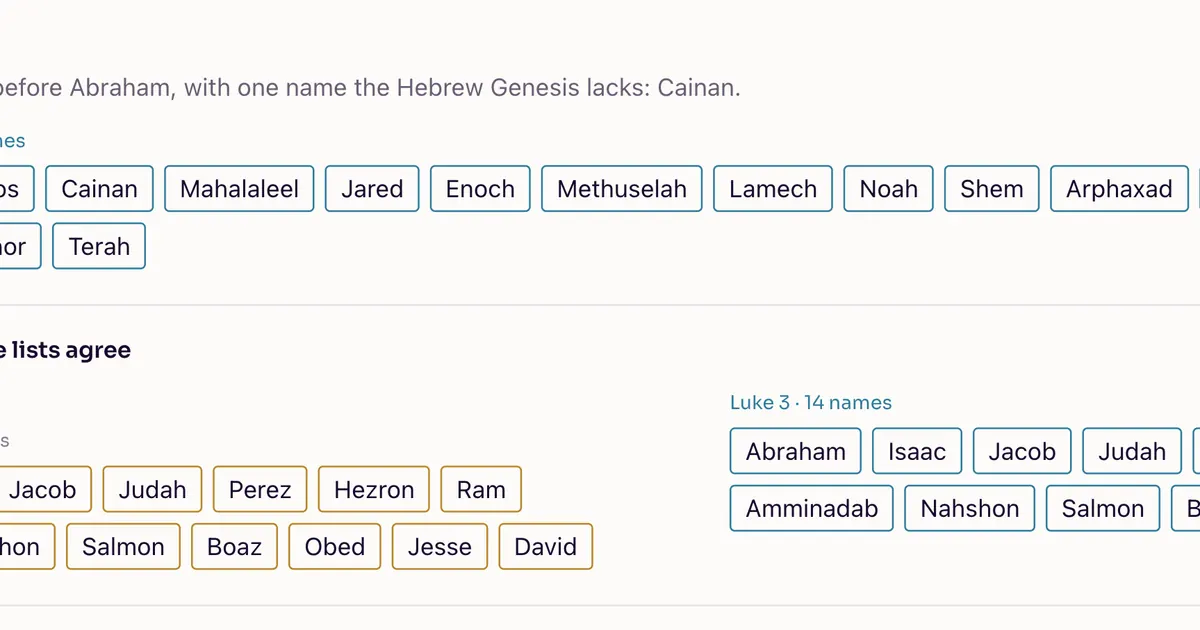
Matthew and Luke both trace Jesus through Joseph to David, but by different roads. Matthew starts with Abraham and comes down through Solomon and the kings of Judah; Luke starts with Jesus and goes all the way back to Adam through another son of David, Nathan. The two lists agree from Abraham to David, meet again briefly at Shealtiel and Zerubbabel, and otherwise share no names between David and Joseph. Christians have explained this in three main ways: Luke gives Mary’s line; both lists are Joseph’s, one by birth and one by law; or Matthew records the royal succession while Luke records the natural descent.
See both genealogies side by side →
What the two texts actually say
Matthew ends his list like this:
Jacob became the father of Joseph, the husband of Mary, from whom was born Jesus, who is called Christ. (Matthew 1:16)
Luke begins his like this:
Jesus himself, when he began to teach, was about thirty years old, being the son (as was supposed) of Joseph, the son of Heli, (Luke 3:23)
So Joseph’s father is Jacob in Matthew and Heli in Luke. That is the whole puzzle in two verses. Everything else follows from it.
| Matthew 1:1–17 | Luke 3:23–38 | |
|---|---|---|
| Direction | Down, from Abraham to Jesus | Up, from Jesus to Adam and God |
| Names | 41, from Abraham to Jesus | 76, from Jesus to Adam |
| Son of David | Solomon | Nathan |
| Joseph’s father | Jacob | Heli |
| Between David and Joseph | 25 generations | 40 generations |
| Shared names after David | Shealtiel, Zerubbabel | Shealtiel, Zerubbabel |
Matthew’s list is deliberately shaped
Matthew tells you he has arranged his material:
So all the generations from Abraham to David are fourteen generations; from David to the exile to Babylon fourteen generations; and from the carrying away to Babylon to the Christ, fourteen generations. (Matthew 1:17)
To get three fourteens he passes over some well-known kings. Between Joram and Uzziah, Kings and Chronicles name three more: Ahaziah, Joash and Amaziah. He also skips Jehoiakim before Jechoniah. That is not a mistake he hoped nobody would notice; ancient genealogies often shortened a line to fit a pattern, and “became the father of” can mean “was the ancestor of”. His third group, counted strictly, has only thirteen names unless Jechoniah or Jesus is counted twice. Why fourteen? Matthew does not say. One guess is that the Hebrew letters of David’s name add up to fourteen.
The point for our question: Matthew’s list is theological and selective. It tells you Jesus is the heir of Abraham and of David’s royal house. It was never meant to be a complete register of fathers and sons.
Three ways to explain the two lines
1. Luke gives Mary’s line
Heli was Mary’s father, and Joseph is “son of Heli” as his son-in-law. Or the phrase “(as was supposed) of Joseph” sets Joseph to one side, and the line runs from Jesus through his mother to Heli. Matthew would then give Joseph’s legal line, Luke Mary’s natural one.
- For: Luke tells the birth story from Mary’s side (Luke 1–2), and this reading gives Jesus physical descent from David, which the New Testament assumes: he “was born of the offspring of David according to the flesh” (Romans 1:3).
- Against: Luke names Joseph, not Mary, and the pattern “the son of” runs unbroken. The view became common only from the late fifteenth century; earlier hints of it are disputed.
2. Both lists are Joseph’s: by birth and by law
This is the oldest surviving explanation. Julius Africanus, writing around AD 220 and citing Jesus’ own relatives, said that Jacob and Heli were half-brothers. Heli died childless, and Jacob married his widow to raise up a son for him, as the Law required:
It shall be that the firstborn whom she bears shall succeed in the name of his brother who is dead, that his name not be blotted out of Israel. (Deuteronomy 25:6)
Joseph would then be Jacob’s son by birth and Heli’s by law, and each Gospel is right.
- For: it is early (preserved by Eusebius, Church History 1.7), and levirate marriage is well attested in Scripture: Tamar, Ruth and Boaz, and the Sadducees’ question in Mark 12:19.
- Against: it rests on a family tradition no one can check, and Africanus admits it is unproven. It also needs a second case like it to explain Shealtiel.
3. Matthew lists the throne, Luke the family
On this view Matthew gives the heirs to David’s throne, not necessarily fathers and sons. When Solomon’s line failed, perhaps after Jechoniah, the right passed to relatives from Nathan’s line, and the two lists meet at Shealtiel. It would explain why Shealtiel is Jechoniah’s son in Matthew but Neri’s son in Luke. But no text says the right passed through Nathan, and Jeremiah 22:30, often cited here, is about ruling, not descent. The lab rates this one speculative.
The Shealtiel and Zerubbabel knot
Both lists include the same pair. Matthew: “Jechoniah became the father of Shealtiel. Shealtiel became the father of Zerubbabel” (Matthew 1:12). Luke: “the son of Zerubbabel, the son of Shealtiel, the son of Neri” (Luke 3:27). Most readers take them to be the same two men: Zerubbabel the governor who led the return from Babylon, and his father. Then Shealtiel has two fathers, and 1 Chronicles 3:19 gives Zerubbabel a third, Pedaiah. That points again to levirate marriage or adoption somewhere along the line. Others think Luke’s pair are different men who happened to carry the same two common names.
Smaller details worth knowing
- Cainan. Luke 3:36 has a Cainan between Arphaxad and Shelah who is not in the Hebrew text of Genesis 11. He comes from the Greek Septuagint, which Luke used.
- Aram or Admin. In Luke 3:33 many manuscripts read “Admin, the son of Arni” where the WEBU, following the Majority Text, has “Aram”.
- Four women. Matthew names Tamar, Rahab, Ruth and “her who had been Uriah’s wife” (Matthew 1:6) before Mary. All four have irregular stories, and at least Rahab and Ruth were foreigners. Together they prepare the reader for an unusual birth.
What we know and what is interpretation
| Point | Evidence level |
|---|---|
| Matthew goes through Solomon, Luke through Nathan; Joseph’s father is Jacob in one and Heli in the other; four women in Matthew | Stated in the text |
| Matthew’s list is selective, shaped into three fourteens | Strongly supported |
| Luke’s Cainan comes from the Septuagint | Strongly supported |
| Luke gives Mary’s line | Plausible |
| Joseph was Jacob’s son by birth, Heli’s by law | Plausible |
| The same Shealtiel and Zerubbabel appear in both | Plausible |
| Matthew records the royal succession, Luke the natural line | Speculative |
Why it still matters
The two Gospels disagree on names, but they agree on the claim. Both place Jesus in David’s family, which is what the angel promised Mary: “The Lord God will give him the throne of his father David” (Luke 1:32). Matthew opens with “Jesus Christ, the son of David, the son of Abraham” (Matthew 1:1), for readers waiting for Israel’s king. Luke goes past Abraham to “Adam, the son of God” (Luke 3:38), for readers from every nation.
Frequently asked questions
Who was Heli in Luke 3:23? Luke calls Joseph “the son of Heli”. Heli may be Joseph’s legal father, or Mary’s father with Joseph as his son-in-law. Scripture does not say which.
Is Luke’s genealogy Mary’s line? It may be. It is one of the main explanations, rated plausible, but Luke’s wording names Joseph.
Do the two genealogies contradict each other? They list different ancestors between David and Joseph. Several early and modern explanations reconcile them; none can be proven from the text alone.
What does “as was supposed” mean in Luke 3:23? Luke is signalling that Joseph was not Jesus’ natural father, though people counted Jesus as Joseph’s son.
Trace it yourself
The Biblical Family Tree lab draws both genealogies side by side, name by name, and lets you open any person with their verses.
Open Heli in the family tree → · or jump to Zerubbabel, Nathan or Solomon.
Related labs
- Nazareth in the first century: the village where Joseph and Mary raised Jesus.
- The birth of Jesus on the Bible Story Map
- David on the Bible Time Map: where both lines branch.
Found this helpful? Pass it on.