 X-Dreamers
Bible Stories for Children: Joseph and Joshua, Read Aloud
Two illustrated Bible stories for ages 8–12, read aloud page by page: Joseph’s road from the pit to forgiveness, and Joshua’s crossing of the Jordan.
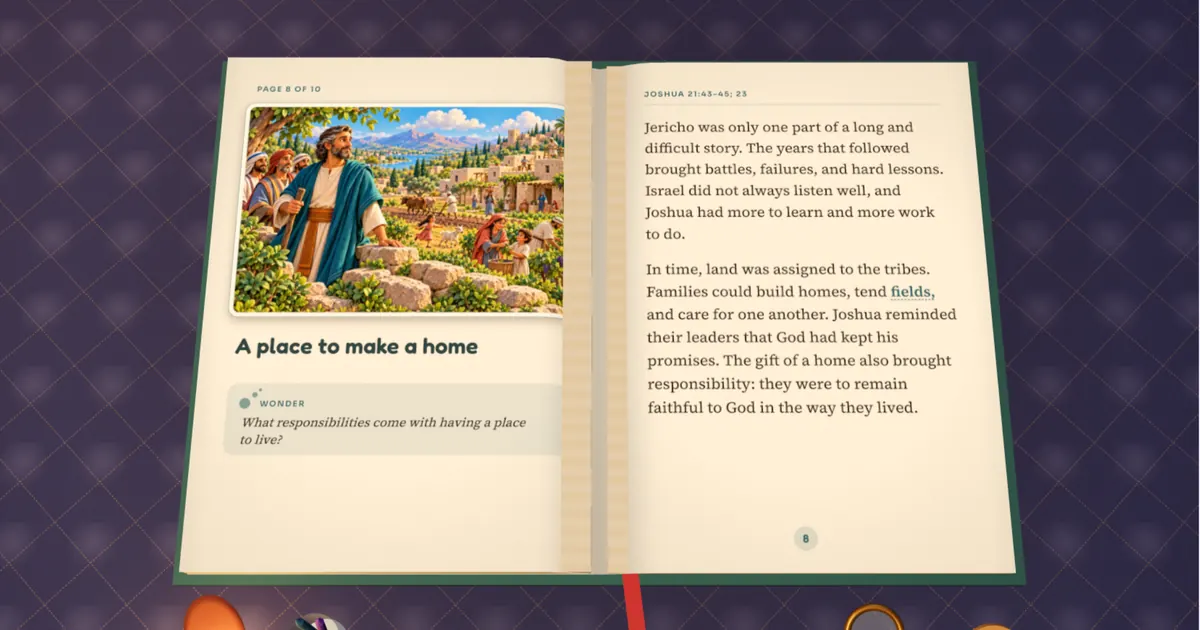
X-Dreamers has two illustrated Bible stories for children aged about 8 to 12, each read aloud page by page. Joseph: Dreams and Forgiveness follows Joseph from his dreams in Canaan, through slavery and prison, to the grain stores of Egypt and the day he forgives his brothers. Joshua: Courage and Promise crosses the Jordan with Israel, from Rahab’s scarlet cord and the twelve stones to the walls of Jericho and the choice at Shechem. Each story takes about eight minutes to hear, and you can open it three ways: as a 3D pop-up book, as an ebook where the words light up as they are read, or as a picture book that ends with a short quiz. The stories are in English, with narration.
The two books at a glance
| Joseph: Dreams and Forgiveness | Joshua: Courage and Promise | |
|---|---|---|
| Follows | Genesis 37; 39–47; 50:15–21 | Joshua 1–6; 21:43–45; 23–24 |
| Story chapters | 10 | 10 |
| Big ideas | Faithfulness when life is unfair, patient hope, forgiveness | Courage, remembering, mercy, keeping promises |
| Reading level | Ages 8–12, intermediate English | Ages 8–12, intermediate English |
| Narration | About 8 minutes for the story | About 8 minutes for the story |
| Extras | Word page, activities, suggested answers, PDF | Word page, activities, suggested answers, PDF |
Joseph: a long road home
The Joseph book opens on a hillside in Canaan, with a father’s favouritism and a brother’s dreams. Genesis is blunt about where the trouble began:
Now Israel loved Joseph more than all his children, because he was the son of his old age, and he made him a tunic of many colors. (Genesis 37:3)
From there the ten chapters move through the pit and the traders, Potiphar’s house, the prison, the cupbearer who forgot, Pharaoh’s dreams, the storehouses, and the brothers bowing before a governor they do not recognise. One chapter belongs to Judah, who offers to stay as a slave in Benjamin’s place. It is easy to skip in a children’s version, and it matters: it is the moment Joseph hears that his brothers have changed.
The book is careful with its big theme. Near the end it says of Joseph, “He did not call the harm good. He chose to answer it with care.” That is a faithful reading of Joseph’s own words:
As for you, you meant evil against me, but God meant it for good, to save many people alive, as is happening today. (Genesis 50:20)
For children who have been hurt, and for the adults who teach them, the book’s closing note makes the same point in plain words: forgiveness does not make cruelty acceptable. If you want to go further with older children, our article on Joseph’s thirteen years of waiting looks at the same years through the ages Genesis gives.
Joshua: one faithful step at a time
The Joshua book starts with a new leader who feels the job is too big for him, and with the words God gave him:
Haven’t I commanded you? Be strong and courageous. Don’t be afraid. Don’t be dismayed, for the LORD your God is with you wherever you go.” (Joshua 1:9)
It then follows the opening chapters closely: the two spies and Rahab, the priests stepping into the flooded Jordan, the twelve stones at Gilgal, the first Passover in the land and the end of the manna, the silent marches round Jericho and the rescue of Rahab’s family. The book is honest that Jericho “was a terrible day for the people who lived there”, and it keeps the battle scenes free of graphic detail. After that it passes over most of the fighting in the middle of Joshua and picks up again with Joshua as an old man, reminding the people that God kept his word and calling them to choose:
but as for me and my house, we will serve the LORD. (Joshua 24:15)
Parents may find the twelve stones chapter the most useful of all. Joshua set the stones up so that children would ask questions:
that this may be a sign among you, that when your children ask in the future, saying, ‘What do you mean by these stones?’ (Joshua 4:6)
A story read aloud at bedtime can do the same job.
Three ways to read each story
Read in 3D. A pop-up book that opens on screen, with narration, word highlighting and picture quizzes. It runs as a separate reader, so it opens at its own address: Joseph in 3D or Joshua in 3D.
Read & listen. An illustrated ebook of fourteen pages: the cover, ten story chapters, a page of six words to learn, a page of activities and a page of suggested answers. Press Play and each word lights up as it is read. Turn on Read to me and the pages turn by themselves; the reader pauses at the end of the story so a child can think before the activities. You can slow the voice down, save a page’s audio, or save the whole book as a PDF to read away from the screen. Joseph · Joshua
Picture book & quiz. The ten scenes again, each labelled with the chapter it retells, then a question to reflect on and a five-question picture quiz with spoken questions. Joseph · Joshua
Using the stories at home or in Sunday school
Every chapter ends with a “Pause and wonder” question, such as “How might favoritism affect a family?” or “How can an ordinary object help people remember?” These are good places to stop the audio and talk. A few suggestions:
- Read the Bible alongside. The picture book gives the passage for every scene (for example Genesis 40 for the cupbearer and baker, Joshua 6:1–14 for the marches). Read that passage aloud afterwards, so children can hear which parts of the story come straight from Scripture.
- Use the word page. Joseph’s words are jealousy, faithful, famine, prepare, responsibility and forgiveness; Joshua’s are courage, covenant, scarlet, memorial, mercy and faithfulness. Each comes with a definition and a sentence from the story.
- For English learners. The books were written in intermediate English with language activities, so they also suit children learning English.
- For younger children. A parent reading along and pausing on the pictures works well below age eight.
What comes from Scripture and what the storybooks add
| In the storybooks | Where it comes from |
|---|---|
| The order of events, the people, the places, the numbers (seven years, twelve stones, seven days round Jericho) | From Genesis and Joshua |
| Speech and descriptions, such as “Joseph invited them closer” | Paraphrased for young readers; not quotations from any Bible translation |
| Several scenes joined into one, and time compressed | Abridged; the books say “some events are compressed” |
| Most of the fighting in Joshua 7–22 | Left out; the book says it “does not cover every event” |
| Feelings and settings (“the road grew dusty”) and the pictures | Added by the authors to help children imagine the scene |
| The “Pause and wonder” questions and activities | Teaching material, not part of the Bible text |
Both books print these limits on their last page, so a child who reads to the end sees them too.
Frequently asked questions
What age are the stories for? About 8 to 12, in intermediate English. Younger children can enjoy them read aloud with a parent.
Are they free, and can I print them? Yes. Each book can be read online or downloaded as a PDF.
Is there a Chinese version? Not yet. The stories and narration are English. The children’s page itself has a Chinese introduction.
Who reads the stories? The narration is a computer-generated voice, made on our own machines rather than by an online service. It reads clearly and at a steady pace, and you can choose Slower in the ebook.
Start reading
Pick a story, press Play, and stop at the first “Pause and wonder”.
Read and listen to Joseph → · Read and listen to Joshua →
Related labs
- Joseph’s Robe: what the “tunic of many colors” may really have looked like.
- Joseph in Egypt on the Bible Story Map, and the fall of Jericho: where each story fits in the whole Bible.
- Joshua on the Bible Time Map
Found this helpful? Pass it on.