 X-Dreamers
Reading A
A count of years
PlausibleResearch
The 480 years are a real span of time, putting the exodus around 1446 BC.
Enter from a verse
In the four hundred and eightieth year… he began to build the house of the LORD
1And it came to pass in the four hundred and eightieth year after the children of Israel were come out of the land of Egypt, in the fourth year of Solomon’s reign over Israel, in the month Zif, which is the second month, that he began to build the house of the LORD.
Scripture: King James Version (1769).
One verse ties the Temple to the exodus and gives the Bible's best-known date line. Four doors open the date, the site, the building and the debate about the number.
Work began in the month Ziv, the second month, in Solomon's fourth year, about 966 BC on the usual reckoning, and took seven years. The verse counts back 480 years to the exodus.
1And it came to pass in the four hundred and eightieth year after the children of Israel were come out of the land of Egypt, in the fourth year of Solomon’s reign over Israel, in the month Zif, which is the second month, that he began to build the house of the LORD.
Work began in the month Ziv of Solomon's fourth year, 480 years after the exodus, and took seven years.
Stated in 1 Kings 6:1 and 6:37–38. How the 480 years map onto calendar dates is debated.
The 480th year after the exodus (Greek: 440th): Both translations read 480. The Greek 440 and Josephus' 592 are noted by Ellicott, Barnes and the Cambridge Bible; Keil and Delitzsch defend the 480. The figure matters for dating the exodus (see the Exodus lab).
Chronicles places the house on Mount Moriah, at the threshing floor David bought from Ornan the Jebusite, the hill north of the City of David. Many readers take it to be the land of Moriah where Abraham offered Isaac.
The house was built on Mount Moriah, at the threshing floor of Ornan the Jebusite.
Stated in 2 Chronicles 3:1.
This is the same place as Abraham's 'land of Moriah'.
The name links them and Jewish and Christian tradition identify them; Genesis 22 speaks of a region, not a named hill.
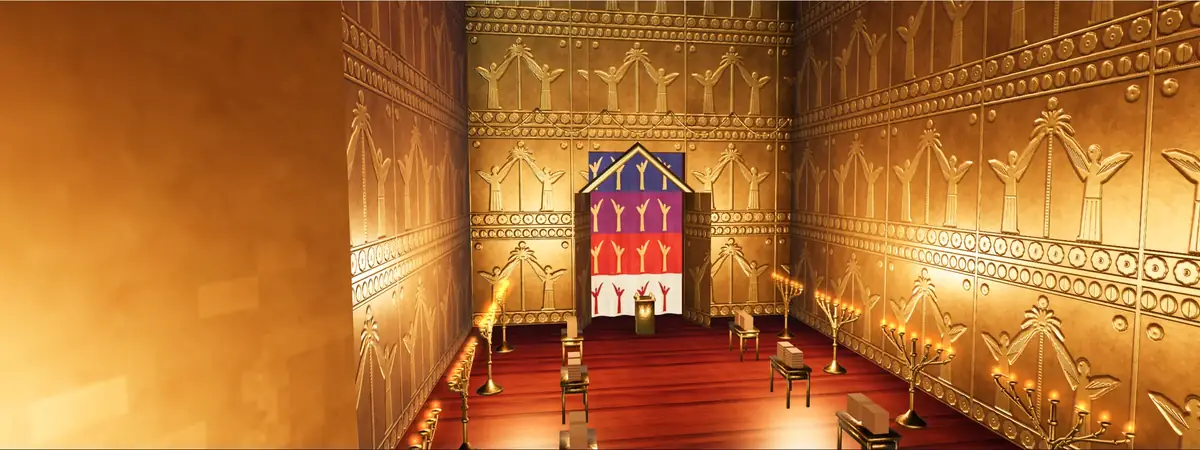
The house was sixty cubits long, twenty wide and thirty high, with a porch before it and storeys of side chambers around it. It doubles the inside dimensions of the Tabernacle, the pattern it replaced.
2And the house which king Solomon built for the LORD, the length thereof was threescore cubits, and the breadth thereof twenty cubits, and the height thereof thirty cubits.
The house doubles the Tabernacle's inside dimensions: 30 × 10 × 10 becomes 60 × 20 × 30, and the most holy place 10³ becomes 20³.
Comparing 1 Kings 6:2, 20 with the usual reading of Exodus 26 (the Tabernacle's interior is not stated outright; see the Tabernacle lab).
If the 480 years are added up literally, the exodus falls about 1446 BC. Many scholars read the number as twelve generations of forty years and place the exodus under Ramesses II. Both are shown; we do not choose.
Reading A
The 480 years are a real span of time, putting the exodus around 1446 BC.
Reading B
480 is twelve times forty, a symbolic count of generations; the exodus would be about 1270–1250 BC, when a city called Rameses was being built.
Doors into the verse
1And it came to pass in the four hundred and eightieth year after the children of Israel were come out of the land of Egypt, in the fourth year of Solomon’s reign over Israel, in the month Zif, which is the second month, that he began to build the house of the LORD.
See this verse's connections in the Knowledge Graph
Every door is drawn from the Bible Labs knowledge graph: each claim keeps its evidence level, and readings that link one passage to another are marked as interpretation. King James Version (1769).