 X-Dreamers
X-Dreamers · Lab sheet
Bible Word Usage
Charts of where key words such as love, grace, law and faith appear across the 66 books, in English, Chinese, Hebrew and Greek, with a search for any word.
Scan to open the lab
Key facts
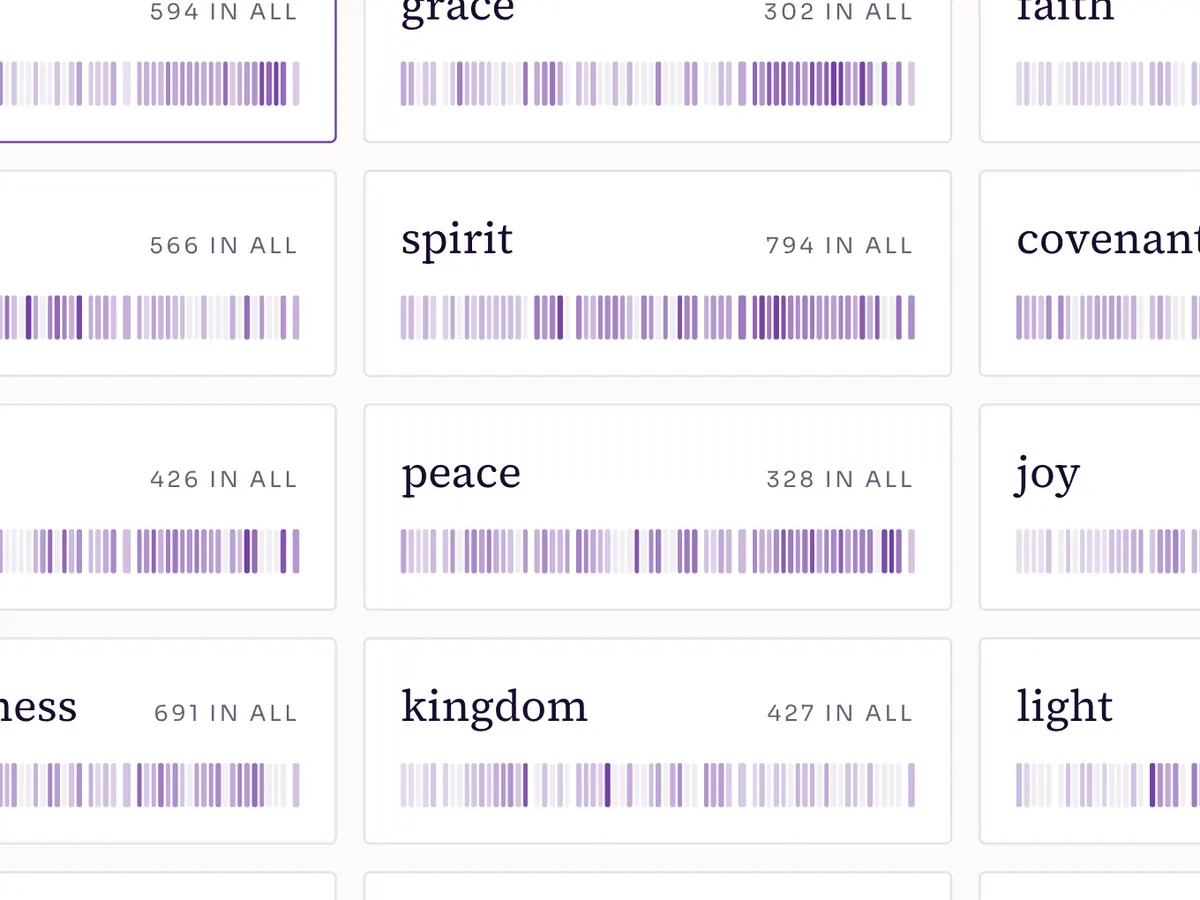
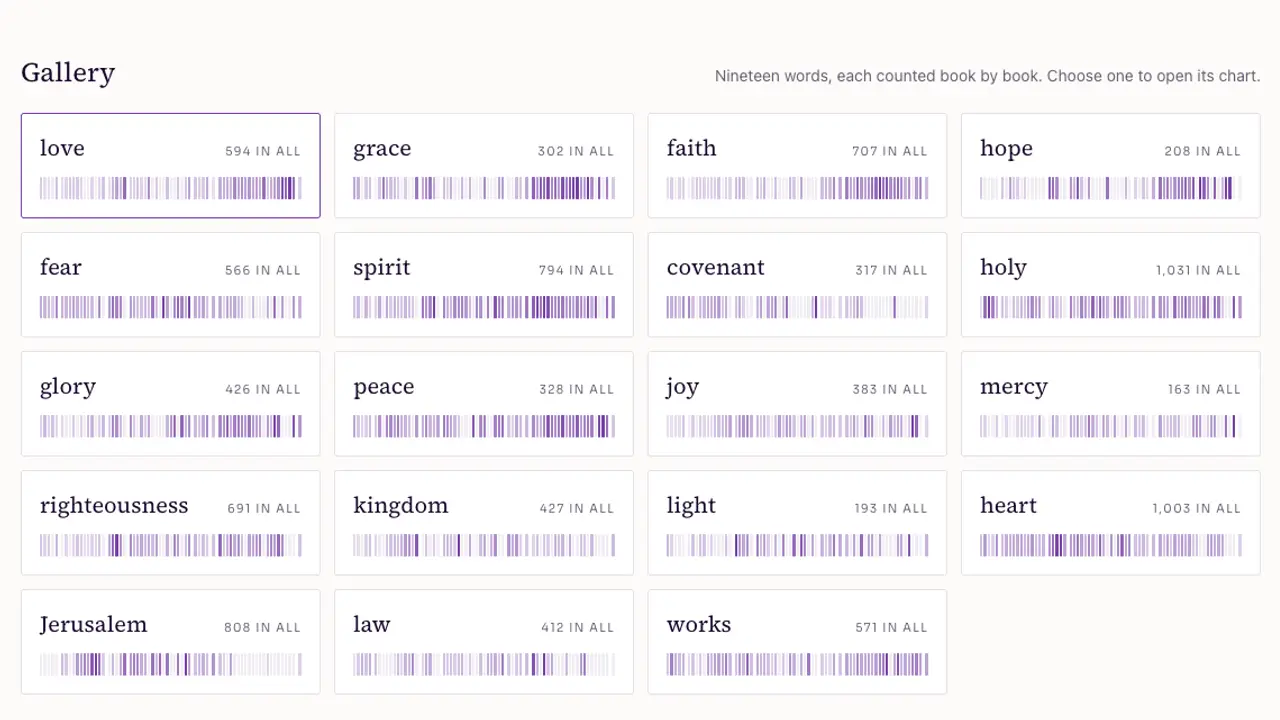
- Each chart is one bar per book, in canonical order, so you can see at a glance where a word gathers.
- Switch the text between the KJV, the 1919 Chinese Union Version and the Hebrew and Greek, and the answer can change.
- In English, “faith” is most frequent in Romans; in Greek the faith words are most frequent in John, mostly the verb “believe”.
- Search any English word (add * for every form), a Chinese word, or a Hebrew or Greek lemma, also by Strong's number such as H157 or G26.
- Switch between raw counts and a rate per 1,000 words, so a short letter is not drowned out by a long book.
- In class: ask the group to guess where a word is most common before you show the chart.
Key verses
He that loveth not knoweth not God; for God is love.1 John 4:8 · King James Version
For by grace are ye saved through faith; and that not of yourselves: it is the gift of God:Ephesians 2:8 · King James Version
For therein is the righteousness of God revealed from faith to faith: as it is written, The just shall live by faith.Romans 1:17 · King James Version
Talk about it
- Where did you expect the word to be most common, and what surprised you?
- In the KJV John never says “faith” but often says “believe”. Does that change how you read his Gospel?
- A count shows where a word appears, not what it means. What else do we need to read well?
How sure can we be?
The Bible says
- Counts are taken from the texts themselves: the KJV, the 1919 Chinese Union Version and the tagged Hebrew and Greek.
- Each chart lists the forms, characters or lemmas it counts.
Our reconstruction
- Which forms count as “the same word” is a choice; each count belongs to its text, not to the Bible in general.
- Chinese has no spaces, so a character is also counted inside longer words.
Still debated
- Translators render one Hebrew or Greek word in several ways, so counts in different Bibles differ.
© X-Dreamers · xdreamers.com · Free to print and project for teachingxdreamers.com/labs/bible-word-usage