 X-Dreamers
Bible Word Counts: What They Reveal About Love, Grace and Law
How often do love, grace and law appear in the Bible? Counts in English, Chinese, Hebrew and Greek, where each word clusters, and why translations disagree.
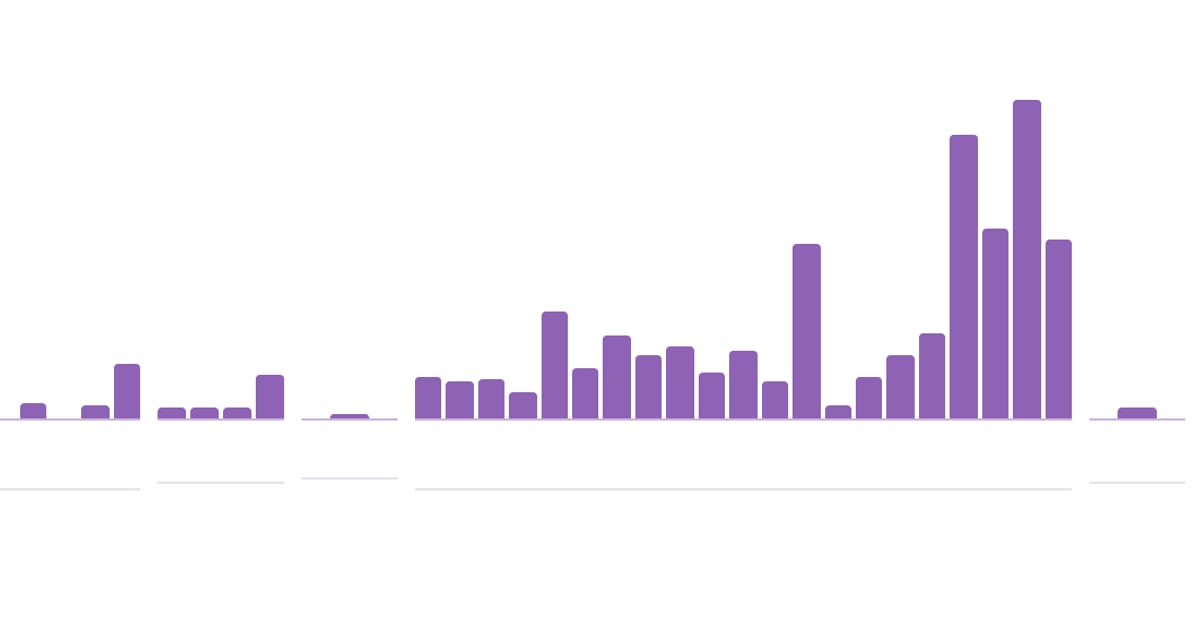
Counting words in the Bible tells you where a theme is concentrated, but the number you get depends on which Bible you count. In the Hebrew and Greek, the words chosen for love occur 594 times, grace 302 and law (torah and nomos) 412. In the World English Bible Updated (WEBU) the English forms come to 665, 178 and 535; in the 1919 Chinese Union Version (和合本) the characters 爱 and 恩 and the word 律法 come to 969, 552 and 382. The differences are not errors. They mark the places where translators made choices.
Three words, three texts
| Word | Hebrew & Greek lemmas | English (WEBU) | Chinese (1919 和合本) |
|---|---|---|---|
| Love | 594: ʾāhab, ʾahăbâ, agapaō, agapē, agapētos, phileō | 665: love, loves, loved, lover, lovers, beloved | 969: every 爱 |
| Grace | 302: ḥēn, ḥānan, charis | 178: grace, gracious, graciously | 552: every 恩 |
| Law | 412: torah, nomos | 535: law, laws | 382: 律法 |
The lab opens on Hebrew & Greek, counted per 1,000 words, with love selected. Switch the text to English or 中文, or the scale to Raw count; every bar opens its verses.
Love: one English word, six originals
Behind the English “love” stand six words. The lab counts agapaō (143 times), agapē (116), agapētos, “beloved” (61) and phileō (25), with Hebrew ʾāhab (209) and ʾahăbâ (40). The more telling results are where the texts disagree.
The Psalms. In Hebrew the love words occur 41 times in Psalms, and in English 47. In Chinese the count jumps to 197. The reason is ḥesed, God’s steadfast covenant love, which occurs about 245 times in the Hebrew Bible. The WEBU usually renders it “loving kindness” (176 times, 121 of them in Psalms), and the gallery does not count that as “love”. The 和合本 usually renders it 慈爱, which contains 爱, so all 124 uses in Psalms are counted. The refrain of Psalm 136 is the clearest case: “Give thanks to the LORD, for he is good, for his loving kindness endures forever” (Psalm 136:1).
The Song of Songs. In English it has the highest density of “love” in the Bible: 66 uses. In Hebrew the chosen lemmas occur only 18 times. Most of the gap is “beloved” (34 times), which translates dôd, the bride’s word for her lover, a different Hebrew word that is not in the love set.
John’s writings. Here the three texts agree. In Hebrew & Greek the Gospel of John has more love words than any other book (57), and 1 John is close behind with 52 in a letter of five chapters. At per 1,000 words, the chart’s densest bar is 3 John, but that is six uses in a very short letter, and the lab warns that the shortest books swing widely. The sentence at the centre of it all is short: “He who doesn’t love doesn’t know God, for God is love” (1 John 4:8).
Grace: not only a New Testament word
In English, grace looks like a New Testament word. The WEBU forms occur 45 times in the Old Testament and 133 in the New, and the bare word “grace” is in the Old Testament only 10 times. The Hebrew tells a different story. ḥēn (favour) and ḥānan (to be gracious) occur 147 times in the Old Testament, against 155 for charis in the New.
The gap is translation again. The WEBU often renders ḥēn “favor”, which the grace count leaves out. The first time the word appears in the Bible, Noah receives it: “But Noah found favor in the LORD’s eyes” (Genesis 6:8). The 和合本 has 蒙恩 there, so the Chinese count includes it, and that is one reason the Chinese total (552) is so much higher. The other reason is that 恩 is counted inside every word that contains it: 恩典, 恩惠, 施恩, 恩待. The two-character word 恩典 on its own occurs only 60 times, 20 in the Old Testament and 40 in the New.
So it is fair to say that the vocabulary of grace thickens in Paul. Romans has 24 of the English uses and 25 of the Greek. It is not fair to say that grace begins there. The Old Testament’s own description of God, given to Moses on the mountain and repeated through the Psalms and prophets, already uses it: “The LORD is merciful and gracious, slow to anger, and abundant in loving kindness” (Psalm 103:8).
Law: Torah, nomos and a mother-in-law
The Hebrew torah occurs 219 times and the Greek nomos 193. Torah means instruction or teaching more than a legal code, which is why a psalmist can say, “How I love your law! It is my meditation all day” (Psalm 119:97). In the originals, Psalms has 36 uses, second only to Romans (74). At per 1,000 words the densest book is Galatians, followed by Romans: the two letters where Paul argues about what the law can and cannot do.
The English count has a trap, and the lab shows it plainly. The WEBU count of “law” and “laws” is 535, but 79 of those are the “law” in “mother-in-law”, “father-in-law” and “daughter-in-law”. Switch to English and Per 1,000 words, and Ruth, a book with no torah in it at all, ranks just behind Galatians and Romans. Its 19 uses are Naomi and her daughters-in-law. Exodus has 15 more, for Moses’ father-in-law Jethro. A count is only as good as what it counts.
Law and grace side by side
The lab’s Compare two words section opens on law and grace, drawn on one scale, the first word above the line and the second below. In Hebrew & Greek, Romans has 74 law words against 25 grace words, and Galatians 32 against 7. That fits the letters’ subject: Paul discusses the law at length because he is explaining why it cannot save, and he states the result in a single line: “For sin will not have dominion over you, for you are not under law, but under grace” (Romans 6:14). John puts the two words in one sentence: “For the law was given through Moses. Grace and truth were realized through Jesus Christ” (John 1:17).
What the counts show and what they cannot
| Claim | How reliable |
|---|---|
| How often a form, character or lemma occurs in this text, book by book | Exact for the text counted |
| Which Hebrew and Greek lemmas stand behind “love”, “grace” or “law” | An editorial choice; each chart lists its lemmas |
| Comparisons between English, Chinese and the originals | Shaped by translation (“loving kindness” vs 慈爱, “favor” vs 蒙恩) |
| Densities in the shortest books | Unstable: one use moves the bar |
| That a book is “about” love or law because the word is frequent | Interpretation; read the verses before concluding |
The method notes on the lab page say the same thing more briefly: a count here is a count of this text, not of the Bible’s ideas. A passage can be full of grace without using the word: the parable of the lost son in Luke 15 never does.
Frequently asked questions
How many times is love mentioned in the Bible? It depends on the translation. In the WEBU, love, loves, loved, lover, lovers and beloved occur 665 times. The Hebrew and Greek love words occur 594 times. In the 1919 和合本 the character 爱 occurs 969 times, including 慈爱.
How many times does grace appear in the Bible? Grace, gracious and graciously occur 178 times in the WEBU. ḥēn, ḥānan and charis occur 302 times in the Hebrew and Greek.
Which book uses “law” the most? Romans, with 74 uses of nomos. Galatians, being shorter, uses it more densely.
Can I count a word that is not in the gallery? Yes. Use Search any word: an English word (add * for every word that starts with it), a Chinese word, or a Hebrew or Greek lemma, including Strong’s numbers such as H157 or G26.
Count a word yourself
Pick a gallery word, switch between Hebrew & Greek, English and 中文, and open any bar to read its verses. The waiting words in the Psalms are traced this way in Seasons of Waiting.
Related labs
- ḥesed in the Hebrew Word Explorer: the word behind “loving kindness”, read in Psalm 136.
- Life Phases of Old Testament Heroes: eight lives, from Noah to David, on one age axis.
- The Bible Story Map: where Ruth, the Psalms and Paul’s letters sit in the whole story.
Found this helpful? Pass it on.