
Where Did Jesus Grow Up?
Jesus grew up in Nazareth, a hill village of a few hundred people in Lower Galilee. What the Gospels say, what the village was like, and which house it was.
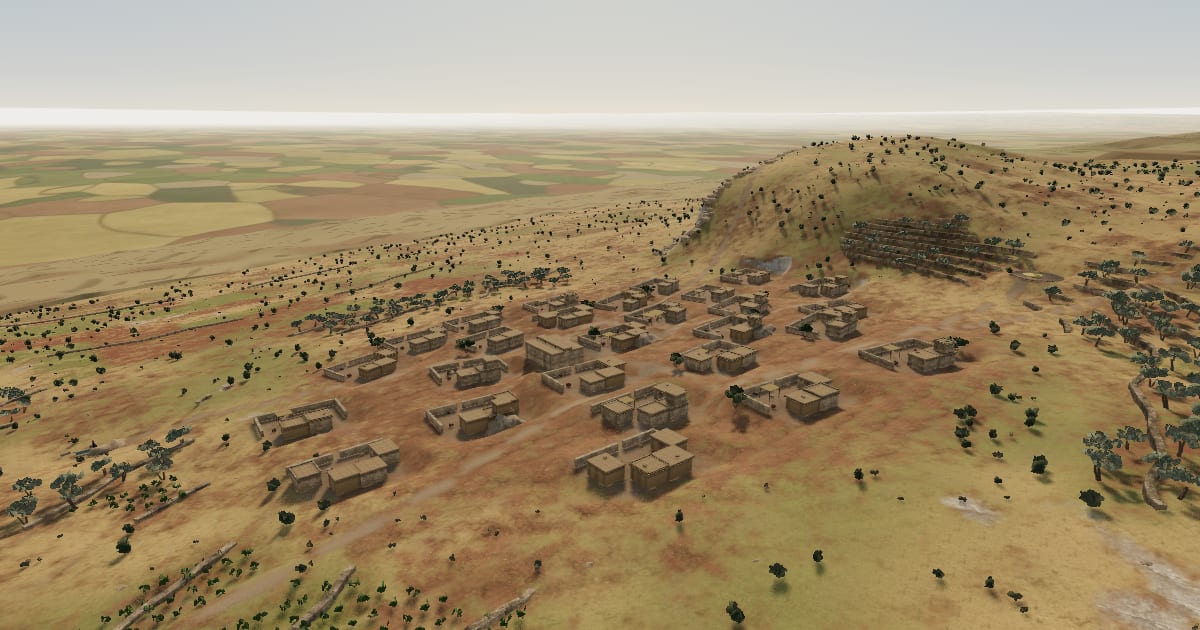
Jesus grew up in Nazareth, a small farming village in the hills of Lower Galilee. Born in Bethlehem, he was brought back to Nazareth as a young child after the family’s time in Egypt, and he lived there, working as a builder like Joseph, until his public ministry began and he moved to Capernaum (Matthew 4:13).
In the 3D Nazareth lab, start at the builder’s yard. It is where the lab’s own story Growing up in Nazareth opens, and it shows the trade the town knew him by.
What do the Gospels say?
Matthew and Luke tell the move to Nazareth differently, but both end in the same village. In Matthew, Joseph returns from Egypt, hears that Archelaus is reigning in Judaea, and is warned in a dream:
And he came and dwelt in a city called Nazareth: that it might be fulfilled which was spoken by the prophets, He shall be called a Nazarene. (Matthew 2:23)
Luke starts from Nazareth: it is Mary’s town when Gabriel comes (Luke 1:26), and after the presentation in the Temple “they returned into Galilee, to their own city Nazareth” (Luke 2:39). Then a single sentence covers the childhood: “And the child grew, and waxed strong in spirit, filled with wisdom: and the grace of God was upon him” (Luke 2:40).
The only scene from those years is the visit to Jerusalem at twelve. Afterwards “he went down with them, and came to Nazareth, and was subject unto them” (Luke 2:51). Years later Luke still calls it the place “where he had been brought up” (Luke 4:16).
What was Nazareth like?
The lab’s figures: about 200–400 people, about 350 m above sea level, 6 km from the city of Sepphoris. The village’s size is a range of estimates (Plausible). Its finds are not in doubt: chalk vessels, cooking pots and storage jars of a Jewish village of modest means, without the fine imported wares of Sepphoris (Strongly supported).
Families lived in one-storey rooms of fieldstone and mud plaster round shared courtyards, and the soft limestone under the village was full of caves, silos and cisterns (both Strongly supported). The family courtyard shows the oven, the loom and a back room opening into the hillside.
Sons usually learned their father’s trade. The neighbours later asked, “Is not this the carpenter, the son of Mary” (Mark 6:3), and the Greek word, tektōn, means a builder who worked in wood and often in stone: roof beams, doors, ploughs and yokes. That he and Joseph worked on the rebuilding of Sepphoris, an hour’s walk away, is a guess that no text supports (Speculative).
Which house did he live in?
No one knows. The lab’s courtyard is a typical house, “not a claim about a specific site”, and its evidence level is Speculative. One candidate has been studied closely: a courtyard house partly cut into the rock below the Sisters of Nazareth convent, built in the Early Roman period and later honoured by Byzantine Christians as the house where Jesus was brought up. The archaeologist Ken Dark finds the identification possible but unprovable, and the lab rates it Plausible.
So the village is certain (Textually stated); the house is not.
Walk into the builder’s yard in Nazareth →, then open Growing up in Nazareth under Stories in Nazareth.
Related
- Where did Jesus live and teach? Nazareth, Capernaum, the Sea of Galilee and the Temple Mount.
- The chapter guide to Luke 2.
Found this helpful? Pass it on.